About this book
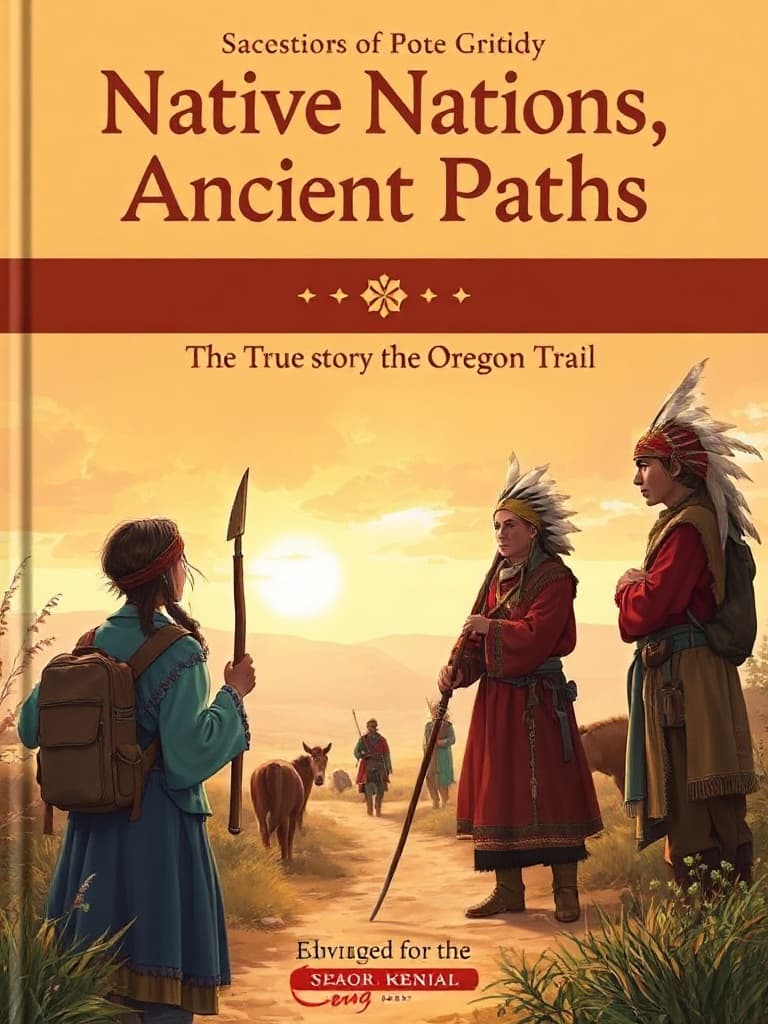
Native Nations, Ancient Paths: The True Story of the Oregon Trail
180
0
81
0
This is truthful and accurate history of The Tribal Nations from Idaho to Oregon
Chapters
- 1Echoes of the Ancients: The First StewardsThis chapter will immerse the reader in the ancestral lands that would become the Oregon Trail, focusing on the deep, millennia-old connection of the Indigenous nations—primarily the Nez Perce (Niimíipu), Umatilla (Confederated Tribes of the Umatilla Indian Reservation - CTUIR), and Warm Springs (Confederated Tribes of Warm Springs) peoples, but also acknowledging the broader spectrum of tribes whose territories were traversed or impacted. The narrative will begin with a sweeping, almost mythic, portrayal of the landscape as it existed before major European intrusion. We will explore the intricate knowledge systems these tribes held regarding the land: their understanding of the seasons, the celestial bodies, the migration patterns of animals, the medicinal properties of plants, and the sacredness of rivers and mountains. Specific locations that would later become landmarks on the Oregon Trail will be presented through an Indigenous lens—perhaps the Snake River as a life-giving artery, the Blue Mountains as spiritual guardians, or the vast plains as hunting grounds governed by ancient protocols. The chapter will delve into the rich cultural tapestry: their diverse languages, intricate social structures, spiritual beliefs, artistic expressions (such as weaving, beadwork, and storytelling), and the vital role of oral traditions in preserving their history and knowledge. We will highlight the concept of 'stewardship' ratherp than 'ownership,' emphasizing their role as caretakers of the land for future generations. For the Nez Perce, this might involve detailing their sophisticated equestrian culture and their ability to adapt to varied environments. For the Umatilla, their connection to the Columbia River and its abundant salmon runs will be central. For the Warm Springs, their ancestral lands might span diverse terrains, requiring nomadic or semi-nomadic lifestyles. The chapter will establish the profound sense of belonging and identity these nations derived from their lands, setting a poignant baseline for the dramatic changes to come. The emotional arc will be one of profound peace, harmony, and deep-rooted belonging, tinged with the subtle, almost imperceptible, awareness of the vastness and the unknown beyond their immediate world. Continuity notes: Establish the specific tribal nations that will be central to the narrative and their general geographical areas. Introduce the concept of their deep connection to the land and their established way of life. Subtle foreshadowing of the fragility of this balance will be woven in through descriptions of natural cycles and the vastness of the continent. Ending hook: A final scene might depict a gathering under the vast, star-filled sky, a moment of communal peace, with a storyteller recounting ancient legends, unaware that the world, and the very stars they navigate by, are about to change irrevocably.
- 2Whispers on the Wind: First EncountersThis chapter marks the initial intrusion of European presence into the Indigenous territories, focusing on the early explorers and traders whose journeys predated the mass migration of the Oregon Trail. We will explore the initial encounters through the eyes of both the Indigenous peoples and the Europeans, emphasizing the profound cultural misunderstandings and the cautious curiosity that characterized these first meetings. The narrative will introduce figures like Meriwether Lewis and William Clark, not as conquerors, but as part of a complex web of exploration and trade that began to weave new threads into the existing Indigenous tapestry. Sacagawea's role will be subtly introduced here, not necessarily as the central figure of the Lewis and Clark expedition itself, but as a potent symbol of the potential for cross-cultural understanding and the vital role Indigenous women often played as intermediaries and knowledge-keepers. We will describe the initial exchanges: the offering of unfamiliar goods (metal tools, firearms, beads) in return for provisions, knowledge of the land, and safe passage. The Indigenous perspective will highlight their observations of these newcomers: their strange clothing, their vehicles (boats, unlike anything they knew), and their seemingly insatiable curiosity about the continent's interior. There will be a sense of wonder and perhaps apprehension, as these encounters, while often peaceful, represent the first tangible signs of a world beyond their own beginning to impinge upon theirs. The chapter will detail specific instances of interaction, perhaps a trading post being established near a river, or a chance meeting on a hunting trail. The emotional tone will be one of tentative exploration, mutual observation, and the dawning, yet not fully comprehended, realization of significant change. We will explore the initial Indigenous reactions: some welcoming the novelty and potential benefits of trade, others viewing the newcomers with suspicion, recognizing the disruption they might bring to established patterns of life. The language will be descriptive, focusing on the sensory details of these encounters—the smell of woodsmoke, the glint of metal, the unfamiliar sounds of foreign languages. Continuity notes: Connect these early encounters to the established Indigenous cultures from Chapter 1. Introduce the concept of trade and its initial impact. Subtly foreshadow Sacagawea's broader significance as a symbol of cross-cultural interaction. Ending hook: The chapter will conclude with a scene where Indigenous leaders, having observed these early travelers, discuss their implications. Some may dismiss them as transient wanderers, while others, perhaps the elders, voice a deeper concern about the long-term consequences of inviting strangers into their lands.
- 3The First Tracks: Indigenous Pathways and Early IncursionsThis chapter delves into the precursor trails and pathways that existed long before the formalized 'Oregon Trail,' emphasizing how Indigenous knowledge was the foundation upon which early European explorations and subsequent trails were built. We will explore the intricate network of trails used by various tribes for millennia—paths forged for hunting, trade, seasonal migrations, and inter-tribal communication. These were not merely lines on a map but living routes deeply integrated with the landscape, reflecting an intimate understanding of topography, water sources, and seasonal changes. The narrative will highlight how early European explorers, traders, and missionaries relied heavily on Indigenous guides and their knowledge to navigate these territories. The concept of 'sharing' knowledge will be explored, often unintentionally, as Indigenous people guided newcomers through their lands, revealing crucial passes, river crossings, and safe havens. We will introduce Kicking Bear's people (Lakota/Sioux), placing them geographically in relation to the emerging routes of passage, perhaps observing early fur trappers or explorers venturing further west. Their initial perspective will be one of curiosity tinged with the understanding that these were not their lands being traversed, but territories connected to their own through ancient networks. The chapter will detail specific examples of Indigenous ingenuity in trail-making: how they utilized natural features like river valleys, mountain passes, and game trails. The contrast between Indigenous travel (often on foot or horseback, with a focus on sustainability and minimal impact) and the burgeoning European methods (heavy wagons, reliance on draft animals) will be subtly drawn. The emotional arc will be one of pragmatic adaptation and subtle observation from the Indigenous perspective, while for the Europeans, it is a journey of discovery and resource acquisition. Continuity notes: Build upon the established Indigenous cultures and their connection to the land. Show how their existing infrastructure (trails) becomes the basis for future routes. Introduce Kicking Bear's people and their initial awareness of external movements. Ending hook: The chapter will end with a scene where Kicking Bear, or a similar figure within his community, witnesses a more substantial group of non-Indigenous travelers than ever before, perhaps a small party with rudimentary wagons, marking a noticeable increase in the 'incursions' and prompting a more serious discussion within his tribe about the implications.
- 4Chief Tolo's Council: A Leader's DilemmaThis chapter focuses on Chief Tolo of the Nez Perce (Niimíipu) and his pivotal role in responding to the escalating presence of European-American settlers and travelers on or near Nez Perce ancestral lands. The narrative will depict Chief Tolo as a wise, pragmatic, and deeply concerned leader, acutely aware of the potential threats posed by the newcomers. The chapter will center on a significant council meeting convened by Tolo, where various viewpoints within the Nez Perce leadership and community are presented. Older, more traditional members might advocate for maintaining strict separation and upholding ancient customs, perhaps expressing deep distrust of the outsiders. Younger, more progressive individuals might see potential benefits in trade or even limited interaction, hoping to leverage new technologies or goods. Others might express fear and a desire for immediate resistance. Tolo's internal struggle will be central: his responsibility to protect his people's way of life, their lands, and their sovereignty versus the perceived inevitability of change and the potential risks of outright conflict. The dialogue within the council will be rich, reflecting complex political and social dynamics within the tribe. Tolo's wisdom will be demonstrated through his ability to listen, synthesize differing opinions, and guide the discussion toward a decision that balances immediate safety with long-term survival. His deep love and concern for his people will be palpable, perhaps expressed through worries about the impact on their hunting grounds, fishing rights, and sacred sites. The chapter will explore the weight of leadership and the profound consequences of the choices made. The emotional arc will be one of intense deliberation, anxiety, and the heavy burden of responsibility. Continuity notes: Directly follow the initial encounters and observations of outsiders. Establish Chief Tolo as a key Indigenous protagonist facing a critical decision. Highlight the internal diversity of opinion within Indigenous communities regarding settlers. Ending hook: The chapter will conclude with Chief Tolo delivering his decision or a proposed course of action, perhaps a strategy of cautious engagement and observation, or a firm but measured stance on protecting their territory, leaving the reader with the sense that this decision will have far-reaching consequences.
- 5Eliza's Hope: The Pioneer's DreamThis chapter introduces Eliza Thompson and her family as they embark on their arduous journey west, driven by the promise of a new life and opportunity in the fertile lands of the Oregon Territory. The narrative will establish Eliza's character: resilient, resourceful, and determined, yet also carrying a blend of pioneer grit and underlying compassion. Her motivations for undertaking the perilous journey—perhaps seeking economic stability, escaping hardship, or pursuing the dream of owning land—will be explored. The chapter will paint a vivid picture of the initial stages of their journey: the preparation, the loading of the wagon, the farewells, and the first tentative miles on the trail. Juxtaposed with the hopeful aspirations of the Thompson family will be the stark realities of the trail: the immense physical labor, the constant vigilance, the limited comforts, and the underlying dangers. We will introduce the initial, often fearful or tentative, encounters with Native peoples from Eliza's perspective. These encounters might be brief glimpses of figures observing from a distance, or perhaps more direct, cautious interactions involving trade for provisions or water. Eliza's observations will be colored by the prevailing attitudes and prejudices of the time, but also by her own innate curiosity and developing awareness. The emotional arc will be one of determined optimism mingled with apprehension and the dawning realization of the immense challenges ahead. The chapter will emphasize the shared human desire for a better future, while simultaneously hinting at the cultural chasm that exists between Eliza's world and the world she is entering. Continuity notes: Introduce Eliza Thompson as a key settler protagonist. Establish her motivations and the initial phase of her journey. Begin to show the settler's perspective on the landscape and its Indigenous inhabitants. Ending hook: The chapter will conclude with Eliza and her family facing their first significant hardship on the trail—perhaps a severe storm, a broken wagon wheel, or a particularly unnerving encounter with a Native hunting party—forcing them to confront the fragility of their dreams and the immediate dangers of their undertaking.
- 6The River of Sorrows: Columbia's DisruptionThis chapter centers on the Columbia River, a vital artery for both Indigenous life and the burgeoning westward expansion, portraying it as a critical point of contention and ecological disruption. We will explore the river's profound significance to the Indigenous nations whose territories it traverses, particularly the salmon runs that have sustained them for millennia. This will involve detailing their sophisticated fishing techniques, their spiritual connection to the salmon, and the intricate social systems built around this resource. The arrival of European explorers, traders, and eventually settlers brought significant changes. The chapter will depict the disruption of traditional fishing grounds due to increased river traffic, the introduction of new fishing technologies by settlers, and the eventual overfishing that began to deplete the salmon populations. This ecological impact will be directly linked to rising tensions between Indigenous communities and the newcomers, as access to vital food sources and sacred sites became contested. We will illustrate specific instances of conflict or negotiation related to the river: perhaps a dispute over fishing rights, a clash over access to traditional fishing camps, or the desecration of sacred sites along the riverbanks. The narrative will convey the sense of loss and violation felt by the Indigenous peoples as their ancient relationship with the river was undermined. The emotional arc will be one of growing distress, anger, and a profound sense of injustice among the Indigenous populations, contrasted with the settlers' often oblivious or utilitarian view of the river as a resource to be exploited. Continuity notes: Connect the Columbia River to the Indigenous nations previously introduced. Detail the ecological and cultural importance of the river and its resources. Show the direct impact of settler activity on Indigenous lifeways. Ending hook: The chapter will conclude with a scene depicting a significant disruption to a traditional salmon fishing ceremony or harvest, highlighting the tangible loss and the escalating conflict over the river's bounty, perhaps with a tribal elder vowing to protect this sacred resource for future generations.
- 7Kicking Bear's Vigil: Witnessing the EncroachmentThis chapter places Kicking Bear, the young Lakota warrior, in a position of keen observation as the flow of settlers and their wagons begins to noticeably increase through or near territories historically utilized by his people. His perspective will be central, focusing on his growing awareness of the profound impact these newcomers are having on the land and its inhabitants. The narrative will describe Kicking Bear witnessing the physical changes: the trampling of grasslands, the felling of trees for fuel and construction, the disruption of wildlife migration routes, and the pollution of water sources. He will observe the sheer scale of the migration – the endless lines of wagons, the large numbers of people and livestock – which contrasts sharply with the more transient encounters of earlier years. His warrior spirit, initially perhaps focused on traditional pursuits like hunting and defending against inter-tribal rivalries, will begin to be stirred by this external threat. The chapter will explore his internal conflict: the ingrained Lakota values of respecting the land versus the aggressive, seemingly limitless consumption demonstrated by the settlers. He will witness acts of carelessness or disregard for the natural world by the travelers, fueling his sense of outrage and deep-seated resistance. The emotional arc will be one of growing unease, frustration, and the hardening of his resolve. He may discuss his observations with other young warriors, sharing a growing sense of alarm and a desire to protect their ancestral hunting grounds and way of life. Continuity notes: Establish Kicking Bear's growing awareness and concern. Detail the observable impact of settlers on the environment from an Indigenous perspective. Build his character's motivation towards resistance. Ending hook: The chapter will culminate in Kicking Bear witnessing a particularly egregious act of environmental disregard or disrespect by the settlers – perhaps the wanton killing of game animals, the fouling of a sacred spring, or the desecration of a burial site – which solidifies his belief that passive observation is no longer sufficient and that active defense of their lands is becoming necessary.
- 8A Dance of Diplomacy: Tolo's NegotiationThis chapter delves into Chief Tolo's efforts to engage in diplomacy with key settler leaders and representatives, showcasing his pragmatic approach and his earnest desire for peaceful coexistence while simultaneously highlighting his deep-seated fears for his people's future sovereignty. We will depict Tolo participating in meetings, councils, or negotiations with figures who represent the growing settler presence. The narrative will focus on Tolo's communication style: his measured words, his emphasis on mutual respect, and his attempts to articulate the Nez Perce perspective on land use, resource sharing, and territorial rights. He will likely present proposals for boundaries, shared access agreements, or protocols for interaction, demonstrating his strategic thinking and his commitment to finding a non-violent path forward. However, the chapter will also underscore the inherent difficulties and power imbalances in these negotiations. The settlers, driven by Manifest Destiny and the pursuit of land ownership, may not fully grasp or respect Tolo's concepts of stewardship and communal rights. The dialogue will reveal the cultural misunderstandings and differing worldviews that create friction. Tolo's internal monologue or private conversations will reveal his underlying fears: the apprehension that even the most carefully crafted agreements could be undermined by the sheer numbers of settlers, the indifference of distant governments, or the inherent expansionist drive of the newcomers. He might be seeking assurances that cannot realistically be given. The emotional arc will be one of cautious hope mixed with profound anxiety, showcasing the immense pressure on Tolo to secure a future for his people in the face of overwhelming change. Continuity notes: Build upon Chief Tolo's deliberations from Chapter 4. Show the practical application of Indigenous leadership in attempting to manage settler relations. Highlight the complexities and potential pitfalls of inter-cultural negotiation. Ending hook: The chapter will conclude with a fragile agreement being reached, or perhaps a point of understanding established, but Tolo will depart the meeting with a lingering sense of unease, perhaps noticing a subtle dismissal or a lack of genuine commitment from the settler representatives, foreshadowing the precariousness of any such accord.
- 9Trail Dust and Disease: The Invisible ScourgeThis chapter addresses the devastating and often overlooked impact of European diseases on Indigenous populations along the routes of westward expansion. The narrative will shift focus to the tragic spread of illnesses such as smallpox, measles, influenza, and cholera, which had catastrophic consequences for communities that had no prior immunity. We will explore how these diseases were inadvertently introduced by travelers, traders, and missionaries, traveling along the nascent trails and spreading rapidly through inter-tribal networks and communities. The chapter will depict the profound disruption these epidemics caused: the decimation of populations, the loss of elders who held vital cultural knowledge, the weakening of social structures, and the profound psychological trauma experienced by survivors. The narrative will move beyond mere statistics to illustrate the human cost, perhaps through the experiences of specific families or communities struggling to cope with widespread death and illness. The weakening effect of these diseases will be presented as a significant factor contributing to the diminished capacity of Indigenous nations to resist encroachment or negotiate from positions of strength. The emotional arc will be one of profound sorrow, helplessness, and the deep injustice of a silent, invisible enemy that decimated populations far more effectively than any direct conflict. We will emphasize the irony that while settlers feared Indigenous attacks, the greatest threat often came from the diseases they carried. Continuity notes: Connect the spread of disease to the increasing travel along the developing trails. Show the disproportionate and devastating impact on Indigenous populations. Underscore how this weakens Indigenous resistance. Ending hook: The chapter will conclude with a poignant scene depicting the aftermath of a particularly virulent epidemic in an Indigenous village – empty lodges, grieving survivors, and a palpable sense of loss that has fundamentally altered the community’s ability to sustain itself, leaving them vulnerable to further pressures.
- 10The Wagon Road Widens: Eliza's Continuing OrdealThis chapter marks a significant escalation in the scale of westward migration, with the 'Oregon Trail' becoming a more defined and heavily trafficked route. The narrative will describe the sheer volume of wagons, the increasing pressure on resources like water and grazing land, and the growing environmental impact of thousands of travelers passing through. Eliza Thompson's journey will continue, now embedded within this larger migration. Her experiences will reflect the increased challenges and complexities of the trail: greater competition for resources, more frequent interactions (both positive and negative) with Native peoples, and the constant struggle against the elements and the harsh terrain. We will detail specific hardships Eliza and her family face – perhaps navigating difficult river crossings, dealing with sickness within their own group, or managing dwindling supplies. Her observations of the trail's impact will be sharpened: the growing number of abandoned belongings, the graves of those who perished, and the changing landscape. The chapter will also explore Eliza's evolving perspective. While still driven by her goal of establishing a new life, her encounters and observations might lead to a more nuanced understanding of the complexities of the land and its original inhabitants, perhaps witnessing acts of both kindness and cruelty. The emotional arc will be one of persistent determination against mounting adversity, a test of Eliza's resilience and her commitment to her dream. Continuity notes: Show the tangible growth and impact of the Oregon Trail as a major migration route. Continue Eliza's personal journey, highlighting the escalating difficulties. Reinforce the theme of cultural encounters and the changing landscape. Ending hook: The chapter will conclude with Eliza's party reaching a particularly challenging and notorious section of the trail, such as the Blue Mountains or the Snake River plains, where the dangers are amplified by the sheer number of people, forcing a critical decision or a moment of profound doubt about whether they will reach their destination.
- 11Shared Water, Separate Paths: Escalating ConflictsThis chapter focuses on the escalating friction between settlers and Indigenous peoples, specifically over the critical resources of water and grazing lands. As the Oregon Trail became more established and settler populations grew, competition for these essential elements intensified. The narrative will depict instances where settler wagons and livestock depleted water sources, fouled streams, and overgrazed pastures vital to Indigenous communities and their herds (such as the Nez Perce horses). We will illustrate specific scenarios of conflict: perhaps confrontations at waterholes, disputes over grazing rights near established Native villages or traditional use areas, or instances where settlers illegally occupied or diverted water from Indigenous-controlled lands. The chapter will showcase a spectrum of interactions, moving beyond simple curiosity or cautious exchange to outright clashes. There will be examples of both sides resorting to violence, driven by desperation, fear, or a perceived threat to their livelihoods. Simultaneously, the chapter will acknowledge that not all interactions were hostile. There may be lingering instances of cooperation, trade, or attempts at peaceful resolution, highlighting the complex and often contradictory nature of these encounters. The emotional arc will be one of growing tension, frustration, and a sense of encroaching loss for the Indigenous peoples, contrasted with the settlers' often aggressive assertion of their perceived rights and needs for expansion. Continuity notes: Directly build upon the increased settler presence described in previous chapters. Focus on resource competition as a primary driver of conflict. Show the shift from initial encounters to more direct clashes. Ending hook: The chapter will conclude with a significant confrontation over water or land, perhaps a skirmish resulting in injuries or fatalities on both sides, leaving a bitter legacy and demonstrating the deepening animosity and the difficulty of finding common ground.
- 12Sacagawea's Legacy: The Unseen GuideThis chapter serves as a reflective interlude, focusing on the enduring influence and often-underestimated significance of Sacagawea. While her direct involvement with the Lewis and Clark expedition occurred earlier, her story serves as a powerful symbol and a lens through which to understand the vital, yet frequently marginalized, role of Indigenous women and Indigenous knowledge in the broader narrative of westward expansion. The narrative will explore how Sacagawea, through her intelligence, linguistic skills, knowledge of the terrain, and diplomatic presence, facilitated the success of expeditions that paved the way for later migrations. Her ability to navigate diverse landscapes, identify edible plants, and mediate interactions with various tribes demonstrated a level of expertise and understanding that settlers and explorers often lacked. The chapter will delve into the complexities of her position – caught between her obligations to the expedition and her deep-seated loyalty to her own heritage and people. Her presence, a woman with an infant, traveling with armed men through potentially hostile territory, was a profound statement of peace and a testament to her courage. We will reflect on how her contributions, though historically acknowledged, are often simplified or romanticized, failing to capture the full depth of her agency and the broader implications of her role as a bridge between cultures. The chapter will argue that Sacagawea represents not an isolated anomaly, but an archetype of the countless Indigenous individuals whose knowledge, guidance, and resilience were instrumental in the survival and success of those who traversed their lands. The emotional arc will be one of respect, admiration, and a call for a more comprehensive and equitable historical understanding. Continuity notes: Connect Sacagawea's historical role to the ongoing narrative of exploration and settlement. Emphasize the theme of Indigenous knowledge and guidance. Frame her story as representative of broader Indigenous contributions. Ending hook: The chapter will conclude with a powerful image or reflection on Sacagawea’s legacy, perhaps juxtaposing her quiet strength and profound understanding of the land with the noisy, often destructive, passage of the settlers, prompting the reader to reconsider who truly guided the path west.
- 13Eliza's Compassion: A Moment of Shared HumanityThis chapter offers a poignant counterpoint to the increasing conflicts and hardships of the trail, focusing on a moment of unexpected compassion and shared humanity between Eliza Thompson and a Native American family. While Eliza's journey is marked by determination and the pursuit of her own goals, this encounter will reveal her underlying capacity for empathy. The scene will depict Eliza encountering a Native family in distress – perhaps they are suffering from illness, have lost essential supplies, or are facing a personal tragedy. Despite any lingering fear or cultural barriers, Eliza’s innate compassion compels her to offer assistance. This might involve sharing food, offering basic medical aid, or simply providing comfort and a moment of shared presence. The interaction will be portrayed with sensitivity, emphasizing the tentative nature of their communication, perhaps relying on gestures and shared human emotions rather than fluent language. The chapter will highlight the complexities of the situation, showing that not all encounters were defined by conflict and that moments of mutual aid and understanding were possible, even amidst the broader tensions. Eliza might receive a small token of gratitude from the Native family, a memento that she cherishes not just for its intrinsic value, but for the profound connection it represents. This memento could become a recurring symbol for Eliza, representing both a positive memory and perhaps a subtle reminder of the human cost of the expansion. The emotional arc will be one of warmth, empathy, and a brief, hopeful respite from the harsh realities of the trail, underscoring the shared humanity that transcends cultural divides. Continuity notes: Build upon Eliza's developing observations and reinforce her character traits. Provide a counter-narrative to the escalating conflicts. Introduce a symbolic object that carries emotional weight. Ending hook: The chapter will conclude with Eliza reflecting on this encounter as she continues her journey, clutching the memento she received. The memory of shared vulnerability and kindness offers a brief moment of solace, but the vast, challenging trail ahead, and the knowledge of the ongoing struggles between settlers and Native peoples, quickly return, leaving the reader with a bittersweet sense of hope amidst the overarching difficulties.
- 14Kicking Bear's Resolve: The Warrior's StandThis chapter details the hardening of Kicking Bear's resistance against the encroaching settlers, fueled by his increasing frustration and his witnessing of further desecration of sacred lands and traditions. His initial vigilance and observation have now transformed into a firm resolve to actively defy the settlers' relentless advance. The narrative will depict specific events that serve as catalysts for Kicking Bear's intensified defiance. These might include witnessing the destruction of a sacred site, the aggressive displacement of his people from traditional hunting grounds, or acts of violence against fellow Lakota individuals. His internal conflict, if any, will have largely subsided, replaced by a fierce determination to protect his heritage and way of life. We will explore Kicking Bear's growing influence among other young warriors, as his conviction and courage inspire them to join a more active form of resistance. The chapter will illustrate his strategic thinking, perhaps involving coordinated efforts to harass settler parties, disrupt supply lines, or defend specific territories deemed vital to the tribe. The emotional arc will be one of righteous anger, unwavering courage, and a deep sense of duty to his people and their ancestral lands. Kicking Bear becomes a symbol of Lakota resistance, embodying the spirit of defiance against overwhelming odds. Continuity notes: Directly follow Kicking Bear's observations and growing unease from Chapter 7. Show the progression from observation to active resistance. Highlight the factors driving his intensified defiance. Ending hook: The chapter will culminate in Kicking Bear participating in, or leading, a significant act of resistance – perhaps an ambush, a raid, or a direct confrontation with a settler party or military detachment. This action, while potentially successful in the short term, will carry the heavy implication of escalating conflict and foreshadow more serious repercussions for his people.
- 15The Nez Perce Accord: A Fragile PeaceThis chapter focuses on the outcome of Chief Tolo's diplomatic efforts, detailing the establishment of a fragile agreement or accord between the Nez Perce and certain settler representatives or territorial officials. The narrative will depict the terms of this accord, which might involve demarcated boundaries, designated areas for shared use, or protocols for future interactions. Chief Tolo's pragmatism and desire for peace will be evident in his willingness to compromise, but the chapter will also highlight the inherent limitations and potential weaknesses of such an agreement. The accord may offer a temporary respite from conflict, allowing for a period of relative calm along certain sections of the trail or in specific territories. However, the narrative will deliberately sow the seeds of future misunderstandings and governmental interference. This could manifest as vagueness in the treaty language, differing interpretations of the terms by the involved parties, or the involvement of external forces (like the U.S. government) whose interests may not align with the negotiated peace. We will explore the reactions within the Nez Perce community – some may welcome the stability, while others remain deeply skeptical, remembering past broken promises or distrustful of the settlers' intentions. The emotional arc will be one of cautious optimism tinged with underlying anxiety, a sense of having achieved a temporary victory but recognizing the precariousness of the peace. Continuity notes: Build upon Chief Tolo's diplomatic engagement from Chapter 8. Show the tangible results of negotiation, however temporary. Introduce the element of governmental influence and potential future breaches of trust. Ending hook: The chapter will conclude with the signing or formalization of the accord, but with a lingering sense of foreboding. Perhaps a high-ranking U.S. official, not present at the negotiation, expresses skepticism about the agreement, or a Nez Perce elder privately voices concerns that the terms do not adequately protect their ancestral lands, foreshadowing the inevitable erosion of this accord.
- 16Broken Promises: The Government's GripThis chapter shifts the focus to the increasing influence and policies of the U.S. government, detailing how its actions systematically undermined Indigenous sovereignty and land rights across the territories impacted by the Oregon Trail. The narrative will explore the era of treaty-making, where agreements were often negotiated under duress, with skewed power dynamics, and with little regard for Indigenous customs or true consent. We will depict how these treaties, once signed, were frequently broken or reinterpreted by the government to suit its expansionist agenda. Specific examples of broken promises will be highlighted: land cessions demanded through coercion, the establishment of reservations that confined tribes to diminishing territories, and the erosion of traditional governance structures. The chapter will illustrate the systematic nature of this dispossession, showing how government policies, legislation, and military actions worked in concert to disempower Indigenous nations. The narrative will convey the profound sense of betrayal and injustice felt by the tribes as their ancestral lands were increasingly encroached upon and their autonomy eroded, despite previous agreements. The emotional arc will be one of disillusionment, anger, and a growing sense of helplessness as the weight of governmental power crushes nascent hopes for self-determination and peaceful coexistence. Continuity notes: Directly follow the fragile peace established in Chapter 15. Detail the role of the U.S. government in breaking treaties and asserting control. Show the systematic nature of Indigenous dispossession. Ending hook: The chapter will conclude with a powerful illustration of a broken treaty – perhaps the forced removal of a tribe from lands guaranteed to them by treaty, or the imposition of government agents who disregard tribal leadership – leaving the reader with a stark understanding of the governmental machinery driving Indigenous displacement.
- 17The Great Uprooting: Forced DisplacementThis chapter centers on the painful and traumatic process of forced displacement, detailing how Indigenous nations were systematically removed from their ancestral lands to make way for settler expansion and governmental control. The narrative will vividly describe the human cost of these relocations, emphasizing the deep emotional and spiritual connection Indigenous peoples had to their homelands. We will portray the scenes of uprooting: families compelled to leave behind sacred sites, burial grounds, and lands that had sustained them for generations. The journey itself will be depicted as arduous and filled with suffering, often undertaken under harsh conditions with inadequate provisions. The chapter will illustrate the impact on various tribes whose territories lay along or were affected by the Oregon Trail, from the plains to the fertile valleys of the Willamette. The narrative will convey the sense of profound loss, cultural disruption, and the breakdown of traditional ways of life that resulted from these forced migrations. The emotional arc will be one of deep sorrow, anguish, and a profound sense of injustice, as Indigenous communities are torn from the very fabric of their existence. We will highlight the resilience of the human spirit even in the face of such devastation, as communities struggled to maintain their identities and traditions in unfamiliar surroundings. Continuity notes: Directly follow the governmental policies described in Chapter 16. Focus on the tangible, human consequences of displacement. Show the widespread impact across different tribal groups. Ending hook: The chapter will conclude with a powerful, heart-wrenching scene depicting a community being forced onto wagons or marched away from their ancestral lands, perhaps with elders weeping and children confused, symbolizing the immense trauma and loss associated with this 'Great Uprooting.'
- 18Eliza's New Home: The Transformed LandscapeThis chapter follows Eliza Thompson as she finally establishes her farm and begins to build her new life in the Willamette Valley, a land fundamentally transformed by the wave of settlement. The narrative will depict the realization of Eliza's dream – the clearing of land, the building of a home, the cultivation of crops, and the establishment of a stable existence. However, this success will be presented within the context of the profound changes wrought upon the landscape and the displacement of the Indigenous peoples who had stewarded it for millennia. Eliza's perspective will reflect a settler's view of progress and prosperity, but the narrative will subtly underscore the underlying cost of this transformation. We will see how her farm, like many others, is built upon land that was once part of a vibrant Indigenous ecosystem and culture. The chapter may touch upon Eliza's continued, albeit perhaps distant, interactions with Native peoples, now as a landowner in a landscape where their presence is diminished and their power curtailed. Her earlier experiences of compassion might resurface, but are now framed within the reality of settler dominance. The emotional arc will be one of achieved ambition and newfound stability for Eliza, but for the reader, it will carry a complex undercurrent of loss and the acknowledgement of the profound societal and environmental shifts that made her success possible. Continuity notes: Directly follow Eliza's journey and her ultimate arrival in the Willamette Valley. Connect her success to the broader theme of westward expansion and its consequences. Reinforce the contrast between settler aspirations and Indigenous displacement. Ending hook: The chapter will conclude with Eliza surveying her successful farm, a symbol of her hard-won prosperity. Yet, as she looks out over the valley, a fleeting image or memory might intrude – perhaps the face of the Native family she helped, or the sound of traditional songs now silenced – reminding her, and the reader, of the complex history embedded in the land she now calls home.
- 19Kicking Bear's Stand: The Final ResistanceThis chapter culminates Kicking Bear's arc of resistance, depicting him participating in a significant and often tragic act of defiance against the overwhelming forces of westward expansion. This pivotal event will serve as a powerful illustration of the desperate defense of a way of life under siege. The narrative will focus on the specific historical context of Kicking Bear's actions, portraying the motivations behind this final stand – the defense of sacred lands, the protection of tribal sovereignty, or a response to escalating government aggression and broken promises. We will detail the events of this encounter, emphasizing the courage and determination of the warriors involved, while also acknowledging the immense disparity in resources and military might between the Indigenous defenders and the settler or military forces. The chapter will explore the profound consequences of this act of resistance, highlighting how it often led to further suppression, increased violence, and the ultimate erosion of Indigenous autonomy. The emotional arc will be one of intense bravery, fierce loyalty, and ultimately, profound sorrow and tragedy, as Kicking Bear’s stand, though valiant, underscores the devastating cost of unchecked expansion and the immense challenges faced by Indigenous peoples in preserving their heritage. Continuity notes: Directly follow Kicking Bear's growing resolve and actions from Chapter 14. Depict a climactic event of Indigenous resistance. Highlight the tragic consequences of this defiance. Ending hook: The chapter will conclude with the aftermath of Kicking Bear's stand – perhaps his capture, death, or the scattering of his people – leaving a somber legacy that encapsulates the fierce spirit of resistance against overwhelming odds and the tragic price paid for defending ancestral lands.
- 20Enduring Spirits: Resilience and SovereigntyThis final chapter reflects on the long-term aftermath of the great westward migration, focusing on the enduring resilience of the Indigenous nations whose ancestral lands formed the Oregon Trail. The narrative will move beyond the immediate period of intense conflict and displacement to explore the ongoing struggles and triumphs of these tribes in the modern era. We will detail their continued fight for sovereignty, cultural preservation, and the reclamation of their identities in the face of historical injustices. The chapter will highlight the ways in which Indigenous communities have worked to revitalize their languages, traditions, and spiritual practices, often against significant odds. It will showcase their efforts to protect their remaining lands, manage their resources sustainably, and assert their rights in contemporary legal and political arenas. The narrative will emphasize that the story of the Oregon Trail did not end with the closing of the frontier; rather, it continues in the ongoing efforts of Indigenous peoples to heal from historical trauma, maintain their cultural distinctiveness, and build a future on their own terms. The emotional arc will be one of profound respect for Indigenous resilience, a celebration of cultural survival, and a call for continued recognition and reconciliation. It will underscore the enduring strength and spirit of the Native nations, assuring the reader that their stories, their cultures, and their voices persist. Continuity notes: Provide a concluding perspective on the long-term consequences of the Oregon Trail era. Focus on Indigenous resilience, cultural survival, and the ongoing fight for sovereignty. Connect historical struggles to contemporary Indigenous realities. Ending hook: The chapter will conclude with a powerful image or statement that encapsulates the enduring spirit of the Native nations – perhaps a scene from a modern Indigenous cultural ceremony, a speech by a tribal leader advocating for their rights, or a reflection on the deep, unbroken connection to the land that persists despite centuries of change, offering a message of hope and continued existence.
- 21Episode 21The Senseless rape and slaughter of Native Americans by European Settlers and the U.S.Calvary
- 22Episode 22
- 23Episode 23
- 24Episode 24What Native America taught the Settlers so that They could survive the severe weather conditions
- 25Episode 25
- 26Episode 26
- 27Episode 27
- 28Episode 28The Harsh conditions while on the Oregon Trail
- 29Episode 29
- 30Episode 30
- 31Episode 31
- 32Episode 32Life expectancy on the Oregon Trail
- 33Episode 33
- 34Episode 34
- 35Episode 35
- 36Episode 36Native American Medicine
- 37Episode 37
- 38Episode 38
- 39Episode 39
- 40Episode 40The Hunt for Bison
- 41Episode 41
- 42Episode 42
- 43Episode 43
- 44Episode 44
- 45Episode 45The Great Tribal Leaders of the Oregon Trail
- 46Episode 46
- 47Episode 47
- 48Episode 48
- 49Episode 49The true story of Lewis and Clark and Their treatment of Native Americans on the Oregon Trail
- 50Episode 50
- 51Episode 51
- 52Episode 52
- 53Episode 53The true story of Who started the trouble between the Native Americans and the U S Cavalry
- 54Episode 54
- 55Episode 55
- 56Episode 56
- 57Episode 57The true story of who started the trouble between the Native Americans and the European Settlers
- 58Episode 58
- 59Episode 59
- 60Episode 60
- 61Episode 61The true wisdom of the Native Americans Nations on the Oregon Trail
- 62Episode 62
- 63Episode 63
- 64Episode 64
- 65Episode 65Ghostly cries ,chants,flutes and drums of the Native Americans on the Oregon Trail
- 66Episode 66
- 67Episode 67
- 68Episode 68The Poetry of the Tribal Nations along the Oregon Trail
- 69Episode 69
- 70Episode 70
- 71Episode 71
- 72Episode 72
- 73Episode 73
- 74Episode 74
- 75Episode 75A time of peace
- 76Episode 76
- 77Episode 77
- 78Episode 78Today's relationships with The Tribal Nations in the 21st century
- 79Episode 79
- 80Episode 80
- 81Episode 81
More Other stories
Browse all Other →- Symphony of Spices
A man named Arthur finds a recipe book in his basement. He does the recipes and they were great. He opens a new diner called the Spice Box with all the recipes. Business booms.
- Vladislaus and Katja: An Unfinished Portrait
The Vampyre King Vladislaus and His Queen Katja have carried for over 600 years the profound loss of all of their small children who perished from the black death and the Ottoman Army.. nothing can consul them only their great love for one another keeps them sane. King Vladislaus seeks vengeance but Katha tries Her best to keep Her King calm but will She succeed???
- The Complete History of Poenari Castle ( Before and after Vlad)
I, Amy Kathryn Allen, an going to tell You the complete history of Poenari Castle stone by stone,blood,sweat and tears..not much happeniess,so many fears...
- Cache Valley Hearth: Pioneer Recipes from Utah's Fertile Land
Let's Cook like the Pioneers of Old Cactus Valley Utah....Good morning, Amy! What a wonderful addition this would make to your manuscript collection. Pioneer and settler cooking is one of the most honest, resourceful culinary traditions in American history — food born of necessity, ingenuity, and sheer grit.🪵 Pioneer & Settler Recipes of the American West🌾 About Pioneer CookingSettlers traveling the Oregon, California, and Santa Fe Trails — and those who homesteaded the Great Plains and Rocky Mountain West — cooked under extraordinary constraints. They had no refrigeration, limited fuel, and carried only what a wagon could hold. Their pantry staples were cornmeal, dried beans, salt pork, lard, dried fruit, coffee, sugar, vinegar, and flour. They foraged, hunted, and traded with Native peoples along the way. Every recipe below is historically grounded in what real pioneers actually made.🔥 Trail & Camp CookingHardtack (Trail Bread / Pilot Bread)The most essential food on any wagon train — dense, nearly indestructible, and sustaining.Ingredients:•2 cups all-purpose flour•1 tsp salt•½ cup water (approximately)Instructions:1.Mix flour and salt together in a bowl.2.Add water gradually, mixing until a stiff, dry dough forms — it should not be sticky.3.Roll out to about ½ inch thickness on a floured surface.4.Cut into 3×3 inch squares.5.Using a nail, skewer, or fork, punch a grid of holes across each square — 4 rows of 4 holes. This prevents puffing and helps it dry evenly.6.Bake in a Dutch oven or cast iron skillet over a low fire, or in a modern oven at 375°F (190°C) for 30 minutes per side, until completely dry and hard.7.Cool completely before storing. Properly dried hardtack keeps for months.Pioneer Notes: Pioneers softened hardtack by soaking it in coffee, water, or bean broth. It was also crumbled into stews and soups as a thickener.Johnnycakes (Journey Cakes / Corn Dodgers)A cornmeal flatbread cooked directly on a griddle or flat stone — one of the oldest American trail foods.Ingredients:•1 cup stone-ground cornmeal (white or yellow)•½ tsp salt•1 tsp sugar (optional — many pioneers omitted this)•¾ cup boiling water•2 tbsp lard or bacon drippings, plus more for the panInstructions:1.Combine cornmeal, salt, and sugar in a bowl.2.Pour boiling water over the cornmeal and stir well. Let stand 5 minutes.3.Stir in the lard. The batter should be thick and hold its shape.4.Heat a cast iron skillet or griddle over medium heat. Grease lightly with lard.5.Drop spoonfuls of batter onto the griddle and flatten slightly to about ½ inch thick.6.Cook 4–5 minutes per side until golden brown and crisp on the outside.7.Serve hot with molasses, honey, or alongside beans and salt pork.Pioneer Notes: On the trail, these were sometimes baked on a flat rock beside the fire or wrapped around a green stick and held over the coals.Chuck Wagon BeansThe backbone of the cowboy and settler diet — slow-cooked, smoky, and deeply satisfying.Ingredients:•2 cups dried pinto beans (or navy beans)•½ lb salt pork or thick-cut bacon, cut into chunks•1 medium onion, roughly chopped•2 tbsp molasses•1 tbsp brown sugar•1 tsp dry mustard•1 tsp salt•½ tsp black pepper•Water to coverInstructions:1.Soak beans overnight in cold water. Drain and rinse.2.Place beans in a large Dutch oven or heavy pot. Cover with fresh water by 2 inches.3.Add salt pork and onion.4.Bring to a boil, then reduce to a low simmer. Cook 1 hour.5.Add molasses, brown sugar, mustard, salt, and pepper. Stir well.6.Continue simmering, partially covered, for another 2–3 hours until beans are completely tender and the broth has thickened. Add water as needed to keep beans submerged.7.Taste and adjust salt before serving.Pioneer Notes: On the trail, this pot was buried in a fire pit with coals above and below — a primitive slow cooker that could cook all day while the wagon moved.Salt Pork and Cornmeal MushA humble, filling staple eaten morning and night across the frontier.Ingredients:•1 cup stone-ground cornmeal•4 cups water•1 tsp salt•¼ lb salt pork, sliced thin•Molasses or maple syrup for servingInstructions:1.Bring water and salt to a boil in a heavy pot.2.Slowly pour in cornmeal while stirring constantly to prevent lumps.3.Reduce heat to very low. Cook, stirring frequently, for 20–25 minutes until thick and pulling away from the sides of the pot.4.Meanwhile, fry salt pork slices in a cast iron skillet until crisp and golden.5.Serve mush in bowls topped with salt pork and drizzled with molasses.Pioneer Notes: Leftover mush was poured into a pan, allowed to set overnight, then sliced and fried in lard the next morning — a dish called fried mush that was a beloved breakfast across the frontier.🍲 Homestead CookingPrairie Chicken StewSettlers hunted prairie chickens, grouse, and wild turkey throughout the Great Plains and Rocky Mountain West. This is a classic one-pot stew.Ingredients:•1 whole chicken, cut into pieces (or 2–3 lbs bone-in chicken pieces)•3 medium potatoes, peeled and cubed•2 carrots, sliced•1 large onion, chopped•2 stalks celery, sliced (if available)•2 tbsp lard or bacon drippings•1 tsp salt•½ tsp black pepper•1 tsp dried thyme or sage•4 cups water or broth•2 tbsp flour mixed with ¼ cup cold water (for thickening)Instructions:1.Heat lard in a large Dutch oven over medium-high heat.2.Brown chicken pieces on all sides. Remove and set aside.3.Add onion and celery to the pot. Cook until softened, about 5 minutes.4.Return chicken to the pot. Add potatoes, carrots, salt, pepper, and herbs.5.Pour in water or broth to cover.6.Bring to a boil, then reduce to a simmer. Cook 45 minutes to 1 hour until chicken is falling off the bone.7.Stir in the flour-water mixture and simmer another 10 minutes until the broth thickens.8.Taste and adjust seasoning. Serve with johnnycakes or cornbread.Sourdough BiscuitsPioneers maintained sourdough starters for months on the trail — a living culture of wild yeast that required no commercial leavening.For the Sourdough Starter (begun 3–5 days ahead):•1 cup flour•1 cup warm water•Mix together in a crock or jar. Leave uncovered in a warm place. Feed daily with equal parts flour and water until bubbly and active.For the Biscuits:•1 cup active sourdough starter•1½ cups flour•½ tsp salt•½ tsp baking soda•2 tbsp lard or butterInstructions:1.Mix flour, salt, and baking soda together.2.Cut in lard until mixture resembles coarse crumbs.3.Stir in sourdough starter until a soft dough forms. Do not overwork.4.Turn out onto a floured surface. Pat to ¾ inch thickness.5.Cut into rounds with a tin cup or biscuit cutter.6.Place in a greased Dutch oven or cast iron skillet.7.Bake covered over medium coals (or in a modern oven at 425°F / 220°C) for 15–20 minutes until golden.Dried Apple Stack CakeOne of the most beloved pioneer desserts — layers of thin gingerbread cake filled with spiced dried apple filling. Settlers brought dried apples in barrels across the plains.For the Cake Layers:•3 cups flour•½ cup sugar•½ cup lard or butter•½ cup molasses•1 egg•½ cup buttermilk (or soured milk)•1 tsp baking soda•1 tsp ginger•½ tsp cinnamon•½ tsp saltFor the Dried Apple Filling:•2 cups dried apples•2 cups water•½ cup brown sugar•1 tsp cinnamon•½ tsp allspice•¼ tsp clovesInstructions — Filling:1.Simmer dried apples in water until completely soft, about 30 minutes.2.Mash or chop finely. Stir in brown sugar and spices.3.Cook another 10 minutes until thick. Cool completely.Instructions — Cake:1.Cream lard and sugar. Beat in egg and molasses.2.Mix dry ingredients separately. Alternate adding dry ingredients and buttermilk to the wet mixture.3.Divide dough into 6 equal portions. Roll each into a thin round to fit a 9-inch skillet.4.Bake each layer in a greased cast iron skillet at 350°F (175°C) for 8–10 minutes until just set.5.Stack layers with apple filling spread between each one.6.Wrap the finished cake and let it rest overnight — the layers absorb the filling and the cake becomes moist and deeply flavored.Vinegar PieWhen lemons were unavailable — which was almost always on the frontier — settlers made a tart, custard-style pie using apple cider vinegar.Ingredients:•1 unbaked pie crust (see below)•3 eggs•1 cup sugar•2 tbsp apple cider vinegar•2 tbsp flour•1 tbsp butter, melted•1 cup water•½ tsp vanilla (if available)•Pinch of nutmegFor the Pioneer Pie Crust:•1½ cups flour•½ tsp salt•½ cup lard•3–4 tbsp cold waterMix flour and salt. Cut in lard until crumbly. Add cold water one tablespoon at
- Mehmet II : The Conquerer who remade the World
In this novel I,Amy Kathryn Allen,will em ark on a historical journey that tells Us the true history of Mehmet II,Vlad the Impaler,Radu the Handsome and the Rise of Constantinople and the Ottoman Empire
- The Art of Our Enemy
So a boy and girl are enemies but then the moment arrives when they became lovers for not remembering they were enemies in they childhood
Want to write a story like this?
Learn the craft in our free AI story generator, then draft your first chapter with an AI co-writer.
What stayed with you?
Read a chapter and leave the author a comment.
Reader notes
Loading reader notes…