Explore storiesStart my first chapter
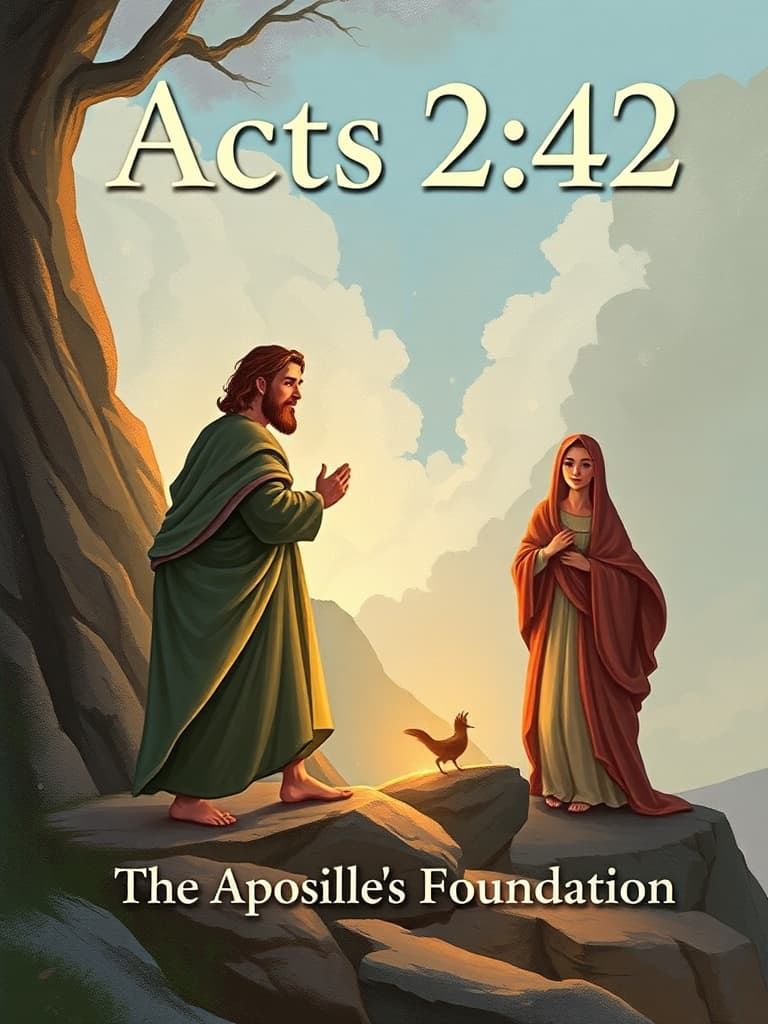
About this book
Acts 2:42: The Apostolic Foundation
Spiritual
Views
22
Likes
0
Chapters
6
Comments
0
The "apostles' doctrine" or "teaching" refers to the foundational truths and instructions about Jesus Christ that were handed down by his chosen disciples.
Chapters
- 1Echoes in the DustChapter 1: Whispers in the Archives **Scene 1: The Weight of Unanswered Questions** Elias Thorne, a man in his late twenties, stands in the dimly lit study of his inherited ancestral home. Dust motes dance in the single shaft of sunlight piercing the gloom, illuminating stacks of old books and forgotten artifacts. Elias feels a profound disconnect between the vibrant faith he once knew and the sterile, ritualistic practices of his current church. His internal dialogue is a tempest of doubt; logical inconsistencies in scripture, the perceived hypocrisy of religious leaders, and the absence of genuine spiritual fervor plague his waking thoughts and haunt his dreams. He clutches a worn Bible, its pages dog-eared and underlined, yet the words offer no solace, only a deeper chasm of confusion. He recalls childhood memories of fervent prayer and a palpable presence of the divine, a stark contrast to the lukewarm faith he experiences now. His unease isn't a recent development; it's a slow-burning fire that has consumed his peace for years. He’s tried to reconcile his doubts with the teachings of his denomination, attending theological lectures, engaging in lengthy debates with pastors, and immersing himself in apologetics. Each attempt, however, only deepens his disquiet, revealing layers of interpretation and tradition that seem to obscure rather than illuminate the core message of Christ. He feels like a stranger in his own spiritual home, yearning for something authentic, something that resonates with the raw, unadulterated truth he intuitively feels must exist. **Scene 2: The Unforeseen Discovery** While cataloging his late grandfather’s extensive library, Elias stumbles upon a peculiar, unlabeled tome bound in ancient, faded leather. It’s not a printed book but a collection of handwritten manuscripts, brittle with age. The script is archaic, the ink faded, but remarkably preserved. His grandfather, a reclusive scholar of religious history, had never mentioned this particular volume. Intrigued, Elias carefully opens it. The initial pages are filled with dense, scholarly annotations, but as he delves deeper, he finds passages that are distinctly different from any biblical text or theological commentary he has ever encountered. These are not doctrinal pronouncements or historical accounts in the traditional sense. Instead, they are vivid, personal recollections, seemingly transcribed by early followers of Jesus. The language is simple, direct, and imbued with an astonishing spiritual power. There are descriptions of Jesus’ teachings that emphasize radical love, communal living, and an intimate, personal relationship with the divine, far removed from the hierarchical structures and dogmatic pronouncements he’s grown accustomed to. One recurring phrase, "the apostles' doctrine," appears frequently, presented not as a set of rules, but as a living, breathing embodiment of Christ’s spirit and teachings. He finds references to practices and beliefs that seem to have vanished from mainstream Christianity, hinting at a foundational body of knowledge lost to time or, more disturbingly, deliberately suppressed. The text speaks of a direct transmission of wisdom, a spiritual lineage that continued unbroken from the apostles themselves. Elias’s heart pounds with a mixture of trepidation and exhilarating discovery. This isn't just a historical curiosity; it feels like a key, a potential answer to the gnawing questions that have tormented him. **Scene 3: The Seed of a Quest** Elias spends days poring over the ancient text, his sleep neglected, his meals forgotten. He cross-references names and places mentioned in the manuscripts with historical records, finding surprising correlations that lend credence to their authenticity. The more he reads, the more he becomes convinced that this text represents a purer, earlier form of Christianity, one that has been significantly altered over centuries of institutionalization and doctrinal development. He feels a growing responsibility, an almost sacred obligation, to understand this rediscovered teaching. The unease he felt before now transforms into a burning conviction. He begins to question the motivations behind the apparent divergence from these original teachings. Was it a natural evolution, or something more deliberate? The thought of a potential suppression of truth sends a shiver down his spine, yet it also ignites a fierce determination within him. He decides he cannot let this discovery remain buried. His quest has begun, not out of academic curiosity, but out of a deep, spiritual necessity. He feels a pull, an inner guidance, urging him to seek out more information, to unearth the full extent of this lost apostolic doctrine. He knows this path will not be easy, that his doubts have led him to the edge of a precipice, but for the first time in years, he feels a flicker of genuine hope, a sense that he might finally find the answers he so desperately seeks. **Continuity Notes:** - Elias's background: Raised in a devout Christian household, but always possessed an independent and questioning mind. His grandfather was a respected but eccentric historian, known for his controversial theories on early church history. - The ancestral home: Old, filled with historical artifacts and documents, providing a rich environment for discovery. - The ancient text: A unique manuscript, not part of any known biblical canon or historical record, containing personal testimonies and direct teachings of early Christians. - Elias's internal state: Deeply troubled by faith's inconsistencies, experiencing spiritual and intellectual doubt, but driven by a sincere desire for truth. - Foreshadowing: The text's emphasis on radical love and communal living hints at themes that will be central to the rediscovered doctrine. Elias’s name echoes biblical prophets, suggesting a role in challenging established norms. **Ending Hook:** As Elias carefully closes the ancient manuscript, a faint, almost imperceptible symbol etched onto its cover catches his eye – a stylized dove with an olive branch, a symbol he vaguely recognizes from obscure historical texts related to early Christian sects. He feels a profound sense of destiny, but also a prickle of unease. What does this symbol signify? And is he truly alone in his discovery, or has something he has unearthed already drawn unwanted attention?
- 2The Veiled HistoryChapter 2: Shadows of Doubt **Scene 1: The Whispers of Discrepancy** Elias Thorne, armed with the ancient manuscript, finds himself increasingly unsettled by the stark contrast between its contents and the doctrines he has always known. The manuscript speaks of a "living word," a direct impartation of spiritual understanding and divine guidance, a stark departure from the rigid interpretations and historical traditions that dominate contemporary religious discourse. He revisits his own church, attending services with a new, critical ear. The sermons, once sources of comfort, now sound hollow, filled with platitudes and pronouncements that lack the visceral spiritual resonance described in the manuscript. He observes the congregants, their faith often appearing more performative than profound, a societal adherence rather than a deeply personal connection. He feels a growing alienation, a sense that he is seeing through a veil that others cannot perceive. He attempts to discuss his findings with his pastor, a man he has known for years, but the conversation quickly devolves into polite dismissal. His pastor attributes the manuscript's content to "apocryphal writings" and "heresies of the early church," reinforcing the established narrative that the current doctrines are the pure, unbroken lineage. Elias leaves the meeting with a heavier heart, the pastor's words echoing the familiar refrain of tradition and authority, but failing to address the core spiritual anomalies Elias perceives. The unease grows into a palpable suspicion: what if the dominant narrative is not the whole truth? **Scene 2: The Labyrinth of Obscure Records** Driven by this suspicion, Elias embarks on a clandestine investigation. He begins to haunt obscure libraries, dusty archives, and antiquarian bookshops, seeking any mention of early Christian movements or writings that deviate from the accepted historical canon. He spends hours poring over microfiche, deciphering faded ink on brittle parchment, piecing together fragments of information. He discovers references to Gnostic texts, Montanist prophecies, and other "heresies" that, upon closer examination, seem to share striking similarities with the teachings in his manuscript. These texts often speak of direct spiritual experience, the "inner Christ," and a personal, unmediated relationship with God, concepts that are largely marginalized or outright rejected by mainstream Christianity. He finds scholarly works that hint at deliberate suppression, citing instances where early church fathers systematically denounced and sought to eradicate dissenting viewpoints. He uncovers mentions of councils and synods where certain texts were deemed heretical and excluded from the developing canon, often for reasons that appear more political or theological than purely spiritual. He learns of the "Gnostics," whose emphasis on spiritual knowledge and direct experience was seen as a threat to the burgeoning hierarchical structure of the church. He reads about Marcion, who challenged the Old Testament God and advocated for a distinct, purely Pauline gospel. Each discovery adds another layer to the puzzle, reinforcing the idea that the "apostles' doctrine" as Elias understands it from the manuscript was not universally accepted but was, in fact, a subject of intense debate and conflict. **Scene 3: The Shadow of Suppression** As Elias delves deeper, he begins to notice a pattern. Certain historical periods and theological debates seem conspicuously absent or glossed over in mainstream accounts. He finds that prominent theologians and historians, while acknowledging the existence of diverse early Christian thought, consistently steer the reader back towards the 'orthodox' tradition, framing all other viewpoints as deviations or errors. He encounters scholarly articles that seem to deliberately downplay or reinterpret evidence of alternative spiritual paths. It feels as though a protective wall has been erected around the accepted narrative, deflecting any inquiry that might challenge its foundations. He starts to feel a sense of being watched, a subtle paranoia that gnaws at him. He notices individuals in libraries who seem to linger too long, observing him. He finds himself second-guessing his research, wondering if he is simply projecting his own doubts onto history. The manuscript, once a beacon of hope, now feels like a dangerous secret. He recognizes that the "apostles' doctrine" he cherishes isn't just lost; it appears to be actively suppressed. The implications are staggering. If these teachings have been deliberately hidden, then the very foundation of his faith, and arguably the faith of millions, has been built on incomplete or distorted truths. He realizes that his quest is no longer just about personal understanding; it has become a mission to uncover a historical and spiritual deception. The path forward is fraught with uncertainty, but the growing evidence of a deliberate cover-up fuels his resolve, pushing him to uncover the full extent of what has been hidden. **Continuity Notes:** - Elias's research methods: Thorough, persistent, utilizing historical archives, obscure texts, and academic sources. - The nature of the 'suppression': Not overt destruction, but rather a gradual marginalization, reinterpretation, and condemnation of dissenting voices and texts. - Elias's emotional state: Growing suspicion, paranoia, a sense of alienation from his community, but also a deepening resolve. - Foreshadowing: The mention of "heresies" and "apocryphal writings" foreshadows the conflict Elias will face with established religious authorities. His growing paranoia hints at the emergence of antagonistic forces. **Ending Hook:** While researching in a secluded corner of a university library, Elias intercepts a hushed conversation between two men who seem out of place. They speak in coded language, mentioning "containment" and "unauthorized access" to "sensitive historical materials." One of them glances in Elias's direction, his eyes sharp and unnervingly direct. Elias quickly pretends to be engrossed in his work, but his heart races. He realizes his investigation might have already attracted the attention of forces far more organized and sinister than he had imagined. Who are these men, and what do they know about his research?
- 3The Watchers in the DarkChapter 3: The Guardians' Watch **Scene 1: The First Warning** Elias Thorne’s clandestine research takes a perilous turn. Following a lead from an obscure theological journal, he travels to a remote monastery rumored to house a neglected collection of early Christian manuscripts. As he arrives, he notices a black, unmarked sedan parked discreetly down the road. Inside, two men in dark suits observe him. Inside the monastery, the librarian, a stern, elderly monk, is unusually evasive when Elias inquires about specific texts. He claims the archives are being reorganized and access is severely restricted. Elias, however, spots a section of shelves in the back, partially obscured by a tapestry, exhibiting signs of recent activity – dust disturbed, books slightly out of place. He attempts to access this section, feigning a search for a different volume, but is intercepted by the librarian who sternly reminds him of the rules. As Elias leaves the monastery, frustrated and increasingly wary, the black sedan follows him for several miles before turning off abruptly. The encounter leaves Elias with a chilling certainty: his pursuit of the "apostles' doctrine" is not going unnoticed, and whoever is watching is actively trying to impede his progress. The unease he felt in the previous chapter solidifies into a tangible fear. He begins to question the safety of his own home, scrutinizing every shadow, every unfamiliar car. He feels a constant sense of being observed, a psychological toll that makes even simple tasks feel fraught with anxiety. **Scene 2: Escalating Obstructions** Elias’s attempts to obtain crucial information or texts are met with increasingly sophisticated obstacles. A planned meeting with a reclusive historian, who had hinted at possessing documents related to the early church's schisms, is abruptly cancelled at the last minute with a vague excuse. When Elias investigates further, he discovers the historian has suddenly fallen ill and is under strict medical observation. An online forum where Elias had cautiously posted a question about alternative interpretations of early Christian teachings is suddenly shut down, with the administrator citing "security breaches." He finds that rare books he had ordered online are mysteriously lost in transit or returned to the sender with fabricated reasons. Each setback is subtly orchestrated, designed to frustrate and deter him without leaving overt evidence of foul play. He starts to suspect a coordinated effort, a network of individuals dedicated to preventing the dissemination of the knowledge he seeks. He recalls the hushed conversation he overheard in the library, the mention of "containment." He begins to use pseudonyms and encrypted communication, but he suspects these measures are insufficient against a well-resourced and determined adversary. The sense of peril intensifies; he realizes he is not just seeking knowledge, but actively engaging in a struggle against powerful forces. **Scene 3: The Guardians Emerge** Through a series of near misses and unsettling encounters, Elias begins to piece together the identity of his adversaries. He learns of a clandestine organization, operating in the shadows of religious and academic institutions, known only as the "Guardians of the Status Quo." Their mandate, as he slowly uncovers through fragmented whispers and coded references in obscure historical documents, is to preserve the established religious order at all costs. They view any deviation from accepted doctrine as a dangerous threat to spiritual stability and societal harmony. Their methods are subtle but ruthless: they employ surveillance, disinformation, and the quiet suppression of inconvenient truths. Elias realizes that Silas Vane, a charismatic and influential figure in contemporary religious circles whom Elias has encountered at academic conferences, is likely a key player, if not the leader, of this organization. Vane’s public pronouncements about the importance of tradition and unwavering faith now take on a sinister new meaning. Elias understands that Vane and his Guardians see him as a destabilizing force, a rogue element threatening to unravel centuries of carefully constructed dogma. The peril is no longer abstract; it is embodied in the watchful eyes of the Guardians. Elias feels hunted, his pursuit of truth transforming into a desperate fight for survival. He must find a way to outmaneuver them, to bypass their watchful eyes, and to continue his quest for the authentic "apostles' doctrine" before they silence him or his discovery permanently. **Continuity Notes:** - The Guardians of the Status Quo: A shadowy organization with a vested interest in maintaining the current religious doctrines. They are resourceful, influential, and operate through subtle means. - Silas Vane: Introduced as a potential leader or significant figure within the Guardians. His public persona contrasts with his suspected hidden agenda. - Elias's evolving tactics: Forced to become more cautious, employing pseudonyms, encrypted communication, and heightened situational awareness. - Setting details: Remote monasteries, obscure archives, academic institutions, and even seemingly innocuous public spaces become potential sites of surveillance and conflict. - Elias's emotional state: Fear, paranoia, a growing sense of isolation, but also a hardening resolve and a developing strategic mindset. **Ending Hook:** Elias narrowly escapes an incident where his hotel room is subtly ransacked while he is out. Nothing valuable is taken, but his research notes are disturbed, and a specific page in his ancient manuscript is subtly marked with a faint indentation, as if examined closely. He realizes the Guardians are not just watching him; they are actively seeking the manuscript itself. He knows he cannot stay in one place for long, and that his current methods are no longer sufficient. He needs a new approach, a way to go deeper, to find allies, and to uncover the truth before the Guardians can confiscate or destroy the very foundation of his quest.
- 4The Unseen CommunityChapter 4: The Hidden Wellspring **Scene 1: A Trail of Breadcrumbs** Following a cryptic clue found within a marginal note of an obscure theological treatise – a reference to a "community dwelling in the silence of the mountains, preserving the unadulterated word" – Elias Thorne embarks on a new phase of his quest. He understands that direct confrontation with the Guardians of the Status Quo is becoming increasingly dangerous. His research now focuses on finding this hidden community, believing they may hold the key to understanding and preserving the original "apostles' doctrine." He travels to a remote, mountainous region known for its natural beauty and historical isolation. His journey is arduous, involving long treks through rugged terrain, relying on limited local knowledge and intuition. He encounters skepticism and guarded responses from the few villagers he meets; they speak of old traditions and a deep-seated distrust of outsiders, hinting at a long history of protecting their way of life. Elias feels a growing sense of anticipation, mixed with trepidation. He knows that if such a community exists, it has likely survived by remaining hidden, and its members may be wary of anyone seeking their knowledge. He recalls the Guardians’ relentless pursuit and understands that revealing himself too readily could endanger not only himself but also those he seeks. He adopts a more humble, observant approach, spending time in the local villages, listening to stories, and demonstrating genuine respect for their traditions, hoping to gain their trust and perhaps a subtle indication of the community's whereabouts. **Scene 2: The Threshold of Revelation** After weeks of searching, Elias stumbles upon a hidden valley, accessible only through a narrow, overgrown pass. The air here feels different – serene, charged with a subtle spiritual energy. He discovers a small, self-sufficient community living in simple dwellings, their lives seemingly untouched by the modern world. The inhabitants are peaceful, their faces etched with a quiet wisdom. He observes their communal living, their deep respect for nature, and their profound sense of interconnectedness. They engage in simple, meaningful work, their interactions marked by genuine love and mutual support. Elias, initially hesitant, approaches them with humility, explaining his journey and his search for authentic spiritual understanding. He is met not with immediate acceptance, but with a gentle, probing inquiry. He is introduced to Seraphina, an elder of the community, a woman whose eyes hold an ancient depth and a profound serenity. Seraphina listens patiently to Elias’s story, recognizing the earnestness of his quest and the sincerity of his struggle with doubt. She doesn't dismiss his journey but sees it as a validation of the enduring human search for truth. She reveals that her community is indeed a lineage of preservers, descendants of those who sought to maintain the original teachings of the apostles, safeguarding them from distortion and suppression throughout the centuries. **Scene 3: The Living Doctrine** Seraphina, sensing Elias’s readiness, begins to share the "apostles' doctrine" not through dry exposition, but through lived experience. Elias is invited to participate in their daily life. He witnesses their practices: communal meals where gratitude is expressed for every element, meditative prayer that fosters a deep inner peace, and discussions that focus on empathy, mutual understanding, and the practical application of love in all interactions. He learns that the "apostles' doctrine" is not merely a set of theological propositions but a holistic way of life, emphasizing direct experience of the divine, radical compassion, and the inherent worth of every individual. He sees how they interpret scripture not as a rigid legal text, but as a dynamic guide for spiritual growth, emphasizing the spirit of the teachings over the letter. He observes their healing practices, their deep connection to the natural world, and their unwavering commitment to peace and non-violence. He meets Brother Thomas, a pragmatic member of the community who was initially wary of Elias, but whose skepticism gradually dissolves as he witnesses Elias’s genuine seeking and his growing understanding. Thomas shares his own past struggles with doubt, finding solace and truth within the community’s preserved teachings. Elias experiences moments of profound spiritual clarity, feeling the presence of God in a way he never had before. He realizes that the "apostles' doctrine" is not a lost relic but a living, vibrant force, capable of transforming lives and fostering genuine community. The peace and authenticity he finds here are overwhelming, offering a stark contrast to the spiritual void he has been living in. He understands that the Guardians of the Status Quo have systematically worked to suppress this very essence of authentic Christianity, fearing its power to disrupt their established order. **Continuity Notes:** - The Hidden Community: A secluded, self-sufficient group dedicated to preserving the original apostolic teachings. They live a life of simplicity, love, and deep spiritual connection. - Seraphina: The wise elder and spiritual guide of the community, representing the lineage of truth-keepers. - Brother Thomas: A member of the community who initially distrusts Elias but becomes a loyal ally. His character arc reflects the potential for transformation within the community. - Elias's transformation: Moving from doubt and fear to experiencing genuine spiritual peace and understanding. - The 'apostles' doctrine' as a lived experience: Emphasizing practice, love, and direct divine connection over rigid dogma. **Ending Hook:** As Elias immerses himself in the community’s way of life, he begins to notice subtle signs of external threat. A drone briefly hovers over the valley, quickly disappearing. A distant, unfamiliar vehicle is spotted on the mountain pass. Seraphina confides in Elias that their hidden existence is becoming increasingly precarious. The Guardians, she believes, are closing in, driven by the fear of what Elias has discovered and what this community represents. Elias realizes that his presence, while welcomed, may have inadvertently endangered this sanctuary. He is faced with a new dilemma: how to protect this sacred place and its precious teachings, and what role he will play in their future, especially if the Guardians discover their existence.
- 5The Weight of TruthChapter 5: The Crossroads of Conviction **Scene 1: The Looming Threat** The peace Elias Thorne has found within the hidden community is shattered by the undeniable signs of external pressure. The sporadic sightings of drones and unfamiliar vehicles escalate. Seraphina reveals to Elias that their isolation has been compromised, and the Guardians of the Status Quo are actively searching for them, alerted by Elias's prolonged absence from his previous life and possibly by subtle surveillance of his movements. Silas Vane, she explains, views this community and its preserved teachings as the ultimate threat to the established religious order – a living testament to a different path, a path that could unravel centuries of dogma and control. Elias is consumed by guilt, realizing his quest may have led directly to the endangerment of this sanctuary and its inhabitants. He sees the quiet fear in the eyes of the community members, a fear that contrasts sharply with their usual serenity. Brother Thomas, once skeptical, is now fiercely protective, organizing rudimentary defenses and urging vigilance. Elias feels the weight of responsibility, torn between his desire to protect the community and his burning conviction that the "apostles' doctrine" must be shared with the wider world. He understands that the Guardians will stop at nothing to silence this truth, and that their methods will likely become more aggressive now that they have a clearer target. **Scene 2: The Council of Preservation** Seraphina convenes a council of the community elders, including Brother Thomas and Elias. The discussion is somber. They acknowledge the immediate danger: the Guardians are likely closing in, and their hidden valley may not remain secret for long. The core of their debate revolves around their mandate: preservation. For centuries, they have carefully guarded the apostolic teachings, ensuring their survival in secret. Now, they face a new challenge: Elias’s desire to share these truths openly. Some elders argue for continued secrecy, believing that any attempt to expose the doctrine will inevitably lead to persecution and the destruction of their way of life. They point to historical examples of suppressed movements being violently eradicated. Others, swayed by Elias’s earnestness and the palpable spiritual power he has witnessed, believe that the time may have come for these teachings to re-emerge, albeit cautiously. Brother Thomas, surprisingly, advocates for a measured approach, emphasizing the need for Elias to be properly prepared and for the community to devise a strategy that minimizes risk. Seraphina, wise and ancient, listens to all perspectives, her gaze resting on Elias. She sees in him the potential for a bridge between the hidden preserve and the searching world, but also the immense personal risk he faces. The internal conflict within the community mirrors Elias’s own. **Scene 3: The Choice and Its Cost** Elias is presented with a stark choice. He can remain with the community, embracing their secluded existence and helping to preserve the doctrine in its hidden sanctuary, ensuring his own safety but condemning the world to ignorance of these profound truths. Or, he can leave, taking the manuscript and the knowledge he has gained, and attempt to share it with the outside world, risking persecution, disbelief, and the wrath of the Guardians, potentially exposing the community to even greater danger. The weight of this decision is immense. He thinks of the spiritual emptiness he once felt, the unanswered questions that plagued him, and the transformative power of the doctrine he now holds. He sees the faces of the community members, their peaceful existence a testament to the truth they embody. He also sees the calculating eyes of Silas Vane and the shadowy network of the Guardians, a force determined to maintain control. His personal quest for peace has evolved into a moral imperative. He realizes that true preservation might not mean hiding the truth, but allowing it to flourish, even at great personal cost. He confides in Seraphina, articulating his decision. He cannot remain silent. The "apostles' doctrine" is too vital, too life-affirming, to be kept hidden any longer. He accepts the risk, understanding that his path will be fraught with peril, but driven by the conviction that truth, even when suppressed, has an inherent power to resonate and transform. He knows this choice will irrevocably alter his life and potentially the course of religious history, but he feels a profound sense of peace in making it. **Continuity Notes:** - The escalating threat from the Guardians: Their search is becoming more focused, putting the hidden community in direct danger. - The community’s internal debate: Reflects the tension between preservation through secrecy and dissemination for broader impact. - Elias’s internal conflict: Torn between personal safety and his moral obligation to share the truth. - Seraphina’s role: Acts as a mediator and guide, acknowledging the risks but supporting Elias’s conviction. - Brother Thomas’s new role: Transitioning from protector of the community to a strategic ally for Elias. - The nature of the choice: A clear dichotomy between safety in silence and risk in speaking truth. **Ending Hook:** As Elias prepares to depart, Seraphina entrusts him with a small, intricately carved wooden box. Inside, she explains, are not only copies of the most critical texts from their preserved archives but also a series of personal accounts – testimonies from individuals whose lives were profoundly changed by the "apostles' doctrine" throughout history, hidden records of those who kept the flame alive in secret. "These are not mere words, Elias," she says, her voice filled with solemnity. "They are the echoes of the living truth. Carry them with courage, for the path you choose will be arduous, and the Guardians will be relentless. But remember, the seed, once planted, can grow in the most unexpected places."
- 6The UnveilingChapter 6: Dawn of the Doctrine **Scene 1: Stepping into the Light** Elias Thorne, now armed with the ancient manuscript and the precious wooden box of testimonies entrusted to him by Seraphina, emerges from the hidden valley. He leaves behind the sanctuary that offered him peace and understanding, stepping back into a world that feels both familiar and alien. The weight of his decision presses upon him, but it is tempered by a newfound clarity and a profound sense of purpose. He knows the Guardians of the Status Quo, led by Silas Vane, will be actively hunting him, their resources and influence vast. His immediate priority is to find a safe space, a way to begin disseminating the "apostles' doctrine" without immediately falling into the hands of his adversaries. He operates with heightened caution, constantly aware of his surroundings, employing the clandestine strategies he learned during his initial investigation, but now with the added urgency of protecting the knowledge he carries. He recalls the faces of Seraphina and Brother Thomas, the quiet strength of the hidden community, and understands that his actions carry not just personal risk, but the potential to impact generations. He feels a deep connection to the historical figures whose testimonies he carries, a sense of participating in a long, unbroken chain of truth-seekers. His initial unease has transformed into a quiet but unwavering courage, fueled by the transformative power of the doctrine itself. **Scene 2: The First Seeds of Truth** Elias begins his mission subtly. He doesn't seek out large public platforms immediately, recognizing the danger. Instead, he starts by connecting with individuals he identifies as sincere seekers, people who, like him, are grappling with doubt and yearning for deeper spiritual meaning. He uses encrypted communication channels and carefully arranged, discreet meetings in neutral, public spaces – quiet cafes, secluded park benches, university libraries. He shares fragments of the "apostles' doctrine," focusing on its core tenets of radical love, personal spiritual experience, and communal harmony. He presents the ancient manuscript not as an infallible holy text, but as a historical account of a vibrant, living faith. The testimonies from the wooden box serve as powerful evidence, offering compelling narratives of transformation and authentic spiritual connection. He witnesses firsthand the impact of these teachings: eyes lighting up with understanding, hearts opening to new possibilities, long-held doubts beginning to dissolve. He finds that the simplicity and profound wisdom of the doctrine resonate deeply with those who feel disillusioned by the rigidity and perceived hypocrisy of established religious institutions. He carefully avoids direct confrontation with the Guardians, focusing instead on building a network of like-minded individuals, planting seeds of truth that he hopes will grow organically. **Scene 3: Facing the Storm** As Elias's network begins to grow, albeit slowly and discreetly, whispers of his activities reach the ears of Silas Vane and the Guardians. They recognize the threat posed by the "apostles' doctrine" – its potential to undermine their authority and dismantle their carefully constructed edifice of control. Vane, outwardly portraying himself as a defender of faith, initiates a more aggressive campaign to discredit Elias and suppress the rediscovered teachings. Elias finds himself the target of disinformation campaigns, subtle smear tactics, and increased surveillance. He anticipates this escalation, having prepared himself for the inevitable confrontation. He understands that his journey from seeker to messenger will be fraught with peril. He may face opposition not only from the Guardians but also from those who are deeply entrenched in the established doctrines and fearful of change. The path ahead is uncertain. He does not know if the "apostles' doctrine" will be embraced or rejected, if it will spark a revival of authentic faith or lead to further conflict. However, he stands firm in his conviction. He has seen the power of this truth, its capacity to heal, unite, and bring genuine spiritual fulfillment. He is ready to face whatever comes, armed with the rediscovered wisdom of the apostles, stepping out of the shadows not seeking to overthrow institutions, but to offer a path back to the authentic heart of faith. The implications for the future are vast and unpredictable, but for the first time, Elias feels a profound sense of peace and purpose, ready to embrace the dawn of this ancient, yet ever-new, doctrine. **Continuity Notes:** - Elias's current status: Operating covertly, building a network of seekers. - The Guardians' response: Escalating efforts to discredit and suppress Elias and the doctrine. - Silas Vane's role: Actively working to maintain the status quo, using disinformation and surveillance. - Elias's strategy: Gradual dissemination, focusing on sincere seekers, avoiding direct confrontation initially. - The 'apostles' doctrine's' impact: Demonstrating its transformative power on individuals. - The uncertain future: The outcome of Elias's mission is unknown, holding potential for both positive change and conflict. **Ending Hook:** Elias receives an anonymous message, delivered through a secure, untraceable channel. It contains a single phrase: "The wellspring is not as hidden as you believe. Seek the shepherd who guards the lost sheep." He recognizes the coded language, suggesting an unexpected ally within the very structures the Guardians seek to control. Is this a trap, or the first sign that his efforts have resonated with others who also yearn for a purer faith? The path forward has just become even more complex, and potentially, more hopeful.
More Spiritual stories
- Chains are Shattered and Broken
Chains Broken, Prayers, Prophetic, Deliverance
- Whispered Spells Of Old
Awaking Mystical Powers
As you embark on this mystical journey, you will discover the secrets of ancient incantations, forbidden knowledge, and mystical practices that have been hidden for centuries. With each turn of the page, you will unlock the mysteries of the unknown revealing the hidden patterns and codes that govern the universe.
Want to write a story like this?
Learn the craft in our free AI story generator, then draft your first chapter with an AI co-writer.
What stayed with you?
Read a chapter and leave the author a comment.
Reader notes
Loading reader notes…