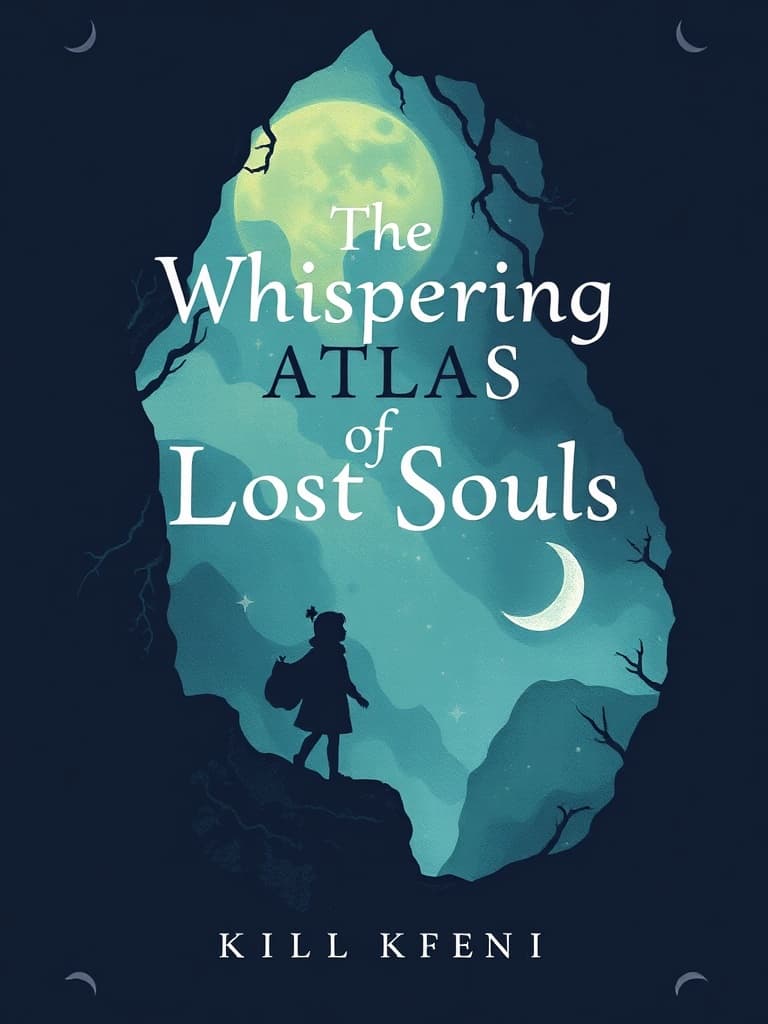
About this book
The Whispering Atlas of Lost Souls
10
0
12
0
A Collection of Love, Loss, and Wanderlust WITH A SPECIAL SECTION OF HERBAL & HEALTHY RECIPES AT THE BACK LOVE YOU TARCON
Chapters
- 1The Cartographer's Quiet GriefChapter 1 opens with Elara, a cartographer of exquisite precision, living a life steeped in solitude. Her small studio, tucked away in a quiet corner of the city, is a sanctuary of meticulously organized maps, vials of colored inks, and the comforting scent of aged parchment. Sunlight, often diffused by dust motes dancing in the air, illuminates her focused expression as she painstakingly details coastlines and mountain ranges. The narrative emphasizes her dedication to her craft, her movements economical and deliberate, reflecting a mind that finds solace in order and predictability. Yet, beneath this veneer of calm, a profound sadness simmers. This grief, a silent companion, stems from a profound loss – the departure of a loved one, perhaps a lover, perhaps a family member, whose absence has left an unfillable void. This loss is not overtly discussed but is hinted at through subtle details: a framed, faded photograph on her desk turned slightly away from view, a lingering glance at a particular star constellation visible from her window, a sigh that escapes her lips when a certain melody drifts from a nearby street musician. Her interactions with the outside world are minimal, her days dictated by the rhythms of her work and the quiet ache in her heart. The only significant object that disturbs the otherwise ordered calm of her studio is an ancient atlas, an inheritance from a distant relative, perhaps a grandmother or great-aunt known for her eccentricities and affinity for the arcane. This atlas is unlike any other Elara has encountered. Its leather binding is worn smooth, its pages thick and strangely cool to the touch. More importantly, its maps are not of recognizable lands. The coasts are fluid, the continents shift, and the place names are written in an unknown script that seems to shimmer with an inner light. Initially, Elara dismisses it as a curious, perhaps even artistic, creation – a beautiful but ultimately useless artifact. She places it on a prominent shelf, a silent testament to a forgotten lineage. However, the atlas exerts a subtle, almost imperceptible pull on her. She finds herself drawn to it, her fingers tracing its strange lines when she believes no one is looking. There are moments when she feels a faint vibration emanating from it, a low hum that seems to resonate deep within her bones. The air around it feels different, charged with a latent energy that she, a cartographer accustomed to tangible realities, cannot quite define. The chapter will meticulously build Elara's character, establishing her routine, her skills, and the deep well of sorrow she carries. The introduction of the atlas will be gradual, presenting it as an enigmatic presence that disrupts her quiet existence. The emotional core of the chapter will be Elara's profound sense of loss, which colors every aspect of her life, making her susceptible to the subtle influences of the atlas. The narrative will focus on sensory details: the scratch of her quill, the scent of ink, the texture of paper, the subtle shift in atmosphere around the atlas. Elara's internal monologue will reveal her quiet resignation to her grief and her subconscious yearning for something more, something that might fill the emptiness within her. The chapter ends with Elara feeling an inexplicable connection to the atlas, a sense that it holds more than just ink and parchment, a feeling that it might, in some unknown way, understand her silent sorrow. The foreshadowing of her affinity for herbs will be subtle, perhaps she uses a specific herbal tea to calm her nerves before sleep, or a small potted rosemary plant sits on her windowsill, its scent a faint, grounding presence in her studio. This detail will serve as a subtle nod to her inherent nurturing and healing capabilities, which will become crucial later in the narrative. Scene Breakdown: 1. Introduction to Elara's studio: detailing her meticulous nature, the tools of her trade, and the atmosphere of quiet solitude. Establishing her as a skilled cartographer. 2. Elara's routine: depicting her methodical work, her isolation, and the subtle manifestations of her grief (e.g., a fleeting expression, a distant gaze). 3. The introduction of the Atlas: its physical description, its enigmatic maps, and Elara's initial dismissal of it as a mere curiosity. 4. Subtle interactions with the Atlas: Elara's subconscious draw to it, the faint vibrations, the charged atmosphere around it. 5. Elara's internal monologue: revealing her underlying sadness, her resignation, and a nascent, unacknowledged yearning for solace or understanding. 6. A moment of reflection: Elara observing the stars or a natural element, connecting her inner state to the external world, hinting at a deeper sensitivity. 7. Foreshadowing of herbal affinity: a brief mention of her use of herbs for comfort or as part of her studio's decor. 8. Ending hook: Elara feeling a strange resonance with the Atlas, a sense that it might hold a key to her unspoken pain, but not yet understanding how. Character Intent: - Elara: To find peace and order in her work, to cope with her grief through routine, and to subconsciously explore the mystery of the atlas. - The Atlas: To subtly exert its influence, to awaken to consciousness through Elara's touch, and to prepare for its eventual communication. Setting Details: - Elara's studio: a haven of organized chaos, filled with maps, inks, quills, sunlight, and the scent of paper and ink. - The Atlas: ancient, leather-bound, cool to the touch, with shifting, ethereal maps and shimmering, unknown script. Emotional Turns: - From quiet resignation to a nascent curiosity and a sense of inexplicable connection. - From isolation to a subtle awareness of an external, mysterious presence. Continuity Notes: - Elara's grief must remain a present but understated element throughout. - The atlas's unusual nature needs to be established without revealing its full capabilities yet. - The foreshadowing of herbalism should be subtle and organic to the scene. Ending Hook: Elara feels a distinct, almost magnetic pull from the atlas, a sensation that it might be more than just an old book, a faint hope glimmering in the depths of her grief.
- 2Whispers from the ParchmentChapter 2 begins in the quiet aftermath of Elara's initial encounter with the Whispering Atlas. The lingering sense of its strange energy has unsettled her accustomed routine, leading to a night of restless sleep punctuated by fragmented dreams. The chapter opens with Elara waking just before dawn, the first pale light of morning filtering through her studio window. She feels a lingering unease, a sense that something has fundamentally shifted. Her gaze is immediately drawn to the atlas, which sits on its shelf, appearing outwardly unchanged. However, Elara now perceives it differently. She approaches it with a mixture of trepidation and an irresistible curiosity, her cartographer's instinct to understand and categorize warring with a growing, almost primal, sense of wonder. As she reaches out to touch its worn cover, a faint tremor runs through her fingertips, more pronounced than before. This time, however, it is accompanied by something else – a sound. It's faint, almost imperceptible, like the rustling of dry leaves or the distant murmur of voices carried on the wind. Intrigued and slightly unnerved, Elara leans closer, her ear pressed to the ancient binding. The sounds coalesce, resolving into distinct whispers. These are not the clear, coherent voices of people speaking, but rather ethereal fragments of emotion, impressions, and half-formed thoughts. She hears snippets of laughter, the soft sigh of contentment, the sharp pang of regret, the desperate plea of longing. It’s as if the atlas itself is breathing, exhaling the echoes of forgotten feelings. Elara is mesmerized. Her meticulous mind struggles to make sense of this phenomenon. She tries to decipher the whispers, to assign them meaning, but they are fleeting, elusive, and deeply emotional. They speak not of directions or landmarks, but of the inner landscapes of the heart: the joy of a first kiss, the crushing weight of heartbreak, the quiet warmth of enduring affection, the bitter sting of betrayal. She realizes, with a dawning sense of awe and a touch of fear, that the atlas is not mapping physical space, but the intangible territories of the soul. The whispers are not random; they seem to carry a narrative, hinting at stories of love and loss experienced by individuals who have long since passed from the world. Some whispers are joyous, others melancholic, and some are imbued with a profound, almost unbearable sorrow. Elara’s own grief, which she has tried to keep contained, begins to stir in response to these spectral emanations. The atlas’s whispers seem to resonate with her own unspoken pain, offering a strange, disquieting form of companionship. She finds herself drawn to certain whispers, her heart aching in sympathy, while others evoke a sense of unease. The chapter will detail Elara's gradual realization of the atlas's true nature. The narrative will focus on the sensory experience of the whispers – their ethereal quality, their emotional resonance, their fragmented nature. Elara’s internal conflict between her rational mind and her growing intuition will be a central theme. The descriptions of the whispers will be evocative, using metaphors of wind, water, and faint music to convey their elusive quality. The chapter will also explore the initial impact of these whispers on Elara’s own emotional state, suggesting a nascent connection to her buried grief. The atlas, for the first time, is presented not just as an object, but as a sentient entity, communicating its essence to Elara. The foreshadowing of herbs could be a momentary distraction for Elara, as she feels overwhelmed and instinctively reaches for a small vial of lavender oil to calm herself, the familiar scent a grounding anchor in the face of the extraordinary. The chapter will end with Elara understanding that the atlas is a repository of emotional histories, a spectral map of the human heart, leaving her with more questions than answers and a profound sense of wonder. Scene Breakdown: 1. Elara wakes with a sense of unease: the lingering effects of the atlas's energy, a feeling of something profound having occurred. 2. Elara's approach to the Atlas: a mixture of fear, curiosity, and a cartographer's drive to understand. 3. The first audible whispers: describing their faint, ethereal quality and how they begin to form coherent emotional impressions. 4. Elara's attempt to decipher the whispers: her struggle to reconcile them with her understanding of maps and geography. 5. The realization of the Atlas's true nature: it maps souls and emotions, not physical places. 6. Specific examples of whispers: illustrating the range of emotions – joy, sorrow, longing, regret – and hinting at past lives and connections. 7. The impact on Elara's own grief: her buried sadness beginning to stir in response to the atlas's whispers. 8. Elara's internal monologue: grappling with the implications of this discovery, the wonder and the fear. 9. Foreshadowing of herbal affinity: Elara using lavender oil to cope with the overwhelming sensory input. 10. Ending hook: Elara accepting the atlas as a map of souls, but uncertain of its purpose or her role. Character Intent: - Elara: To understand the source and meaning of the whispers, to map this new, intangible territory, and to find answers to her own unspoken questions. - The Atlas: To communicate its essence, to reveal its nature as a repository of emotional memories, and to draw Elara deeper into its mystery. Setting Details: - Elara's studio: now imbued with a new, ethereal energy originating from the Atlas. - The Atlas: actively whispering, its presence more palpable than before. Emotional Turns: - From curiosity to awe and a touch of fear. - From isolation to a nascent sense of connection with the spectral echoes. - From repressed grief to a subtle stirring of emotion. Continuity Notes: - The whispers must remain fragmented and emotionally driven, not yet forming clear narratives. - Elara's grief should be subtly amplified by the atlas's influence. - The foreshadowing of herbs should be a brief, coping mechanism. Ending Hook: Elara stares at the atlas, no longer seeing it as a mere object, but as a living chronicle of human connection, its whispers now a haunting symphony that promises to unravel the deepest secrets of the heart.
- 3Spectral Maps of the HeartChapter 3 delves into the heart of the Whispering Atlas's mystery, moving beyond mere whispers to the visual manifestation of its power. Elara, now fully captivated and somewhat overwhelmed by the atlas's ethereal voices, begins to actively study its pages. The chapter opens with Elara spending hours poring over the atlas, her cartographer's eye now trained to perceive beyond conventional cartography. The faint luminescence she noticed before seems to intensify when she focuses her attention, particularly when the whispers are strongest. She discovers that the strange, shifting lines on the maps are not random. When she traces them with her finger, or when a particularly strong whisper emanates from a certain section, the parchment subtly changes. Ethereal ink, appearing as if drawn by moonlight, begins to bloom on the pages, forming intricate patterns that resemble both celestial constellations and the delicate circuitry of the human nervous system. These are not static drawings; they shift and pulse with a faint, internal light. Elara realizes that these are not geographical boundaries, but rather representations of emotional connections, pathways of love and sorrow that have been etched into the fabric of existence. She begins to see spectral figures emerge within these shifting lines – faint, translucent forms of men and women, locked in gestures of affection or despair. These are the spectral lovers, the echoes of souls whose experiences are imprinted within the atlas. Their forms are wispy, their features often indistinct, yet their emotions are palpable. Elara witnesses moments frozen in time: a couple embracing under a spectral moon, a solitary figure weeping by a phantom shore, two hands reaching for each other across an ethereal chasm. She understands that the atlas chronicles not just places, but the profound emotional journeys undertaken within those places by individuals who loved deeply and lost profoundly. Each spectral map is a testament to a unique relationship, a tapestry woven from shared experiences, unspoken vows, and enduring memories. The chapter will meticulously describe these spectral manifestations. Elara's attempts to interpret them will be a central focus. She might try to cross-reference the faint clues within the atlas with historical records or local legends, but she quickly realizes that the atlas operates on a different plane of understanding, one that transcends factual history and delves into emotional truth. The narrative will explore the emotional impact of witnessing these spectral lovers. Elara finds herself deeply moved by their stories, her own suppressed grief resonating with their echoes of loss. She begins to feel a sense of responsibility towards them, a cartographer's desire to document and understand these forgotten connections. The chapter will emphasize the interconnectedness of love and loss, showing how the atlas portrays them not as separate entities, but as two sides of the same coin, intrinsically linked. Elara’s meticulous nature will be highlighted as she attempts to create her own annotations, trying to map these spectral relationships, her quill now poised over pages that hold the weight of forgotten affections. The whispers, too, will evolve, becoming slightly clearer, offering fragmented phrases, sighs, and even names, hinting at the individual stories waiting to be discovered. The descriptions of the spectral ink and figures will be poetic and evocative, emphasizing their ephemeral nature. The chapter will also touch upon the atlas's fragility. As Elara observes the spectral figures, she might notice certain areas fading, their light dimming, hinting at a vulnerability that is not yet understood. This foreshadows the coming threat. The foreshadowing of herbs could be Elara using a poultice made from chamomile and lavender to soothe her eyes after prolonged, intense study of the atlas, or perhaps she incorporates dried flowers into her bookmark, a small act of preservation reflecting her growing role. The chapter concludes with Elara understanding that the atlas is a vast, living archive of human affection and sorrow, a repository of forgotten connections and unspoken goodbyes, and she feels an overwhelming urge to preserve these fading echoes. Scene Breakdown: 1. Elara's intense study of the Atlas: focusing on the pages and the evolving whispers. 2. The manifestation of spectral ink: describing its ethereal quality and how it forms patterns on the pages. 3. The emergence of spectral figures: the translucent forms of lovers, their gestures and emotions. 4. Elara's interpretation of the spectral maps: understanding them as emotional connections and relationship chronicles. 5. Witnessing specific spectral scenes: detailing moments of love, longing, and sorrow frozen in time. 6. The emotional impact on Elara: her own grief resonating with the spectral echoes, fostering empathy. 7. Elara's growing sense of responsibility: her cartographer's drive to document and understand these forgotten connections. 8. The interconnectedness of love and loss: the atlas portraying them as inseparable. 9. Foreshadowing of the Atlas's fragility: noticing areas that are fading or dimming. 10. Elara's attempt to annotate the Atlas: her growing desire to map these spectral relationships. 11. Foreshadowing of herbal affinity: Elara using soothing herbs for her eyes or incorporating them into her study materials. 12. Ending hook: Elara realizing the Atlas is a profound archive of emotional history, feeling compelled to protect these fading memories. Character Intent: - Elara: To decipher the spectral maps, to understand the stories of the spectral lovers, and to find a way to preserve these fading echoes. - The Atlas: To reveal its deeper nature, to awaken Elara's empathy, and to hint at its own vulnerability. - Spectral Lovers: To have their stories acknowledged and their love remembered, even in their faded state. Setting Details: - Elara's studio: filled with the faint glow of the Atlas, the air thick with unspoken emotions. - The Atlas: pages alive with spectral ink and figures, whispers growing more nuanced. Emotional Turns: - From fascination to empathy and a growing sense of purpose. - From detached observation to a deep emotional connection with the spectral echoes. - From curiosity about the Atlas to a nascent sense of duty. Continuity Notes: - The spectral figures should remain ethereal and fragmented, not fully formed individuals yet. - The fading elements of the Atlas need to be introduced subtly, hinting at a threat. - Elara's grief should be a consistent undercurrent, now amplified by her empathy for the spectral lovers. Ending Hook: Elara gazes at the pages, a profound understanding dawning within her: the Whispering Atlas is not merely a collection of memories, but a living testament to the enduring power of love and the pervasive shadow of loss, and she feels an urgent, protective instinct to safeguard its fragile heart.
- 4The Creeping BlightChapter 4 introduces a palpable sense of dread and decay, marking a significant turning point in Elara’s understanding of the Whispering Atlas and its contents. The chapter opens with Elara deeply immersed in her study of the spectral maps, meticulously documenting the emerging patterns of love and sorrow. She has grown accustomed to the faint luminescence of the pages and the ethereal whispers, finding a strange solace in this communion with the past. However, a subtle shift begins to occur, something that chills her more profoundly than the spectral figures themselves. She starts to notice areas within the atlas where the spectral ink appears to be dimming, its ethereal glow faltering. The delicate lines that represent emotional connections seem to fray at the edges, and the translucent figures become even more indistinct, as if being leached of their very essence. This phenomenon is not isolated; it appears to be spreading, like a slow-acting poison seeping into the ancient parchment. Elara initially attributes this to the natural fading of old materials, but the pattern is too deliberate, too insidious. The whispers in these dimming areas also change. They become weaker, more distorted, tinged with a profound, suffocating sadness that feels different from the usual echoes of loss. It’s a hollow despair, a silence that screams of forgotten grief and unacknowledged pain. Elara realizes with growing alarm that something is actively consuming the atlas's memories, actively erasing the spectral lovers' stories. She dubs this encroaching darkness 'the Blight,' a term that reflects its insidious, destructive nature. The Blight seems to feed on the unacknowledged sorrows, the unresolved emotions, and the severed connections that the atlas holds. It thrives in the absence of remembrance and acknowledgment. As the Blight spreads, Elara feels a corresponding increase in her own anxiety. The atlas is more than just a repository of stories; it is becoming a reflection of a universal struggle against oblivion, against the erasure of love and memory. She senses a growing danger, not just to the atlas and the spectral souls within it, but to the very essence of love and connection that they represent. Her own grief, which she has been slowly beginning to process through her interaction with the atlas, feels amplified by this external threat. The Blight’s presence seems to mirror the parts of herself she has kept hidden, the sorrows she has refused to fully confront. The chapter will focus on the sensory details of this decay: the dimming light, the distorted whispers, the feeling of a pervasive coldness emanating from the affected pages. Elara’s reaction will be one of growing urgency and determination. She will try to use her cartographer's skills to map the spread of the Blight, to understand its patterns and potential origins. The narrative will explore the concept of the Blight as a manifestation of collective, unacknowledged grief – a force born from forgotten connections and the pain of severed bonds. The atlas's vulnerability will be highlighted, emphasizing that its power also makes it susceptible to forces that prey on emotion. The foreshadowing of herbs could involve Elara noticing that certain herbs in her studio, perhaps those she uses for grounding or warding, seem to react strangely to the Blight's presence – wilting or emitting a faint, unpleasant odor – suggesting a subtle resistance or an unwanted interaction. The chapter will end with Elara understanding that the Blight is a serious threat, actively working to extinguish the light of the spectral memories, and she feels a desperate need to find a way to combat it, to protect the atlas from this encroaching darkness. Scene Breakdown: 1. Elara's continued study of the Atlas: her growing comfort with its spectral manifestations. 2. The first signs of decay: noticing areas of dimming light and fraying spectral lines. 3. The change in whispers: becoming distorted, weaker, and tinged with a hollow despair. 4. Elara identifies the threat: naming it 'the Blight' and understanding its destructive nature. 5. The Blight's mechanism: feeding on unacknowledged grief and forgotten connections. 6. The Blight's spread: observing its insidious, creeping expansion across the atlas's pages. 7. Elara's emotional response: growing anxiety, urgency, and a sense of responsibility. 8. The Blight as a metaphor: reflecting unresolved grief and the universal struggle against oblivion. 9. Foreshadowing of herbal affinity: herbs in her studio reacting negatively to the Blight's influence. 10. Ending hook: Elara realizing the severity of the threat and the urgent need to protect the Atlas. Character Intent: - Elara: To understand the nature and origin of the Blight, to map its spread, and to find a way to halt its destructive progress. - The Atlas: To convey the danger it is in, to warn Elara of the encroaching darkness. - The Blight: To consume and erase, to silence the whispers of love and loss. Setting Details: - Elara's studio: the atmosphere becoming heavier, tinged with a sense of decay originating from the Atlas. - The Atlas: pages showing visible signs of decay, the spectral ink fading, whispers becoming distorted. Emotional Turns: - From fascination and solace to alarm and a growing sense of dread. - From a desire to understand to a desperate need to protect. - Her own grief is stirred by the Blight's reflection of unacknowledged sorrow. Continuity Notes: - The Blight must be presented as a tangible, encroaching force affecting the Atlas. - Elara's grief should be subtly linked to the Blight's nature. - The foreshadowing of herbs needs to be a subtle environmental cue, not a direct interaction. Ending Hook: Elara stares at the encroaching decay on the atlas's pages, the once vibrant spectral maps now marred by a creeping darkness. The whispers in these blighted sections are mere echoes of despair, and she understands with a chilling certainty that the very soul of the atlas is under attack, and she is its only hope.
- 5Hunters of EmotionChapter 5 marks a dramatic escalation of the conflict, thrusting Elara out of her solitary existence and into a world of hidden dangers. The chapter opens with Elara continuing her desperate efforts to understand and combat the Blight, her studio now a sanctuary of urgent research and quiet anxiety. She has been meticulously documenting the Blight's spread, trying to find any pattern, any weakness, but the darkness seems to advance with an almost organic inevitability. Her focus is so intense that she barely notices the subtle shifts in the outside world – the unusual number of strangers lingering on her street, the hushed conversations she overhears, the feeling of being watched. This sense of being observed intensifies gradually, starting as a prickling sensation on the back of her neck, then evolving into a more concrete awareness that her quiet life is no longer as private as she believed. The Blight’s existence, and the atlas’s power, have not gone unnoticed. A clandestine organization, referred to as the Obsidian Hand, has been monitoring unusual energetic fluctuations, and their attention has been drawn to Elara and her inherited atlas. These individuals are not driven by a desire to preserve memories or understand love; they view the atlas as a tool, a weapon. They understand its ability to resonate with and potentially manipulate emotions, and they seek to harness this power for their own nefarious purposes – perhaps to control populations, incite conflict, or sow discord. Their methods are subtle and insidious, employing agents who are adept at tracking, infiltration, and psychological manipulation. One evening, as Elara is working late, the first direct confrontation occurs. It might not be a violent attack, but rather a subtle intrusion – a shadowy figure attempting to access her studio, a coded message left on her doorstep, or a seemingly accidental encounter with an individual who asks pointed, probing questions about the atlas. Elara, initially disoriented and frightened, quickly realizes that these individuals are not merely curious; they pose a direct threat. Her quiet life is shattered. The meticulous order of her studio is disrupted by the intrusion of a dangerous external force. The Obsidian Hand’s pursuit is relentless. They are skilled hunters, operating from the shadows, and they are determined to acquire the atlas. Elara’s initial instinct is to hide, to protect the atlas by concealing it, but she soon understands that this is not enough. The atlas’s power is too significant, and the Obsidian Hand’s reach is too wide. The chapter will focus on the transition from Elara’s internal struggle with the Blight to an external conflict with the Obsidian Hand. The sense of paranoia and being hunted will be paramount. Descriptions of the Obsidian Hand will be deliberately vague and menacing, emphasizing their shadowy nature and their cold, calculating intent. Elara’s fear will be palpable, but it will begin to be tempered by a growing resolve, fueled by her commitment to the atlas and the spectral souls within it. The narrative will highlight the contrast between Elara’s empathetic connection to the atlas and the Obsidian Hand’s utilitarian, exploitative view of its power. The foreshadowing of herbs could involve Elara using a strong herbal concoction, perhaps a tincture of valerian root and passionflower, to try and calm her racing heart and sharpen her senses as she realizes she is being watched, or she might notice a particular herb in her studio wilting dramatically when one of the Obsidian Hand’s agents is nearby, sensing their negative aura. The chapter will end with Elara understanding that she is no longer just a guardian of memories, but a target, and she must now learn to navigate not only the spectral landscapes within the atlas but also the dangerous realities of the world outside her studio. Scene Breakdown: 1. Elara's continued efforts against the Blight: her focus and dedication. 2. Subtle signs of surveillance: unusual activity around Elara's studio, a growing sense of unease. 3. Introduction of the Obsidian Hand: their nature, motivations, and interest in the Atlas. 4. The first direct confrontation or intrusion: a veiled threat, a probing question, or a subtle attempt to access the Atlas. 5. Elara's realization of the danger: understanding that her life is threatened. 6. The shattering of her quiet existence: the intrusion of external conflict into her solitary world. 7. The Obsidian Hand's relentless pursuit: emphasizing their skill and determination. 8. Elara's initial reaction: fear and the instinct to hide. 9. Foreshadowing of herbal affinity: Elara using herbs for calming or sensing danger, or observing their negative reaction to the Obsidian Hand. 10. Ending hook: Elara accepting her new reality as a hunted individual, forced to protect the Atlas from a tangible, external threat. Character Intent: - Elara: To protect the Atlas and herself, to understand the nature of the Obsidian Hand and their goals. - The Obsidian Hand: To acquire the Atlas and its power, to eliminate Elara as an obstacle. - The Atlas: To warn Elara of the danger, to subtly guide her towards understanding the external threat. Setting Details: - Elara's studio: once a sanctuary, now a potential target, filled with the watchful presence of the Atlas. - The outside world: subtly transformed into a place of lurking danger and surveillance. Emotional Turns: - From quiet determination to fear and a dawning sense of resolve. - From isolation to a stark awareness of external threats. - Her grief, previously a private sorrow, now fuels a protective instinct. Continuity Notes: - The Obsidian Hand must be portrayed as a shadowy, insidious organization, not overtly violent initially. - Elara’s fear needs to be balanced with her growing bravery. - The foreshadowing of herbs should be a subtle indicator of Elara's connection to nature and her growing sensitivity to unseen forces. Ending Hook: Elara clutches the Whispering Atlas, the weight of its secrets now matched by the chilling awareness of the hunters closing in. Her quiet life is over; a dangerous new journey, fraught with external peril, has just begun.
- 6Navigating Lost AffectionsChapter 6 marks Elara's forced embarkation on a journey, both literal and metaphorical, driven by the pursuit of the Obsidian Hand and the need to understand the atlas's secrets more deeply. The chapter opens with Elara having narrowly escaped an encounter with the Obsidian Hand, perhaps having fled her studio with the atlas. She is now on the run, her meticulously ordered life thrown into chaos. The atlas, which she clutches protectively, seems to sense her predicament. Its whispers, once a gentle murmur, now carry a sense of urgency, guiding her away from immediate danger and towards cryptic clues embedded within its spectral maps. Elara realizes that the atlas is not just a passive repository of memories; it is an active guide, its ethereal ink and shifting lines now pointing towards specific locations, not on a physical map, but within the spectral landscapes it contains. These spectral landscapes are not imaginary realms, but rather echoes of places where significant emotional events have occurred – a forgotten garden where lovers met, a desolate crossroads where a painful farewell took place, a silent library where a secret was shared. Elara must learn to navigate these spectral realms, which are populated by the fragmented memories of the spectral lovers. She encounters these echoes not as fully formed individuals, but as fleeting impressions, moments of intense emotion replaying themselves. She might witness a spectral couple arguing in a spectral rainstorm, or a solitary figure weeping by a spectral hearth. To decipher the atlas’s cryptic clues and understand the Blight’s origins, Elara must piece together these fragmented memories. This involves understanding the underlying emotions, the unspoken words, and the hidden connections between these spectral lovers. Her cartographer’s skill in pattern recognition becomes invaluable, but now applied to the intricate web of human emotion. The journey is perilous, not just because of the Obsidian Hand’s pursuit, but also because of the emotional toll these fragmented memories take on Elara. She is forced to confront echoes of love, longing, jealousy, and despair, which stir her own suppressed grief. The spectral landscapes themselves can be disorienting, shifting and morphing based on the intensity of the emotions they contain. The whispers from the atlas become her lifeline, offering subtle guidance, warning her of spectral hazards, and hinting at the connections between different spectral lovers and their stories. The chapter will emphasize Elara’s growing courage and resourcefulness as she adapts to her new, dangerous reality. The spectral landscapes will be described vividly, using sensory details that evoke emotion rather than physical reality – the scent of spectral rain, the sound of phantom laughter, the chill of spectral sorrow. The process of piecing together the spectral lovers’ stories will be depicted as a detective-like endeavor, requiring empathy, intuition, and keen observation. The Blight’s presence will be felt even in these spectral realms, perhaps appearing as patches of decay within the spectral landscapes, further reinforcing its threat. The foreshadowing of herbs could involve Elara finding a rare herb growing in an unexpected, spectral location, an herb known for its properties of clarity or protection, which she instinctively gathers and uses to focus her mind or create a protective charm. The chapter will end with Elara having gained a deeper understanding of the atlas’s interconnectedness, having pieced together the beginning of a spectral narrative, and realizing that the Blight’s origins are tied to profound, unresolved emotional wounds, but she is still unaware of the full extent of its connection to the Obsidian Hand. She finds herself more determined than ever to protect the atlas, not just from the Blight, but from those who would exploit its power. Scene Breakdown: 1. Elara on the run: fleeing her home, clutching the Atlas. 2. The Atlas as a guide: its whispers and spectral maps directing her. 3. Entering spectral landscapes: describing these emotionally charged echoes of places. 4. Encounters with fragmented spectral lovers: witnessing replayed emotional moments. 5. Elara's task of piecing together memories: using her cartographer skills for emotional patterns. 6. The emotional toll of the journey: Elara’s own grief being stirred. 7. The spectral landscapes' disorientation: their shifting nature based on emotion. 8. The whispers as a lifeline: guidance and warnings from the Atlas. 9. Foreshadowing of herbal affinity: finding a significant herb in a spectral location. 10. The Blight's presence in spectral realms: reinforcing its destructive nature. 11. Ending hook: Elara understanding the Blight's connection to unresolved emotional wounds, but not its full scope or the Obsidian Hand's true motive. Character Intent: - Elara: To navigate the spectral realms, to decipher the clues within the Atlas, to understand the Blight, and to evade the Obsidian Hand. - The Atlas: To guide Elara, to reveal the interconnectedness of souls and the origins of the Blight. - Spectral Lovers: To have their fragmented stories understood, to offer clues to the Blight's nature. - The Obsidian Hand: To track Elara and reclaim the Atlas. Setting Details: - Spectral landscapes: ethereal, emotionally charged environments that shift and change. - Elara's temporary refuge: wherever she can find safety on the run. - The Atlas: actively communicating, its pages a dynamic map. Emotional Turns: - From fear and disorientation to growing courage and resolve. - From passive observer to active participant in the spectral narratives. - Her empathy deepens as she witnesses more raw emotional experiences. Continuity Notes: - The spectral realms should feel distinct and emotionally resonant. - The Blight's influence should be present, subtly hindering Elara’s progress. - The foreshadowing of herbs should be a moment of serendipity and insight. Ending Hook: Elara, guided by the atlas's ethereal whispers, navigates a spectral landscape haunted by the echoes of lost love. She has begun to understand the Blight's roots in profound, unacknowledged sorrow, but the shadows of the Obsidian Hand loom closer, and she knows her journey is far from over.
- 7The Cartographer's ResolveChapter 7 focuses on Elara's internal transformation as she continues her journey, her empathy growing and her resolve solidifying in the face of mounting challenges. The chapter opens with Elara deep within the spectral realms, guided by the Whispering Atlas, her initial fear slowly giving way to a profound sense of connection and purpose. She has spent more time observing the spectral lovers, not just as fragmented images, but as representations of deep emotional experiences. She has witnessed acts of profound kindness, moments of heartbreaking sacrifice, and the enduring power of love in the face of adversity. These encounters are deeply affecting her, forcing her to confront the layers of her own unacknowledged grief. The loss she carries, once a dull ache, now begins to surface more acutely, not as a debilitating sorrow, but as a point of resonance. She begins to understand that her own pain, when acknowledged and felt, can become a source of strength, a bridge to understanding the suffering of others. The spectral lovers’ stories, though tinged with sadness, are also filled with moments of beauty and fierce love. Elara starts to see parallels between their experiences and her own unspoken heartbreaks, not in the specifics, but in the universal language of human emotion. This realization is not a descent into despair, but an awakening. Her empathy, once a quiet trait, now blossoms into a powerful force. She feels a fierce protectiveness towards the spectral souls, a deep-seated desire to ensure their stories are not lost to the Blight. This empathy extends to the atlas itself, which she now views not as an artifact, but as a living entity carrying the weight of countless lives. The Blight, which seemed like an external threat, now also feels like an internal one – a manifestation of the grief and sorrow that remains unacknowledged and unresolved, both within the atlas and within herself. Elara’s resolve hardens. She is no longer merely trying to escape the Obsidian Hand or understand the atlas; she is determined to heal it, to protect its precious cargo of memories. Her cartographer’s mind, once focused on charting physical landscapes, is now dedicated to mapping the terrain of the heart, to charting paths towards healing and remembrance. She begins to see her own grief not as a burden, but as a key – a testament to her capacity for love and her ability to connect with the spectral souls on a profound level. The narrative will highlight the shift in Elara’s internal landscape. The descriptions of the spectral realms will reflect this shift, perhaps becoming less disorienting and more imbued with a sense of shared melancholy and quiet beauty. Elara’s interactions with the spectral echoes will become more direct, more conversational, as she begins to offer them solace through her understanding. The focus will be on her internal growth, her acceptance of her own pain as a catalyst for empathy and strength. The foreshadowing of herbs could involve Elara discovering a patch of a specific herb, perhaps vervain or yarrow, growing in a place that was previously blighted, symbolizing nascent healing and resilience, and she uses it to create a salve for her weary hands or as a tea to steady her nerves, the act itself a ritual of self-care and connection to the earth. The chapter will end with Elara having a renewed sense of purpose, her resolve strengthened by her growing empathy and her acceptance of her own grief, ready to confront the challenges ahead with a grounded, compassionate heart, but still facing the looming threat of the Obsidian Hand and the pervasive Blight. Scene Breakdown: 1. Elara’s continued immersion in spectral realms: her initial fear transforming into connection. 2. Deeper observation of spectral lovers: understanding their emotions and experiences. 3. Elara's own grief surfacing: not as debilitating sorrow, but as a point of resonance. 4. Realization of universal human emotion: connecting her pain to the spectral echoes. 5. Awakening empathy: a powerful force driving her actions. 6. Growing protectiveness towards the Atlas and spectral souls. 7. The Blight as an internal manifestation: linked to unacknowledged grief. 8. Elara's resolve solidifies: determination to heal and protect. 9. Her grief as a key: a catalyst for understanding and connection. 10. Foreshadowing of herbal affinity: discovering a healing herb in a blighted area, symbolizing hope. 11. Ending hook: Elara’s strengthened resolve, ready for further challenges, but the external threats remain. Character Intent: - Elara: To understand and heal the Atlas, to protect the spectral souls, and to find peace with her own grief. - The Atlas: To encourage Elara's empathy, to reveal the interconnectedness of sorrow and healing. - Spectral Lovers: Their stories now serve as direct catalysts for Elara's internal growth. - The Blight: Its presence continues to serve as a constant threat, emphasizing the need for healing. Setting Details: - Spectral realms: becoming less disorienting, more imbued with a sense of melancholy and quiet beauty. - Elara’s inner world: experiencing a profound shift towards acceptance and strength. Emotional Turns: - From fear to courage, from isolation to connection, from resignation to fierce resolve. - Her grief transforms from a source of pain into a source of empathy and strength. Continuity Notes: - Elara’s internal transformation must be clearly depicted. - The Blight remains a threat, but Elara is now equipped to face it with greater understanding. - The foreshadowing of herbs should reinforce the theme of healing and natural resilience. Ending Hook: Elara stands amidst the spectral echoes, her heart no longer a vessel of quiet grief but a beacon of burgeoning empathy. She understands that her own pain is a map to understanding, and her resolve to protect the Atlas and its souls has been forged in the crucible of her own acknowledged sorrow.
- 8Echoes of Forbidden LoveChapter 8 delves into a particularly poignant and illuminating story within the Whispering Atlas, one that directly addresses the roots of the Blight and the societal forces that can fracture love. Elara, now more attuned to the atlas's spectral narratives, is drawn to a specific cluster of whispers and fading spectral figures. This story, she senses, holds a crucial key to understanding the Blight's nature. As she delves deeper, the spectral ink coalesces to reveal the tale of two souls whose love was deemed impossible by the standards of their time, or perhaps by the rigid dictates of their society. This could be a love between individuals of different social classes, different faiths, or perhaps between those whose very beings were considered incompatible by the prevailing norms. Their spectral echo is imbued with a deep sense of longing, but also with a palpable undercurrent of fear and societal judgment. Elara witnesses moments of stolen intimacy, clandestine meetings under spectral moonlight, and the agonizing pain of separation imposed by external forces. The whispers around them are not just of their love, but also of the whispers of condemnation, the judgment, and the scorn they faced. This narrative is starkly different from the more personal heartbreaks Elara has encountered; it is a story of love crushed by the weight of prejudice and misunderstanding. As Elara pieces together their story, she begins to see the direct connection between this forbidden love and the Blight. The societal judgment, the fear of the 'other,' and the pain of severed bonds created a deep well of unacknowledged sorrow, a festering wound that the Blight feeds upon. The very act of suppressing and condemning love, rather than nurturing it, has given rise to this destructive force. The spectral figures of these lovers are particularly faded, their forms almost entirely leached away, a testament to the profound damage inflicted by external forces. Their story illustrates that the Blight is not just born of personal grief, but also of collective prejudice and the fear that leads to the ostracization and denial of genuine connection. Elara finds herself deeply moved by their plight, seeing in their story a reflection of how societal pressures can inflict deep wounds, leaving behind echoes of pain that can fester for generations. Her own grief, while personal, now feels connected to this broader theme of love being suppressed and misunderstood. This realization strengthens her resolve to protect the atlas, not just as a collection of individual stories, but as a testament to the universal need for love and acceptance. The narrative will focus on the specific details of this forbidden love story, making it emotionally resonant and relatable. The descriptions of the spectral figures will emphasize their fragility and the impact of societal judgment on their lingering presence. Elara’s interpretation of this story will be a pivotal moment in her understanding of the Blight, revealing its connection to broader societal issues. The foreshadowing of herbs could involve Elara finding a rare, resilient herb, perhaps a wild violet or a delicate fern, growing in the harshest, most blighted part of the spectral landscape associated with this story, symbolizing the enduring nature of love even in the face of oppression, and she collects a small sample, feeling a sense of kinship with its quiet strength. The chapter will end with Elara understanding that the Blight is deeply rooted in the silencing of authentic connection, and the Obsidian Hand, with their desire to control and manipulate, represent a continuation of this societal tendency to suppress genuine emotion, making her more determined to protect the atlas’s unvarnished truth about love and loss. She may also start to suspect that the Obsidian Hand’s interest is not just in power, but in erasing such stories of defiant love. Scene Breakdown: 1. Elara drawn to a specific spectral narrative: sensing its importance. 2. Revelation of a forbidden love story: detailing the circumstances of their impossible connection. 3. Depiction of societal judgment and condemnation: the external forces that opposed their love. 4. Witnessing moments of stolen intimacy and painful separation. 5. The spectral figures' fragility: emphasizing the damage caused by prejudice. 6. Direct link established: this story's sorrow as a source of the Blight. 7. Elara's emotional response: deep empathy for the lovers and their societal oppression. 8. Broader understanding of the Blight: not just personal grief, but collective prejudice. 9. Foreshadowing of herbal affinity: finding a resilient herb symbolizing enduring love. 10. Elara's strengthened resolve: commitment to preserving authentic stories of love. 11. Ending hook: Elara connecting the Blight's origins to societal suppression and suspecting the Obsidian Hand's motives. Character Intent: - Elara: To fully understand the origins of the Blight and its connection to societal forces, to find a way to honor these forbidden lovers. - The Atlas: To reveal this crucial story, to highlight the destructive nature of judgment. - Spectral Lovers (Forbidden Love): To have their story acknowledged, to serve as a stark example of love’s vulnerability. - The Blight: To feed on the unacknowledged sorrow of suppressed love. Setting Details: - Spectral realm associated with forbidden love: tinged with melancholy, fear, and the echoes of societal judgment. - Elara's internal state: a deeper understanding of the societal roots of suffering. Emotional Turns: - From empathy to a profound sense of injustice. - From personal grief to a broader understanding of collective suffering. - Her resolve hardens with the understanding that love itself is under attack. Continuity Notes: - The forbidden love story must be compelling and emotionally resonant. - The connection between societal prejudice and the Blight must be explicit. - The foreshadowing of herbs should reinforce the theme of resilience and enduring spirit. Ending Hook: Elara gazes at the fading spectral forms of the forbidden lovers, their story a stark testament to love's vulnerability in the face of prejudice. She now understands that the Blight thrives on the suppression of genuine connection, and the Obsidian Hand’s pursuit of the atlas feels less like a quest for power and more like an attempt to silence the very truth of the heart.
- 9Confronting the ShadowsChapter 9 brings Elara face-to-face with the Obsidian Hand, moving beyond evasion to direct confrontation, armed not with physical force, but with the profound understanding she has gained. The chapter opens with Elara having deciphered enough of the atlas’s secrets, particularly the story of forbidden love, to understand the true nature of the threat she faces and the ideology that drives the Obsidian Hand. She knows that simply running is no longer an option; the atlas and its memories are too important, and the organization’s reach is too extensive. She decides to confront them, not in a violent clash, but in a way that leverages her unique knowledge and the wisdom of the atlas. Elara might orchestrate a meeting, perhaps by leaving a coded message for them, or she might be cornered by them, forcing her hand. Regardless of how the confrontation begins, the setting will be crucial – perhaps a neutral, sterile location that contrasts with the emotional depth of the atlas, or maybe they find her in a place imbued with strong emotional resonance, where the atlas’s whispers are amplified. The leader of the Obsidian Hand, or a high-ranking representative, will be present. This individual will likely be cold, calculating, and utterly convinced of their organization’s righteousness, viewing emotions as chaotic forces to be controlled, not celebrated. Elara will not wield a weapon. Instead, she will present the atlas, not as a prize to be seized, but as a testament to the very truths the Obsidian Hand seeks to suppress. She will speak of the spectral lovers, of the profound beauty and inherent value of love and loss, and how the Blight is born from the suppression and denial of these fundamental human experiences. She will explain that their pursuit of control is, in fact, what fuels the very darkness they may unknowingly be perpetuating. Her argument will be rooted in empathy, in the understanding gained from countless spectral lives. She will offer them a different path, not one of dominance, but of peace and acceptance. She will suggest that by acknowledging the richness of human emotion, by embracing both love and loss, they can begin to heal the Blight, both within the atlas and potentially within themselves. The Obsidian Hand’s reaction will be critical. They might initially dismiss her words, viewing her as naive or delusional. Their agents might attempt to seize the atlas by force, forcing Elara to use the atlas's subtle influences – perhaps amplifying feelings of doubt, regret, or longing in her attackers, not to harm them, but to make them pause and consider her words. The confrontation is not about defeating them, but about offering them a choice, a chance to see the world through a different lens. The chapter will focus on the dialogue and the emotional weight of Elara’s confrontation. Her words will be carefully chosen, drawing directly from the lessons learned from the atlas. The Obsidian Hand’s perspective will be presented as a counterpoint to Elara’s empathy, highlighting their fear of chaos and their desire for order through control. The foreshadowing of herbs could involve Elara carrying a small sachet of calming herbs, like chamomile and lemon balm, not as a weapon, but as a personal anchor, a reminder of the natural balance she advocates, or perhaps she uses a crushed herb to mark the ground, creating a subtle, symbolic boundary that the Obsidian Hand’s agents hesitate to cross, sensing its natural power. The chapter will end with the Obsidian Hand’s reaction uncertain. They may not be immediately convinced, but Elara will have planted a seed of doubt, offering them a path to peace instead of their destructive pursuit of power. The outcome of the confrontation will be left ambiguous, but Elara will have taken a decisive step in protecting the atlas, demonstrating that true strength lies not in control, but in understanding and compassion. Scene Breakdown: 1. Elara's decision to confront the Obsidian Hand: driven by her understanding of the atlas and the Blight. 2. Orchestrating the confrontation: either by choice or by being cornered. 3. The setting of the confrontation: chosen for its symbolic importance. 4. Introduction of the Obsidian Hand's leader/representative: their cold, controlling nature. 5. Elara presents the Atlas: not as a prize, but as a testament to emotional truth. 6. Elara's argument: emphasizing the value of love and loss, the Blight’s origins in suppression. 7. Offering an alternative path: peace and acceptance over control and dominance. 8. The Obsidian Hand's reaction: initial dismissal, potential attempts to seize the Atlas. 9. Elara’s subtle use of the Atlas’s influence: amplifying emotions to provoke thought, not harm. 10. Foreshadowing of herbal affinity: using herbs as personal anchors or symbolic boundaries. 11. Ending hook: The Obsidian Hand is left with a choice, Elara has planted seeds of doubt, but their ultimate decision is unknown. Character Intent: - Elara: To convey the truth of the Atlas, to offer the Obsidian Hand a path to peace, to protect the Atlas from their destructive intentions. - The Obsidian Hand: To acquire the Atlas, to maintain their control, but potentially to be swayed by Elara's words. - The Atlas: To amplify Elara’s message, to subtly influence the Obsidian Hand towards reflection. Setting Details: - A neutral or emotionally charged location for the confrontation. - The sterile, controlled environment of the Obsidian Hand versus the organic, emotional truths of the Atlas. Emotional Turns: - From fear to courageous conviction. - From passive defense to active advocacy. - Elara’s empathy is tested and ultimately demonstrated as a powerful force. Continuity Notes: - The Obsidian Hand’s reaction should be nuanced, not a simple good-vs-evil dynamic. - Elara’s use of the Atlas’s influence must be consistent with her character – offering understanding, not aggression. - The foreshadowing of herbs should align with themes of balance and natural order. Ending Hook: Elara stands firm, the Whispering Atlas a silent witness to the standoff. She has offered the Obsidian Hand a glimpse into the truth of the heart, a path away from the shadows. Whether they choose to walk it remains uncertain, but her courage has ignited a flicker of hope, and the fate of the Atlas now hangs in the balance of their choice.
- 10The Atlas HealedChapter 10 focuses on the direct healing of the Whispering Atlas, a process intrinsically linked to Elara’s own emotional journey and the resolution of the Blight. The chapter opens in the aftermath of Elara’s confrontation with the Obsidian Hand. While the confrontation may not have resulted in their immediate conversion, Elara’s actions and words have planted seeds of doubt and perhaps even sorrow within them, creating a subtle shift in their energetic influence. More importantly, Elara has gained a profound understanding of the Blight’s nature – it is born from unacknowledged grief, suppressed love, and severed connections, amplified by societal judgment and fear. She realizes that the key to healing the atlas lies in acknowledging these very things, bringing them into the light of remembrance and acceptance. The process of healing begins with Elara herself. Her own suppressed grief, which has been surfacing throughout her journey, must be fully acknowledged and embraced. She revisits the spectral maps and stories, not with a sense of dread, but with a compassionate understanding. She touches the faded spectral figures, whispering words of comfort and acknowledgment, not just to them, but also to the parts of herself that have been wounded. This act of self-acceptance and empathy for the spectral souls begins to counteract the Blight. As Elara’s own emotional landscape begins to shift towards healing, the Blight’s power wanes. The spectral ink on the atlas’s pages starts to regain its luminescence, the ethereal lines become clearer, and the spectral figures become more defined, their forms less leached and more vibrant. The oppressive atmosphere in her studio, which had been tinged with decay, begins to lift, replaced by a sense of gentle peace. She might actively work to mend specific spectral narratives that were particularly ravaged by the Blight, perhaps by focusing her intent and emotional energy on them, or by creating symbolic representations of their healing within her own work. The whispers of the atlas also change. The distorted, sorrowful murmurs recede, replaced by clearer echoes of love, remembrance, and acceptance. The narrative will highlight the reciprocal nature of healing: as Elara heals herself, she heals the atlas, and as the atlas heals, it offers her a path to her own emotional recovery. The connection between collective grief and the Blight is further explored, suggesting that by healing individual wounds, Elara is also contributing to a broader sense of emotional well-being. The foreshadowing of herbs could involve Elara using specific herbs known for their purifying and restorative properties – perhaps a cleansing ritual with sage smoke, or a restorative bath infused with rose petals and calendula – as she actively works to cleanse the atlas's pages, symbolizing the purification of memory and the restoration of emotional clarity. The chapter will end with the Blight significantly receding, its destructive power diminished by the light of remembered love and accepted sorrow. The atlas is not fully restored to its pristine state, but its vibrant essence is returning, and Elara feels a profound sense of accomplishment and inner peace, her own heart finding solace in the act of healing. Scene Breakdown: 1. Elara’s realization of the healing process: acknowledging grief and suppressed emotions. 2. Revisiting spectral narratives with compassion: acts of remembrance and acceptance. 3. Elara’s self-healing: embracing her own grief as a catalyst. 4. The Blight’s recession: its power diminishing as Elara’s healing progresses. 5. The Atlas’s restoration: spectral ink regaining luminescence, figures becoming clearer. 6. The lifting of the oppressive atmosphere: a sense of peace returning. 7. Symbolic acts of healing: Elara actively mending specific spectral stories. 8. The changing whispers: from distortion to clearer echoes of love and acceptance. 9. Reciprocal relationship: Elara healing the Atlas, the Atlas healing Elara. 10. Foreshadowing of herbal affinity: using purifying and restorative herbs in a symbolic ritual. 11. Ending hook: The Blight significantly diminished, the Atlas showing signs of recovery, and Elara feeling a profound sense of inner peace. Character Intent: - Elara: To actively heal the Atlas, to complete her own emotional journey, to understand the interconnectedness of healing. - The Atlas: To respond to Elara’s healing efforts, to guide her towards deeper self-understanding. - The Blight: To recede, its power broken by acknowledgment and acceptance. Setting Details: - Elara's studio: the atmosphere transforming from decay to peace. - The Atlas: pages visibly healing, its whispers becoming more harmonious. Emotional Turns: - From determination to profound peace and self-acceptance. - From a focus on external threats to an internal journey of healing. - Her grief transforms into a source of strength and compassion. Continuity Notes: - The healing process should be gradual and believable. - The Blight should not disappear entirely, but be significantly weakened. - Elara’s personal growth must be evident. - The foreshadowing of herbs should align with themes of purification and renewal. Ending Hook: As the last vestiges of the Blight recede from the Whispering Atlas, its pages glow with renewed luminescence, and Elara feels a profound sense of peace settle within her. The journey of healing has been arduous, but the atlas, and her own heart, are beginning to mend, their whispers now carrying the gentle melody of acceptance.
- 11A Guardian's Gentle WanderlustChapter 11 centers on Elara's acceptance of her new role as the guardian of the Whispering Atlas and the profound transformation of her wanderlust. The chapter opens with the Blight significantly diminished, its oppressive influence receded, and the Whispering Atlas humming with a gentle, renewed energy. Elara, having witnessed the profound interconnectedness of souls and the power of acknowledged love and loss, no longer feels the desperate need to escape her own grief or to hide from the world. Instead, she feels a quiet sense of purpose and belonging. The pursuit by the Obsidian Hand has not entirely ceased, but their influence has waned, perhaps due to the seeds of doubt Elara planted, or perhaps because their primary objective – the acquisition of the atlas's raw power – has been thwarted by its healing and Elara's guardianship. Elara chooses to remain with the atlas, not as a captive or a reluctant protector, but as a willing guardian. Her meticulous cartographer's nature finds a new, profound application: to understand, to preserve, and to chronicle the countless emotional journeys contained within its pages. Her wanderlust, once a restless yearning for escape or a desire to chart unknown territories, transforms into a gentle, internal exploration. It becomes a yearning to understand the subtle threads that connect all souls, the universal experiences of love, joy, sorrow, and connection. She sees the world not as a series of disconnected places, but as a vast tapestry of human experience, each soul a unique thread contributing to the whole. Her focus shifts from mapping physical landscapes to mapping the emotional currents that flow between individuals and across time. She finds a deep satisfaction in this quiet form of exploration, a sense of fulfillment that her previous life, filled with order but lacking emotional depth, could not provide. Her own heart, once broken and scarred, is now healed, not by forgetting her loss, but by integrating it into a broader understanding of empathy and shared human experience. She recognizes that her own sorrow has given her the capacity to connect with the sorrow of others, and in that connection, she finds solace and a profound sense of purpose. The chapter will emphasize Elara’s calm acceptance and her newfound wisdom. Her interactions with the atlas are no longer driven by fear or desperation, but by respect and a deep, abiding love for the stories it holds. The whispers of the atlas are now soothing, a gentle hum of shared experience. The foreshadowing of herbs could involve Elara cultivating a dedicated herb garden, a place of quiet contemplation and healing, where she uses her knowledge to nurture plants that represent resilience, peace, and connection, symbolically tending to the emotional landscape she now guards, perhaps creating tinctures or salves not for personal ailments, but as offerings of healing to the stories within the atlas or to any lost souls who might find solace in her presence. The chapter will end with Elara settled into her role as guardian, her wanderlust transformed into a profound curiosity about the interconnectedness of all life, her heart at peace, ready to embrace the quiet wisdom and gentle purpose the atlas offers. Scene Breakdown: 1. Elara’s acceptance of her role as guardian: embracing her connection to the Atlas. 2. The waning influence of the Obsidian Hand: their pursuit diminished. 3. Transformation of wanderlust: from restless escape to gentle exploration of emotional landscapes. 4. New focus: understanding the interconnectedness of souls and universal human experiences. 5. Elara’s healed heart: integrating her grief into empathy and purpose. 6. Gentle interactions with the Atlas: respect, love, and guardianship. 7. The whispers of the Atlas: now soothing and harmonious. 8. Foreshadowing of herbal affinity: cultivating a healing garden, creating symbolic offerings. 9. Elara’s inner peace and quiet purpose. 10. Ending hook: Elara embracing her role, her curiosity focused on the vast tapestry of human connection. Character Intent: - Elara: To serve as a guardian, to understand the interconnectedness of souls, to live a life of quiet purpose. - The Atlas: To continue its role as a keeper of memories, to offer wisdom and solace. - The Obsidian Hand: To be a lingering, but less immediate, threat, their power diminished. Setting Details: - Elara's studio/residence: now a sanctuary of peace and gentle guardianship. - The Atlas: a vibrant, living entity of interconnected memories. Emotional Turns: - From fear and uncertainty to acceptance and profound peace. - From a focus on personal loss to a broad sense of empathy and connection. - Her wanderlust finds its true meaning in understanding rather than escape. Continuity Notes: - The Obsidian Hand should not be entirely absent but their threat should be significantly reduced. - Elara’s transformation must be evident in her demeanor and actions. - The foreshadowing of herbs should reinforce the themes of healing, nurturing, and connection. Ending Hook: Elara, surrounded by the gentle whispers of the Whispering Atlas, feels a profound sense of peace. Her wanderlust has found its true north not in distant lands, but in the infinite landscapes of the human heart, and she embraces her role as guardian, her life now a quiet testament to the enduring power of love and the solace found in shared experience.
- 12The Lullaby of SoulsChapter 12 brings the narrative to a serene conclusion, depicting Elara’s settled life as the guardian of the Whispering Atlas and the ultimate peace she finds in its quiet wisdom. The chapter opens with the Whispering Atlas in a state of gentle equilibrium. The Blight is no longer a threat, its shadowy tendrils having receded entirely, replaced by the soft, harmonious glow of preserved memories. The spectral maps are vibrant, their ethereal ink and shifting lines now representing a rich tapestry of interconnected souls, each story acknowledged and honored. The whispers that emanate from its pages have transformed from fragmented echoes into a soothing, melodic lullaby – a gentle symphony of shared human experience, encompassing the full spectrum of love, joy, sorrow, and resilience. Elara has fully embraced her role as the atlas’s guardian. Her studio, once a place of quiet grief and meticulous cartography, is now a sanctuary of peace and contemplation. The atlas sits at the center of her life, not as a burden, but as a constant source of quiet inspiration and profound wisdom. Her days are filled with a gentle routine: tending to the atlas, perhaps transcribing particularly poignant stories, or simply listening to the collective whispers that now serve as a comforting presence. Her wanderlust has been entirely transmuted into a deep, abiding curiosity about the infinite nuances of human connection. She understands that every soul, every story, no matter how small or seemingly insignificant, contributes to the grand narrative of existence. Her own past grief, once a source of profound pain, is now a wellspring of empathy, allowing her to connect with the spectral souls on a level of deep understanding and acceptance. She no longer seeks to escape her memories, but to integrate them, recognizing that they are an integral part of who she has become. The Obsidian Hand remains a distant, fading memory, their manipulative intentions rendered moot by the atlas’s healing and Elara’s unwavering guardianship. Their pursuit of power through emotional control has been countered by Elara’s advocacy for understanding and acceptance. The chapter will emphasize the quietude and fulfillment of Elara’s life. The descriptions will focus on sensory details that evoke peace and harmony: the soft glow of the atlas, the gentle murmur of its whispers, the scent of herbs from her carefully tended garden, the warmth of sunlight filtering into her studio. Elara’s internal monologue will reflect her profound contentment and the wisdom she has gained. She finds solace not in grand adventures, but in the quiet contemplation of the human condition, in the enduring power of love, and in the healing found in remembering. The act of guardianship has brought her a quiet purpose, a deep connection to the continuum of life. The foreshadowing of herbs could involve Elara creating a special blend of herbal tea, a 'Lullaby Blend,' infused with calming and memory-affirming herbs like chamomile, lemon balm, and rosemary, which she drinks as she listens to the atlas, symbolizing the integration of natural healing with the wisdom of the souls. This blend could even be included as a recipe at the back of the book, connecting the narrative directly to its promised inclusion of herbal remedies. The chapter will conclude with Elara finding her ultimate peace and purpose, her life a quiet testament to the enduring strength of the human spirit and the profound solace found in understanding the interconnectedness of all souls, the atlas a gentle companion in her serene existence. Scene Breakdown: 1. The Atlas in equilibrium: Blight receded, whispers harmonious. 2. Elara’s settled life as guardian: her studio as a sanctuary of peace. 3. The transformed whispers: a soothing lullaby of shared human experience. 4. Elara’s deep curiosity about interconnectedness: her wanderlust finding meaning. 5. Her past grief integrated into empathy and understanding. 6. The Obsidian Hand as a fading memory: their influence neutralized. 7. Elara’s quiet routine and purpose: tending to the Atlas and its stories. 8. Sensory details evoking peace and harmony: light, scent, sound. 9. Elara’s profound contentment and gained wisdom. 10. Foreshadowing of herbal affinity: creating a special herbal blend symbolizing integration and peace. 11. Ending hook: Elara finding ultimate peace and purpose in her quiet, connected existence. Character Intent: - Elara: To live a life of quiet purpose as guardian, to find peace in understanding and connection. - The Atlas: To continue its role as a source of wisdom and comfort, its whispers a lullaby of souls. - The Blight: To be entirely vanquished. Setting Details: - Elara's studio/residence: a haven of tranquility and gentle purpose. - The Atlas: a source of soothing, harmonious energy and wisdom. Emotional Turns: - From struggle and transformation to profound peace and fulfillment. - From personal healing to a deep understanding of universal connection. - Her life finds meaning in quiet service and contemplative wisdom. Continuity Notes: - The Blight must be completely resolved. - Elara’s transformation should be complete, her character arc fulfilled. - The foreshadowing of herbs should directly lead into the promised recipe section. Ending Hook: Elara closes her eyes, the gentle lullaby of the Whispering Atlas washing over her, a symphony of souls finding peace. Her journey has led her not to distant lands, but to the profound depths of the human heart, and in its quiet wisdom, she has found her home, her purpose, and her enduring peace.
More Fantasy stories
Browse all Fantasy →- The quiet record
A timid village musician wants to win the grand fairy tale music contest to prove her worth, but the magic-infused instruments refuse to play for anyone lacking confidence. What makes this story different is the humorous interplay between the musician and quirky enchanted instruments, each with their own eccentric personalities that challenge her growth in unexpected ways.
- The Whispering Twins of Eldoria
Twin foals were born into Eldoria, a beautiful land full of horses unicorns, Pegasus and Alicorns all with powers the twins were born with the 2 strongest powers the colt with spirit energy and the filly with Galaxion the strongest the filly is named Soul and the colt Spring
- Vampire chronicles
A Council of vampire establish called vampire Academy which trains the vampires and also magics behind them against their strong enemies the hybrids half vampire and half werewolf
- My thinking
Two kids which helps others and learn
- Winter continues in SINN
SINN A dark fantasy romance / paranormal mystery set in the Alaskan wilderness, where a National Park Service anthropologist becomes trapped in a winter storm, a solitary Kodiak were-bear becomes her protector, and a bloodthirsty werewolf pack threatens to expose the supernatural world to humanity. 1. Core Premise JJ Sinn, a National Park Service anthropologist who assists with investigations of human remains disc
- The Unraveling of a Princess's Fate
It is a ordinary date in Germany where a small village live in their princess Phoenix. Onevday, princess Phoenix went down to the village and saw everyone having fun, they all smiled at Phoenix was walking around, she noticed that there was a part of the village that looked different than the rest of the Kingdom of Phoenix. to see what it was , so she went down the alley way
Want to write a story like this?
Learn the craft in our free AI story generator, then draft your first chapter with an AI co-writer.
What stayed with you?
Read a chapter and leave the author a comment.
Reader notes
Loading reader notes…