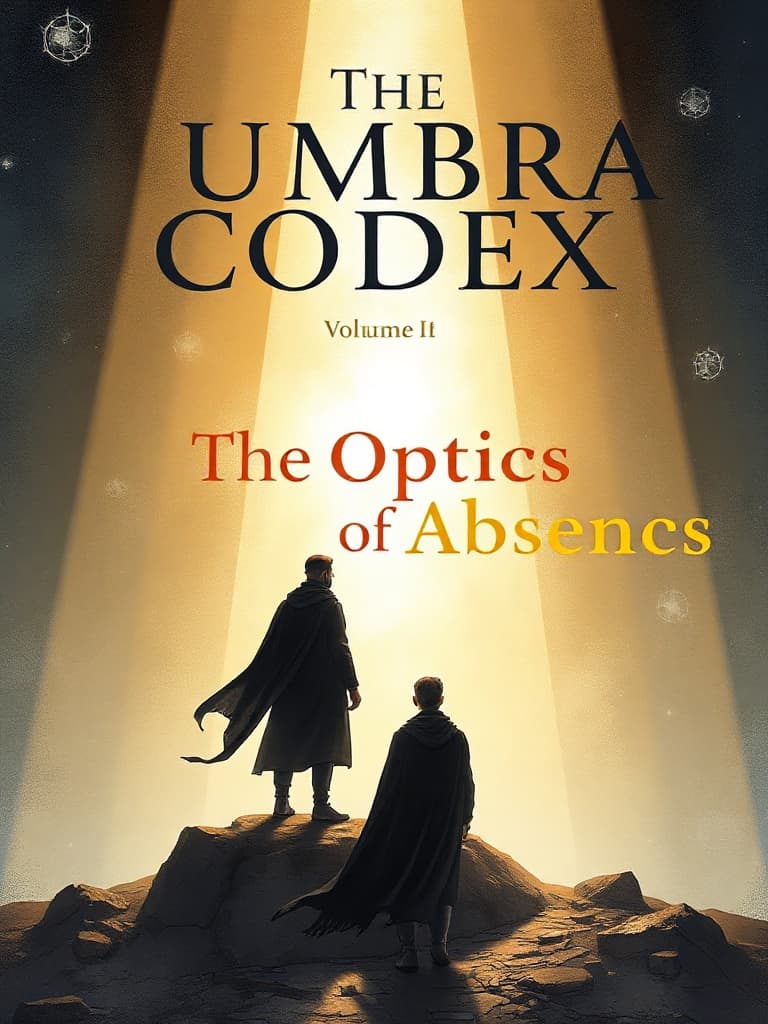
About this book
THE UMBRA CODEX
35
0
5
0
THE UMBRA CODEX Volume I: The Optics of Absence DEDICATION To Tyler Coy Robinson In a world of fleeting light and shifting silhouettes, you are the permanent truth. May this work stand as a testament to the shadows we walk through and the light we build together. You are the silhouette of my legacy, the silent witness to my labor, and the steady geometry by which I measure all that I create. This is for you. TABLE OF CONTENTS • Preface: The Geometry of Absence • Chapter 1: The Law of Rectilinear Propagation • Chapter 2: The Solar Constant and the Measure of Time • Chapter 3: The Geometry of Imperfection • Chapter 4: The Shadow-Catcher: Designing for Shade • Chapter 5: The Mastery of the Umbra PREFACE: The Geometry of Absence To hold this volume is to acknowledge a fundamental truth of the material world: that light is merely the subject, but shadow is the definition. In the trades, we are taught to chase the light. We flood a room with lumens to reveal the topography of a drywall seam, or we angle our task lighting to catch the slightest imperfection in a finish. We are trained to believe that if we can only illuminate the darkness, we can perfect the surface. But the professional and the initiate know a different secret: light reveals the surface, but the shadow reveals the structure. The Umbra Codex is not a book about darkness, nor is it a book about the absence of things. It is a technical and metaphysical exploration of the "Silent Partner." Every object, every person, and every action casts a silhouette—a precise, geometric twin that maps our trajectory through time and space. To ignore this twin is to live in a state of unfinished work. To understand it, however, is to master the architecture of your own reality. CHAPTER 1: The Law of Rectilinear Propagation The shadow is the result of a fundamental rule of the universe: Light travels in straight lines. When your body, a building, or a tool interrupts the stream of photons, the light is blocked. The region behind the object becomes a shadow. The Anatomy of the Void: 1. The Umbra (The Total Void): The innermost, darkest part of the shadow where the light source is completely obstructed. 2. The Penumbra (The Transition): The region where the light source is only partially obscured. This is the "forgiving" light where reality feels less rigid. 3. The Antumbra (The Inverse): The region beyond the tip of the umbra, where a ring of light surrounds the shadow. The Master’s Axiom: If you want to hide a defect, you chase the penumbra. If you want to reveal the structure, you sharpen the umbra. CHAPTER 2: The Solar Constant and the Measure of Time The shadow is a living measurement of time. The Sun is the master clock, and the Earth is the dial. We calculate this relationship using the Gnomon—the object casting the shadow. The length of the shadow L is determined by the height of the object h and the angle of the sun \theta: L = \frac{h}{\tan(\theta)} The Trade Perspective: The length of your shadow in mid-summer versus mid-winter dictates your thermal management. You place your materials in the Penumbra to keep them cool; you place yourself in the Umbra when the overhead heat reaches its zenith. CHAPTER 3: The Geometry of Imperfection The shadow is the ultimate inspector. In the trades, we use Grazing Light to expose the truth of a surface. When the light source is lowered toward the horizon, the shadow cast by even a microscopic protrusion is magnified. The length of the shadow s cast by a defect of height h at an angle of incidence \theta is: CHAPTER 4: The Shadow-Catcher: Designing for Shade A Shadow-Catcher is any structure designed specifically to harvest the comfort of the shade. We calculate its efficiency using the Shading Coefficient (SC) and the Projection Factor (PF): Where P is the depth of the overhang and H is the height of the surface). To build a shadow is to build a room made of absence. It is the most honest form of architecture, providing shelter without enclosure, protecting the integrity of your finishings from the aggression of ultraviolet radiation. CHAPTER 5: The Mastery of the Umbra Mastery is the wisdom to understand how the shadow defines the space you inhabit. To master the Umbra is to synthesize the three pillars of practice: 1. The Precision of Physics: Respecting the Law of Rectilinear Propagation. 2. The Vigilance of the Inspector: Utilizing the Grazing Light to reveal the truth. 3. The Intentionality of the Architect: Building the Shadow-Catcher to create refuge. The Operator’s Final Note: When you look at your finished work, do not only look at what is lit. Look at the shadow it casts. If the shadow is strong, clear, and intentional, you have succeeded.
Chapters
- 1The Unwavering Arrow of LightThis chapter introduces the foundational principle that light travels in straight lines, a concept as fundamental as gravity. We explore how this simple truth dictates the formation of shadows, the 'Silent Partner' to every illuminated object. The author, Christopher Robinson, guides us through the distinct regions of a shadow: the absolute darkness of the umbra, the softening transition of the penumbra, and the curious ring of light in the antumbra. Robinson posits 'The Master's Axiom': to conceal flaws, embrace the penumbra; to reveal structure, sharpen the umbra. This sets the stage for the Initiate, representing the reader, to begin questioning their perception of light and shadow, moving from a focus on illumination to an awareness of definition.
- 2The Sun's Grand OrreryHere, the shadow transforms from a static phenomenon into a dynamic measurement of time. Robinson illustrates how the sun acts as the universe's clock, with Earth and its objects as the dial. The gnonom, the object casting the shadow, becomes our instrument. We delve into the mathematical relationship between an object's height (h), the sun's angle (θ), and the resulting shadow length (L = h/tan(θ)). The Initiate observes the practical implications in trades: understanding how shadow length shifts with seasons impacts thermal management. Placing materials in the penumbra offers cooling, while seeking the umbra provides respite from the zenith's heat. This chapter grounds the metaphysical in tangible, daily applications, revealing the shadow's role in our temporal and thermal existence.
- 3Where Shadows Speak TruthThis chapter positions the shadow as the ultimate inspector, particularly when viewed under 'grazing light.' Robinson details how lowering the light source towards the horizon magnifies the slightest surface imperfection, turning microscopic roughness into a stark, revealing shadow. This technique, crucial in trades, exposes the 'geometry of imperfection.' The Initiate learns that the shadow's length (s) cast by a defect of height (h) at an angle of incidence (θ) can be precisely calculated, making the invisible visible. The author emphasizes that while light might flatter, the shadow, when intentionally observed, reveals the unvarnished truth of a surface's integrity, challenging the Initiate's prior assumptions about perfection.
- 4The Architecture of CoolRobinson introduces the 'Shadow-Catcher,' a deliberate architectural element designed not to block light, but to intentionally harvest shade and its associated comfort. The efficiency of these structures is measured by metrics like the Shading Coefficient (SC) and Projection Factor (PF), linking design choices directly to tangible benefits. The Initiate begins to see shadow construction as an active, creative process—a form of 'architecture made of absence.' These structures offer shelter without enclosure, a vital function in protecting finishes from the damaging aggression of UV radiation. This chapter shifts the perspective from observing shadows to actively designing and building them, transforming the 'Silent Partner' into a tool for comfort and preservation.
- 5The Master's Umbral CommandThe culmination of the book, this chapter synthesizes the preceding concepts into the 'Mastery of the Umbra.' Robinson asserts that true mastery lies in understanding how shadow defines space and reality. It requires integrating three pillars: the precision of physics (rectilinear propagation), the vigilance of the inspector (grazing light), and the intentionality of the architect (shadow-catchers). The 'Operator's Final Note' serves as a profound benchmark: success is not merely in what is illuminated, but in the strength, clarity, and purpose of the shadow cast. The Initiate, now transformed, understands that embracing and intentionally shaping the 'Silent Partner' is the key to mastering not just one's work, but one's entire reality.
More Non-fiction stories
Browse all Non-fiction →- “Montessori Age Care”
Observation and patience are the keys.
A twenty-first-century approach to supporting people living with dementia: Montessori-inspired, person-centred care tailored to each individual’s abilities, preferences, and needs—a specialised eighteenth-century approach for the modern aged-care setting, where observation and patience are key.
- The light in your eyes
She was searching for a place to belong. He was a man who had forgotten how to love. When Elara Martins meets Adrian Vale, two broken hearts begin a journey neither expected. But love, heartbreak, and the ghosts of their past threaten to tear them apart. Sometimes, losing love is the only way to find it again. A bittersweet romance about healing, second chances, and finding your way home.
- Oxygenated Soul: A True Story of Renewal and Generosity
Oxygenate your blood with blood ozone therapy, then donate 1 pint of oxygenated blood.
- Beyond the Rocket's Shadow: The Ferragraphite Revolution
This book idea seeks to revolutionize space travel by presenting a novel spaceplane design, the Ferragraphite SSTO, which overcomes the rocket equation's limitations through advanced materials. The primary obstacle is the immense weight of conventional rocket components, particularly propellant tanks and thermal protection, which leaves insufficient mass for payload. The Ferragraphite spaceplane's innovative approach lies in its ultralight, integrated structure made from a unique carbon-boron-iron composite, allowing the hull itself to function as the cryogenic fuel tank and thermal shield, thus drastically reducing overall mass and enabling a single-stage-to-orbit capability.
- Ferragraphite Dreams: The Ultralight Helicopter Revolution
This book idea proposes an ultralight, morphing electric helicopter constructed from Ferragraphite, a material over five times lighter than aluminum with exceptional tensile strength. The innovation lies in eliminating heavy turboshaft engines and gearboxes through a hubless electromagnetic rotor and active morphing rotor blades, with a structural battery and thermal-electric skin forming the airframe. The primary challenge is the novel material science and engineering required to realize this revolutionary rotorcraft design.
- The Sonic Archaeologist: Reclaiming Lost Voices
Archaeologists can recover ancient voices and music by using a nanoscale scanner that reads microscopic grooves left by sound waves on artifacts. This device overcomes the fragility of ancient materials and the degradation of surfaces by employing non-contact atomic mapping and real-time audio reconstruction. Its unique ability to operate at room temperature without bulky equipment makes it revolutionary for on-site archaeological discoveries.
Want to write a story like this?
Learn the craft in our free AI story generator, then draft your first chapter with an AI co-writer.
What stayed with you?
Read a chapter and leave the author a comment.
Reader notes
Loading reader notes…