About this book
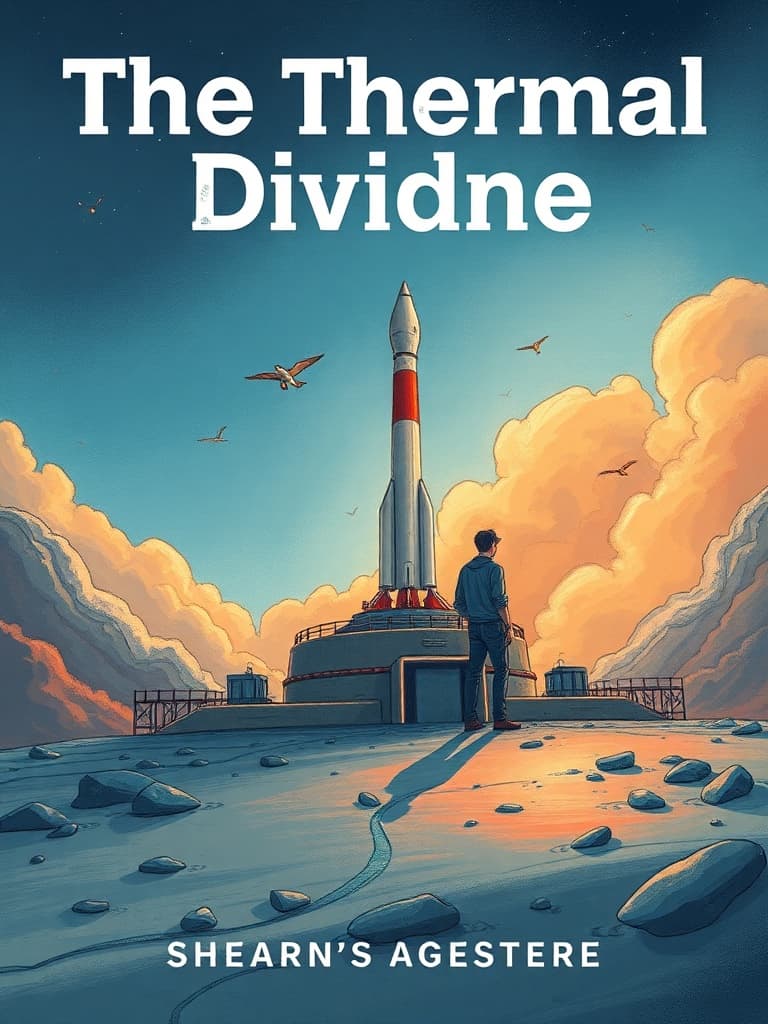
The Thermal Dividend: Can Space Launch Pay for Itself?
24
0
6
0
Use the heat from launching a rocket to melt a large block of aluminium. This thermal battery can run the hot side of a sterling engine, which will then be converted into electricity. Can the value of this electricity reduce the cost of launching the rocket?
Chapters
- 1Igniting the Dream: A Fiery VisionIntroduction to Dr. Evelyn Reed's audacious concept: harnessing rocket exhaust heat to generate electricity. The team forms, driven by the dream of making space launches economically self-sustaining through a 'thermal dividend'.
- 2Melting Point: The Science of Heat CaptureExplaining the core technology: capturing intense rocket heat to melt a large aluminum block. This 'thermal battery' will store energy, setting the stage for the Stirling engine's role in electricity generation.
- 3Cooling Reception: Early Skepticism and SetbacksThe team faces initial disbelief and engineering hurdles. Inefficient heat transfer, unreliable prototypes, and funding challenges test their resolve. Ben Carter voices practical concerns, while Maya Sharma analyzes financial viability.
- 4The Spark: A Successful Fusion of Heat and PowerA critical experiment yields success. The thermal battery effectively stores heat, and the Stirling engine runs steadily, producing measurable electricity. This breakthrough validates Dr. Reed's vision and boosts team morale.
- 5Full Scale: From Lab to LaunchpadThe project scales up, aiming for integration with actual rocket launches. New logistical and engineering challenges arise, demanding robust solutions and careful planning for real-world application and testing.
- 6The Dividend Declared: Economic Viability AssessedThe final verdict. Real-world test results are analyzed. Maya Sharma calculates the market value of generated electricity against launch costs. The book concludes by assessing the 'thermal dividend' as a sustainable economic model for space exploration.
More Non-fiction stories
Browse all Non-fiction →- “Montessori Age Care”
Observation and patience are the keys.
A twenty-first-century approach to supporting people living with dementia: Montessori-inspired, person-centred care tailored to each individual’s abilities, preferences, and needs—a specialised eighteenth-century approach for the modern aged-care setting, where observation and patience are key.
- The light in your eyes
She was searching for a place to belong. He was a man who had forgotten how to love. When Elara Martins meets Adrian Vale, two broken hearts begin a journey neither expected. But love, heartbreak, and the ghosts of their past threaten to tear them apart. Sometimes, losing love is the only way to find it again. A bittersweet romance about healing, second chances, and finding your way home.
- Oxygenated Soul: A True Story of Renewal and Generosity
Oxygenate your blood with blood ozone therapy, then donate 1 pint of oxygenated blood.
- Beyond the Rocket's Shadow: The Ferragraphite Revolution
This book idea seeks to revolutionize space travel by presenting a novel spaceplane design, the Ferragraphite SSTO, which overcomes the rocket equation's limitations through advanced materials. The primary obstacle is the immense weight of conventional rocket components, particularly propellant tanks and thermal protection, which leaves insufficient mass for payload. The Ferragraphite spaceplane's innovative approach lies in its ultralight, integrated structure made from a unique carbon-boron-iron composite, allowing the hull itself to function as the cryogenic fuel tank and thermal shield, thus drastically reducing overall mass and enabling a single-stage-to-orbit capability.
- Ferragraphite Dreams: The Ultralight Helicopter Revolution
This book idea proposes an ultralight, morphing electric helicopter constructed from Ferragraphite, a material over five times lighter than aluminum with exceptional tensile strength. The innovation lies in eliminating heavy turboshaft engines and gearboxes through a hubless electromagnetic rotor and active morphing rotor blades, with a structural battery and thermal-electric skin forming the airframe. The primary challenge is the novel material science and engineering required to realize this revolutionary rotorcraft design.
- The Sonic Archaeologist: Reclaiming Lost Voices
Archaeologists can recover ancient voices and music by using a nanoscale scanner that reads microscopic grooves left by sound waves on artifacts. This device overcomes the fragility of ancient materials and the degradation of surfaces by employing non-contact atomic mapping and real-time audio reconstruction. Its unique ability to operate at room temperature without bulky equipment makes it revolutionary for on-site archaeological discoveries.
Want to write a story like this?
Learn the craft in our free AI story generator, then draft your first chapter with an AI co-writer.
What stayed with you?
Read a chapter and leave the author a comment.
Reader notes
Loading reader notes…