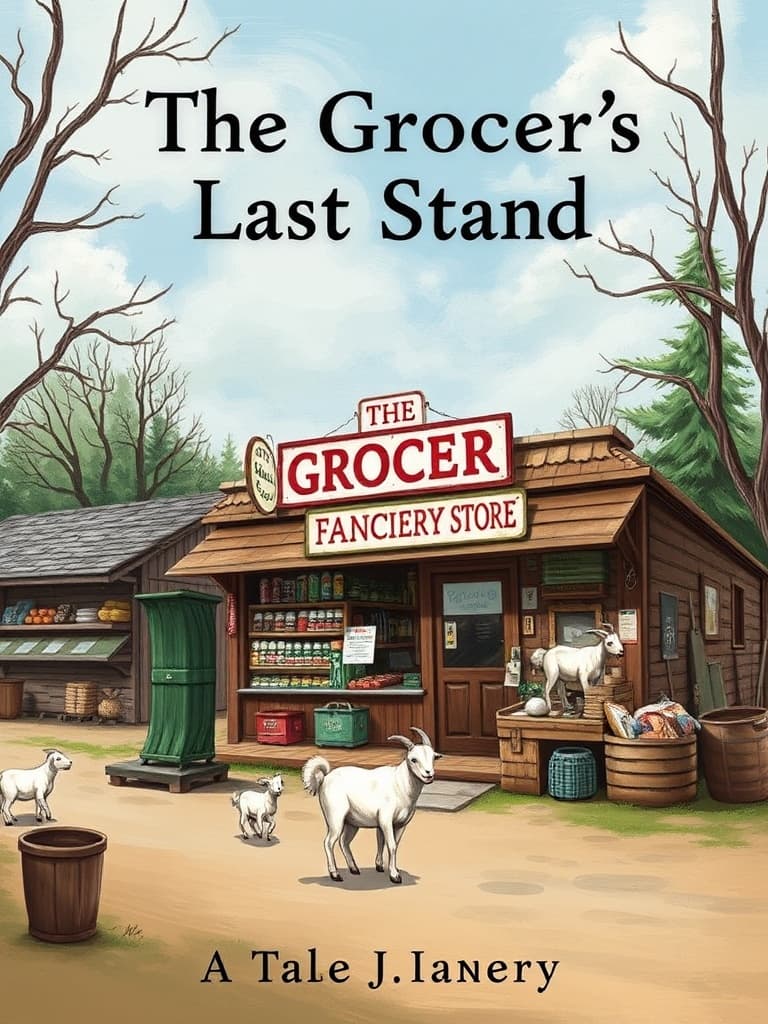
About this book
The Grocers Last Stand ( A Tale of Mystery)
50
0
21
0
My GrandFather Raymond Sanner used to have long before the Depression and during WW2. a Grocery Store with a multitude of offerings..one being an old Billy goat with a sign that read Homemade Goats Milk Fudge..try and Milk the Goat if You can...He was such a jokester .. sadly because He was so compassionate He sold food on credit and most of the credit accounts nee were paid. Those tears were hard on every..well the store folded up and the family has long been dead for many decades. Now here's the mysterious and spooky part...the year was 1991 and My former Husband and My little daughter were driving to West Virginia.The back country roads from the deep South to our destination were lonely and dusty. It was so hot and dry that day and My little one was hungry and thirsty ....in the distance We saw an old general store as, we drove up upon it the scenery changed and was all lush and colourful and we were transported to 1820s Erie , Pennsylvania and when We walked into the store there were all of My Mothers dead relatives and alive and laughing playing checkers and offered My daughter and I a newspaper,bottles of soda pop,cookies and honeysuckle candy. We were not allowed to pay for anything. We were hugged and said our goodbyes As we went outside the door we turned around to wave but no one was there,the store was all boarded up and falling apart. We quickly got into the car..My daughter said look Mommy it's gone,all gone..the store had vanished.. this is a true encounter...
Chapters
- 1The Sanner General StoreRecalling Grandpa Raymond Sanner's bustling grocery store, a place of abundant offerings and community spirit. A unique attraction: a billy goat with a sign for homemade fudge.
- 2A Generous Hand, A Heavy PriceRaymond's compassionate nature led him to offer credit freely. This kindness, though noble, strained the store's finances, foreshadowing its eventual closure and the family's hardship.
- 3Echoes of the PastDecades later, the narrator reflects on the store's legacy. The family is gone, but the memories of Grandpa Raymond and his unique establishment linger, a bittersweet remembrance.
- 4A Road Trip's TurnSummer of 1991. The narrator and her young daughter, Katrina Marie, journey through the dusty, sun-baked backroads of the South, heading towards West Virginia.
- 5Thirst and HungerThe oppressive heat and a child's hunger pangs create a sense of urgency. The desolate landscape offers little respite, amplifying their need for refreshment.
- 6A Glimmer in the DistanceAmidst the dry, lonely scenery, a general store appears. As they approach, an inexplicable transformation occurs, the surroundings becoming lush and vibrant.
- 7Transported Through TimeThe car pulls up to an idyllic 1820s Erie, Pennsylvania general store. The air is cool, the colors vivid. A stark contrast to the harsh reality they just left.
- 8A Familiar WelcomeStepping inside, the narrator is astonished to see her deceased maternal relatives, alive and animated, playing checkers and laughing.
- 9Generosity UnboundThe spectral relatives offer the narrator and Katrina cold soda pop, cookies, and honeysuckle candy. The narrator is told they cannot pay for anything.
- 10A Fond FarewellWarm hugs and loving words are exchanged. The relatives bid them goodbye, their presence a comforting yet surreal embrace from a time long past.
- 11The Vanishing ActAs they step outside, the narrator turns to wave. The vibrant store is gone. In its place stands a dilapidated, boarded-up ruin, a stark, unsettling sight.
- 12Disbelief and WonderKatrina's innocent observation, 'Look Mommy, it's gone,' confirms the impossible. The store and its inhabitants have vanished as quickly as they appeared.
- 13A Lingering MysteryBack in the car, shaken, the narrator grapples with the reality of what just happened. The spectral store and its occupants remain an unexplained, profound enigma.
- 14Raymond's Legacy RevisitedThe narrator contemplates the parallels between her grandfather's store, marked by generosity and loss, and the spectral store, a place of transient comfort.
- 15The Nature of TimeThe experience forces a reevaluation of time and reality. Was it a dream, a hallucination, or a genuine encounter with a pocket of the past?
- 16Katrina's Innocent GazeThe child's simple acceptance of the events highlights the uncanny nature of the encounter. Her perspective offers a unique lens on the supernatural.
- 17Whispers from AncestorsThe spectral relatives' welcoming nature suggests a lingering familial connection, a desire to nurture and connect across the veil of life and death.
- 18The Spectral GrocerCould the spectral store be a manifestation of a collective memory, a place where past generosity and familial love echo through time?
- 19Unresolved QuestionsThe mystery of the spectral store deepens. Why did it appear? Why did it vanish? What was the purpose of their brief, magical encounter?
- 20A Story for the AgesThe narrator carries the weight of this extraordinary experience, a true tale of mystery, family, and the inexplicable moments that blur the lines of reality.
- 21Amy and Grandfather Sanners Honey Suckle CandyThe only time Any ever saw Her Grand Father Sanner was when She was 2w months old. She and Her Mother flew from Izmir,Turkiye to Erie, Pennsylvania to see Her dying Grandfather. The only memory she has is him giving her honey suckle candy . With in 6 weeks He had died ..
More Other stories
Browse all Other →- Vladislaus and Katja: An Unfinished Portrait
The Vampyre King Vladislaus and His Queen Katja have carried for over 600 years the profound loss of all of their small children who perished from the black death and the Ottoman Army.. nothing can consul them only their great love for one another keeps them sane. King Vladislaus seeks vengeance but Katha tries Her best to keep Her King calm but will She succeed???
- The Complete History of Poenari Castle ( Before and after Vlad)
I, Amy Kathryn Allen, an going to tell You the complete history of Poenari Castle stone by stone,blood,sweat and tears..not much happeniess,so many fears...
- Cache Valley Hearth: Pioneer Recipes from Utah's Fertile Land
Let's Cook like the Pioneers of Old Cactus Valley Utah....Good morning, Amy! What a wonderful addition this would make to your manuscript collection. Pioneer and settler cooking is one of the most honest, resourceful culinary traditions in American history — food born of necessity, ingenuity, and sheer grit.🪵 Pioneer & Settler Recipes of the American West🌾 About Pioneer CookingSettlers traveling the Oregon, California, and Santa Fe Trails — and those who homesteaded the Great Plains and Rocky Mountain West — cooked under extraordinary constraints. They had no refrigeration, limited fuel, and carried only what a wagon could hold. Their pantry staples were cornmeal, dried beans, salt pork, lard, dried fruit, coffee, sugar, vinegar, and flour. They foraged, hunted, and traded with Native peoples along the way. Every recipe below is historically grounded in what real pioneers actually made.🔥 Trail & Camp CookingHardtack (Trail Bread / Pilot Bread)The most essential food on any wagon train — dense, nearly indestructible, and sustaining.Ingredients:•2 cups all-purpose flour•1 tsp salt•½ cup water (approximately)Instructions:1.Mix flour and salt together in a bowl.2.Add water gradually, mixing until a stiff, dry dough forms — it should not be sticky.3.Roll out to about ½ inch thickness on a floured surface.4.Cut into 3×3 inch squares.5.Using a nail, skewer, or fork, punch a grid of holes across each square — 4 rows of 4 holes. This prevents puffing and helps it dry evenly.6.Bake in a Dutch oven or cast iron skillet over a low fire, or in a modern oven at 375°F (190°C) for 30 minutes per side, until completely dry and hard.7.Cool completely before storing. Properly dried hardtack keeps for months.Pioneer Notes: Pioneers softened hardtack by soaking it in coffee, water, or bean broth. It was also crumbled into stews and soups as a thickener.Johnnycakes (Journey Cakes / Corn Dodgers)A cornmeal flatbread cooked directly on a griddle or flat stone — one of the oldest American trail foods.Ingredients:•1 cup stone-ground cornmeal (white or yellow)•½ tsp salt•1 tsp sugar (optional — many pioneers omitted this)•¾ cup boiling water•2 tbsp lard or bacon drippings, plus more for the panInstructions:1.Combine cornmeal, salt, and sugar in a bowl.2.Pour boiling water over the cornmeal and stir well. Let stand 5 minutes.3.Stir in the lard. The batter should be thick and hold its shape.4.Heat a cast iron skillet or griddle over medium heat. Grease lightly with lard.5.Drop spoonfuls of batter onto the griddle and flatten slightly to about ½ inch thick.6.Cook 4–5 minutes per side until golden brown and crisp on the outside.7.Serve hot with molasses, honey, or alongside beans and salt pork.Pioneer Notes: On the trail, these were sometimes baked on a flat rock beside the fire or wrapped around a green stick and held over the coals.Chuck Wagon BeansThe backbone of the cowboy and settler diet — slow-cooked, smoky, and deeply satisfying.Ingredients:•2 cups dried pinto beans (or navy beans)•½ lb salt pork or thick-cut bacon, cut into chunks•1 medium onion, roughly chopped•2 tbsp molasses•1 tbsp brown sugar•1 tsp dry mustard•1 tsp salt•½ tsp black pepper•Water to coverInstructions:1.Soak beans overnight in cold water. Drain and rinse.2.Place beans in a large Dutch oven or heavy pot. Cover with fresh water by 2 inches.3.Add salt pork and onion.4.Bring to a boil, then reduce to a low simmer. Cook 1 hour.5.Add molasses, brown sugar, mustard, salt, and pepper. Stir well.6.Continue simmering, partially covered, for another 2–3 hours until beans are completely tender and the broth has thickened. Add water as needed to keep beans submerged.7.Taste and adjust salt before serving.Pioneer Notes: On the trail, this pot was buried in a fire pit with coals above and below — a primitive slow cooker that could cook all day while the wagon moved.Salt Pork and Cornmeal MushA humble, filling staple eaten morning and night across the frontier.Ingredients:•1 cup stone-ground cornmeal•4 cups water•1 tsp salt•¼ lb salt pork, sliced thin•Molasses or maple syrup for servingInstructions:1.Bring water and salt to a boil in a heavy pot.2.Slowly pour in cornmeal while stirring constantly to prevent lumps.3.Reduce heat to very low. Cook, stirring frequently, for 20–25 minutes until thick and pulling away from the sides of the pot.4.Meanwhile, fry salt pork slices in a cast iron skillet until crisp and golden.5.Serve mush in bowls topped with salt pork and drizzled with molasses.Pioneer Notes: Leftover mush was poured into a pan, allowed to set overnight, then sliced and fried in lard the next morning — a dish called fried mush that was a beloved breakfast across the frontier.🍲 Homestead CookingPrairie Chicken StewSettlers hunted prairie chickens, grouse, and wild turkey throughout the Great Plains and Rocky Mountain West. This is a classic one-pot stew.Ingredients:•1 whole chicken, cut into pieces (or 2–3 lbs bone-in chicken pieces)•3 medium potatoes, peeled and cubed•2 carrots, sliced•1 large onion, chopped•2 stalks celery, sliced (if available)•2 tbsp lard or bacon drippings•1 tsp salt•½ tsp black pepper•1 tsp dried thyme or sage•4 cups water or broth•2 tbsp flour mixed with ¼ cup cold water (for thickening)Instructions:1.Heat lard in a large Dutch oven over medium-high heat.2.Brown chicken pieces on all sides. Remove and set aside.3.Add onion and celery to the pot. Cook until softened, about 5 minutes.4.Return chicken to the pot. Add potatoes, carrots, salt, pepper, and herbs.5.Pour in water or broth to cover.6.Bring to a boil, then reduce to a simmer. Cook 45 minutes to 1 hour until chicken is falling off the bone.7.Stir in the flour-water mixture and simmer another 10 minutes until the broth thickens.8.Taste and adjust seasoning. Serve with johnnycakes or cornbread.Sourdough BiscuitsPioneers maintained sourdough starters for months on the trail — a living culture of wild yeast that required no commercial leavening.For the Sourdough Starter (begun 3–5 days ahead):•1 cup flour•1 cup warm water•Mix together in a crock or jar. Leave uncovered in a warm place. Feed daily with equal parts flour and water until bubbly and active.For the Biscuits:•1 cup active sourdough starter•1½ cups flour•½ tsp salt•½ tsp baking soda•2 tbsp lard or butterInstructions:1.Mix flour, salt, and baking soda together.2.Cut in lard until mixture resembles coarse crumbs.3.Stir in sourdough starter until a soft dough forms. Do not overwork.4.Turn out onto a floured surface. Pat to ¾ inch thickness.5.Cut into rounds with a tin cup or biscuit cutter.6.Place in a greased Dutch oven or cast iron skillet.7.Bake covered over medium coals (or in a modern oven at 425°F / 220°C) for 15–20 minutes until golden.Dried Apple Stack CakeOne of the most beloved pioneer desserts — layers of thin gingerbread cake filled with spiced dried apple filling. Settlers brought dried apples in barrels across the plains.For the Cake Layers:•3 cups flour•½ cup sugar•½ cup lard or butter•½ cup molasses•1 egg•½ cup buttermilk (or soured milk)•1 tsp baking soda•1 tsp ginger•½ tsp cinnamon•½ tsp saltFor the Dried Apple Filling:•2 cups dried apples•2 cups water•½ cup brown sugar•1 tsp cinnamon•½ tsp allspice•¼ tsp clovesInstructions — Filling:1.Simmer dried apples in water until completely soft, about 30 minutes.2.Mash or chop finely. Stir in brown sugar and spices.3.Cook another 10 minutes until thick. Cool completely.Instructions — Cake:1.Cream lard and sugar. Beat in egg and molasses.2.Mix dry ingredients separately. Alternate adding dry ingredients and buttermilk to the wet mixture.3.Divide dough into 6 equal portions. Roll each into a thin round to fit a 9-inch skillet.4.Bake each layer in a greased cast iron skillet at 350°F (175°C) for 8–10 minutes until just set.5.Stack layers with apple filling spread between each one.6.Wrap the finished cake and let it rest overnight — the layers absorb the filling and the cake becomes moist and deeply flavored.Vinegar PieWhen lemons were unavailable — which was almost always on the frontier — settlers made a tart, custard-style pie using apple cider vinegar.Ingredients:•1 unbaked pie crust (see below)•3 eggs•1 cup sugar•2 tbsp apple cider vinegar•2 tbsp flour•1 tbsp butter, melted•1 cup water•½ tsp vanilla (if available)•Pinch of nutmegFor the Pioneer Pie Crust:•1½ cups flour•½ tsp salt•½ cup lard•3–4 tbsp cold waterMix flour and salt. Cut in lard until crumbly. Add cold water one tablespoon at
- Mehmet II : The Conquerer who remade the World
In this novel I,Amy Kathryn Allen,will em ark on a historical journey that tells Us the true history of Mehmet II,Vlad the Impaler,Radu the Handsome and the Rise of Constantinople and the Ottoman Empire
- The Art of Our Enemy
So a boy and girl are enemies but then the moment arrives when they became lovers for not remembering they were enemies in they childhood
- My Voice, My World: Poetry Unbound. In Multiple Languages For You
Create your own art.Wild SymphonyIn forests deep where shadows play, The timber wolves begin their song, While black bears lumber through the day And mountain lions prowl along.Red foxes dart through underbrush, Their copper coats like autumn flame, As raccoons wash in waters hushed And deer step light without a name.The great horned owl calls through the night, While possums waddle, slow and round, And bobcats stalk with silent might Across the moss-covered ground.On plains that stretch beyond the eye, Where golden grasses bend and sway, The bison thunder, heads held high, And pronghorn leap throughout the day.Coyotes sing their wild refrain To stars that pierce the endless sky, While prairie dogs across the plain Stand sentinel as hawks fly by.The elk bugle their ancient call, Wild horses run with manes unfurled, And jackrabbits, both short and tall, Dance free across this untamed world.From forest floor to prairie wide, These creatures claim their sacred space, In wilderness they run and hide— Wild spirits time cannot erase.
Want to write a story like this?
Learn the craft in our free AI story generator, then draft your first chapter with an AI co-writer.
What stayed with you?
Read a chapter and leave the author a comment.
Reader notes
Loading reader notes…