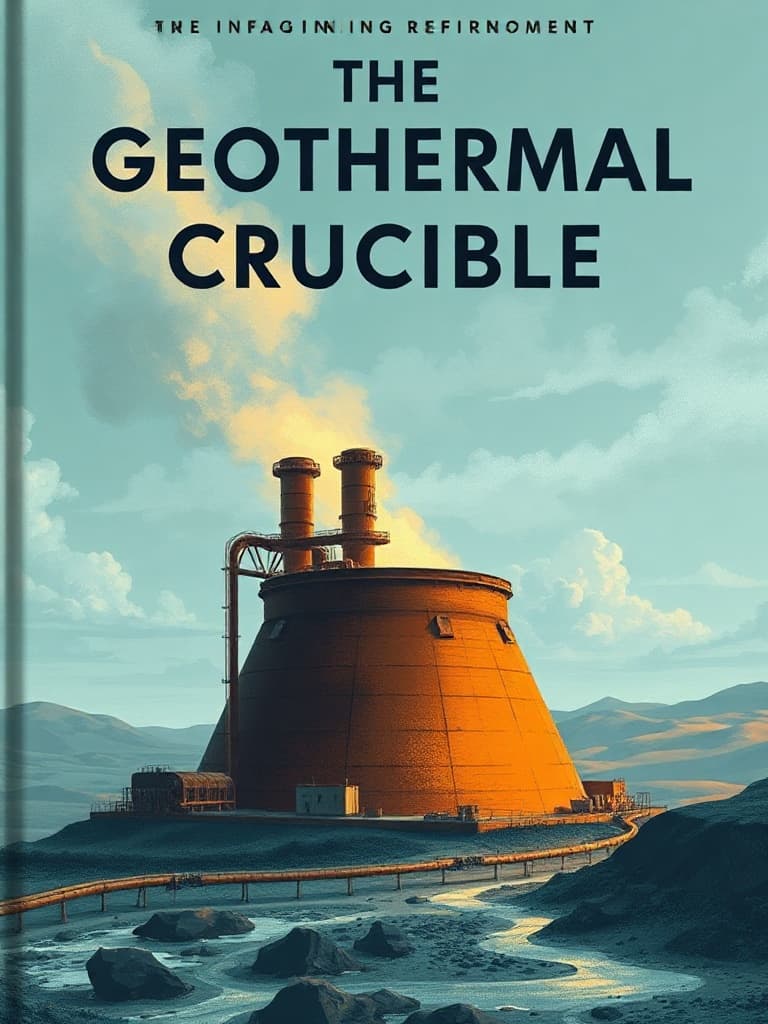
About this book
The Geothermal Crucible: Reimagining Refinement
25
0
6
0
A startup company that captures the emissions from a coal powered power station and uses renewable energy to add this captured carbon to crude oil and then refine the oil. The company combines underground heat and a sterling engine to produce the electricity!
Chapters
- 1The Spark of an IdeaDr. Aris Thorne, haunted by environmental concerns, conceives a radical plan: capture coal plant emissions and refine crude oil using geothermal energy. His vision clashes with conventional wisdom.
- 2Forging the CrucibleAris assembles his team: Lena Petrova, the pragmatic engineer, and Ben Carter, the optimistic dealmaker. They begin building their prototype, facing early technical glitches and funding anxieties.
- 3The Sterling's StruggleThe heart of their operation, the Sterling engine, proves temperamental. It struggles to generate enough power, threatening the entire project and Aris's reputation. Lena works tirelessly to fix it.
- 4Igniting the Geothermal HeartA crucial breakthrough in the Sterling engine's design unlocks its true potential. The geothermal heat is harnessed efficiently, providing the power needed for the carbon capture and refinement process.
- 5The First Refined DropThe pilot run is a success! The cleaner, more efficient oil produced by The Geothermal Crucible garners attention and secures vital investment, validating Aris's audacious vision.
- 6A Greener HorizonThe company scales up, navigating industrial adoption and ongoing debates. The Geothermal Crucible emerges as a symbol of innovation, proving that traditional industries can embrace sustainability.
More Non-fiction stories
Browse all Non-fiction →- The Sonic Archaeologist: Reclaiming Lost Voices
Archaeologists can recover ancient voices and music by using a nanoscale scanner that reads microscopic grooves left by sound waves on artifacts. This device overcomes the fragility of ancient materials and the degradation of surfaces by employing non-contact atomic mapping and real-time audio reconstruction. Its unique ability to operate at room temperature without bulky equipment makes it revolutionary for on-site archaeological discoveries.
- Drip of the Future: Magnetic Nutrients for a Greener Harvest
This essay proposes a revolutionary Agricultural Micro-Drip Network, utilizing a novel Ferragraphite metamaterial architecture, to address the inefficiencies and environmental damage caused by current irrigation and fertilization methods. The network aims to deliver precisely timed, magnetically charged nutrient ions directly to crop root zones, drastically reducing water and fertilizer waste and increasing global food yields. This paradigm shift is hindered by the limitations of existing drip irrigation systems, which suffer from clogging, uneven distribution, and fertilizer runoff, but the proposed metamaterial solution offers unprecedented control and efficiency.
- Beyond Combustion: The Future of Electric Flight Suits
This book idea explores the transformation of a kerosene-powered jet suit into an all-electric wearable flight exoskeleton using advanced Ferragraphite technology. The primary obstacle is achieving comparable thrust and flight endurance to the original, while the innovation lies in replacing combustion engines with quiet, efficient electric ducted fans and a structural battery system.
- Starship's Unyielding Embrace: The Ferragraphite Revolution
This concept proposes a novel thermal protection system for SpaceX's Starship using a Ferragraphite metamaterial, aiming to replace fragile, ablative tiles with a durable, self-sustaining shield. The current reliance on sacrificial tiles presents challenges in terms of fragility and maintenance, while the Ferragraphite system offers a continuous, active shield that converts reentry heat into electrical power. This innovative architecture, called the Starship Hyper-Shield, promises zero maintenance and significant weight savings for future spaceflights.
- Beyond the Vacuum: The Dawn of Integrated Maglev
This concept proposes a supersonic maglev train system that overcomes traditional speed limitations by utilizing a novel Ferragraphite metamaterial. The material's unique properties allow for a seamless, continuous structure that eliminates aerodynamic drag, friction, and noise. This creates an integrated transit system where both the train and the vacuum tube infrastructure function as a single, active computational and electromagnetic entity.
- F1's Next Frontier: The Aerodynamic Power of the Open Box
This essay explores a novel F1 aerodynamic concept: an open-front, open-back rectangular box with inwardly and outwardly curved sides designed to generate low drag downforce. The author aims to demonstrate how this "open box" can be integrated into an F1 car's package, potentially enhancing the performance of traditional wings. The challenge lies in overcoming the established norms of F1 aero design and proving the practical efficacy of this unconventional approach.
Want to write a story like this?
Learn the craft in our free AI story generator, then draft your first chapter with an AI co-writer.
What stayed with you?
Read a chapter and leave the author a comment.
Reader notes
Loading reader notes…