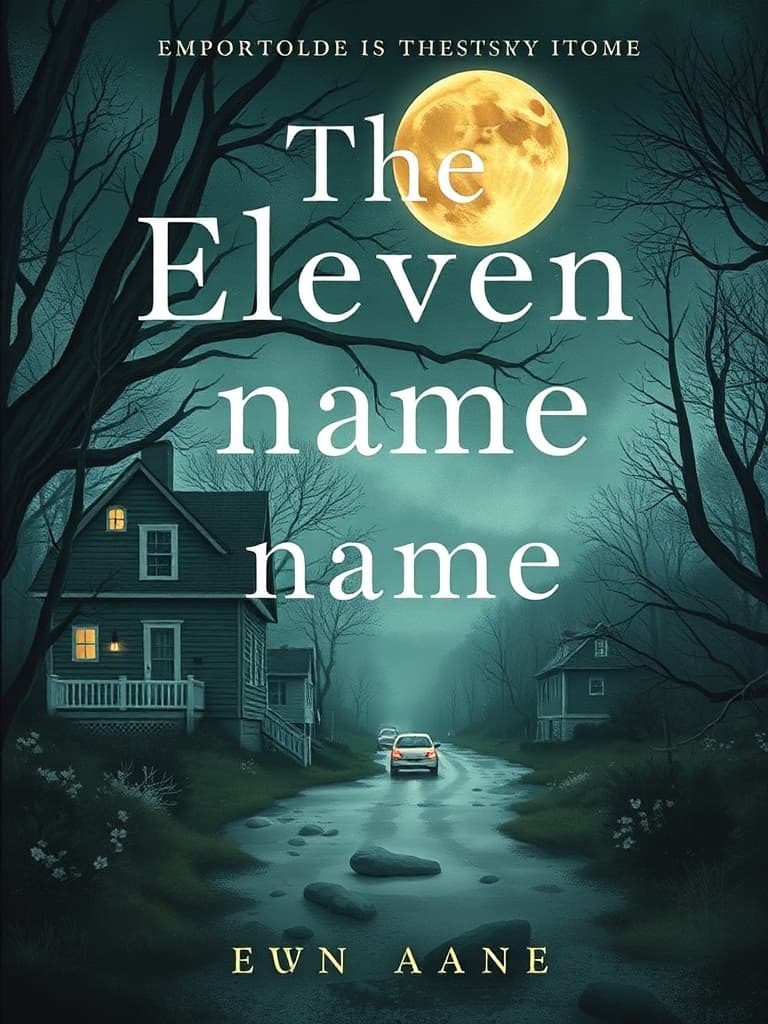
About this book
The Eleventh name
18
0
20
0
For over fifty years, the quiet town of Blackridge has lived by one terrifying certainty: every October, a mysterious list appears with ten names, and before the year is over, every person on it vanishes without a trace. No bodies are ever found. No one knows who writes the list. This year, the impossible happens. There are eleven names. When the eleventh name belongs to a young woman who left Blackridge years ago, she's forced to return home and uncover the truth behind the town's darkest secret. As more people begin to disappear, she realizes the list is only the beginning. Every clue reveals another lie, every ally has something to hide, and the people she trusts most may know far more than they're willing to admit. In Blackridge, some secrets are worth killing for—but the truth may be even more terrifying.
Chapters
- 1The Uninvited GuestSarah Jenkins, a woman who has meticulously built a life far removed from her unsettling Blackridge origins, is jolted from her carefully constructed peace by an event that defies the town's morbid folklore. The annual list, a chilling harbinger of disappearances that has haunted Blackridge for over fifty years, has always contained ten names. This year, it contains eleven. Sarah's name, scrawled with an unnerving familiarity, is the impossible addition. The shock is visceral, a cold dread that seeps into her bones, shattering her denial and forcing a confrontation with the past she so desperately fled. She remembers the hushed whispers, the averted gazes, the pervasive fear that clung to Blackridge like a shroud. The list was a certainty, a grim ritual that Blackridge endured, and she had always believed herself safely outside its reach. Now, she is not only a part of it but the anomaly, the eleventh name that breaks a fifty-year tradition. This deviation is more terrifying than the tradition itself. It suggests a change, an escalation, or perhaps, a deliberate targeting. The impulse to flee again is strong, but the instinct for survival, for understanding *why*, is stronger. She has to go back. The thought of Blackridge makes her stomach clench. It's a place of shadowed memories, of a childhood abruptly cut short by unspoken anxieties, and a repressed trauma she has spent decades trying to outrun. Her childhood home, now empty and decaying, represents a festering wound. Her father, the former mayor, was a man consumed by Blackridge's secrets, his silence a constant, oppressive presence. His death, years ago, had been a quiet release for Sarah, but now his legacy, entwined with the town's darkness, pulls her back. She packs a single bag, her movements stiff with a growing unease. She knows the residents of Blackridge. They are a community bound by shared fear and complicity, their silence a weapon. They will offer no comfort, only suspicion and more questions. The journey itself is a descent into a familiar, suffocating atmosphere. The landscape grows more desolate, the trees thicker, the sky a perpetual overcast. Each mile marker passed is a step closer to the abyss. She recalls fragmented whispers from her youth about 'the pact,' 'the appeasement,' and 'the chosen few.' These were dismissed as childish fears, but now they echo with a chilling resonance. The core of the story begins here: Sarah’s forced return, the shattering of her perceived safety, and the dawning realization that the list is not merely a mysterious phenomenon but something deeply personal and terrifyingly active. Her internal conflict is paramount: the desire to escape versus the necessity to confront. The external conflict is the immediate threat of the list itself. The narrative tone is set: one of pervasive dread, a sense of inescapable fate, and the unsettling feeling that the past is not dead but merely waiting. The emotional arc for Sarah begins with shock and denial, moving quickly to fear and then a grim determination. The ending hook for this chapter must be Sarah’s arrival at the Blackridge town limits, the oppressive silence of the town a palpable entity, and the dawning realization that her return is not just a choice but a necessity dictated by a force far greater than she understands. The narrative should emphasize the psychological impact of seeing her name on the list, the feeling of being marked, and the profound sense of loss of control. Her decision to return is driven by a primal need for answers, a desperate attempt to reclaim agency in a situation where she has none. The chapter must establish Sarah's background, her estrangement from Blackridge, and the psychological scars left by her upbringing, making her return a deeply fraught and emotionally charged event. The narrative will weave in sensory details of the drive – the smell of damp earth, the rustling of unseen creatures in the woods, the way the light seems to dim as she approaches the town – to build atmosphere. The internal monologue will be crucial, highlighting her fear, her anger, and her desperate hope that this is all a terrible mistake. The narrative will also subtly introduce the idea that Sarah's past in Blackridge is more significant than she remembers, hinting at repressed memories and subconscious connections to the town's dark secrets. The chapter needs to end with her physically entering Blackridge, the weight of its history pressing down on her, and the chilling certainty that her life has irrevocably changed. The narrative will also make it clear she has no outside support, emphasizing her isolation. She has no one to call, no one to confide in who would understand or believe her. The townspeople are her only potential source of information, and they are her biggest obstacle. The psychological thriller aspect is established through Sarah's internal turmoil and the omnipresent sense of dread that permeates her thoughts and the setting. The mystery element is introduced by the impossible eleventh name, immediately raising questions about the nature and purpose of the list. The narrative will focus on Sarah's perspective, her immediate reactions and thoughts, making the reader feel her fear and uncertainty as if it were their own. The chapter should end with Sarah pulling up to her old house, the key feeling heavy in her hand, a symbol of her forced return to a place she thought she'd buried forever.
- 2Homecoming of ShadowsSarah's physical return to Blackridge is a descent into a suffocating, suffocating reality. The familiar landscape, once a backdrop to childhood anxieties, now feels like a cage. The air itself seems heavier, laced with an unspoken dread that permeates every shadow and every silent gaze. Her childhood home, a place she’d hoped to only revisit in memory, stands as a monument to her past, its decaying facade mirroring the rot she suspects lies beneath the town's surface. The silence here isn't peaceful; it's a heavy, watchful quiet, broken only by the rustling of unseen things in the overgrown gardens and the distant, mournful cry of a crow. Her father's absence is a palpable void, a constant reminder of the secrets he carried and the silence he enforced. The house is a museum of ghosts – her mother's faded photographs on the mantelpiece, the worn armchair where her father used to sit, lost in thought, the faint scent of pipe tobacco clinging to the curtains. Each object is a trigger, stirring fragmented memories, a tapestry of repressed fear and unspoken trauma. Sarah tries to move through the house with purpose, but her feet feel leaden, her every step echoing the weight of her history. She finds herself drawn to the study, her father’s sanctuary, hoping for some tangible clue, some shred of explanation left behind. Instead, she finds only more questions, more layers of dust obscuring the truth. The feeling of being watched is overwhelming, a constant prickle on her skin. She glimpses movement from the corner of her eye, fleeting shadows that vanish when she turns to look. The townspeople, when she encounters them, are like specters themselves – their faces etched with a weariness that seems to go beyond age, their eyes holding a vacant, fearful stare. They offer curt nods, mumbled greetings, but no genuine interaction. Their silence is a wall, thicker and more imposing than any physical barrier. Sarah attempts to engage a few, her voice trembling slightly, asking simple questions about the town, about recent events, about anything that might offer a sliver of normalcy. But their responses are clipped, evasive, their gazes sliding away, unable to meet hers. They seem to move with a practiced, almost robotic caution, as if every word, every gesture, is carefully weighed against an unseen threat. There's an underlying current of fear that binds them, a shared secret that renders them mute. Sarah’s initial hope of finding solace or support in her return is quickly extinguished, replaced by a chilling isolation. She is an outsider, even in her own hometown, a pariah marked by the impossible eleventh name. The narrative should emphasize Sarah’s isolation and the oppressive atmosphere of Blackridge. The description of the town and her childhood home should be rich with sensory details – the smell of decay, the oppressive silence, the feeling of being watched – to create a tangible sense of unease. Sarah’s internal monologue should reflect her growing fear, her frustration with the townspeople’s reticence, and her deep-seated anxieties about her own past. The chapter should reveal more about Sarah’s complicated relationship with her father and the impact of his secretive nature on her childhood. The foreshadowing of her repressed memories should be more pronounced, perhaps through a sensory trigger in the house that brings a flash of an unsettling image or feeling. The chapter needs to end with Sarah feeling utterly alone, trapped within the suffocating embrace of Blackridge, and the chilling realization that her quest for answers will likely be a solitary and dangerous one. The narrative will focus on the psychological impact of her return, the way the town seems to actively resist her presence, and the oppressive weight of its history. The chapter should also hint at the subtle ways the town might be actively trying to keep her from investigating, not just through silence, but perhaps through small, unnerving incidents that could be dismissed as coincidences. The narrative will explore the duality of Blackridge: its outward appearance as a quiet, sleepy town, and the sinister undercurrent of fear and secrecy that defines its true nature. Sarah’s personal journey is underscored by her internal struggle to reconcile the Blackridge of her childhood memories with the terrifying reality she now faces. The chapter will conclude with Sarah standing at her kitchen window, watching the unnaturally still streets, feeling the weight of her eleventh name pressing down on her, and the dawning, terrifying understanding that she is not just back home, but back in the heart of the mystery that has haunted her for years. The narrative will also introduce a fleeting sense of unease about the familiar faces she sees, the subtle shifts in their expressions when they look at her, hinting that even those who might seem benign could be part of the town's protective facade. The chapter’s resolution should leave Sarah with a profound sense of being trapped, both by the town’s atmosphere and by the mystery of her own name appearing on the list.
- 3Whispers in the WindSarah's attempts to pierce the veil of silence surrounding Blackridge are met with a wall of passive resistance that is more unnerving than outright hostility. Every question she poses, whether to the stoic shopkeeper or the indifferent librarian, seems to evaporate into the oppressive air, met with vacant stares, mumbled non-sequiturs, or a hasty change of subject. The townspeople, a community seemingly bound by an invisible, unbreakable pact, refuse to acknowledge the existence of the list or the disappearances that have defined their town for generations. Their collective amnesia is a meticulously constructed facade, a testament to the depth of their fear or the strength of their complicity. Sarah probes, her determination hardening with each dead end. She tries a gentler approach, feigning casual curiosity, but even then, the responses are guarded, evasive. It's as if speaking about the vanished, about the list, is a cardinal sin, a transgression that could bring down the wrath of whatever force dictates Blackridge's grim fate. She observes the subtle cues: the flicker of fear in a neighbor's eyes when she mentions her own name, the way conversations abruptly cease when she enters a room, the almost imperceptible tightening of lips when the subject of October is broached. These are not the actions of innocent ignorance; they are the calculated maneuvers of a populace actively engaged in a conspiracy of silence. Sarah starts to notice patterns in their evasiveness. Some deflect by focusing on mundane town gossip, others by expressing a generalized, almost paralyzing fear of the unknown, while a few simply resort to outright denial, claiming to know nothing. This shared denial is the most chilling aspect; it suggests a deep-seated, perhaps inherited, fear that has been passed down through generations. She recalls childhood games where children would dare each other to approach the old oak by the cemetery, whispering tales of spirits and shadows. Now, those childish fears seem to have manifested into a collective adult phobia. Sarah finds herself scrutinizing every interaction, searching for a crack in the facade, a misplaced word, a fleeting expression that betrays the truth. She begins to suspect that the silence isn't just about fear of the list itself, but about protecting something – a secret, a way of life, or perhaps a person. The oppressive atmosphere of the town amplifies her own paranoia. Every rustle of leaves, every creaking floorboard, every distant car headlight seems to hold a hidden meaning, a potential threat. She feels like an unwelcome intruder, a disruptor of a carefully maintained equilibrium. Her childhood friend, Ethan Vance, reappears, offering a veneer of familiarity and support, but even his presence, while welcome, is tinged with the same elusive quality that pervades the town. He offers comfort but few answers, his explanations often vague, his concern sometimes feeling like a subtle form of surveillance. Sarah’s internal monologue is filled with frustration and mounting paranoia. She feels increasingly isolated, her attempts to uncover the truth hampered by the very people she needs help from. The narrative should emphasize the psychological toll of this pervasive silence, the way it isolates Sarah and fuels her suspicions. The chapter should highlight Sarah’s growing frustration and her determination to break through the town’s collective denial. The dialogue, or lack thereof, should be a key element, with the power of unspoken words and averted glances carrying as much weight as any spoken sentence. The chapter needs to end with Sarah realizing that the silence is not just a passive act of fear, but an active, coordinated effort to keep her away from the truth, and the chilling question of who benefits from this silence. The narrative will focus on Sarah’s detective work, her observational skills, and her ability to read between the lines of the townspeople's guarded responses. The chapter will also explore the social dynamics of Blackridge, how the fear of the list has shaped its community and its interactions. The narrative will build suspense by showing Sarah’s limited progress, emphasizing the difficulty of her task and the formidable nature of the obstacle she faces. The chapter’s resolution should leave Sarah with a deeper understanding of how deeply entrenched the secret is, and the realization that she will need to find more unconventional methods to uncover the truth. The narrative will also hint at the history of this silence, suggesting it has been enforced for a long time, possibly through generations of fear and intimidation. The final moments of the chapter should see Sarah looking out at the town, the setting sun casting long, ominous shadows, and feeling the weight of the unspoken words pressing in on her, making her wonder if she will ever get an honest answer from anyone in Blackridge.
- 4The Archivist's SilenceSarah's search for concrete evidence leads her to the heart of Blackridge's administrative power: the town hall. She believes that if the disappearances are a recurring event, there must be records, official documentation, a paper trail that can shed light on the pattern. Her objective is clear: to access historical town records, specifically those pertaining to previous years' lists and the individuals who vanished. She approaches Mayor Thompson, the current custodian of Blackridge's secrets, hoping his position will grant her access, or at least, his cooperation. Mayor Thompson, however, embodies the town's practiced evasiveness, cloaked in an air of bureaucratic helpfulness that is anything but. He is smooth, affable, and utterly unyielding. When Sarah requests access to old town registries, land deeds, and any documents pertaining to the annual disappearances, he feigns surprise, then regret. He speaks of fires, floods, and the regrettable passage of time, all convenient excuses for the conspicuous absence of crucial historical data. He presents an image of a man who is sympathetic to her plight, yet subtly, firmly, obstructs her at every turn. His explanations for missing records are plausible on the surface – a fire in the old archives decades ago, water damage to basement storage – but the sheer volume of missing documentation, spanning over fifty years of disappearances, strains credulity. Sarah’s observant nature picks up on the subtle tells: a tremor in his hand when she presses too hard, a flicker of apprehension in his eyes when she mentions specific years or names, an overly rehearsed sincerity in his tone. His authority, she realizes, is not a tool for transparency but a shield, protecting the town's dark heart from her prying eyes. He offers to provide general town history, sanitized and devoid of any mention of the list, but refuses any specific information related to the disappearances. His deference to 'town tradition' and 'maintaining peace' becomes a recurring, infuriating refrain. Sarah suspects he is not merely ignorant; he is actively hiding something, orchestrating the erasure of evidence to preserve a carefully crafted narrative. She notices that certain sections of the town hall, particularly the older, less-used archives, are kept under lock and key, and Mayor Thompson is notably possessive of the keys. The interaction leaves Sarah feeling more frustrated and suspicious than ever. She realizes that the official channels are a dead end, deliberately so. The mayor's polite obstruction confirms her suspicion that the town's leadership is deeply involved in maintaining the status quo, whatever the cost. The narrative should depict Sarah’s methodical approach to investigation, contrasting her earnest pursuit of truth with the mayor’s calculated deception. The dialogue between Sarah and Mayor Thompson should be a subtle dance of veiled accusations and evasive responses, highlighting the power dynamics at play. The description of the town hall should evoke a sense of faded grandeur and hidden secrets, with dusty shelves and dimly lit corridors adding to the atmosphere. Sarah’s internal monologue should reflect her growing distrust of authority figures and her realization that the conspiracy runs deeper than she initially imagined. The chapter needs to end with Sarah leaving the town hall, defeated but more determined, realizing that the official records are a lost cause and that she must look for clues in less conventional places. The narrative will focus on the psychological aspect of obstruction – how the denial of information can be as powerful as any threat. The chapter will emphasize Sarah’s growing understanding of the town’s systems of control and how they are used to maintain the secret. The narrative will build suspense by showing the deliberate nature of the cover-up, making it clear that the missing records are not accidental. The chapter’s resolution should leave Sarah with a sense of vulnerability, understanding that the very institutions meant to provide order and information are actively working against her. The narrative will also subtly introduce the idea that Mayor Thompson’s fear might be rooted in something specific, a past event or a particular entity that he is trying to keep at bay. The final scene should depict Sarah standing outside the imposing town hall, the weight of its secrets pressing down on her, and a renewed resolve to find the truth, even if it means digging through the town’s forgotten past and its hidden underbelly.
- 5Echoes of the PastFrustrated by the official stonewalling, Sarah turns her attention to the older residents of Blackridge, individuals who might possess a longer memory and a deeper understanding of the town's history, untainted by current political pressures. Her search leads her to Agnes Miller, an elder whose reputation precedes her – a recluse, a keeper of stories, a woman who has witnessed generations of Blackridge's grim tradition. Agnes lives in a secluded cottage on the outskirts of town, a place that seems to exist outside the oppressive grip of the present, filled with the accumulated memories of a life lived long and observed keenly. Sarah's approach is tentative, respectful, aware that she is treading on delicate ground. She doesn't directly ask about the list, but instead probes gently about the town's history, its founding families, and the traditions that have shaped it. Agnes, initially reticent, her eyes sharp and observant behind a veil of frailty, begins to speak. Her words are not direct answers but fragmented pieces of a forgotten narrative, delivered in a cadence that suggests a deep well of unspoken knowledge. She speaks of old families, their interwoven destinies, and a pact made long ago, a promise etched in the very foundations of Blackridge. She hints at a turning point, a decades-old event that irrevocably altered the town's trajectory, setting in motion the cycle of disappearances. Agnes's fragmented knowledge is a breadcrumb trail, each cryptic utterance a clue leading Sarah deeper into the town's buried past. She mentions names Sarah vaguely recognizes from her father's old papers, names associated with prominent families who have held power in Blackridge for generations. She speaks of 'the balance' and 'the sacrifice,' terms that resonate with Sarah’s growing unease. Agnes also alludes to families who have always been 'keepers of the secret,' implying a lineage of custodianship for whatever dark truth Blackridge harbors. Sarah senses that Agnes knows far more than she is revealing, her cryptic pronouncements a test, or perhaps a way to gauge Sarah's own understanding and resolve. The elder's fragmented knowledge is a stark contrast to the outright denial Sarah has faced elsewhere. Here, there is acknowledgment, albeit veiled, of a deeper history. Agnes's fragmented narrative suggests that the disappearances are not random acts of fate but the result of a deliberate, long-standing arrangement. She speaks of Sarah's parents, particularly her father, with a knowing gaze, implying a connection and a burden that Sarah herself is now inheriting. The elder’s fragmented knowledge hints at a pact or an agreement made by the town’s founders, a sacrifice necessary to ensure the town’s continued existence or prosperity, and that the list is a mechanism for fulfilling that pact. Sarah leaves Agnes's cottage with more questions than answers, but also with a crucial understanding: the disappearances are not a mystery to be solved, but a secret to be uncovered, a secret embedded in the very fabric of Blackridge's history and its prominent families. The narrative should focus on the atmosphere of Agnes's cottage, making it a sanctuary from the town's oppressive modernity, filled with the weight of history. The dialogue between Sarah and Agnes should be poetic and layered, with Agnes speaking in riddles and metaphors. Sarah's internal monologue should reflect her struggle to decipher Agnes's words and her growing realization that the truth is deeply rooted in the town's past. The chapter needs to end with Sarah contemplating Agnes's cryptic words, feeling the weight of generations of secrets, and the dawning awareness that her own family is intrinsically linked to this historical burden. The narrative will explore the theme of inherited secrets and the burden of history. The chapter will emphasize the contrast between the town's present fear and its historical origins, suggesting that the past holds the key to understanding the present. The narrative will build suspense by showing Sarah’s gradual accumulation of knowledge, each piece of information adding to the complexity of the mystery. The chapter’s resolution should leave Sarah with a sense of connection to the town's past, understanding that she is not just an outsider but a part of its history, whether she likes it or not. The narrative will also subtly hint that Agnes might be testing Sarah, seeing if she is worthy or capable of handling the truth. The final scene should depict Sarah walking away from Agnes's cottage, the twilight gathering around her, the cryptic phrases echoing in her mind, and a realization that the 'old families' and 'forgotten promises' are not just historical footnotes but active participants in Blackridge's ongoing tragedy.
- 6A Friend's Familiar FaceAmidst the suffocating atmosphere of Blackridge and the bewildering silence of its inhabitants, the reappearance of Ethan Vance offers Sarah a flicker of warmth and a semblance of normalcy. Ethan, a childhood friend, a face from a time before the suffocating weight of the list became her constant companion, approaches her with an earnest concern that feels both genuine and deeply unsettling. He is charismatic, his presence a comforting anchor in the sea of suspicion, and his immediate offer of support is a balm to Sarah's frayed nerves. He remembers their shared past, their youthful adventures, the unspoken bond that once existed between them. He expresses shock at her name appearing on the list, his words laced with a protective instinct that Sarah finds herself leaning into. He assures her he will help her, that he understands the town's secrets better than most, and that he will do everything in his power to keep her safe. Ethan's presence is a double-edged sword. On one hand, he represents a connection to her past, a reminder of a time when her life wasn't defined by fear and mystery. He is someone who knew her before she became the 'eleventh name,' and his belief in her innocence, his desire to protect her, feels like a lifeline. He offers insights into the town's dynamics, explaining the deep-seated fear that drives the residents' reticence, framing it as a collective trauma response. He subtly guides her, suggesting places to look, people to avoid, and offering explanations that, while often vague, seem plausible within the context of Blackridge's peculiar reality. However, Sarah, hardened by her experiences and acutely aware of the pervasive deceit in Blackridge, cannot shake a nagging sense of unease about Ethan. His attentiveness, while comforting, also feels like a subtle form of surveillance. His explanations, though helpful, often lack specific details, leaving gaps that prick at her intuition. He is always there, almost too conveniently, a constant presence that, while seemingly protective, also limits her independent investigation. She finds herself questioning his motives, wondering if his concern is entirely selfless or if he, too, has something to hide. The fact that he is the son of the town doctor, a man Sarah suspects of complicity, only adds to her suspicion. His protectiveness begins to feel less like a shield and more like a cage, designed to keep her safe but also contained, controlled. Sarah finds herself caught between her desperate need for an ally and her ingrained distrust of everyone in Blackridge. She weighs the comfort he offers against the unsettling feeling that he is withholding crucial information, that his understanding of the town's secrets might be more profound and far more personal than he lets on. The narrative should emphasize the ambiguity of Ethan's character, making him a potential ally and a potential threat. The dialogue between Sarah and Ethan should be charged with unspoken subtext, with Sarah probing and Ethan deflecting. The descriptions of their interactions should highlight the physical and emotional intimacy that Sarah craves, juxtaposed with her internal suspicion. Sarah's internal monologue should reveal her conflicting feelings towards Ethan – her attraction and her distrust, her need for his help and her fear of his secrets. The chapter needs to end with Sarah accepting Ethan's help, but with a lingering sense of doubt, the comforting façade of their friendship beginning to show hairline cracks. The narrative will explore the theme of trust and betrayal, questioning whether even a childhood friend can be truly trusted in Blackridge. The chapter will emphasize the psychological tension of Sarah's situation, highlighting her isolation and her reliance on potentially unreliable sources. The narrative will build suspense by showing how Ethan's presence both aids and hinders Sarah's investigation, creating a sense of uncertainty about his true role. The chapter’s resolution should leave Sarah in a precarious position, dependent on Ethan but increasingly suspicious of him, wondering if his protection is a genuine act of friendship or a calculated move to control her. The narrative will also hint at Ethan's deep connection to Blackridge's history and his family's role in the town's secrets. The final scene should depict Sarah and Ethan walking together through the darkening streets of Blackridge, his arm around her shoulder, a gesture of comfort that Sarah can't fully embrace, her gaze scanning the shadows, questioning everything and everyone, including the man by her side.
- 7The First ClueSarah's investigation has been a frustrating cycle of evasiveness and dead ends. The townspeople remain silent, Mayor Thompson obstructs, and even Ethan's assistance feels laced with ambiguity. Desperate for any tangible lead, Sarah begins a more focused, albeit clandestine, search of her childhood home. She meticulously combs through her father's study, the one place she believes he might have left behind a breadcrumb, a confession, or at least, a hint of his own knowledge. The room is a testament to his secretive nature – filled with books on local history, obscure legal texts, and stacks of old town ledgers, many of which appear to have been recently disturbed or tampered with. It's during this painstaking search, behind a loose floorboard beneath her father's desk, that Sarah stumbles upon a hidden compartment. Inside, she finds not a diary or a letter, but a small, worn leather-bound journal. The pages are brittle with age, filled with a cramped, almost frantic handwriting that Sarah doesn't immediately recognize. The entries are sporadic, detailing observations, anxieties, and a growing sense of dread that mirrors her own experiences. This is not her father's journal; it belongs to someone else, someone who was clearly investigating the disappearances before her. The journal’s author, a victim from a previous year, writes of a pattern, a chilling logic behind the selection of names that defies the town’s narrative of random misfortune. The entries are filled with coded messages, cryptic references to local landmarks, and a desperate plea for someone to uncover the truth. The author details a growing suspicion that the victims were not chosen at random but were specifically selected for a reason, a reason tied to a hidden aspect of Blackridge's history. Sarah pores over the journal, her heart pounding with a mixture of fear and exhilaration. This is the first concrete piece of evidence, a tangible link to the past and a validation of her suspicions. The coded messages are a puzzle, a challenge that ignites her determination. She recognizes some of the landmarks mentioned – the old mill, the abandoned church, the Whispering Woods on the edge of town. The author's growing paranoia is palpable, detailing instances of being followed, of strange occurrences that were dismissed by others as coincidence. The journal entries hint at a conspiracy involving prominent families, individuals who have always held sway in Blackridge, and a recurring symbol that appears in connection with the disappearances. The author’s fear is infectious; Sarah finds herself looking over her shoulder, the silence of the house now amplified by the chilling narrative unfolding before her. The journal suggests that the victims were not just chosen to disappear, but were perhaps chosen for their knowledge, their lineage, or their potential to uncover something that powerful forces in Blackridge wanted to keep buried. The narrative should focus on the discovery of the journal as a pivotal moment, shifting Sarah’s investigation from passive observation to active deduction. The description of the journal should be detailed, emphasizing its age, its worn condition, and the frantic nature of the handwriting. Sarah’s reaction should be one of intense focus and growing dread, her intellectual curiosity battling with her primal fear. The chapter needs to end with Sarah deciphering a partial code from the journal, revealing a connection between the victims and a specific, decades-old event in Blackridge, leaving her with the terrifying realization that the truth is deeply personal and far more sinister than she imagined. The narrative will explore the theme of hidden knowledge and the dangers of uncovering forbidden truths. The chapter will emphasize Sarah’s resourcefulness and her growing understanding of how the town’s secrets are protected. The narrative will build suspense by showing the gradual unfolding of the journal’s secrets, revealing fragments of a larger, more complex conspiracy. The chapter’s resolution should leave Sarah with a clear objective: to decode the rest of the journal and uncover the truth about the decades-old event, understanding that this knowledge might put her in grave danger. The narrative will also hint at the identity of the journal's author, perhaps through a recurring phrase or a specific detail that Sarah recognizes, further personalizing the mystery. The final scene should depict Sarah, alone in her father’s study, the journal open before her, the dim light casting long shadows, as she works to crack the next code, the weight of the past pressing down on her, and the chilling possibility that the author of the journal met a grim fate because of what they discovered.
- 8The Weight of a PromiseFueled by the chilling revelations from the hidden journal, Sarah plunges deeper into Blackridge’s past, driven by the urgent need to understand the decades-old event that the journal’s author alluded to. Her focus narrows as she begins to connect the names of previous victims, not just to each other, but to specific families and incidents from Blackridge’s history. The journal entries, once cryptic, start to form a disturbing tapestry, revealing a pattern of interconnectedness that extends far beyond the disappearances themselves. Sarah discovers that many of the victims shared a common thread: their families were either descendants of the town's founders or had been involved in a controversial land acquisition that occurred roughly fifty years prior, around the time the list and the disappearances began. This event, shrouded in local legend and historical ambiguity, seems to be the fulcrum around which Blackridge’s darkness pivots. As Sarah digs through old town records, she finds repeated references to a powerful, influential group of families who controlled much of the town’s wealth and land during that period. She recognizes some of these names from Agnes Miller’s cryptic pronouncements and from the journal itself. It becomes clear that this clandestine group, bound by a shared secret or a shared ambition, played a significant role in the town’s development, and perhaps, its downfall. The journal also contains fragmented entries about a pact, a promise made by these families, a burden they agreed to carry, or perhaps, to enforce, for the perceived good of Blackridge. Sarah’s own family history, once a source of confusion and estrangement, now comes into sharp, terrifying focus. She finds evidence suggesting her father, the former mayor, was privy to this secret, and perhaps even a reluctant participant in maintaining it. Her family’s long-standing presence in Blackridge, their position of authority, now appears less like a legacy of service and more like a hereditary obligation to a dark pact. The journal’s author writes of a specific gathering, a clandestine meeting held at the old Blackwood estate (a property now derelict and rumored to be haunted), where the 'promise' was solidified. The author also makes veiled references to a ‘guardian,’ a protector of this secret, implying that the disappearances are not just sacrifices but also a means of silencing those who might threaten to expose the truth. Sarah feels a growing dread, a visceral realization that her own name appearing on the list is not a random act of fate, but a deliberate consequence of her lineage and her proximity to this buried truth. The weight of this inherited secret is almost crushing. She feels a profound sense of betrayal, not just by the town, but by her own family, by the very history she tried to escape. The narrative should emphasize Sarah’s dawning realization of her family’s complicity and the personal nature of the conspiracy. The descriptions of the historical documents and family trees should be detailed, illustrating the complex web of connections. Sarah’s internal monologue should convey her growing sense of duty mixed with fear, the understanding that she is now responsible for confronting a legacy she never wanted. The chapter needs to end with Sarah discovering a direct link between her family and the original pact, perhaps through a hidden document or a coded message in her father’s belongings, confirming her suspicion that her appearance on the list is not an accident but a consequence of her heritage. The narrative will explore the theme of inherited guilt and the inescapable nature of family history. The chapter will emphasize Sarah’s emotional turmoil as she grapples with this revelation, making her quest for truth deeply personal. The narrative will build suspense by drawing parallels between the historical events and the present-day disappearances, suggesting a continuity of purpose. The chapter’s resolution should leave Sarah with a profound sense of isolation, understanding that her own family is entwined in the darkness, and that her quest is now a battle against forces that have shaped Blackridge for generations. The narrative will also hint at the specific nature of the 'promise' or pact, suggesting it involves a sacrifice for the town's prosperity or protection. The final scene should depict Sarah holding a faded photograph or a cryptic note from her father, the weight of generations of secrets pressing down on her, and the chilling understanding that the truth behind the list is deeply personal and has been woven into the fabric of her family’s existence.
- 9A New DisappearanceSarah's investigation into Blackridge's past and her family's connection to the list has consumed her, but the town's grim tradition is far from dormant. Just as she begins to piece together the historical context of the disappearances, another name vanishes from the town's collective consciousness. This new disappearance is not just a statistic; it is a chilling reminder of the immediate danger she faces and the active, ongoing nature of the threat. The victim, a seemingly ordinary resident, is suddenly gone, their absence a gaping wound in the fabric of the community. The townspeople react with their usual, practiced silence, their faces a mask of sorrow and resignation. Yet, beneath the surface, Sarah senses a heightened level of fear, a palpable tension that grips Blackridge even tighter than before. This latest disappearance serves as a stark warning: the list is still active, the forces behind it are still in control, and Sarah's time is rapidly running out. The acceleration of the disappearances, from the annual once-a-year event to what now feels like an increasingly volatile and unpredictable pattern, suggests a shift, an escalation. It implies that whatever mechanism is at play is becoming more urgent, more demanding, or perhaps, more desperate. Sarah’s personal quest for answers is now intertwined with a desperate race against time. She feels an increased sense of urgency, knowing that any delay in uncovering the truth could mean another life lost, and potentially, her own. The disappearance also brings into sharp focus the impact of these events on the victims' families. Sarah observes the quiet grief, the unspoken questions, the resigned acceptance that seems to be the hallmark of those left behind in Blackridge. She sees the fear in their eyes, the way they flinch at sudden noises, the way they avoid any mention of the vanished. This latest loss intensifies Sarah's empathy and her resolve, but it also deepens her suspicion. How many of these families know more than they let on? How many are complicit in maintaining the silence? The disappearance could also be a direct consequence of Sarah's investigation, a move by the orchestrators of the disappearances to sow confusion, to create fear, or perhaps, to send a more direct message to Sarah herself. She wonders if the chosen victim had stumbled upon something, or if their disappearance was intended to derail her progress. The narrative must convey the increasing urgency and danger Sarah faces. The description of the new disappearance should be stark and impactful, highlighting the sudden void left by the victim. Sarah's internal monologue should reflect her growing anxiety, her determination, and her fear that she is being actively targeted. The chapter needs to end with Sarah finding a subtle clue related to the latest disappearance – perhaps an item left behind, a witness who offers a cryptic comment, or a connection to the journal’s cryptic messages – that suggests this disappearance is not random, but directly linked to her investigation, further fueling the sense that she is being watched and manipulated. The narrative will explore the theme of escalating danger and the consequences of uncovering forbidden truths. The chapter will emphasize Sarah’s growing understanding of the active threat she faces, making her investigation more perilous. The narrative will build suspense by showing how the disappearances are not isolated incidents but part of a continuous, evolving pattern. The chapter’s resolution should leave Sarah with a renewed sense of urgency, understanding that she must act quickly before the cycle claims another victim, possibly herself. The narrative will also hint at the psychological manipulation at play, suggesting that the disappearances are designed to instill fear and control the town’s narrative. The final scene should depict Sarah standing in the empty house of the recently vanished, the silence deafening, as she notices a small, almost imperceptible detail – a misplaced object, a strange mark on the wall – that directly connects this disappearance to the journal she found, solidifying her belief that she is not just investigating the past, but actively caught in its deadly present.
- 10The Doctor's DilemmaSarah's investigation has led her to believe that the town doctor, Dr. Vance, Ethan's father, holds crucial medical knowledge about the victims. Given his long tenure in Blackridge and his position within the community, it's plausible he would have access to the medical histories of those who have vanished over the years, or perhaps, information about their final moments. Sarah decides to confront him directly, hoping to exploit his professional ethics or his potential guilt to extract information he might be withholding. She approaches Dr. Vance in his clinic, a sterile, quiet space that contrasts sharply with the town's pervasive decay. Her objective is to question him about any anomalies he might have observed in the medical records of previous victims, any patterns or unusual circumstances that might have been overlooked or deliberately ignored. Her questions are framed carefully, focusing on medical curiosities rather than direct accusations of complicity. She asks about the general health of the vanished, any predispositions they might have had, or any unusual symptoms they exhibited in the period leading up to their disappearances. Dr. Vance, a man who outwardly projects an air of calm professionalism, becomes visibly uncomfortable under Sarah's scrutiny. His practiced composure begins to crack, his responses becoming clipped and evasive. He deflects her questions with medical jargon, emphasizing the lack of conclusive evidence and the passage of time. He speaks of the difficulty of recalling details from decades ago and the limitations of medical records. However, Sarah observes subtle tells: a nervous tic in his eye, a tremor in his hands as he reaches for a medical chart, a sudden harshness in his tone when she presses him on a specific detail. He avoids direct eye contact, his gaze darting around the room as if searching for an escape route or an unseen accomplice. Sarah senses that he is hiding something significant, his professional calm a thin veneer over a deep-seated fear or guilt. He might be complicit, actively participating in the cover-up, or he might be a victim himself, terrified of the consequences of revealing what he knows. His reluctance suggests that the disappearances are not merely a matter of local folklore but involve specific, perhaps physical, elements that only a medical professional might have witnessed or documented. Sarah suspects he might have been involved in documenting the cause of death, or the state of the bodies, if any were ever found, or perhaps, in fabricating medical reports to obscure the truth. His evasiveness about the most recent disappearances is particularly telling, suggesting a more immediate and personal stake in the ongoing events. The interaction leaves Sarah with a stronger conviction that the medical community, or at least its representative in Blackridge, is deeply entangled in the town's dark secret. His dilemma is clear: preserve his career and his safety by maintaining the silence, or risk everything by revealing the truth. The narrative should highlight the sterile, clinical environment of the doctor's office as a stark contrast to the messy, emotional reality of the town's secrets. The dialogue between Sarah and Dr. Vance should be tense, with Sarah’s probing questions met by his increasingly strained evasiveness. Sarah’s internal monologue should focus on her keen observation of his discomfort and her growing certainty that he knows more than he is willing to admit. The chapter needs to end with Dr. Vance making a veiled threat or a desperate plea for Sarah to stop her investigation, implying that she is stirring up something dangerous that he cannot control, leaving her with the chilling understanding that the doctor’s knowledge is a key piece of the puzzle, and his fear is a testament to the power of those who orchestrated the list. The narrative will explore the theme of professional ethics versus personal survival. The chapter will emphasize Sarah’s growing understanding of the interconnectedness of the town’s elite and their shared responsibility in maintaining the secret. The narrative will build suspense by showing how Dr. Vance’s fear suggests a tangible, dangerous threat that Sarah is approaching. The chapter’s resolution should leave Sarah with a deeper appreciation for the depth of the conspiracy, realizing that even those in positions of trust are compromised. The narrative will also hint at the possibility that Dr. Vance might have been forced into his role, making him a victim as well as a potential accomplice. The final scene should depict Sarah leaving the clinic, the sterile air now feeling heavy with unspoken horrors, as she glances back at Dr. Vance, who stands silhouetted in his doorway, his expression a mixture of fear and warning, a silent testament to the dangerous game she is playing.
- 11A Conspiracy UnfoldsSarah's fragmented discoveries, from the journal’s cryptic entries to Agnes Miller’s historical allusions and Dr. Vance’s evasive discomfort, begin to coalesce into a disturbing, overarching narrative of conspiracy. The pieces she has gathered – the interconnectedness of the victims through their families, the historical land acquisition fifty years ago, the powerful families who have long dominated Blackridge, and the recurring symbol mentioned in the journal – all point towards a deeply entrenched, generations-old plot. Sarah starts to meticulously map these connections, creating a visual representation of the conspiracy. She uses old town maps, family trees, and the journal’s coded messages, trying to decipher the hierarchy and the mechanics of this hidden operation. The recurring symbol, which she recognizes from old town crests and obscure historical texts, appears to be a sigil of authority or ownership, marking the families who have been at the center of Blackridge’s power structure for decades. The missing land deeds Agnes hinted at are not just lost documents; they represent a systematic transfer of ownership, a deliberate consolidation of power and resources by a select group of families. It becomes clear that the land acquisition fifty years ago was not a legitimate business transaction but a calculated maneuver, possibly involving coercion or manipulation, to secure control over a significant portion of Blackridge’s territory and its hidden resources. The journal’s author wrote of a clandestine organization, a council of sorts, comprised of these powerful families, who met regularly to discuss and implement their agenda. Sarah suspects Mayor Thompson, as the descendant of one of these prominent families and the current mayor, is a direct descendant or representative of this group, explaining his fierce protection of the town’s secrets and his obstruction of her investigation. Dr. Vance’s fear, she now understands, likely stems from his role in documenting the consequences of this conspiracy – perhaps the ‘sacrifices’ themselves or the methods used to ensure their silence. The missing records are not just lost; they have been deliberately destroyed to erase any trace of this historical manipulation and its ongoing repercussions. The conspiracy, Sarah realizes, is not just about the disappearances; it’s about maintaining control, preserving power, and protecting a secret that has been the foundation of Blackridge’s prosperity for generations. The list, she now suspects, is not an ancient curse but a tool, a chillingly effective method of eliminating threats to this established order, individuals who might have stumbled upon the truth or who pose a risk to the families' continued dominance. The narrative should emphasize Sarah’s analytical process as she pieces together the conspiracy, showing her drawing lines between disparate pieces of information. The visual aids she uses – maps, charts, family trees – should be described to convey the complexity of the conspiracy. Sarah’s internal monologue should reflect her growing understanding, her awe at the scale of the deception, and her increasing fear as she realizes the magnitude of the forces she is up against. The chapter needs to end with Sarah discovering a specific document or a coded message that directly implicates a particular family or group of families in the original land acquisition and its subsequent cover-up, providing a concrete target for her investigation and a clear understanding of the power she is challenging. The narrative will explore the theme of hidden power structures and the manipulation of history. The chapter will emphasize Sarah’s growing understanding of the systemic nature of the conspiracy, showing how it has permeated every aspect of Blackridge’s society. The narrative will build suspense by revealing the calculated, long-term nature of the plot, making it seem almost insurmountable. The chapter’s resolution should leave Sarah with a clear objective: to expose the complicity of these powerful families and the truth behind the land grab, understanding that this will inevitably put her in direct conflict with them. The narrative will also hint at the potential motives behind the conspiracy – not just power, but perhaps something more profound, tied to the land itself or an ancient belief. The final scene should depict Sarah looking at her meticulously constructed web of connections, the recurring symbol seeming to pulse with dark energy, as she realizes that the most dangerous secrets are often guarded by the most powerful people, and that her next move could be her last.
- 12Betrayal's Cold TouchThe growing certainty of a deep-seated conspiracy in Blackridge leaves Sarah feeling more isolated than ever. Her reliance on Ethan Vance, the childhood friend who had offered solace and support, now begins to unravel as her suspicions intensify. The subtle inconsistencies in his stories, his convenient presence at crucial moments, and his vague explanations start to form a pattern of their own, a pattern that points towards deception. Sarah, armed with the knowledge of the conspiracy and the complicity of Blackridge’s elite families, begins to question Ethan’s motives more deeply. She starts to observe him with a critical eye, noticing how his reassurances often steer her away from certain lines of inquiry, how his ‘advice’ seems designed to limit her access to information or to guide her towards less threatening avenues. She recalls his insistence on keeping certain parts of town off-limits, his subtle discouragement of her delving too deeply into her father's past beyond a certain point, and his unusually calm demeanor when discussing the disappearances, which now seems less like empathy and more like detached observation. The realization dawns on her gradually, a chilling, creeping dread that solidifies with each passing moment. Ethan is not just withholding information; he is actively manipulating her. His protectiveness, once a source of comfort, now feels like a carefully constructed cage, designed to keep her confined within a narrative that serves his own agenda. He is feeding her information, yes, but it’s information that is curated, filtered, and strategically deployed to misdirect her or to control the pace of her discoveries. Sarah suspects that Ethan's family, the Vances, are also part of the powerful families involved in the conspiracy, perhaps not as direct perpetrators of the disappearances, but as facilitators or beneficiaries of the established order. His role, she now believes, is to monitor her, to ensure she doesn’t uncover the full extent of his family’s involvement or the true nature of the pact. The emotional toll of this potential betrayal is immense. Sarah had allowed herself to trust Ethan, to let down her guard, and the prospect of that trust being shattered is devastating. The warmth of their shared past now feels like a deliberate ploy, a way to gain her confidence and exploit her vulnerability. She starts to re-examine their interactions, looking for the subtle signs of manipulation, the moments when his concern felt performative, the times his words were designed to soothe rather than to inform. The narrative should emphasize Sarah’s internal conflict as she grapples with her growing suspicions about Ethan. The dialogue between them should become more strained, filled with subtext and unspoken accusations, as Sarah tests the waters and Ethan deflects. The descriptions of their interactions should highlight the subtle shifts in their body language and the growing emotional distance between them, even as they maintain a facade of friendship. Sarah’s internal monologue should convey her heartbreak, her anger, and her determination to uncover the truth, regardless of the personal cost. The chapter needs to end with Sarah making a definitive discovery that confirms Ethan's betrayal – perhaps overhearing a conversation, finding evidence linking him to the conspiracy, or witnessing an act that clearly demonstrates his manipulation – leaving her feeling utterly alone and vulnerable, realizing that her closest ally is also her greatest threat. The narrative will explore the theme of trust and its devastating consequences when broken. The chapter will emphasize Sarah’s growing paranoia and her realization that she cannot rely on anyone in Blackridge. The narrative will build suspense by showing how Ethan’s manipulation has been subtle and insidious, making the betrayal all the more shocking. The chapter’s resolution should leave Sarah with a profound sense of isolation and a renewed determination to expose the truth on her own, understanding that the greatest dangers often come from those closest to us. The narrative will also hint at Ethan’s specific role in the conspiracy – perhaps he is tasked with ensuring the smooth running of the 'sacrifices' or with managing the town’s perception of the events. The final scene should depict Sarah watching Ethan from a distance, his charming smile and confident demeanor now appearing sinister and calculated, as she clutches a piece of evidence that proves his deception, the weight of his betrayal a heavy burden that fuels her resolve to bring him and the entire conspiracy down.
- 13The Eleventh HourThe revelation of Ethan’s betrayal leaves Sarah reeling, but it also sharpens her focus and strengthens her resolve. With her primary ally now revealed as a potential adversary, she knows she must seek out the remaining sources of truth, however dangerous. Her path leads her back to Agnes Miller, the wise elder who has been a fount of cryptic wisdom. This time, Sarah approaches Agnes not as a seeker of fragmented clues, but as someone prepared to confront the full, terrifying scope of Blackridge’s secret. She lays out everything she has discovered: the conspiracy of the founding families, the land grab, the journal, Dr. Vance’s fear, and Ethan’s deception. She implores Agnes to reveal the full truth, the purpose behind the list, and the real reason for the disappearances. Agnes, seeing Sarah’s preparedness and her unyielding determination, finally sheds the veil of riddles. She reveals the true, horrifying purpose of the list: it is not a prophecy of doom, but a meticulously crafted selection process. The names on the list are not chosen by chance or by some external force; they are chosen by the town's most powerful families, the descendants of the original pact-makers. The disappearances are not random sacrifices but a deliberate appeasement, a ritualistic sacrifice designed to maintain Blackridge's prosperity and to protect a terrible secret buried deep within the town's history. Agnes explains that the 'pact' made decades ago was a deal with something ancient and powerful, a pact that required a periodic offering of life in exchange for the town's continued fortune and protection from a catastrophic event that was averted by this sacrifice. The list is the mechanism by which these offerings are made, ensuring that the burden is shared, but also controlled, by the families who hold the power. Sarah’s appearance as the eleventh name, Agnes reveals, was no accident. It was a deliberate act by the council of families, a calculated move to bring Sarah, the descendant of a key lineage involved in the original pact, back into the fold. Her lineage, Agnes explains, carries a unique responsibility, a connection to the pact that makes her both a potential threat and, paradoxically, the only one who could possibly fulfill a crucial role in the ritual. Sarah’s purpose, Agnes reveals, is not merely to survive or to expose the truth, but to confront the architects of this system and to break the cycle. She is the eleventh name because she is meant to be the catalyst for change, the one who can finally expose the terrible truth and end the fifty years of required sacrifice. The weight of this revelation is immense. Sarah learns that her family has been integral to this dark tradition since its inception, that her father’s silence was not just fear but a burden of knowledge and complicity. Her return to Blackridge was orchestrated, her presence on the list a deliberate ‘invitation’ to confront her destiny. The narrative should emphasize the gravity of Agnes's revelations, painting a clear picture of the ritualistic nature of the disappearances and the control exerted by the elite families. The descriptions of Agnes’s home should reflect the weight of history and the burden of secrets. Sarah’s internal monologue should convey her shock, her anger, and her dawning understanding of her own role in this unfolding drama. The chapter needs to end with Agnes revealing a specific detail about Sarah's lineage and its connection to the pact, perhaps a hidden power or a unique ability she possesses, making her the intended 'eleventh' to break the curse, and directly implicating the council of families in her selection, leaving Sarah with a clear, terrifying objective: to confront the council and defy the ritual. The narrative will explore the theme of destiny versus free will, and the burden of inherited responsibility. The chapter will emphasize Sarah’s transformation from victim to agent of change, understanding that her life is inextricably linked to Blackridge’s darkest secret. The narrative will build suspense by revealing the true power structure of Blackridge and the stakes involved in Sarah’s defiance. The chapter’s resolution should leave Sarah with a newfound understanding of her purpose and a clear path forward, however dangerous, to confront the perpetrators. The narrative will also hint at the entity or force that Blackridge is appeasing, suggesting it is ancient and powerful, and that breaking the pact will have unforeseen consequences. The final scene should depict Sarah leaving Agnes’s cottage, the twilight now deepening into night, the cryptic phrases about her lineage echoing in her mind, and a steely resolve hardening in her eyes as she prepares to confront the council of families, knowing that she is walking into the heart of the darkness she has spent her life trying to escape.
- 14The Mayor's ConfessionArmed with Agnes Miller's devastating revelations and the horrifying truth about her own lineage's involvement, Sarah knows she must confront Mayor Thompson. He is not just an obstacle; he is a representative of the council of families, a guardian of the pact, and a key player in the orchestrated disappearances. Sarah confronts him in his office, not with anger, but with a cold, determined calm. She lays out her findings, detailing the conspiracy, the pact, and the deliberate selection of victims, including herself. She presents him with the evidence she has gathered – the journal, Agnes’s testimony, and the historical connections to the land grab. Mayor Thompson, cornered and stripped of his usual smooth facade, initially attempts to deny, to deflect, to revert to his practiced evasiveness. But Sarah's evidence is too compelling, her knowledge too profound. The weight of her accusations, coupled with the undeniable truth of her own lineage being central to the pact, breaks him. He confesses, his voice trembling, his carefully constructed authority crumbling. He admits his role in the cover-up, driven not by malice, but by a twisted sense of duty and a paralyzing fear. He reveals that his family, like others in Blackridge, has been bound by the pact for generations, their position of power a direct consequence of their adherence to its demands. He explains that the disappearances are a necessary ritual, a sacrifice to appease an ancient entity that resides beneath Blackridge, an entity that grants the town its prosperity and protects it from a catastrophic doom. The list, he confesses, is created annually by a clandestine council of the town’s most influential families, who weigh the town's 'needs' against the lives that can be 'spared.' He admits that Sarah's name was added deliberately, not as a mistake, but as a necessary inclusion to fulfill a prophecy or to ensure the pact's continuation, as her lineage carries a unique significance. He speaks of the 'guardian' mentioned in the journal, revealing it to be a role passed down through generations, someone tasked with ensuring the sacrifices are made and the secret is kept. Thompson’s knowledge is incomplete; he is a participant, but not the ultimate architect. He can shed light on the mechanics of the ritual, the symbolism involved, and the fear that permeates the town's leadership, but he doesn't fully understand the entity itself or the ultimate origins of the pact. He reveals that the council meets in secret, their decisions cloaked in tradition and necessity. He confesses that Dr. Vance is privy to the medical aspects of the sacrifices, ensuring that the disappearances are attributed to natural causes or are simply unexplained. He also admits that Ethan, while seemingly an ally to Sarah, is being used by the council to monitor her and, if necessary, to control her. The confession is laced with a desperate plea for understanding, a desperate attempt to justify his actions as necessary for the greater good of Blackridge. He paints a grim picture of a town held captive by its own history and a pact that demands a terrible price for its survival. Sarah listens, her heart heavy with the confirmation of her worst fears, but also with a growing sense of purpose. The mayor’s confession, while shattering, provides the crucial missing pieces, confirming the deliberate, orchestrated nature of the disappearances and the terrifying entity that Blackridge appeases. The narrative should focus on the dramatic tension of the confession, highlighting Mayor Thompson’s descent from authority to broken admission. The setting of his office, once a symbol of power, now becomes a stage for his downfall. Sarah’s reaction should be one of controlled fury and a grim determination to use this confession to her advantage. The chapter needs to end with Mayor Thompson revealing a crucial detail about the upcoming ritual or the location of the council’s next meeting, providing Sarah with a tangible opportunity to confront the true architects of the disappearances, leaving her with a clear, immediate objective and a sense of impending danger. The narrative will explore the theme of moral compromise and the corrupting influence of power and fear. The chapter will emphasize Sarah’s growing understanding of the complex motivations behind the conspiracy, realizing that not all perpetrators are purely evil but are driven by fear and a misguided sense of duty. The narrative will build suspense by revealing the immediate threat of the impending ritual, raising the stakes for Sarah’s actions. The chapter’s resolution should leave Sarah with a clear sense of her next move, understanding that confronting the council is her only chance to break the cycle. The narrative will also hint at the entity Blackridge appeases, suggesting it is ancient and has a specific demand that the council is struggling to meet. The final scene should depict Sarah leaving the mayor’s office, the confession echoing in her mind, as she clutches a piece of information about the ritual, her gaze fixed on the path ahead, ready to face the council and the ultimate truth, whatever the cost.
- 15The Hunter and the HuntedMayor Thompson's confession, while illuminating, has plunged Sarah into a more perilous reality. She is no longer just an investigator; she is a direct threat to the established order, a force that the council of families must neutralize. The person orchestrating the disappearances, the true architect of Blackridge's fifty-year reign of terror, now knows she is close to exposing everything. The town she thought she knew transforms into a labyrinth of danger, where every shadow seems to conceal a threat and every familiar face could belong to an enemy. Sarah finds herself increasingly isolated, her every move seemingly anticipated. She is subjected to subtle forms of intimidation: anonymous threats left on her doorstep, unsettling encounters with unfamiliar individuals who seem to be watching her, and a growing sense of paranoia that gnaws at her sanity. The townspeople, once passively silent, now appear actively wary, their gazes following her with a mixture of fear and suspicion, as if she herself is now a harbinger of misfortune. Her attempts to gather further evidence or to rally support are met with increased resistance, the council tightening its grip on the town's narrative. Allies she thought she could trust are revealed to have their own agendas, their loyalties lying with the entrenched power structure, not with the truth. Even Ethan, whose betrayal was confirmed, might be part of this active hunt, tasked with monitoring her escape routes or ensuring she doesn't reach her objective. Sarah realizes that the council is not a passive entity; it is an active, ruthless organization willing to eliminate any threat to its existence. The disappearances, she now understands, are not just sacrifices but also methods of silencing opposition, of removing loose ends. The narrative shifts from uncovering secrets to a tense game of survival. Sarah must use her wits and her newfound understanding of the conspiracy to evade her pursuers and to find a way to expose the truth before she becomes the next name on the list, or worse, a permanent disappearance. She begins to employ counter-surveillance tactics, relying on her instincts and the fragmented knowledge she has gained. She uses the town’s layout, its hidden paths, and its quiet corners to her advantage, moving with a newfound stealth and caution. The suspense builds as Sarah narrowly escapes several close calls: a staged accident, a deliberately misleading tip, an encounter with someone who clearly intends her harm. She realizes that the person orchestrating the disappearances is likely someone within the council, someone with the authority and the means to wield such power. The question of who this architect is becomes paramount, as identifying them is crucial to dismantling the entire operation. The narrative should emphasize Sarah’s heightened sense of danger and her transformation into a hunted prey. The descriptions of Blackridge should become more menacing, with shadows and hidden corners playing a significant role in creating suspense. Sarah’s internal monologue should reflect her fear, her resourcefulness, and her growing determination to fight back. The chapter needs to end with Sarah narrowly escaping a direct confrontation with the hunter, realizing that they are closing in and that she has only a limited time to expose the truth before her luck runs out, leaving her with a chilling realization of the hunter's identity or a significant clue that points directly to them. The narrative will explore the theme of the hunted becoming the hunter, as Sarah turns her fear into a weapon. The chapter will emphasize the palpable threat Sarah faces, making it clear that her life is in imminent danger. The narrative will build suspense through close calls and near captures, highlighting Sarah’s resilience and intelligence. The chapter’s resolution should leave Sarah with a clear understanding of the immediate danger and a desperate need to act quickly, knowing that her pursuers are relentless. The narrative will also hint at the hunter’s methods, suggesting they are cunning and have a deep understanding of Sarah’s movements. The final scene should depict Sarah, breathless and hidden in a dark alley, watching as the shadowy figure who was moments away from capturing her disappears into the night, leaving her with a chilling sense of their proximity and a renewed determination to unmask them, perhaps noticing a distinctive item of clothing or a particular gait that helps her identify them. The narrative will focus on the psychological toll of being hunted, the constant fear, and the paranoia that infiltrates every aspect of Sarah’s existence.
- 16A Face in the ShadowsThe hunt for the architect of Blackridge's terror intensifies, pushing Sarah to the brink of her endurance. She has narrowly escaped capture, pieced together the mechanics of the conspiracy, and confirmed the deliberate nature of the disappearances. Now, the ultimate question looms: who is the person responsible? The answer, when it finally surfaces, is not a stranger, but someone Sarah has trusted implicitly, someone she believed was an ally, or perhaps, someone whose presence she had underestimated. This revelation is the culmination of her investigation, the devastating twist that shatters her perception of reality and forces her to confront the ultimate betrayal. The architect is revealed to be someone close to her, someone she has interacted with, perhaps even confided in, throughout her journey. This could be Ethan Vance, whose manipulative nature was already suspected, or perhaps an unexpected figure, like a seemingly benign town historian, a member of the founding families she had previously dismissed, or even someone she believed was a victim themselves, playing a far more complex role. The revelation is not just about identifying a villain; it's about understanding the depth of the deception. This person has been orchestrating the disappearances for years, perhaps decades, masking their true intentions behind a facade of respectability or feigned innocence. Their motive is rooted in the preservation of the pact, the protection of Blackridge's privileged status, or perhaps a personal vendetta tied to the town's history. Sarah must confront the terrifying reason why she, as the eleventh name, was specifically chosen by this individual. Was it to silence her, to make an example of her, or to fulfill a specific prophecy tied to her lineage? The confrontation is not just physical; it is deeply emotional. Sarah grapples with the shock, the anger, and the profound sense of loss that comes with discovering that someone she trusted has been the source of so much pain and suffering. The narrative must build towards this revelation, planting subtle clues throughout previous chapters that, in retrospect, point towards the true architect. The final scene of the chapter should be the moment of revelation, the unmasking of the villain, leaving Sarah reeling from the betrayal and the sheer audacity of their actions. The narrative should emphasize the shock and emotional impact of the betrayal, making the antagonist’s identity a devastating blow to Sarah. The descriptions of the setting where the revelation occurs should be charged with tension, perhaps a place of significance to the pact or to Sarah’s past. Sarah’s internal monologue should reflect her disbelief, her anger, and her ultimate resolve to confront this person. The chapter needs to end with Sarah standing face-to-face with the architect of the disappearances, the full weight of their betrayal crushing her, but her determination to expose them solidifying, leaving the reader on the precipice of the final confrontation. The narrative will explore the theme of hidden evil and the devastating consequences of misplaced trust. The chapter will emphasize the psychological impact of the betrayal, making it as significant as the external threat. The narrative will build suspense by hinting at the architect’s identity through their actions and motivations, making the reveal both shocking and believable. The chapter’s resolution should leave Sarah with a clear antagonist and a desperate need for immediate action, understanding that her life depends on confronting them. The narrative will also hint at the architect’s long-term plan and their ultimate goal in maintaining the pact. The final scene should depict Sarah’s stunned realization as the pieces fall into place, the friendly smile or the authoritative demeanor of the revealed architect now appearing monstrous, their confession a chilling testament to their ruthless ambition and their deep-seated belief in the necessity of the sacrifices.
- 17The Ritual's EndThe confrontation with the architect of Blackridge’s disappearances, the person she trusted most, marks the climax of Sarah's quest. This is where the truth behind the fifty years of terror is laid bare, and the ritual, designed to appease the ancient entity, must be stopped. The architect, revealed to be someone deeply entwined with Sarah’s past and the town’s history, stands defiant, their motives chillingly clear: the preservation of Blackridge’s prosperity and the perpetuation of the pact, even at the cost of innocent lives. Sarah, armed with her knowledge and her unyielding resolve, forces a final showdown. The setting for this confrontation is crucial – it should be a place of deep significance to the pact, perhaps the site of the original land acquisition, the old Blackwood estate, or a hidden chamber beneath the town hall, where the council of families convenes. The architect attempts to justify their actions, painting a grim picture of a town held hostage by its own history, where the sacrifices are a necessary evil to avert a far greater catastrophe. They might appeal to Sarah’s sense of duty, her lineage, or her fear, attempting to sway her into becoming a participant rather than an adversary. Sarah, however, is unwavering. She exposes the architect’s machinations, the manipulation, the selective nature of the sacrifices, and the inherent cruelty of their actions. She confronts them with the human cost of their pact, the lives lost, the families shattered. The narrative must build towards a desperate struggle, not just physical, but also ideological. Sarah challenges the very foundation of the pact, questioning the entity’s demands and the council’s blind adherence to tradition. The architect, in their desperation, might attempt to complete the ritual, to finalize the sacrifice, forcing Sarah to act decisively to prevent it. This could involve a physical struggle, a race against time, or a battle of wits as Sarah attempts to disrupt the ritualistic elements. The climax should showcase Sarah’s strength, not just her determination, but her courage to defy generations of ingrained fear and to make a choice that will forever alter Blackridge. The final moments of the confrontation should involve Sarah actively stopping the ritual, perhaps by destroying a key artifact, revealing the truth to the town at a critical juncture, or confronting the entity itself, if it is manifested. The consequences of her actions should be immediate and profound, the power of the pact broken, and the architect's authority shattered. The narrative should emphasize the high stakes of the confrontation, highlighting the physical and emotional toll on Sarah. The descriptions of the ritual site should be atmospheric and menacing, emphasizing the ancient power at play. Sarah’s internal monologue should reflect her moments of doubt, her surge of courage, and her unwavering commitment to ending the cycle. The chapter needs to end with the immediate aftermath of the ritual’s disruption, leaving the fate of the architect uncertain but the town irrevocably changed, with the immediate threat of the disappearances seemingly over. The narrative will explore the theme of courage in the face of overwhelming power and the consequences of challenging deeply entrenched traditions. The chapter will emphasize the dramatic tension of the final confrontation, showing Sarah’s strength and resilience. The narrative will build suspense by depicting the architect’s desperate attempts to complete the ritual and Sarah’s struggle to thwart them. The chapter’s resolution should leave Sarah victorious in stopping the immediate ritual, but with the lingering question of the entity’s true nature and the long-term implications for Blackridge. The narrative will also hint at the architect’s ultimate fate, whether captured, defeated, or having escaped, leaving a sense of closure for their specific arc but an open question about the future. The final scene should depict Sarah, battered but resolute, standing amidst the remnants of the disrupted ritual, the architect subdued or gone, the oppressive atmosphere of Blackridge beginning to lift, but with the chilling awareness that the true cost of breaking the pact is yet to be seen.
- 18The ReckoningWith the ritual disrupted and the architect of Blackridge’s terror exposed, Sarah faces her most daunting task: revealing the truth to the town. The revelations she carries are seismic, shattering the carefully constructed reality that has defined Blackridge for fifty years. She must present her findings, the evidence of the pact, the conspiracy of the founding families, the orchestrated disappearances, and the architect’s identity, to the very community that has lived in fear and silence for so long. The town reels from the truth. The placid surface of Blackridge is broken, revealing the deep fissures of fear, guilt, and complicity that lie beneath. Residents grapple with the horrifying realization that their quiet town has been built on a foundation of human sacrifice, that their prosperity has come at the cost of innocent lives, and that the disappearances were not random acts of fate but deliberate murders. The families of the victims, who had resigned themselves to grief and unanswered questions, are faced with a brutal new reality, one that demands accountability and reckoning. There is shock, disbelief, anger, and a profound sense of betrayal. Some residents cling to denial, unable to accept that their community, their neighbors, could be responsible for such atrocities. Others are consumed by rage, demanding justice for those who were lost. The council of families, their power base shattered, face the full force of the town’s newfound awareness. Their carefully guarded secrets are out, their authority undermined, and their complicity exposed. Mayor Thompson, if he survived the confrontation, now faces the consequences of his confession and his role in the cover-up. The architect, if not apprehended, becomes a fugitive, a symbol of the darkness that Blackridge must confront. Sarah, having borne witness to the town’s descent into chaos, finds herself at the epicenter of this reckoning. She is no longer just the protagonist; she is the catalyst for change, the one who has forced Blackridge to confront its demons. Her actions have ended the cycle of disappearances, but the victory is bittersweet. The town must now navigate the painful process of healing, of accountability, and of rebuilding a community founded on lies. The narrative should focus on the immediate aftermath of the revelation, depicting the town’s collective shock and the varied reactions of its residents. The descriptions of Blackridge should reflect the newfound unease and the breakdown of its usual order. Sarah’s internal monologue should convey her sense of responsibility, her exhaustion, and her hope for genuine change, tempered by the understanding of the difficult road ahead. The chapter needs to end with the town beginning to confront the consequences of its secrets, with initial steps towards accountability being taken, but with the lingering question of whether Blackridge can truly heal and escape its dark past, leaving the reader with a sense of uncertainty about the town's future. The narrative will explore the theme of collective guilt and the difficult path to redemption. The chapter will emphasize the impact of the truth on the community, showing how it fractures and reshapes their relationships and their sense of identity. The narrative will build suspense by depicting the volatile reactions of the townspeople and the potential for further conflict. The chapter’s resolution should leave Sarah with a sense of accomplishment for breaking the cycle, but also with the somber understanding that the scars of Blackridge’s secrets will take generations to heal. The narrative will also hint at the ongoing investigations and the legal ramifications for those involved in the conspiracy. The final scene should depict Sarah standing in the town square, watching as residents begin to confront each other, their faces etched with a mixture of pain and dawning awareness, as the first rays of a new, uncertain dawn break over Blackridge, symbolizing the end of one era and the difficult beginning of another.
- 19Ghosts of the Past, PresentAs Blackridge grapples with the full weight of its revealed secrets, Sarah uncovers a layer of complexity that complicates her understanding of the disappearances. She learns that not all those who vanished were merely unwilling victims. Some, driven by fear, desperation, or a twisted sense of loyalty, had become active participants in the town’s dark tradition. This realization is a profound blow, challenging her simplistic view of heroes and villains and forcing her to confront the moral ambiguities that permeated Blackridge. The journal entries, re-examined with this new perspective, begin to reveal subtler nuances. The author, whom Sarah had initially seen as a pure victim, may have had a more complicated role, perhaps even an awareness of the pact’s necessity, albeit with reservations. Sarah discovers that certain individuals, chosen for the list, were not simply sacrificed but were either groomed for the role, coerced into complicity, or even volunteered in exchange for something – protection, wealth, or the promise of a better future for their families in a town where survival depended on adherence to the pact. This revelation forces Sarah to re-evaluate her own understanding of justice and her mission. If some victims were complicit, does that diminish the atrocity of their deaths? Does it absolve the council of families of their responsibility? The weight of these questions is immense. Sarah grapples with the complex truth that the line between victim and perpetrator in Blackridge was often blurred, a consequence of generations living under the shadow of a terrible pact. She might encounter surviving family members of those who were complicit, their grief now mingled with shame and a desperate need for absolution. This adds another layer of emotional turmoil, as Sarah must navigate these complex relationships and understand the motivations behind their participation. The narrative should delve into the psychological impact of this revelation on Sarah, forcing her to confront the shades of gray in human nature and the compromises people make for survival. The descriptions of past victims' lives, now seen through this new lens, should be more nuanced, revealing their internal struggles and choices. Sarah’s internal monologue should reflect her growing disillusionment, her struggle to reconcile the black-and-white morality she initially held with the complex reality of Blackridge. The chapter needs to end with Sarah encountering a surviving family member whose relative was a complicit participant, leading to a tense, emotionally charged conversation that reveals a deeper, more personal aspect of the pact and its impact on those who were not directly sacrificed but who lived with its shadow, leaving Sarah with a profound understanding of the pervasive nature of the town's darkness. The narrative will explore the theme of moral ambiguity and the compromises made for survival. The chapter will emphasize Sarah’s evolving understanding of the conflict, moving beyond a simple good-versus-evil narrative. The narrative will build suspense by showing how this new understanding complicates Sarah’s pursuit of justice and her perception of the past. The chapter’s resolution should leave Sarah with a heavier heart, understanding that the fight for truth is not just about exposing perpetrators but also about confronting the difficult legacy of complicity. The narrative will also hint at the psychological toll this complicity took on individuals and families, suggesting that some lived with immense guilt. The final scene should depict Sarah listening to a survivor recount the agonizing choices their ancestor made, the shame and regret palpable in their voice, as Sarah realizes that the ghosts of Blackridge are not just the departed, but also those who carry the burden of their ancestors’ dark decisions, a burden that now weighs heavily on Sarah as well.
- 20The Unwritten FutureSarah Jenkins, forever changed by her immersion in Blackridge’s secrets, prepares to leave the town that has haunted her past and threatened her present. The cycle of disappearances has been broken, the architect of the terror exposed, and the truth, however painful, has been revealed to the community. Blackridge stands on the precipice of an uncertain future, its foundation of lies dismantled, its residents forced to confront the consequences of their collective silence and complicity. Sarah’s departure is not a triumphant exit but a somber farewell. She carries with her the heavy burden of knowledge, the scars of betrayal, and a profound understanding of the darkness that can fester beneath the surface of ordinary life. The town, stripped of its protective shroud of mystery, must now find a way to heal, to rebuild trust, and to forge a new identity independent of the pact that once dictated its existence. This process will be slow, arduous, and fraught with challenges. The lingering fear, the unresolved grief, and the moral ambiguities she uncovered will continue to shape the lives of Blackridge’s residents for generations to come. As Sarah looks back, she sees a town irrevocably altered, its innocence lost, but perhaps, with the possibility of a more authentic existence. The victory is not without its cost. She understands that some of the people she lost, some of the names on the list, were not just innocent victims but also individuals who made difficult, and perhaps morally compromised, choices in their struggle to survive within Blackridge’s oppressive system. This complex truth weighs heavily on her, adding a layer of melancholy to her hard-won freedom. The narrative should reflect Sarah’s emotional state as she leaves Blackridge – a mixture of relief, sadness, and a profound sense of closure, yet tinged with the awareness of the ongoing struggles of the town. The descriptions of her departure should be poignant, highlighting the changes in both Sarah and Blackridge. Her internal monologue should focus on her reflections, her acceptance of the past, and her cautious optimism for the future. The chapter needs to end with Sarah driving away from Blackridge, the town receding in her rearview mirror, but with a lingering, unsettling question about the true end of the cycle, leaving the reader with a sense of ambiguity and the chilling possibility that the story is not entirely over. The narrative will explore the theme of closure and its complexities, acknowledging that not all endings are neat and tidy. The chapter will emphasize the lasting impact of Sarah’s journey on both herself and the town, showing that while the immediate threat is gone, the scars remain. The narrative will build suspense by posing a final, unresolved question, leaving the reader to ponder the enduring nature of secrets and the potential for history to repeat itself. The chapter’s resolution should offer a sense of personal liberation for Sarah, but an open-ended future for Blackridge, reflecting the challenges of true societal transformation. The narrative will also hint at the ongoing impact of the pact on the town, suggesting that while the ritual has stopped, the entity or the underlying forces that drove it might still be present. The final scene should depict Sarah on the open road, the Blackridge town limits sign shrinking in the distance, a sense of freedom washing over her, but as she glances in her rearview mirror, she sees not just the departing town, but a fleeting shadow, a whisper on the wind, or a symbol etched on a distant signpost, that triggers a chilling thought: was the list truly destroyed, or was she merely the eleventh name in a much longer, unwritten story, destined to continue in some form?
More Mystery stories
Browse all Mystery →- Parallel Sleep
A boy takes pills to fall asleep better, when it takes a turn when falling asleep puts him in a trance of a parallel world where a clown tests him.... And eventually kill.
- Where Reality Fades
Great wisdom lessons with persuasive skills with knowledge update of modern knowledge and wealth building for life
- The Cursed Souls
The Cursed Souls follows Elena Black and Adrian Vale, two 18-year-old students who discover they have been reincarnated together across 27 lifetimes. Each time they fall in love, a mysterious curse tears them apart. When their souls suddenly swap bodies, Elena begins uncovering memories of their past lives and the dark secret behind the curse. Now, in their 28th lifetime, they must uncover the truth, defeat the woman who cursed them, and decide whether their love is strong enough to finally break the cycle. One love. Twenty-eight lifetimes. One deadly curse.
- At 12:07, She Vanish
At 12:07, She Vanished By Anna John Book Description At exactly 12:07 a.m., Maya Cole vanished without a trace. Her apartment was locked from the inside. Her phone lay untouched on the table. The security cameras showed no one entering or leaving. It was as if she had disappeared into thin air. But just minutes before she vanished, Maya sent her younger sister, Elena, one final message: “If anything happens to me, don't trust the person who finds me.” At first, Elena believes her sister has been kidnapped. But as the police investigate, strange details begin to emerge. Maya had been secretly investigating a woman's disappearance from seven years earlier, a case that was supposedly solved. Then Maya's phone comes alive again. Someone is sending messages from her number. Someone who knows Elena's secrets. Someone who seems to know what happened that night. As Elena follows the clues, she discovers that the people closest to her sister have been hiding terrible truths. Every suspect has a motive, every alibi has a weakness, and every answer leads to another question. But the most disturbing clue is the one Elena cannot explain: a connection between Maya's disappearance and a night from Elena's own childhood that she can barely remember. Why did Maya disappear at 12:07? Who is sending the messages? And what if the person Elena trusts most is the one she should fear? In a city where everyone has something to hide, the truth is more dangerous than the lies. And some secrets are worth disappearing for. One missing woman. Five suspects. A message that changes everything. At 12:07, She Vanished is a suspenseful mystery thriller about secrets, betrayal, buried memories, and a shocking truth that will make readers question everything they thought they knew. Some disappearances are never solved. Others were never meant to be.
- Only warrior in the battle
Don't believe only your wisdom,, pray for some one like u
- Danger fighter
A retired detective, tormented by an old cold case, delves into a string of murders that expose a conspiracy among the city's powerful figures. He must uncover the truth before becoming the killer's next victim, with the narrative exploring the psychological weight of his pursuit and the fine line between justice and vengeance.
Want to write a story like this?
Learn the craft in our free AI story generator, then draft your first chapter with an AI co-writer.
What stayed with you?
Read a chapter and leave the author a comment.
Reader notes
Loading reader notes…