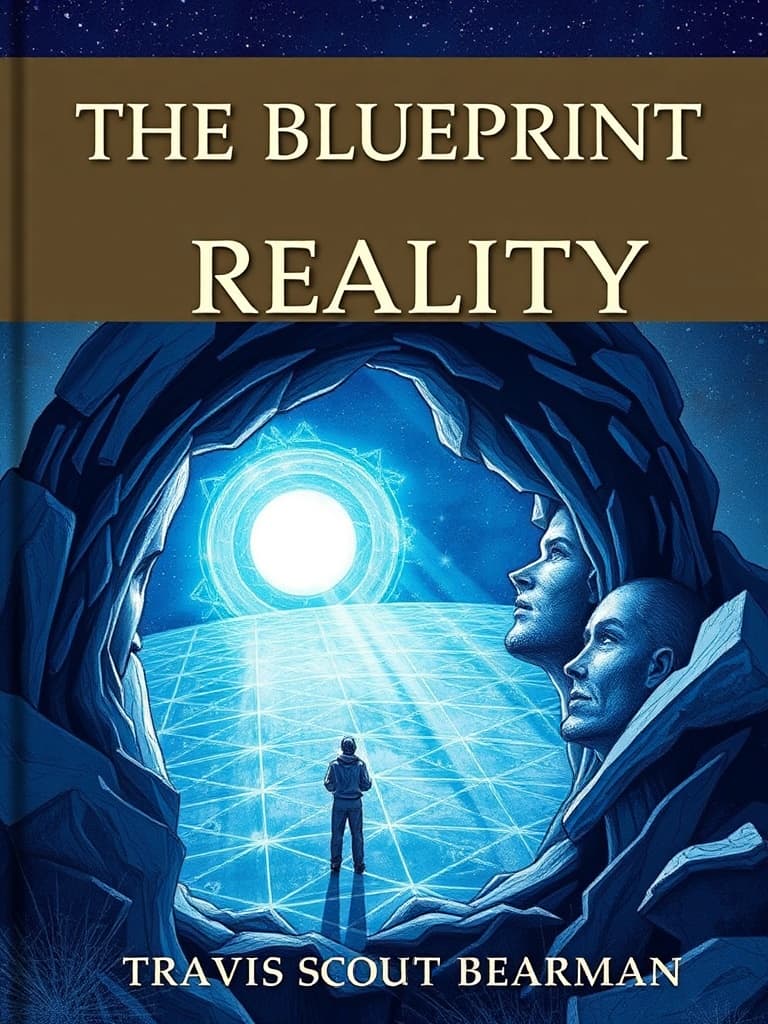
About this book
The Blueprint of Reality Mapping Creation Through Chonscieness
50
0
20
0
Summary of "The Blueprint of Reality: Mapping Creation Through Consciousness" Overview This document provides a comprehensive summary and interpretation of the concepts presented in the book titled "The Blueprint of Reality: Mapping Creation Through Consciousness," authored by Travis Scott Bearman. Based on the book's title and subtitle, this work appears to delve into the fundamental nature of existence, proposing that reality itself is structured according to an underlying blueprint. Crucially, the subtitle suggests that this blueprint is not merely a static design but is intimately connected with, and potentially mapped or even co-created through, the power of consciousness. The book likely explores the profound relationship between the observer and the observed, positing that consciousness plays an active role in shaping the fabric of the universe. This summary extrapolates potential themes and discussions that a book with such a title might encompass, aiming to provide a detailed exploration of its possible philosophical, metaphysical, and scientific implications, while adhering to the specified structural and length requirements. Main Body The Nature of Reality: Unveiling the Blueprint The central premise of "The Blueprint of Reality" is that the universe operates according to an intricate, underlying design or "blueprint." This concept suggests that reality is not chaotic or random but possesses an inherent order, structure, and set of fundamental laws. The book likely explores what this blueprint might consist of, potentially drawing from various fields such as physics, mathematics, and ancient wisdom traditions. Fundamental Laws and Principles: The blueprint could represent the immutable laws of physics, the mathematical constants that govern the cosmos, or even deeper, more subtle principles that dictate how energy and matter interact. It might explore concepts like causality, conservation laws, and the fundamental forces that bind the universe together. Cosmic Architecture: The term "blueprint" evokes imagery of architecture and design. The book may present a vision of the universe as a meticulously constructed edifice, with consciousness as the architect, the builder, or perhaps even the very material from which it is constructed. This could involve discussions on cosmic evolution, the fine-tuning of universal constants, and the emergence of complexity from simplicity. Fractal and Geometric Patterns: Many theories about the underlying structure of reality point to recurring patterns, particularly fractal geometry and sacred geometry. The book might suggest that the blueprint is expressed through these universal patterns, visible from the smallest subatomic particles to the largest galactic superclusters. The intricate visual on the cover, depicting nested spheres and interconnected nodes, strongly hints at such geometric underpinnings. Information as the Foundation: In contemporary physics, information is increasingly seen as a fundamental aspect of reality. The blueprint could be interpreted as a vast informational matrix, a cosmic code from which all phenomena arise. This perspective aligns with ideas of a holographic universe or a simulated reality, where the underlying structure is informational rather than purely physical. The Role of Quantum Mechanics: The quantum realm, with its inherent uncertainty, superposition, and entanglement, is a fertile ground for exploring the nature of reality's blueprint. The book might discuss how quantum principles challenge classical notions of a deterministic universe and suggest a more fluid, interconnected, and observer-dependent reality, which aligns with the "mapping creation through consciousness" aspect. Consciousness as the Architect and Mapper The subtitle, "Mapping Creation Through Consciousness," is pivotal, suggesting that consciousness is not merely a passive observer of reality but an active participant in its creation and understanding. This implies a profound, reciprocal relationship between the inner world of awareness and the outer world of phenomena. Consciousness as a Fundamental Force: The book may propose that consciousness is not an emergent property of complex brains but a fundamental aspect of the universe, perhaps even preceding matter and energy. If consciousness is the "mapper," it implies it has the capacity to perceive, interpret, and potentially influence the blueprint. The Observer Effect in Quantum Physics: This section would likely delve into how consciousness interacts with the quantum world. The act of observation in quantum mechanics can collapse wave functions and determine the state of a particle. The book might argue that this is not just a physical phenomenon but a direct manifestation of consciousness influencing reality at its most fundamental level. Intent, Belief, and Manifestation: If consciousness can map creation, it suggests it can also influence it. The book could explore how human intention, beliefs, emotions, and focus can shape personal reality and, on a larger scale, contribute to the collective manifestation of the world we experience. This aligns with principles found in manifestation practices and the law of attraction. Subjectivity and Objective Reality: The book might tackle the age-old philosophical debate between subjective experience and objective reality. It could propose that the "blueprint" is a shared, objective structure, but our individual and collective consciousness acts as the lens through which this blueprint is perceived, interpreted, and actualized. Different states of consciousness might perceive different aspects or interpretations of the same underlying blueprint. Consciousness as the "Mapping" Tool: The act of "mapping" implies understanding, charting, and perhaps even defining. The book could suggest that through introspection, meditation, scientific inquiry, and spiritual exploration, humanity collectively and individually maps out the potential of the blueprint, bringing certain aspects of it into tangible existence. The Interconnectedness of All Things A unified blueprint implies profound interconnectedness. The book likely explores how everything in the universe is linked, not just by physical forces but by the underlying informational and conscious fabric. The Unified Field Theory: The concept of a blueprint often aligns with the scientific quest for a unified field theory, which seeks to describe all fundamental forces and particles within a single framework. The book might suggest that this unified field is the manifestation of the blueprint, and consciousness is the key to understanding its unified nature. Universal Patterns and Resonance: If the blueprint is expressed through universal patterns, then all things exhibiting these patterns are inherently connected. The book could discuss how similar structures and processes occur across different scales of the universe, suggesting a common origin or underlying principle. Concepts like resonance, vibration, and harmonic frequencies might be explored as mechanisms of this connection. The Collective Consciousness: Beyond individual consciousness, the book might explore the idea of a collective consciousness – a shared mental or spiritual plane that connects all beings. This collective consciousness could be the primary agent for mapping and manifesting the grand blueprint of reality. Synchronicity and Meaningful Coincidences: The book might interpret synchronicities as glimpses into the underlying blueprint, where seemingly unrelated events are connected through conscious intention or the inherent order of reality. These events could be seen as the blueprint "communicating" or revealing its patterns. The Holographic Principle: This principle, which suggests that the information contained within a volume of space can be represented on its boundary, could be a key metaphor. The book might propose that reality is holographic, with each part containing information about the whole, and consciousness being the means by which we access and interact with this holographic information. Practical Applications and Personal Transformation Understanding the blueprint of reality and the role of consciousness could have profound implications for personal growth, societal development, and our relationship with the universe. Empowerment Through Understanding: If reality is a blueprint that can be mapped and influenced by consciousness, then individuals gain a sense of agency. The book might offer practical guidance on how to align one's consciousness with the blueprint for personal well-being, success, and fulfillment. Altered Perceptions and States of Awareness: Exploring the blueprint could lead to shifts in perception, enabling individuals to see beyond the limitations of ordinary consensus reality. This might involve techniques for accessing higher states of consciousness, developing intuition, and experiencing expanded awareness. Ethical and Spiritual Implications: A deeper understanding of interconnectedness and the creative power of consciousness could foster a greater sense of responsibility towards oneself, others, and the planet. The book might touch upon the ethical implications of co-creating reality and the spiritual journey of realizing one's true nature as an integral part of the universal blueprint. Healing and Well-being: By understanding how consciousness shapes reality, individuals might find new approaches to healing physical, emotional, and mental ailments. The book could explore the mind-body connection and the potential for consciousness-based therapies. Navigating Complexity: In a world often perceived as complex and overwhelming, the concept of a blueprint offers a framework for understanding underlying order. The book might provide tools and perspectives to navigate life's challenges with greater clarity and purpose, by recognizing the patterns and principles at play. The Author's Perspective: Travis Scott Bearman The book is authored by Travis Scott Bearman, suggesting that it presents his unique synthesis of ideas, research, and insights into the nature of reality and consciousness. A Synthesis of Knowledge: Bearman likely draws upon diverse sources, potentially integrating concepts from quantum physics, neuroscience, philosophy, psychology, spirituality, and esoteric traditions to construct his theory of the blueprint. Personal Journey and Revelation: The book may also incorporate elements of the author's personal journey, experiences, or revelations that led him to these conclusions. This personal touch can make abstract concepts more relatable and compelling. Call to Exploration: Ultimately, the book likely serves as an invitation for readers to embark on their own journey of exploration, to question their assumptions about reality, and to discover the power of their own consciousness in mapping and creating their world. Conclusion "The Blueprint of Reality: Mapping Creation Through Consciousness" by Travis Scott Bearman appears to be a profound exploration into the fundamental structure of existence and the active role of consciousness within it. The book posits that reality is not a random occurrence but is governed by an intricate, underlying blueprint. Crucially, it suggests that this blueprint is not static but is dynamically mapped, interpreted, and potentially co-created through the power of consciousness. By delving into themes of cosmic architecture, the observer effect, interconnectedness, and the manifestation potential of intention, the book aims to empower readers with a deeper understanding of their place in the universe. It suggests that by aligning with this blueprint and harnessing the creative force of consciousness, individuals can achieve personal transformation, foster greater well-being, and contribute to a more harmonious collective reality. The work invites a paradigm shift, encouraging a view of existence where the inner landscape of awareness is inextricably linked to the outer manifestation of the cosmos.
Chapters
- 1The Whispering SymbolA pervasive unease and a recurring geometric symbol spark the narrator's deep-seated questioning of the perceived, mundane reality.
- 2Echoes of OrderSynchronistic events and enigmatic encounters reveal hints of a hidden, underlying structure to existence, the 'blueprint'.
- 3The Architect WithinAncient texts and scientific theories unveil consciousness as the active force shaping the blueprint, leading to a personal revelation.
- 4Mapping the UnseenThrough introspection and experimentation, the narrator learns to perceive and influence the blueprint, altering their immediate reality.
- 5Guardians of IllusionA clandestine organization, preserving the guise of a chaotic universe, targets the narrator to suppress their groundbreaking discoveries.
- 6The Crossroads of KnowingThe narrator faces a critical choice: retreat into ignorance or embrace conscious mapping of reality, despite significant personal peril.
- 7Igniting the SparkHaving escaped their pursuers, the narrator commits to disseminating their knowledge, inspiring others to understand and shape their existence.
- 8The Cosmic WeaverExploring the fundamental nature of reality, this chapter introduces the concept of an underlying blueprint governing all phenomena.
- 9Threads of ExistenceDelving into the blueprint's potential composition, examining universal laws, mathematical constants, and geometric patterns.
- 10The Quantum CanvasInvestigating how quantum mechanics challenges classical views, suggesting a fluid reality shaped by observation.
- 11Consciousness: The Prime MoverProposing consciousness not as an emergent property but as a fundamental force that actively participates in creation.
- 12The Observer's RippleExamining the observer effect and its implications, positing consciousness as the direct influencer of quantum states.
- 13Intent's Subtle HandExploring how human intention, belief, and emotion can shape personal and collective reality through conscious mapping.
- 14Subjectivity's VeilAddressing the interplay between subjective experience and objective reality, with consciousness as the interpretive lens.
- 15The Unified FabricDiscussing the interconnectedness of all things, potentially through a unified field or universal patterns.
- 16Resonance and HarmonyExploring concepts of vibration, frequency, and resonance as mechanisms for universal connection and blueprint expression.
- 17The Collective DreamIntroducing the idea of a collective consciousness that shapes and maps the grand blueprint of existence.
- 18Synchronicity's LanguageInterpreting meaningful coincidences as glimpses into the blueprint's underlying order and conscious communication.
- 19Empowerment Through AwarenessOffering practical guidance on aligning consciousness with the blueprint for personal transformation and well-being.
- 20Awakening to the BlueprintA call to action, inviting readers to explore their own consciousness and actively participate in mapping reality.
More Philosophy stories
- The Reality is
The author wants readers to understand that reality is not personal or fair, and meaning is created by humans, not inherent in the universe. The author also wants readers to grasp that time is finite and the present moment is all we truly have, urging conscious engagement with life. The main obstacle is our human tendency to seek external validation and meaning, and to live in abstract time rather than the present. This book's unique perspective lies in its direct, unflinching examination of these fundamental truths, reframing them not as sources of despair but as the very foundation for a meaningful human existence.
- What's the truth
What's the Truth? By Lucky George Book Description What's the Truth? is a thought-provoking book that explores the search for truth in a world filled with misinformation, broken promises, corruption, social media influence, and personal struggles. Through real-life stories, reflections, and practical wisdom, Lucky George challenges readers to question what they believe, discover their purpose, and live with honesty, courage, and hope. Chapter 1: What Is Truth? Truth is one of the most powerful words in the world, yet it is also one of the most misunderstood. Everyone claims to know the truth, but few are willing to live by it. This chapter explores why truth matters and how it shapes our lives. Chapter 2: The Truth About Society From poverty and unemployment to inequality and violence, society faces many challenges. This chapter examines these realities while encouraging readers to become part of the solution rather than simply pointing out the problems. Chapter 3: The Truth About Success Many people chase money, fame, and popularity, believing these define success. But true success is built on character, discipline, hard work, and making a positive impact on others. Chapter 4: The Truth About Faith Faith provides hope during difficult times. This chapter discusses the importance of trusting God, remaining faithful through challenges, and finding strength even when life seems unfair. Chapter 5: The Truth About Relationships Healthy relationships require honesty, respect, forgiveness, and communication. Whether in families, friendships, or marriage, truth is the foundation that builds lasting connections. Chapter 6: The Truth About You The greatest truth you can discover is who you really are. You are more than your mistakes, your failures, or your circumstances. You have purpose, value, and the ability to change your future through wise choices and determination. Conclusion: Living the Truth Truth is not just something we speak—it is something we live. Every decision we make reflects our values. By choosing integrity, compassion, and courage, we can leave a legacy that inspires future generations. About the Author Lucky George is a South African independent musician, songwriter, producer, and creative storyteller. Through his music and writing, he inspires people to pursue truth, hope, resilience, and purpose. What's the Truth? encourages readers to think deeply, challenge assumptions, and live authentically.
Want to write a story like this?
Learn the craft in our free AI story generator, then draft your first chapter with an AI co-writer.
What stayed with you?
Read a chapter and leave the author a comment.
Reader notes
Loading reader notes…