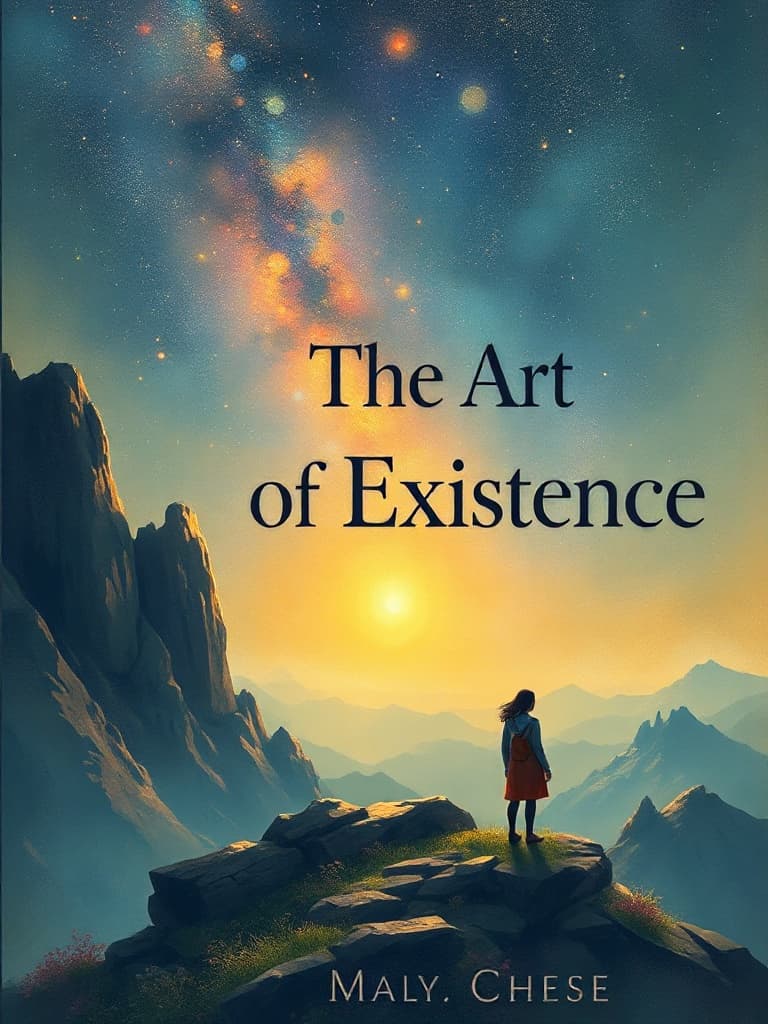
About this book
The Art of Existence
41
0
12
0
A non fiction novel covering the psychology and astrophysical connection of awareness and conciousness.
Chapters
- 1The Unfolding QuestionWe open with a contemplation of the stars, a universal human act that sparks an age-old inquiry: what does it mean to be aware? Dr. Aris Thorne, our guide, introduces this profound mystery, not as an academic puzzle, but as the very essence of our lived experience. He shares anecdotes of childhood wonder, the unsettling feeling of a dream, and common moments where the sheer fact of existence feels overwhelming. Elara Vance, sharp and analytical, represents the reader's initial grounding in empirical reality, questioning the validity of such intangible pursuits. The chapter sets a warm, inviting tone, acknowledging the inherent human drive to understand our place in the vast unknown, hinting at the deep personal stakes involved in this quest for meaning.
- 2Mirrors of the SelfThis chapter dives into the subjective landscape of consciousness. We explore the 'hard problem' of qualia – the raw feel of experience, from the redness of a rose to the sting of sorrow. Dr. Thorne uses relatable examples, perhaps a vivid memory or a moment of intense emotion, to illustrate the deeply personal nature of awareness. Elara voices her skepticism, seeking tangible evidence and logical frameworks, fearing that without them, existence might unravel into meaninglessness. The narrative emphasizes the intimate, often perplexing, nature of our inner lives, posing questions about identity, memory, and the self. The emotional stakes are raised as we confront the possibility that our most fundamental understanding of ourselves might be elusive.
- 3The Brain's Electric SymphonyWe enter the realm of neuroscience and psychology, examining the scientific attempts to map consciousness. Dr. Thorne introduces key theories – from neural correlates to computational models – acknowledging their significant contributions but also their inherent limitations. He illustrates complex concepts with accessible analogies, perhaps comparing the brain to a sophisticated orchestra where instruments play in harmony, but the conductor (consciousness) remains elusive. Elara, initially reassured by this scientific approach, begins to feel the strain as the explanations fall short of capturing the *feeling* of being. The chapter highlights the ongoing debates, the 'explanatory gap,' and the growing recognition within science that consciousness might transcend purely material explanations.
- 4The Limits of the MapThe central conflict sharpens as Elara's analytical mind grapples with the inadequacy of current scientific models. She pushes back against Dr. Thorne's gentle nudges towards less conventional ideas, her fear of meaninglessness surfacing as resistance. Dr. Thorne shares a brief, poignant personal struggle with these limitations, perhaps a moment of doubt that nearly derailed his own quest. The chapter focuses on the frustrations and dead ends encountered when trying to force consciousness into purely reductionist frameworks. The emotional core lies in Elara's internal struggle: her intellect demands empirical proof, yet her deepest longing seeks a more profound understanding that science, as currently practiced, seems unable to provide.
- 5Galactic WhispersThe narrative pivots dramatically, shifting focus from the internal landscape of the mind to the external grandeur of the cosmos. Dr. Thorne introduces the breathtaking scale of the universe, not just as a backdrop, but as a potential participant in the mystery of existence. He speaks of nebulae like cosmic wombs and galaxies as celestial dances, hinting at underlying patterns and interconnectedness. Elara, initially finding solace in the tangible, is now confronted with a vastness that defies easy comprehension. The chapter's tone becomes one of awe and wonder, subtly suggesting that the answers we seek might lie not just within us, but also in the silent, ancient expanse surrounding us. The Universe, as an entity, begins to loom large.
- 6Quantum EntanglementsThis chapter delves into the intriguing intersection of quantum physics and cosmology, exploring theories that suggest reality is far stranger and more interconnected than previously imagined. Dr. Thorne explains concepts like entanglement and observer effects in simple terms, drawing parallels between the seemingly conscious behavior of subatomic particles and the nature of our own awareness. He introduces the idea of the Universe as a 'Cosmic Mirror,' reflecting consciousness back to itself. Elara’s analytical mind is challenged by these counter-intuitive ideas, her skepticism tempered by a growing curiosity. The emotional impact is one of profound intellectual challenge and dawning possibility, as the boundaries between observer and observed begin to blur.
- 7The Inner CosmosWe now synthesize the seemingly disparate threads of psychology and astrophysics. Dr. Thorne illustrates how the vastness of the cosmos can inform our understanding of our inner world, and vice versa. He might use metaphors like fractal patterns, where the structure of a galaxy mirrors the connections in our neural networks or the branching of thoughts. Elara begins to see how the universe's interconnectedness could offer a framework for understanding consciousness that transcends the limitations of the brain alone. The chapter aims to bridge the gap, fostering a sense of cosmic significance for individual awareness, and suggesting that our personal experience of consciousness is not isolated but part of a grand, universal tapestry.
- 8A Moment of UnisonThe turning point arrives as Dr. Thorne shares his deeply personal, previously guarded, experience of cosmic interconnectedness. He recounts a moment of profound unity, perhaps during a solitary stargazing night, where the boundaries of self dissolved, and he felt utterly connected to the universe. This revelation is not just an anecdote; it’s the emotional heart of the book, profoundly impacting Elara and, by extension, the reader. Her analytical resistance begins to crumble, replaced by a sense of wonder and a longing to experience such a connection. The chapter is imbued with a quiet, powerful emotion, demonstrating the transformative potential of embracing this universal unity, moving beyond intellectual understanding to felt experience.
- 9The Embodied StarEnter Maya Chen, a living embodiment of the book's core message. She doesn't theorize about cosmic awareness; she *lives* it. We see her interacting with the world with profound presence, compassion, and a deep sense of belonging. Dr. Thorne introduces her as an example of how integrating these expansive insights can positively transform daily life. Elara observes Maya, her skepticism giving way to admiration and a desire to learn. The chapter shifts to practical illustration, showcasing how a cosmic perspective fosters peace, resilience, and joy in the mundane. Maya’s grounded yet luminous presence offers a tangible vision of what it means to 'be' in the universe.
- 10Weaving the Cosmic ThreadThis chapter provides concrete guidance for readers to cultivate their own sense of cosmic connection. Drawing on Maya’s example and Dr. Thorne’s wisdom, practical techniques are offered: mindful observation of nature, contemplative practices, recognizing interconnectedness in everyday interactions. Elara actively engages with these practices, experiencing small but significant shifts in her perspective. The focus is on making the abstract concepts accessible and applicable, encouraging readers to actively participate in their own journey of awareness. The tone is encouraging and empowering, emphasizing that this integration is a continuous, rewarding process.
- 11The Stillness WithinWe delve deeper into the power of presence and acceptance. Dr. Thorne and Maya guide the reader through understanding that true connection isn't about achieving a constant state of cosmic awe, but about finding profound meaning and peace in the present moment. Elara learns to navigate her lingering doubts and fears with greater equanimity, recognizing the beauty in life's inherent mystery. The chapter emphasizes that embracing the unknown, rather than needing to control or explain it, is key to a richer existence. The emotional stakes involve finding inner peace amidst life's complexities, fostering a deep appreciation for the simple act of being.
- 12The Ever-Expanding SkyThe book concludes with a reflective and hopeful outlook. Dr. Thorne, Elara (now a more integrated seeker), and Maya offer final thoughts on the ongoing journey of awareness. The emphasis is on embracing the mystery, continuing the quest for understanding with curiosity, and celebrating the profound interconnectedness of all life. The narrative encourages readers to view existence not as a problem to be solved, but as a magnificent, unfolding art form. The final pages leave the reader with a sense of expansive possibility, a deeper appreciation for their place in the cosmos, and a warm, enduring sense of wonder about the art of existence.
More Non-fiction stories
Browse all Non-fiction →- “Montessori Age Care”
Observation and patience are the keys.
A twenty-first-century approach to supporting people living with dementia: Montessori-inspired, person-centred care tailored to each individual’s abilities, preferences, and needs—a specialised eighteenth-century approach for the modern aged-care setting, where observation and patience are key.
- The light in your eyes
She was searching for a place to belong. He was a man who had forgotten how to love. When Elara Martins meets Adrian Vale, two broken hearts begin a journey neither expected. But love, heartbreak, and the ghosts of their past threaten to tear them apart. Sometimes, losing love is the only way to find it again. A bittersweet romance about healing, second chances, and finding your way home.
- Oxygenated Soul: A True Story of Renewal and Generosity
Oxygenate your blood with blood ozone therapy, then donate 1 pint of oxygenated blood.
- Beyond the Rocket's Shadow: The Ferragraphite Revolution
This book idea seeks to revolutionize space travel by presenting a novel spaceplane design, the Ferragraphite SSTO, which overcomes the rocket equation's limitations through advanced materials. The primary obstacle is the immense weight of conventional rocket components, particularly propellant tanks and thermal protection, which leaves insufficient mass for payload. The Ferragraphite spaceplane's innovative approach lies in its ultralight, integrated structure made from a unique carbon-boron-iron composite, allowing the hull itself to function as the cryogenic fuel tank and thermal shield, thus drastically reducing overall mass and enabling a single-stage-to-orbit capability.
- Ferragraphite Dreams: The Ultralight Helicopter Revolution
This book idea proposes an ultralight, morphing electric helicopter constructed from Ferragraphite, a material over five times lighter than aluminum with exceptional tensile strength. The innovation lies in eliminating heavy turboshaft engines and gearboxes through a hubless electromagnetic rotor and active morphing rotor blades, with a structural battery and thermal-electric skin forming the airframe. The primary challenge is the novel material science and engineering required to realize this revolutionary rotorcraft design.
- The Sonic Archaeologist: Reclaiming Lost Voices
Archaeologists can recover ancient voices and music by using a nanoscale scanner that reads microscopic grooves left by sound waves on artifacts. This device overcomes the fragility of ancient materials and the degradation of surfaces by employing non-contact atomic mapping and real-time audio reconstruction. Its unique ability to operate at room temperature without bulky equipment makes it revolutionary for on-site archaeological discoveries.
Want to write a story like this?
Learn the craft in our free AI story generator, then draft your first chapter with an AI co-writer.
What stayed with you?
Read a chapter and leave the author a comment.
Reader notes
Loading reader notes…