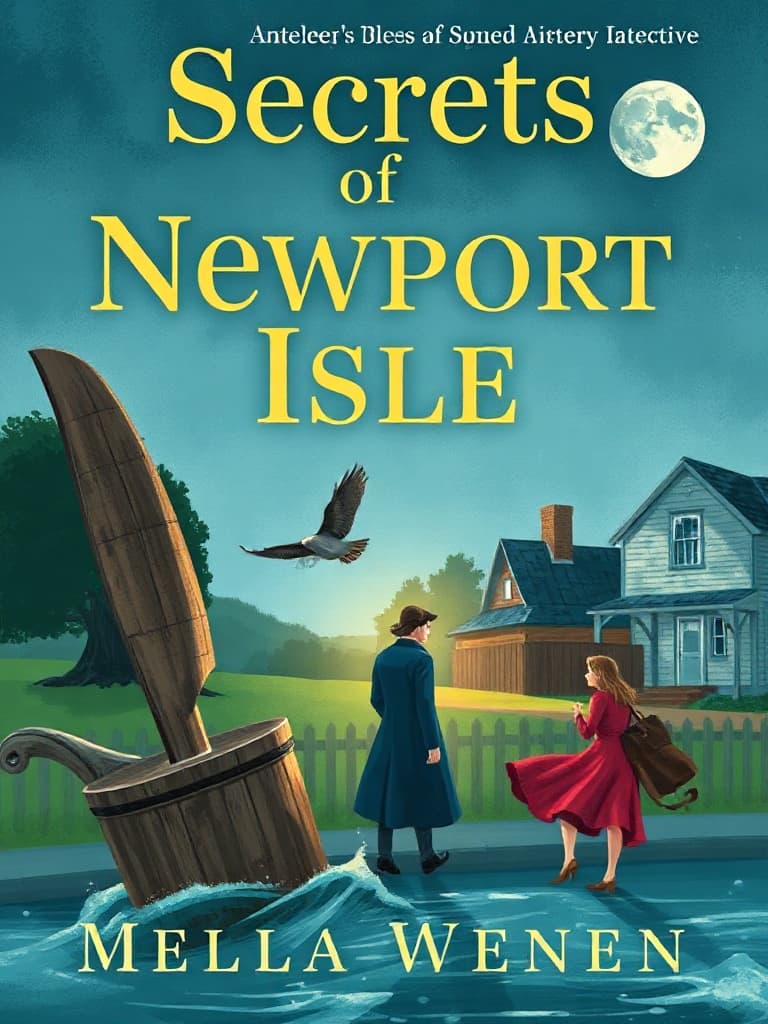
Story overview
Secrets of Newport Isle
19
0
8
published
it's a town where people come back from the city for some reason or another having to deal with their families and end up staying back in the town and while they're in their town there is mist of happening and there's one person that tries to solve it what's going on it's always in the way of the police detective main character owns bakery called the Sugar bowl she is the one that tries to solve all the murders
Table of contents
- 1The Mist and the MuffinChapter 1 opens on Newport Isle, a quaint, picturesque town known for its scenic beauty and close-knit community. The narrative immediately establishes Eliza, the warm and observant owner of 'The Sugar Bowl' bakery, as the heart of the island. Her bakery is more than just a place for delicious pastries; it's the island's unofficial social hub, a place where gossip flows as freely as the coffee. Eliza, with her innate sense of noticing the smallest details – a slight tremor in a hand reaching for a croissant, a hushed whisper exchanged over a scone – is our window into the island's soul. The story begins with a subtle shift in the island's atmosphere. The arrival of the summer season, usually a time of vibrant activity and returning families, is tinged with an unusual phenomenon: a persistent, ethereal mist that seems to cling to the island, particularly around the more secluded, historic areas. This mist isn't just atmospheric; it feels almost sentient, muffling sounds, distorting perceptions, and adding a layer of unease to the otherwise idyllic setting. Eliza first notes its peculiar density and how it seems to linger longer each day, even when the sun is high. Coinciding with the mist's arrival is a noticeable influx of 'city dwellers' – individuals and families who have strong ties to Newport Isle but have spent years or decades living and working in the bustling metropolis. They've returned for various reasons: some for summer holidays, others to reassess their lives, and a few, Eliza suspects, with more complex agendas. Among these returnees are key figures who will become central to the unfolding mystery: Eleanor Vance, the elegant and seemingly reserved heiress of a once-prominent island family, and Silas Croft, a charismatic but sharp businessman with a reputation for shrewd dealings. Eliza observes them from behind her counter, noting their interactions, their subtle glances, and the undercurrent of tension that seems to follow them. She notices how the mist seems to swirl more intensely around the Vance estate and the old Croft manor, places steeped in island history and rumored to hold long-forgotten secrets. The chapter will detail several 'strange occurrences' that, while minor individually, paint a picture of growing disquiet. Perhaps a prized garden statue is found overturned, a few cryptic, unsigned notes are slipped under doors, or a resident reports hearing unsettling whispers carried on the unusually still air. These events are dismissed by most as pranks or the effects of the unusual weather, but Eliza's intuition tells her they are connected, threads of a larger, unseen tapestry. Her internal monologue will reveal her growing concern and her analytical mind at work, piecing together these seemingly disparate events. The chapter will also introduce Detective Harding, the island's resident police detective. He's portrayed as a man of routine, grounded in logic and procedure, and somewhat weary of the island's occasional eccentricities. He's introduced during a brief interaction with Eliza, perhaps when she calls to report a minor incident, and he dismisses her concerns with a polite but firm hand, chalking it up to the fog and the summer influx. This interaction will establish their dynamic: Eliza, the intuitive observer, and Harding, the skeptical enforcer of the law. The chapter will end with Eliza looking out at the mist-shrouded harbor, a single muffin cooling on her counter, a sense of foreboding settling upon her. She knows, with a certainty that chills her, that the mist and the returnees are harbingers of something far more significant, a secret that Newport Isle has kept buried for too long. The mood will be one of quiet unease, a sense of beauty tinged with mystery, and Eliza’s quiet resolve to understand what is unfolding beneath the seemingly peaceful surface. The descriptions of the bakery will be rich and sensory – the aroma of baking bread, the warmth of the oven, the clatter of baking tins – contrasting with the encroaching, damp chill of the mist outside. The island's history will be hinted at through Eliza's observations of the old houses and the returning families, suggesting a past that is not entirely dormant. The chapter will set the stage for the escalating mystery, establishing Eliza's unique position as an observer and her nascent role as an investigator, all while the mysterious mist acts as a character in itself, a silent witness to the island's secrets. The sheer density of the mist, its unnerving silence, and its selective presence will be emphasized, making it a palpable force that affects the islanders' moods and perceptions, creating an atmosphere of subtle psychological tension. Eliza's internal thoughts will be detailed, showing her processing the sensory input of the island and formulating early hypotheses, however vague, about the confluence of the mist, the returnees, and the odd occurrences. This sets up her character as someone who actively seeks understanding rather than passively accepting events. The chapter's closing image will be one of quiet contemplation, a visual metaphor for the secrets that lie hidden beneath the surface of the island's charm, with Eliza poised at the precipice of discovery. The narrative will carefully build a sense of place, making Newport Isle feel like a character in its own right – beautiful, historic, and now, inexplicably, holding its breath.
- 2A Crumb of SuspicionChapter 2 plunges Newport Isle into chaos with the island's first murder, shattering its peaceful facade and directly involving Eliza in the unfolding mystery. The victim, initially presented as a relatively minor figure in the island community – perhaps a local historian known for his eccentricities or a long-time resident with few known enemies – is discovered in a location that hints at secrets, possibly near one of the older, more secluded estates or down by the fog-laden docks. The discovery immediately draws the attention of Detective Harding, who arrives on the scene with his characteristic grim efficiency. However, Harding's investigation is hampered by his rigid adherence to procedure and a tendency to overlook details that don't fit his preconceived notions. This is where Eliza's role as an amateur detective begins to crystallize. She learns of the murder through the usual channels – whispers at the bakery, concerned calls, or perhaps she even stumbles upon the initial commotion. Driven by her intuitive nature and a deep concern for her community, Eliza cannot simply stand by. She visits the vicinity of the crime scene, not to interfere directly, but to observe, to absorb the atmosphere, and to notice the subtle details that Harding and his team might miss. Her keen observational skills, honed by years of watching people and her craft, allow her to pick up on things others overlook: a specific type of mud on a discarded shoe that doesn't match the local soil, an unusual scent lingering in the air beyond the pervasive mist, a peculiar arrangement of objects near the body that seems deliberate rather than accidental. Harding, meanwhile, is focused on the obvious suspects – perhaps the victim had a recent, public dispute, or a known disgruntled associate. He views Eliza's presence and her inquiries with annoyance and suspicion, seeing her as a civilian meddler who could potentially contaminate evidence or spread unnecessary gossip. Their second significant interaction will be a direct confrontation. Harding might find Eliza near the crime scene or hear reports of her asking questions. He confronts her, his tone sharp and dismissive. He warns her to stay out of it, emphasizing the dangers and the fact that she is unqualified. He might even make a condescending remark about bakers sticking to their kitchens. Eliza, though intimidated, stands her ground. She doesn't reveal everything she's seen, but she might subtly question Harding's assumptions or point out a detail he's dismissed, planting a seed of doubt in his mind, even if he doesn't acknowledge it. This confrontation solidifies their antagonistic relationship: Harding sees Eliza as a nuisance, and Eliza sees Harding as either incompetent or deliberately overlooking crucial information. The chapter will delve into Eliza's personal investigation. She starts subtly questioning customers at her bakery, piecing together the victim's last known movements, and investigating the backgrounds of the returning city dwellers, particularly Eleanor Vance and Silas Croft, who seem to be at the center of the island's renewed social dynamics. She might recall a conversation she overheard, a peculiar look exchanged between Eleanor and the victim weeks ago, or Silas Croft's unusual interest in a particular piece of island history related to the victim. The mist continues to play a role, adding to the atmosphere of confusion and obscuring potential clues. It acts as a physical manifestation of the secrets and hidden truths on the island, making it harder for Harding's methodical investigation and aiding Eliza's more intuitive approach. The chapter will explore the impact of the murder on the island community, moving from shock and disbelief to a burgeoning sense of fear and suspicion. Old tensions might resurface as residents eye each other warily. The narrative will emphasize Eliza's internal struggle: her desire to help and uncover the truth versus the warnings of Harding and the inherent danger she might be putting herself in. She might recall a past incident on the island that makes her hesitant to trust easily, or perhaps a personal connection, however tangential, to the victim that fuels her determination. The chapter will end on a cliffhanger, with Eliza discovering a crucial piece of evidence or making a connection that Harding has completely missed, something small but significant – perhaps a unique type of flower petal found near the body that only grows in a specific, secluded part of the island, or a coded message glimpsed in the victim's journal that Harding dismissed as scribbles. This discovery will fuel her resolve and set the stage for her continued, clandestine investigation, while Harding remains focused on his more conventional, and potentially flawed, path. The pervasive fog will be used to isolate characters and create moments of suspense, where figures emerge suddenly from the mist or crucial details are obscured just as they are about to be seen. Eliza's bakery will serve as a sanctuary and a base of operations, where she can process her findings and gather information discreetly. The chapter will also explore the initial reactions of Eleanor Vance and Silas Croft to the murder, showing their carefully constructed facades and hinting at their potential involvement or knowledge. Eleanor might express a detached sort of sorrow, while Silas might offer condolences laced with thinly veiled opportunism. The overall tone will shift from the subtle unease of Chapter 1 to outright tension and a growing sense of danger, with the murder serving as the catalyst for the island's secrets to begin unraveling.
- 3Whispers in the DoughChapter 3 deepens Eliza's investigation into Newport Isle's complex past and the simmering resentments among its returning inhabitants, further escalating her conflict with Detective Harding. Following her discovery of the carved wooden bird and its connection to the northern woods, Eliza feels compelled to explore this lead, despite Harding's explicit warning. The chapter opens with Eliza venturing into these less-traveled parts of the island. The mist here is even more pervasive, creating a disorienting and isolating atmosphere. The northern woods are ancient, filled with gnarled trees, moss-covered stones, and a palpable sense of history. Eliza, armed with her intuition and the vague knowledge of boundary stones, navigates the terrain, her senses heightened. She's not just looking for clues; she's absorbing the environment, trying to feel the island's secrets. She might find evidence of recent activity – disturbed vegetation, footprints, or perhaps even a discarded item that links back to one of the suspects. This exploration is fraught with a subtle tension; the isolation and the mist make her feel vulnerable, and she constantly fears encountering someone or something unexpected. She might discover a hidden clearing, an old, forgotten structure, or a series of boundary markers, one of which bears the same distinctive carving as the bird found with Abernathy. This discovery confirms her suspicion that Abernathy was investigating something significant related to the island's land ownership or history, possibly involving the founding families. Back at The Sugar Bowl, Eliza continues her discreet inquiries, focusing on the history and feuds among the island's prominent families, particularly the Vances and Crofts, and how they relate to the returning city dwellers. She learns that Abernathy was researching the original land grants and that there were long-standing disputes over certain territories, disputes that were supposedly settled generations ago but might have resurfaced due to the return of descendants. Conversations with older residents, or perhaps digging through old town records (if accessible), reveal fragmented stories of betrayals, lost fortunes, and bitter rivalries passed down through generations. She learns that Eleanor Vance's family was once the most powerful, but a significant portion of their land was lost under controversial circumstances, and Silas Croft's family, though less prominent historically, has recently acquired considerable wealth and influence, possibly through means Abernathy might have questioned. This historical context begins to explain the underlying tensions among the returnees. Detective Harding, meanwhile, is pursuing his own investigation, likely focusing on more conventional motives like financial gain or personal grudges among the living. He might be interviewing Silas Croft about his business dealings or Eleanor Vance about her family's history. He views Eliza's continued 'meddling' with growing frustration. He might have his officers discreetly watching Eliza or try to intimidate her further. A scene will depict Harding confronting Eliza again, perhaps at her bakery or as she returns from the woods. He might accuse her of interfering with his investigation, presenting her with evidence that seems to implicate someone else entirely, someone less connected to the historical secrets Eliza is uncovering. He might warn her that her actions could put her in danger or even make her a suspect. Eliza, however, is resolute. The clues she's finding, however fragmented, resonate with her intuition. She might have discovered something specific in the northern woods – a discarded tool, a unique footprint, or a partial inscription – that she believes is crucial. She tries to explain her findings to Harding, emphasizing the historical angle and the potential connection to the founding families, but he dismisses it as fanciful speculation, perhaps stating that Abernathy was known for his eccentric theories. This dismissal fuels Eliza's determination to uncover the truth on her own. The chapter will weave in the deepening mist as a symbolic representation of the obfuscated truth and the growing confusion on the island. It might cause minor inconveniences or even brief moments of disorientation for Eliza, adding to the suspense. She might have a close call in the woods, perhaps hearing footsteps that disappear into the fog, or finding a path suddenly blocked, making her question if someone is actively trying to stop her. The narrative will explore Eliza's internal conflict: her loyalty to her community, her growing understanding of the island's buried secrets, and her fear of the unknown. She might be wrestling with a past trauma related to the island that makes her wary of digging too deep. The chapter will build towards a significant revelation for Eliza, perhaps a direct link between Abernathy's research, the land disputes, and one of the key suspects. She might find a hidden compartment in Abernathy's study (perhaps accessed through a tip from a trusted local) containing research notes that directly implicate Eleanor Vance or Silas Croft in a historical deception that could have modern-day repercussions. The chapter will end with Eliza holding this new, concrete piece of evidence, realizing the true depth and danger of the secrets she is uncovering, and knowing that Harding is still looking in the wrong direction. This sets up a crucial turning point where Eliza must decide how to proceed with this sensitive information, knowing that exposing it could have far-reaching consequences for the entire island and its residents, and that her conflict with Harding must soon evolve.
- 4A Bitter IngredientChapter 4 escalates the danger and personalizes the threat on Newport Isle, forcing a reluctant cooperation between Eliza and Detective Harding. The chapter opens with a second murder, this time far more shocking and personal. The victim is someone Eliza knows well, perhaps a kindly elderly resident who was a regular at The Sugar Bowl, or someone who had recently confided in Eliza about their fears or suspicions related to the ongoing events. This personal connection jolts Eliza out of her detached observation and into a state of urgent determination. The proximity of this second victim to Eliza, or their known relationship with her, makes the danger feel immediate and palpable. The circumstances of this second murder might mirror the first in subtle ways, suggesting a pattern, or they might be deliberately different, designed to mislead. The mist, as always, plays its part, perhaps obscuring the killer's escape or muffling cries for help. Detective Harding, initially perhaps still dismissive of Eliza, is forced to take the situation more seriously. The fact that this victim was known to Eliza, and that Eliza herself might have been a potential target or witness, makes her insights suddenly more valuable, even if he struggles to admit it. Harding's investigation is likely hitting dead ends or being deliberately misled. He might be focusing on a red herring, perhaps a disgruntled local with no connection to the returning families, or he might be struggling to connect the two murders logically. Eliza, armed with the knowledge from Abernathy's journal and her personal connection to the new victim, possesses a crucial piece of the puzzle that Harding has missed. This might be a specific detail about the victim's last known actions, a cryptic message they left, or a connection they had to one of the founding families' secrets that Harding dismissed as irrelevant. The chapter will feature a pivotal scene where Eliza, perhaps driven by desperation or a sense of urgency after the second murder, approaches Harding not as an adversary, but with a plea for his attention and cooperation. She might present him with the journal entry or a piece of evidence she found, explaining its significance and how it connects the historical land disputes to the murders. Harding, initially resistant and skeptical, is finally forced to confront the evidence. Perhaps he recalls a small detail from the second crime scene that aligns with Eliza's findings, or he realizes that his own investigation has been stalling. This moment marks a turning point in their relationship; Harding begins to see Eliza not just as a meddling baker, but as someone with genuine insight and courage. Their cooperation is grudging at first. Harding is still by-the-book, and Eliza relies on her intuition, leading to moments of friction. However, they start to share information, with Harding providing access to police resources (albeit limited) and Eliza offering her unique perspective and access to island gossip. They might conduct joint interviews or stakeouts, with Harding providing the official authority and Eliza offering the nuanced understanding of the island's social dynamics. The chapter will delve deeper into the motivations of the suspects, particularly Eleanor Vance and Silas Croft. With the murders becoming more brazen, their carefully constructed facades might begin to crack. Eliza might observe a flicker of genuine fear or guilt in Eleanor's eyes, or Silas might become more aggressive and desperate in his attempts to control the narrative. The chapter will explore the personal toll these events take on Eliza. The second murder, being closer to home, affects her deeply. She might question her own safety and the wisdom of her continued involvement. Her bakery, usually a place of comfort, now feels like a potential target, and the mist outside seems to carry whispers of impending doom. The narrative will emphasize the growing tension and the increasing stakes. The island community is gripped by fear, and the trust that once defined Newport Isle is eroding. The chapter will feature a scene where Eliza and Harding work together to analyze a piece of evidence or a clue. Eliza might point out a subtle inconsistency in a suspect's alibi, or Harding might use his resources to verify a historical claim Eliza makes. This collaborative effort, though tense, proves fruitful, leading them closer to the truth. The chapter will end with a significant breakthrough, a direct result of their combined efforts. Perhaps they uncover a hidden connection between the two victims that Harding previously missed, or they find evidence that directly implicates one of the main suspects in a way that cannot be ignored. This breakthrough might be related to the victim's personal history, a secret they held, or something they were about to reveal. The mist might play a role in this breakthrough, perhaps by obscuring a getaway route or revealing a hidden path that only becomes visible under certain conditions. The chapter concludes with Eliza and Harding sharing a moment of grim understanding, recognizing the danger they are in and the formidable opponent they face, but also a fragile sense of mutual respect beginning to form. The immediate threat is heightened, and the path forward is fraught with peril.
- 5The Fog ThickensChapter 5 sees the pervasive mist on Newport Isle intensify, mirroring the escalating tension and Eliza's growing realization that the murders are deeply intertwined with a long-buried island secret involving its founding families. The atmosphere on the island becomes increasingly oppressive. The mist isn't just a visual phenomenon anymore; it feels like a tangible entity, seeping into homes, muffling sounds, and distorting perceptions, contributing to a collective sense of unease and paranoia among the residents. Eliza experiences this firsthand – the bakery, usually a warm haven, feels vulnerable, and the familiar streets outside are rendered alien and menacing by the fog. Their tentative partnership with Harding has yielded significant clues, particularly concerning the historical land fraud orchestrated generations ago, benefiting the Croft family at the expense of the Vances, a secret Abernathy was on the verge of exposing. The second victim, Mrs. Gable, was connected to this history, perhaps as a descendant or a keeper of oral traditions who knew Abernathy was onto something. Eliza begins to piece together a more complete picture: the present-day murders are a desperate attempt to prevent this historical truth from coming to light, a truth that would likely shatter the reputations and fortunes of those involved, particularly Silas Croft, who seems to be the primary beneficiary of this historical deception. The chapter will explore Eliza's internal struggle as she grapples with the enormity of this discovery. She understands the potential fallout: exposing the truth could destabilize the island's social fabric, ruin prominent families, and perhaps even lead to further violence. Her bakery, once a symbol of community, now feels like a potential battleground for these old secrets. She might find herself questioning her own motives – is she seeking justice, or is she inadvertently causing more harm? The narrative will delve deeper into the founding families' history, perhaps through Eliza and Harding uncovering old documents, diaries, or family archives. They might discover that the original fraud involved more than just land – perhaps stolen heirlooms, forged wills, or even a suppressed scandal that forced a family into exile. This adds layers of complexity and suggests a motive far deeper than mere financial gain. Harding, now fully invested, works closely with Eliza, their initial animosity replaced by a shared sense of urgency and a grudging respect. He uses his police resources to investigate Silas Croft's current financial dealings, looking for evidence of desperation or attempts to silence those who might know too much. Eliza uses her intimate knowledge of the island and its residents to gauge reactions, observe subtle shifts in behavior, and gather information through her network of bakery customers. The chapter will feature scenes where the mist plays a crucial role in creating suspense and danger. Eliza might be followed through the fog, narrowly avoiding an encounter. Harding might use the mist to his advantage for surveillance. They might plan to meet a confidential informant in a fog-shrouded location, heightening the tension. The chapter will also focus on Eleanor Vance's complex role. Eliza begins to suspect that Eleanor might not be fully complicit in Silas's actions, but perhaps knows more than she lets on, torn between her family's tarnished legacy and the potential consequences of revealing the truth. Eliza might attempt to reach out to Eleanor, trying to appeal to her sense of history or justice, but Eleanor remains guarded, her motivations unclear. Silas Croft, sensing the net closing in, becomes more desperate and potentially dangerous. He might increase his efforts to intimidate Eliza and Harding, or he might attempt to frame someone else, perhaps even Eleanor, to deflect suspicion. The chapter will build towards a significant revelation that Eliza uncovers, possibly through a final piece of Abernathy's research or a confession from a minor character who fears for their safety. This revelation will definitively link the current murders to the historical fraud and identify Silas Croft as the prime suspect, or at least a key player. It might reveal a specific method of the fraud or a hidden consequence that makes the historical crime particularly heinous and the motive for murder even stronger. The chapter will end with Eliza and Harding in possession of this critical information, understanding the full scope of the conspiracy and the danger it represents. The mist, at its thickest, obscures their path forward, but they know they are close to the truth, and the climax is imminent. The narrative will emphasize the psychological toll of the escalating mystery, with the island's atmosphere reflecting the characters' internal turmoil and the weight of generations-old secrets finally coming to light. The sense of threat will be palpable, as the killer, realizing they are close to being exposed, becomes more unpredictable and dangerous.
- 6Baking the TruthChapter 6 culminates in a dramatic confrontation during a significant island event, where Eliza uses her intimate knowledge of Newport Isle and its residents to expose the killer, finally earning Detective Harding's hard-won respect. The island is preparing for its annual Founder's Day festival, an event steeped in tradition and meant to celebrate the island's heritage. However, the usual festive atmosphere is overshadowed by the lingering mist, the recent murders, and the palpable fear that grips the community. The festival provides the perfect, albeit dangerous, backdrop for the climax. Eliza and Harding know that Silas Croft, realizing the investigation is closing in, will likely attempt to silence them permanently or escape before being apprehended. They anticipate he might use the chaos and crowds of the festival as cover. Eliza, having spent years observing the island's inhabitants and understanding their intricate relationships, proposes a plan. She knows the killer's psychology, their potential weaknesses, and the island's hidden pathways. She suggests using the festival's events to draw the killer out or to corner them. Harding, now fully trusting Eliza's instincts, agrees to a plan that blends his procedural methods with her unconventional insights. The chapter will detail Eliza's strategy, which leverages her understanding of the island's history and its people. Perhaps she knows Silas Croft has a particular pride in his family's (albeit fraudulent) historical legacy and plans to use this against him. She might orchestrate a scenario where the truth about the land fraud is subtly hinted at or brought into the public discourse during a speech or a public gathering at the festival, designed to provoke a reaction from Silas. The mist continues to be a factor, adding to the tension and unpredictling chaos of the festival. It obscures vision, creating opportunities for the killer to strike or escape, but also for Eliza and Harding to move unseen. Eliza might use her knowledge of the island's layout – secret passages, forgotten tunnels, or secluded areas – to her advantage, anticipating the killer's escape routes or planning a trap. The confrontation itself will be dramatic. It might occur during a key festival event, such as a historical reenactment, a town hall meeting, or a fireworks display. Eliza, perhaps having lured Silas into a specific location under a pretext, uses her knowledge to corner him. She might reveal specific details of the fraud, the victim's last moments, or Silas's own desperate actions, drawing on conversations she overheard or observations she made. Her calm demeanor, juxtaposed with the killer's growing panic, will be key. She doesn't accuse him outright but presents the irrefutable evidence, forcing him into a corner. Harding, positioned strategically with his team, moves in to make the arrest. There might be a tense chase or a struggle through the mist-laden festival grounds. Silas, his facade finally shattered, reveals his desperate motives – the fear of losing his newfound status, the shame of his family's illicit past, and the lengths he would go to protect his legacy. The chapter will focus on Eliza's courage and her deep connection to her community. She doesn't act out of a desire for vengeance, but from a need to protect Newport Isle from the darkness that has threatened to consume it. Her actions during the confrontation will demonstrate her understanding of human nature and the island's unique dynamics. She might appeal to Silas's sense of island heritage, highlighting how his actions betray the very community he sought to dominate. This is where Detective Harding witnesses Eliza's true strength and intellect. He sees her bravery, her sharp mind, and her genuine care for the island. The confrontation allows him to shed his skepticism and fully acknowledge her as an equal, a vital partner in solving the case. The arrest of Silas Croft marks the climax of the mystery. The immediate threat is neutralized, but the revelations have irrevocably changed the island. The chapter will end with the immediate aftermath of the arrest. The mist might begin to recede slightly, symbolizing the lifting of the oppressive atmosphere. Eliza and Harding share a moment of quiet understanding and mutual respect. Harding might offer a sincere apology for his initial dismissiveness, acknowledging her invaluable contribution. The community, though shaken, begins to process the truth. The focus shifts from the immediate danger to the long-term impact of the revealed secrets. The chapter concludes with Eliza, exhausted but resolute, looking out at the clearing sky, knowing that while the mystery is solved, the island's healing has just begun. The narrative will emphasize the sensory details of the festival – the sounds of music, the smell of food, the visual spectacle – all contrasted with the underlying tension and the threat of violence. Eliza's knowledge of the festival's schedule and the inhabitants' usual behavior will be crucial to her plan, highlighting her deep integration into the island community. The confrontation will be a psychological battle as much as a physical one, with Eliza using words and knowledge as her weapons.
- 7Clearing the AirChapter 7 focuses on the immediate aftermath of Silas Croft's arrest and the gradual lifting of the oppressive mist, symbolizing the island's return to a semblance of peace. The dramatic events of the Founder's Day festival have shaken Newport Isle to its core. The truth about the historical land fraud, the murders, and Silas Croft's desperate actions are now public knowledge, spreading through the community like wildfire. Eliza, having played such a pivotal role, finds herself the subject of newfound respect and curiosity, a stark contrast to Detective Harding's initial dismissiveness. The chapter opens with Eliza back in her bakery, 'The Sugar Bowl,' which is now more than ever a central point of conversation and reflection for the islanders. The air is thick with discussion, a mixture of shock, anger, and a dawning understanding of their island's complex, often dark, history. The mist, which had been such a pervasive presence, begins to noticeably recede. As the fog thins, the island's familiar beauty starts to re-emerge, though now seen through a different lens. The lifting mist is a powerful visual metaphor for the unveiling of truths and the clearing of deception. Harding, now working closely with Eliza, ensures the legal proceedings against Silas Croft are handled efficiently. He relies on Eliza’s testimony and her detailed observations, fully acknowledging her contribution. Their relationship has transformed from adversarial to one of genuine professional respect, perhaps even a nascent friendship. Harding might consult Eliza on how best to handle the community's reaction or discuss the long-term implications of exposing the founding families' secrets. The chapter will explore the impact of these revelations on the island's social structure. The Vance family's historical grievance is now validated, potentially leading to discussions about reparations or acknowledgments. The Croft family's reputation is irrevocably tarnished, forcing them to confront their legacy. Eliza, through her interactions with customers, observes these shifts firsthand. Some residents express relief that the truth is out, while others grapple with the uncomfortable reality of their island's past. There might be a quiet moment where Eliza speaks with Eleanor Vance. Eleanor, now freed from the shadow of her family's perceived disgrace and the threat Silas posed, might express her gratitude to Eliza, perhaps revealing more about her own internal struggles and her complicated feelings towards her family's history. This interaction could signify a potential healing for Eleanor and a bridge between the old island families and the community. The chapter will also detail the practical steps taken to restore order and peace. Harding might address the community, reassuring them of their safety now that the threat has been neutralized. Eliza, in her own way, contributes to this sense of normalcy by continuing her baking, her familiar routines providing a sense of comfort and stability. The aroma of fresh bread and pastries once again fills The Sugar Bowl, a symbol of resilience and continuity. However, the island is irrevocably changed. The innocence has been replaced by a deeper understanding of its history and the complexities of human nature. The 'city dwellers' who returned may find their reasons for staying altered, now facing a community grappling with its unveiled past. Eliza reflects on the events, her initial curiosity having led her down a path of danger and discovery. She finds a quiet satisfaction in having helped protect her community, but also a sense of melancholy for the loss of innocence and the pain the revelations have caused. The chapter will end with Eliza standing at her bakery window, looking out at the now clear, bright Newport Isle. The mist is gone, the sun is shining, and the sounds of the island are sharp and clear once more. She feels a profound sense of peace, but also the weight of her new role – the quiet protector who understands the secrets beneath the surface. The narrative will emphasize the sensory details of the island returning to clarity – the vibrant colors of the harbor, the crispness of the sea air, the distinct sounds of gulls and boat horns – in stark contrast to the muffled, distorted reality of the mist-laden days. Eliza's return to her baking will be portrayed as a deliberate act of reclaiming normalcy and re-establishing a sense of comfort and community. The chapter will conclude with a feeling of catharsis and a hopeful outlook, acknowledging that while the scars remain, Newport Isle is beginning to heal and move forward, united by a shared, albeit difficult, truth.
- 8Sweet EndingsChapter 8 provides a reflective conclusion to the 'Secrets of Newport Isle' saga, focusing on Eliza's personal journey, the lasting impact on the community, and the enduring symbolism of her bakery. The immediate crisis has passed: Silas Croft is in custody, the historical truths have been revealed, and the oppressive mist has dissipated, leaving behind a clearer, albeit changed, Newport Isle. Eliza, no longer just the observant baker but a recognized figure who played a crucial role in uncovering the truth, finds herself contemplating the events and her own transformation. The chapter opens with Eliza in 'The Sugar Bowl,' her sanctuary, which now stands as a testament to resilience and community. The bakery, once a place where Eliza observed secrets unfold, is now a symbol of the island's ability to heal and move forward. The narrative will explore Eliza's personal reflections. She acknowledges the fear she felt, the initial reluctance to get involved, and the courage she discovered within herself. Her intuition, once a quiet hum, has become a powerful force she trusts implicitly. She understands that her ability to notice the small details, to listen to the whispers, and to connect seemingly disparate events was key to solving the mystery. The chapter will delve into the lasting impact on the island community. While the immediate shock has subsided, the revelations about the founding families' past have irrevocably altered the island's social fabric. Discussions about historical justice, the Vance family's legacy, and the Croft family's atonement will continue, shaping the island's future. Eliza, through her bakery, remains a quiet observer and facilitator of this ongoing process. She might host small gatherings or create special baked goods that subtly acknowledge the island's shared history, fostering dialogue and unity. Her relationship with Detective Harding has settled into a comfortable, respectful camaraderie. They might share occasional updates or brief conversations, acknowledging their shared experience and mutual trust. Harding might even consult her informally on future island matters, recognizing her unique insight. The chapter will touch upon the 'city dwellers' who returned. Some may have left, unable to reconcile the island's revealed past with their expectations, while others, like perhaps Eleanor Vance, have found a new sense of belonging, embracing the island's complex heritage. Eliza's bakery becomes a place where these diverse residents can find common ground. The narrative will emphasize the theme of 'sweet endings' – not necessarily a return to the naive 'before,' but a mature acceptance of the island’s complex reality, leading to a more authentic peace. Eliza's pastries, once simple treats, now carry the weight of shared experience and collective memory. A special bake, perhaps a 'Founder's Pie' or 'Mist-Clearing Cake,' could be created to commemorate the events and symbolize the island's healing. The chapter will conclude with Eliza embracing her role not just as a baker, but as a quiet guardian of Newport Isle. She understands that secrets can always resurface, but she is now prepared to face them, armed with her intuition, her community, and the enduring warmth of her bakery. The final scene might show her closing up shop for the night, looking out at the peaceful, clear island, a sense of quiet contentment settling over her. The emphasis will be on the enduring strength of community, the importance of truth, and the quiet power of observation. The bakery, 'The Sugar Bowl,' will be portrayed as a beacon of warmth and stability, a place where the island’s heart continues to beat, resilient and hopeful. The tone will be warm, reflective, and ultimately optimistic, celebrating the journey Eliza and the island have undertaken, transforming a place of hidden darkness into one of shared light and understanding. The narrative will tie up loose ends concerning the secondary characters and their futures on the island, providing a sense of closure for their arcs as well. The focus remains on Eliza's internal state and her peaceful acceptance of her place within the community.
More Mystery stories
Browse all Mystery →- Where is the child
A psychiatric doctor how is very cruel and dominant wants a nurs Maya, to become is good girl and his pet. He will fo anything to get this from manipulating to hypnosis to farmaceutical use
- knock knock
Three triplets Amy,Connor and Laura visit there grandmother. They stayed a for a holiday. A few weeks staying there The grandma went to the market before living she gave a very unusual warning "If you ever hear one knock don't open it the thing is trying to see if your home second knock it's trying to know if your alone and if anything happens go to grandpa bobs room okay sweethearts " the triplets nodded and she left
- The Toothpick's
Synopsis: The story centers around an old bamboo toothpick that serves as a vessel for an ancient curse. The terror begins when Aris inadvertently uses it. From that moment on, he is plagued by supernatural hauntings and excruciating physical torment—most horrifyingly, an agonizing ache accompanied by mysterious wood splinters that begin sprouting inside his body. Together with his wife, Laras, Aris desperately seeks a way to escape the grip of this inexplicable horror.
- THE LAST RESISTANCE: RISE OF THE HOROS
Man in his early 30s in a quest to discover the myth behind
- Increíble pero cierto
Momentos increíbles y reales de la vida donde lo impensable sucede de manera muy extraña casi fantástica
- THE Q-RIS
(The Quantitative-Runic Inscription Symbol)
* Premise: Elena Vance, a forensic digital document restorer, is thrust into a deadly conspiracy when a mysterious symbol known as Q-RIS—a synthesis of a modern digital QR matrix and 17th-century runic ciphers—is etched at the crime scene of a murdered antique collector. * The Investigation: The symbol turns out to be an automated beacon triggering a hunt for the key witnesses of Project Genesis, a covert past initiative started by Elena's late mother and her colleagues to construct a blackmail vault called The Dark Ledger. Teaming up with Detective Miller, Elena races against a ticking clock to decode her mother's musical cipher before the system purges the remaining witnesses and leaks the secrets of the world's global elite. * The Climax: In a chilling twist, Elena discovers that Detective Miller is actually The Executor—a shadow operative for the corrupt syndicate The Obsidian Circle and the man responsible for her mother's death. When Miller corners her at the OmniSec vault to seize control of the database, Elena deliberately triggers an inverted harmonic key (F-sharp), blowing his cover and broadcasting The Dark Ledger publicly across the globe. * Resolution: The public exposure triggers a global institutional collapse, unmasking political cartels and freeing those wrongfully convicted. Having brought justice to her mother's memory and released the truth to the world, Elena receives a final self-deleting message from her mother, leaving her past behind to start a new.
Want to write a story like this?
Learn the craft in our free AI story generator, then draft your first chapter with an AI co-writer.