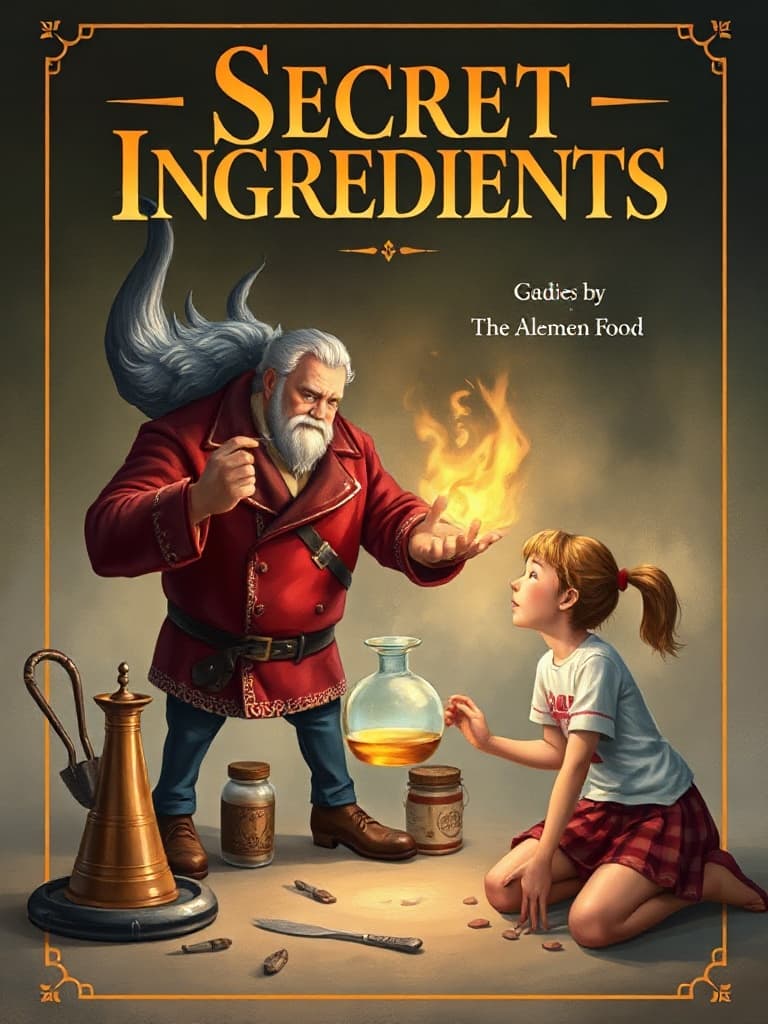
About this book
Secret ingredients
46
0
20
0
Create your own food recipe.
Chapters
- 1The Alchemist's Vanishing ActThe culinary world is abuzz with the sudden disappearance of the enigmatic chef known only as 'The Alchemist'. His famed restaurant is shuttered, leaving behind only a cryptic, handwritten note hinting at a legendary lost recipe, sparking immediate speculation and intrigue.
- 2Elara's Obsession IgnitedFood blogger Elara Vance, a devoted admirer of The Alchemist's genius, is captivated by the mystery. She pores over his past works, seeking any overlooked detail, and stumbles upon a peculiar symbol hidden within an old menu – a potential clue.
- 3A Symbol in the ScrapsElara deciphers the symbol as a marker for a specific, obscure culinary guild. This discovery fuels her belief that the lost recipe is real and tangible, and she resolves to follow this thread, no matter how obscure the path.
- 4Whispers of the GuildHer research leads Elara to hushed conversations about secret culinary societies. She learns of the 'Order of the Golden Spoon,' rumored to guard ancient gastronomic secrets, and suspects they hold the key to The Alchemist's whereabouts.
- 5The Rival EmergesSilas Thorne, a cutthroat chef known for his ambition, also learns of the lost recipe. He sees it as his ticket to ultimate fame and begins his own pursuit, viewing Elara as a naive competitor to be outmaneuvered.
- 6A Cryptic InvitationElara receives an anonymous, coded message, seemingly from within the Order. It contains a riddle pointing to a hidden location and a warning about those who seek the recipe for selfish gain.
- 7The Market of SecretsFollowing the riddle, Elara ventures into a clandestine night market catering to culinary elites. Here, rare ingredients are traded, and she encounters Silas, who attempts to intimidate her into revealing her findings.
- 8Isabelle's Subtle GuidanceElara meets Isabelle Dubois, an elegant woman connected to the Order. Isabelle offers cryptic advice, speaking of 'ingredients found not in jars, but in the hands,' subtly guiding Elara away from literal interpretations.
- 9The First Forgotten TechniqueIsabelle leads Elara to a hidden archive. She learns of 'sous-vide's' ancient ancestor: slow-cooking in clay pots sealed with herbs. Elara begins to grasp that the recipe might involve methods, not just ingredients.
- 10Silas's Blunt PursuitSilas, meanwhile, focuses on acquiring rare spices, believing a mythical 'Sunstone Pepper' is the secret ingredient. He ruthlessly interrogates informants, growing frustrated by his lack of progress.
- 11A Culinary CipherElara discovers a coded journal detailing The Alchemist's experiments. It speaks of 'infusing intention' and 'listening to the food,' further deepening the metaphorical nature of the quest.
- 12The Trial of PatienceIsabelle tasks Elara with a challenge: perfectly fermenting a simple vegetable. It requires immense patience and observation, skills The Alchemist valued above all else. Elara struggles but perseveres.
- 13A Confrontation in the KitchenElara and Silas converge at an abandoned artisan kitchen, both following separate clues. A tense standoff occurs as Silas demands Elara reveal what she knows, convinced she's hiding a physical ingredient.
- 14The Alchemist RevealedThe Alchemist appears, not as a prisoner, but as the orchestrator. He calmly reveals that the 'lost recipe' is a metaphor for rediscovering the soul of cooking, lost in modern culinary trends.
- 15The Secret Ingredient: PassionHe explains the 'secret ingredient' is forgotten passion, innovation, and a deep connection to the food. The ancient techniques Elara has been learning are merely vessels for this essential element.
- 16Silas's BlindnessSilas, focused on tangible results, dismisses The Alchemist's words as poetic nonsense. He storms off, determined to find a 'real' ingredient, missing the profound truth.
- 17A New Culinary PhilosophyThe Alchemist shares his personal journey of disillusionment and his desire to reignite culinary creativity. He sees Elara's earnest pursuit as a sign that his message can still resonate.
- 18The Alchemist's LegacyThe Alchemist entrusts Elara with his story, not a recipe. He encourages her to share the *meaning* behind his quest, to inspire others to find their own culinary voice and passion.
- 19Elara's MasterpieceElara returns, not with a dish, but with a compelling narrative. She publishes her experience, detailing her journey and The Alchemist's philosophy, transforming her blog into a platform for culinary inspiration.
- 20A Resurgence of SoulHer story goes viral, sparking a movement. Young chefs, inspired by Elara's account, begin experimenting with forgotten techniques and infusing their dishes with renewed passion, ushering in a new era of authentic cuisine.
More Other stories
Browse all Other →- Vladislaus and Katja: An Unfinished Portrait
The Vampyre King Vladislaus and His Queen Katja have carried for over 600 years the profound loss of all of their small children who perished from the black death and the Ottoman Army.. nothing can consul them only their great love for one another keeps them sane. King Vladislaus seeks vengeance but Katha tries Her best to keep Her King calm but will She succeed???
- The Complete History of Poenari Castle ( Before and after Vlad)
I, Amy Kathryn Allen, an going to tell You the complete history of Poenari Castle stone by stone,blood,sweat and tears..not much happeniess,so many fears...
- Cache Valley Hearth: Pioneer Recipes from Utah's Fertile Land
Let's Cook like the Pioneers of Old Cactus Valley Utah....Good morning, Amy! What a wonderful addition this would make to your manuscript collection. Pioneer and settler cooking is one of the most honest, resourceful culinary traditions in American history — food born of necessity, ingenuity, and sheer grit.🪵 Pioneer & Settler Recipes of the American West🌾 About Pioneer CookingSettlers traveling the Oregon, California, and Santa Fe Trails — and those who homesteaded the Great Plains and Rocky Mountain West — cooked under extraordinary constraints. They had no refrigeration, limited fuel, and carried only what a wagon could hold. Their pantry staples were cornmeal, dried beans, salt pork, lard, dried fruit, coffee, sugar, vinegar, and flour. They foraged, hunted, and traded with Native peoples along the way. Every recipe below is historically grounded in what real pioneers actually made.🔥 Trail & Camp CookingHardtack (Trail Bread / Pilot Bread)The most essential food on any wagon train — dense, nearly indestructible, and sustaining.Ingredients:•2 cups all-purpose flour•1 tsp salt•½ cup water (approximately)Instructions:1.Mix flour and salt together in a bowl.2.Add water gradually, mixing until a stiff, dry dough forms — it should not be sticky.3.Roll out to about ½ inch thickness on a floured surface.4.Cut into 3×3 inch squares.5.Using a nail, skewer, or fork, punch a grid of holes across each square — 4 rows of 4 holes. This prevents puffing and helps it dry evenly.6.Bake in a Dutch oven or cast iron skillet over a low fire, or in a modern oven at 375°F (190°C) for 30 minutes per side, until completely dry and hard.7.Cool completely before storing. Properly dried hardtack keeps for months.Pioneer Notes: Pioneers softened hardtack by soaking it in coffee, water, or bean broth. It was also crumbled into stews and soups as a thickener.Johnnycakes (Journey Cakes / Corn Dodgers)A cornmeal flatbread cooked directly on a griddle or flat stone — one of the oldest American trail foods.Ingredients:•1 cup stone-ground cornmeal (white or yellow)•½ tsp salt•1 tsp sugar (optional — many pioneers omitted this)•¾ cup boiling water•2 tbsp lard or bacon drippings, plus more for the panInstructions:1.Combine cornmeal, salt, and sugar in a bowl.2.Pour boiling water over the cornmeal and stir well. Let stand 5 minutes.3.Stir in the lard. The batter should be thick and hold its shape.4.Heat a cast iron skillet or griddle over medium heat. Grease lightly with lard.5.Drop spoonfuls of batter onto the griddle and flatten slightly to about ½ inch thick.6.Cook 4–5 minutes per side until golden brown and crisp on the outside.7.Serve hot with molasses, honey, or alongside beans and salt pork.Pioneer Notes: On the trail, these were sometimes baked on a flat rock beside the fire or wrapped around a green stick and held over the coals.Chuck Wagon BeansThe backbone of the cowboy and settler diet — slow-cooked, smoky, and deeply satisfying.Ingredients:•2 cups dried pinto beans (or navy beans)•½ lb salt pork or thick-cut bacon, cut into chunks•1 medium onion, roughly chopped•2 tbsp molasses•1 tbsp brown sugar•1 tsp dry mustard•1 tsp salt•½ tsp black pepper•Water to coverInstructions:1.Soak beans overnight in cold water. Drain and rinse.2.Place beans in a large Dutch oven or heavy pot. Cover with fresh water by 2 inches.3.Add salt pork and onion.4.Bring to a boil, then reduce to a low simmer. Cook 1 hour.5.Add molasses, brown sugar, mustard, salt, and pepper. Stir well.6.Continue simmering, partially covered, for another 2–3 hours until beans are completely tender and the broth has thickened. Add water as needed to keep beans submerged.7.Taste and adjust salt before serving.Pioneer Notes: On the trail, this pot was buried in a fire pit with coals above and below — a primitive slow cooker that could cook all day while the wagon moved.Salt Pork and Cornmeal MushA humble, filling staple eaten morning and night across the frontier.Ingredients:•1 cup stone-ground cornmeal•4 cups water•1 tsp salt•¼ lb salt pork, sliced thin•Molasses or maple syrup for servingInstructions:1.Bring water and salt to a boil in a heavy pot.2.Slowly pour in cornmeal while stirring constantly to prevent lumps.3.Reduce heat to very low. Cook, stirring frequently, for 20–25 minutes until thick and pulling away from the sides of the pot.4.Meanwhile, fry salt pork slices in a cast iron skillet until crisp and golden.5.Serve mush in bowls topped with salt pork and drizzled with molasses.Pioneer Notes: Leftover mush was poured into a pan, allowed to set overnight, then sliced and fried in lard the next morning — a dish called fried mush that was a beloved breakfast across the frontier.🍲 Homestead CookingPrairie Chicken StewSettlers hunted prairie chickens, grouse, and wild turkey throughout the Great Plains and Rocky Mountain West. This is a classic one-pot stew.Ingredients:•1 whole chicken, cut into pieces (or 2–3 lbs bone-in chicken pieces)•3 medium potatoes, peeled and cubed•2 carrots, sliced•1 large onion, chopped•2 stalks celery, sliced (if available)•2 tbsp lard or bacon drippings•1 tsp salt•½ tsp black pepper•1 tsp dried thyme or sage•4 cups water or broth•2 tbsp flour mixed with ¼ cup cold water (for thickening)Instructions:1.Heat lard in a large Dutch oven over medium-high heat.2.Brown chicken pieces on all sides. Remove and set aside.3.Add onion and celery to the pot. Cook until softened, about 5 minutes.4.Return chicken to the pot. Add potatoes, carrots, salt, pepper, and herbs.5.Pour in water or broth to cover.6.Bring to a boil, then reduce to a simmer. Cook 45 minutes to 1 hour until chicken is falling off the bone.7.Stir in the flour-water mixture and simmer another 10 minutes until the broth thickens.8.Taste and adjust seasoning. Serve with johnnycakes or cornbread.Sourdough BiscuitsPioneers maintained sourdough starters for months on the trail — a living culture of wild yeast that required no commercial leavening.For the Sourdough Starter (begun 3–5 days ahead):•1 cup flour•1 cup warm water•Mix together in a crock or jar. Leave uncovered in a warm place. Feed daily with equal parts flour and water until bubbly and active.For the Biscuits:•1 cup active sourdough starter•1½ cups flour•½ tsp salt•½ tsp baking soda•2 tbsp lard or butterInstructions:1.Mix flour, salt, and baking soda together.2.Cut in lard until mixture resembles coarse crumbs.3.Stir in sourdough starter until a soft dough forms. Do not overwork.4.Turn out onto a floured surface. Pat to ¾ inch thickness.5.Cut into rounds with a tin cup or biscuit cutter.6.Place in a greased Dutch oven or cast iron skillet.7.Bake covered over medium coals (or in a modern oven at 425°F / 220°C) for 15–20 minutes until golden.Dried Apple Stack CakeOne of the most beloved pioneer desserts — layers of thin gingerbread cake filled with spiced dried apple filling. Settlers brought dried apples in barrels across the plains.For the Cake Layers:•3 cups flour•½ cup sugar•½ cup lard or butter•½ cup molasses•1 egg•½ cup buttermilk (or soured milk)•1 tsp baking soda•1 tsp ginger•½ tsp cinnamon•½ tsp saltFor the Dried Apple Filling:•2 cups dried apples•2 cups water•½ cup brown sugar•1 tsp cinnamon•½ tsp allspice•¼ tsp clovesInstructions — Filling:1.Simmer dried apples in water until completely soft, about 30 minutes.2.Mash or chop finely. Stir in brown sugar and spices.3.Cook another 10 minutes until thick. Cool completely.Instructions — Cake:1.Cream lard and sugar. Beat in egg and molasses.2.Mix dry ingredients separately. Alternate adding dry ingredients and buttermilk to the wet mixture.3.Divide dough into 6 equal portions. Roll each into a thin round to fit a 9-inch skillet.4.Bake each layer in a greased cast iron skillet at 350°F (175°C) for 8–10 minutes until just set.5.Stack layers with apple filling spread between each one.6.Wrap the finished cake and let it rest overnight — the layers absorb the filling and the cake becomes moist and deeply flavored.Vinegar PieWhen lemons were unavailable — which was almost always on the frontier — settlers made a tart, custard-style pie using apple cider vinegar.Ingredients:•1 unbaked pie crust (see below)•3 eggs•1 cup sugar•2 tbsp apple cider vinegar•2 tbsp flour•1 tbsp butter, melted•1 cup water•½ tsp vanilla (if available)•Pinch of nutmegFor the Pioneer Pie Crust:•1½ cups flour•½ tsp salt•½ cup lard•3–4 tbsp cold waterMix flour and salt. Cut in lard until crumbly. Add cold water one tablespoon at
- Mehmet II : The Conquerer who remade the World
In this novel I,Amy Kathryn Allen,will em ark on a historical journey that tells Us the true history of Mehmet II,Vlad the Impaler,Radu the Handsome and the Rise of Constantinople and the Ottoman Empire
- The Art of Our Enemy
So a boy and girl are enemies but then the moment arrives when they became lovers for not remembering they were enemies in they childhood
- My Voice, My World: Poetry Unbound. In Multiple Languages For You
Create your own art.Wild SymphonyIn forests deep where shadows play, The timber wolves begin their song, While black bears lumber through the day And mountain lions prowl along.Red foxes dart through underbrush, Their copper coats like autumn flame, As raccoons wash in waters hushed And deer step light without a name.The great horned owl calls through the night, While possums waddle, slow and round, And bobcats stalk with silent might Across the moss-covered ground.On plains that stretch beyond the eye, Where golden grasses bend and sway, The bison thunder, heads held high, And pronghorn leap throughout the day.Coyotes sing their wild refrain To stars that pierce the endless sky, While prairie dogs across the plain Stand sentinel as hawks fly by.The elk bugle their ancient call, Wild horses run with manes unfurled, And jackrabbits, both short and tall, Dance free across this untamed world.From forest floor to prairie wide, These creatures claim their sacred space, In wilderness they run and hide— Wild spirits time cannot erase.
Want to write a story like this?
Learn the craft in our free AI story generator, then draft your first chapter with an AI co-writer.
What stayed with you?
Read a chapter and leave the author a comment.
Reader notes
Loading reader notes…