Story overview
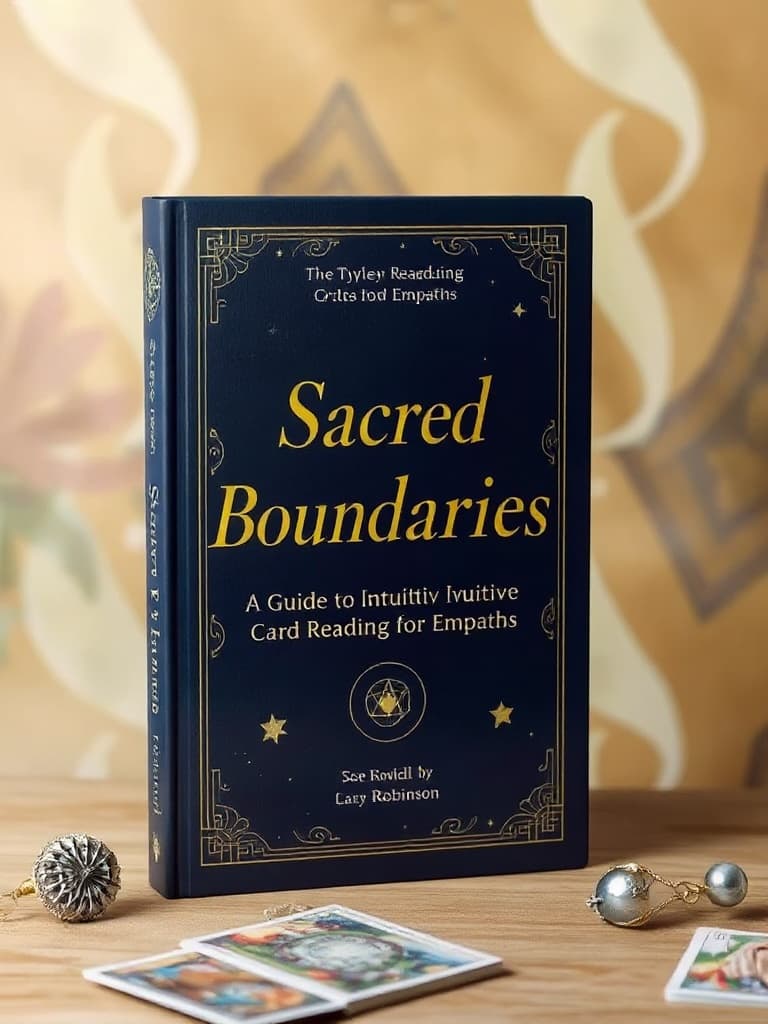
Sacred Boundaries: A Guide to Intuitive Card Reading for Empaths
15
0
9
published
Sacred Boundaries: A Guide to Intuitive Card Reading for Empaths Dedication For Tyler Coy Robinson. In navigating the unseen energies of this life, I have always looked to you as my true north. This book is a labor of love, dedicated to the light you brought into the world and the lasting impact you continue to have on mine. Introduction: The Empathic Anchor If you are reading this, you know the exhaustion. You have spent your life acting as a human emotional lightning rod, absorbing charges that were never meant for you. You are not broken. You are a high-bandwidth receiver operating without a firewall. This book is the blueprint for your renovation. We are not using cards to "predict the future"; we are using them as diagnostic tools to run diagnostics on your internal state. You are moving from a state of absorption to a state of stewardship. Welcome to Sacred Boundaries. It’s time to stop absorbing and start building. Chapter 1: Beyond Fortune Telling Tarot began as a game; it only became "mystical" much later. We are stripping away the parlor tricks. Psychologically, cards are a visual language for the subconscious—a standardized testing kit for your intuition. As a builder, I view these as an interface. You are not "divining"; you are forcing the system to focus on one point of data to slow down the input and organize the noise. Chapter 2: The Empathic Lens You are a "parallel processor." While others process events one by one, you take in everything at once. This leads to system overload. Tarot and Oracle cards act as your input filter. They help you throttle the connection, choosing one packet of data at a time to analyze. This moves you from passive absorption to active stewardship of your own energy. Chapter 3: Choosing Your Vessel Don’t follow "rules" about how you get a deck. Choose a tool that fits your hand and your frequency. 1. Visual Clarity: Does the imagery clear your mind or clutter it? 2. Tactile Response: Does it feel substantial? 3. Energetic Compatibility: Does it feel like a stormy room or an open space? Commit to one deck for 90 days. You cannot calibrate a tool if you are constantly switching it out. Chapter 4: Energetic Hygiene You cannot apply a finish over dirt. Before you read, you must prep the site: 1. Discharge: Shake off your hands to release residual static. 2. Ground: Put your feet flat on the floor. Acknowledge your physical space. 3. Define: Set your perimeter. Declare: "Only my information. Only my truth." Chapter 5: The Language of Symbols Stop memorizing guidebooks. They are the legend, not the blueprint. Perform a Visual Audit: • The Subject: Who or what is the main focus? (Internal state vs. external tool). • The Action: What is the flow? (Blockage vs. momentum). • The Environment: What is the climate? (External pressure). Trust your eyes. Your brain is already wired to recognize these patterns. Chapter 6: The Ritual of Completion The "One and Done" principle is your firewall against analysis paralysis. Pulling card after card creates static, not clarity. • The Closing Ritual: Acknowledge the data, physically put the deck away, and ask: "What is the one concrete action I am going to take today?" • Closing the deck is a signal to your nervous system that the assessment phase is over and the execution phase has begun. Chapter 7: The Boundary Spreads Use these specialized protocols for common structural failures: • The Morning Shield: Define your perimeter before the day begins. • The Empathic Sieve: Decompress after heavy interactions. Identify the debris, the source, and the required release. • The "What Is Mine to Carry?" Spread: A two-card diagnostic to separate the external weight from the work you are actually responsible for. Chapter 8: Integration and Action Data without execution is just information. You must act within your "construction window" of clarity. 1. Translate: Identify the one specific action (not just a feeling). 2. Commit: Attach a timeline. Do it or schedule it within 24 hours. 3. Execute: Perfection is not required. Autonomy is. If you pull a card but do not change your behavior, you are engaging in spiritual bypassing. Use the cards to change your life, not to rationalize staying in a pattern. Chapter 9: The Ethics of Empathy The "Savior Complex" is a structural hazard. When you steal someone’s struggle, you rob them of their strength. True empathy is recognizing another’s capacity to solve their own problems while you maintain your own integrity. You are the architect of your own energy. The most ethical thing you can do for the world is to stay fully charged, fully grounded, and fully in control of your own boundaries. Conclusion The cards are the tools; the protocols are the blueprints. The real work happens when you close the deck, walk away from the table, and step into the world as a person who knows who they are, where they end, and where the world begins. You are the builder. You are the architect. And you are, at long last, home.
Table of contents
- 1Chapter 1: Unveiling the Symbolic InterfaceMove beyond fortune-telling myths. Understand cards as a psychological tool, a visual language for the subconscious, and an interface to organize energetic noise, enabling focused diagnostics of your internal state.
- 2Chapter 2: The Empath's Input FilterLearn how cards act as an 'input filter' for your empathic 'parallel processing.' This helps throttle overwhelming energetic connections, allowing you to analyze data packets one by one for active energy stewardship.
- 3Chapter 3: Selecting Your Energetic CompassDiscover how to choose a deck that resonates energetically. Focus on visual clarity, tactile response, and intuitive compatibility. Commit to one deck for 90 days to calibrate your tool effectively.
- 4Chapter 4: Establishing Energetic GroundworkImplement essential energetic hygiene practices before reading: discharge residual static, ground yourself physically, and set a clear energetic perimeter by declaring your personal information only.
- 5Chapter 5: Decoding the Visual LexiconShift from memorizing guidebooks to performing a 'Visual Audit.' Analyze the subject, action, and environment within card imagery, trusting your brain's innate pattern recognition for intuitive understanding.
- 6Chapter 6: The 'One and Done' RitualEmploy the 'One and Done' principle to prevent analysis paralysis. Conclude readings with a closing ritual, physically putting the deck away to signal the end of assessment and the start of execution.
- 7Chapter 7: Navigating Structural Failures with SpreadsUtilize specialized spreads like the 'Morning Shield,' 'Empathic Sieve,' and 'What Is Mine to Carry?' to manage daily energy, decompress from interactions, and differentiate external burdens from personal responsibility.
- 8Chapter 8: Translating Insight into AutonomyBridge the gap between data and action. Translate card insights into one specific, actionable step, commit to a timeline within 24 hours, and execute to avoid spiritual bypassing and foster true autonomy.
- 9Chapter 9: Ethical Stewardship of EnergyRecognize the 'Savior Complex' as a hazard. Practice ethical empathy by maintaining your own integrity, staying charged and grounded, and empowering others to solve their own problems.
More Non-fiction stories
Browse all Non-fiction →- The Perils of Pure Intention
A man who reported a crime but ended up being jailed because false accusations, leading to him to 10 years in prison leaving her new baby girl to a single mother alone
- The God-Given Gift: Inspiring Acts of Altruism
Wickenel Chivhayo a man with God given gift of giving. But not being recognized by people because of him being in the ruling party in Zimbabwe. Even pastors of another denominations have failed to act like him to their followers. His church being labeled as poor he has raised his fellow congregates by supporting with money just like in the book of acts in the Bible
- The True Heroic People Throughout Cache Valley Utah 1700-1899
I,Amy Kathryn Allen,am writing today about the Brave American Indian and Pioneer People who lived throughout Cache Valley Utah. This book entails their heroic actions from 1700-1899
- Footprints in the Dust: Remembering Alvin
I want too tell a story about my Lil Brother, sometimes I still can't sleep at night. The memories of the past hurt deep in my soul. I can remember my lol Brother and Lashawn were celebrating being the number one crew out there, were untouchable and invincible. It was like the enemy came out of the moon and hit us with a devastating blow, we're always prepared for anything or anybody. Gang task forces wanted us so bad and the streets did also. I can remember how we stayed 10 steps ahead of everything that could hit us, or so we thought. Ican remember the last time we spoke it's taken me it was almost 26 years ago, it took a great part of me and I've never been the same ever since. Alvin was the toughest person you could have protecting you, if you had a problem with me he had a problem with you. T
- Taming the Current: A Hydroelectric Revolution
Placing hundreds of eco friendly hydro electric turbines into one river!
- Amy Kathryn Anna's Complete Guide to Living Off the Land
I was left on many occasions to fend for Myself by learning to do this I taught My Son how to fish,hunt and survive. My Daughter never wanted to learn... Because of my tenacity and My strong desire to prove everyone wrong I did it .... Always remember to have with You a fully stocked First Aid Kit and solar powered Radios ,flashlights etc because batteries do not last long. Always have a few flints and multifunction tool with You . You can never have too many knives and wet stones..if possible have glucose.salt and quinine tablets with You. Always have 3 months of prescriptions on hand and away to collect and carry water Before You start Your adventure.kayer on clothes. Lots and lots of Sunscreen .... For thirst have hard sour candy ,for sugar emergency have hard sweet candy. Always keep face ,arms,eyes ,legs covered and wear proper hiking footwear Always have a snake / spider bite kit. Ideally travel with more than 1 other person...Have someone in Your group know CPR and First Aid.
Want to write a story like this?
Learn the craft in our free AI story generator, then draft your first chapter with an AI co-writer.