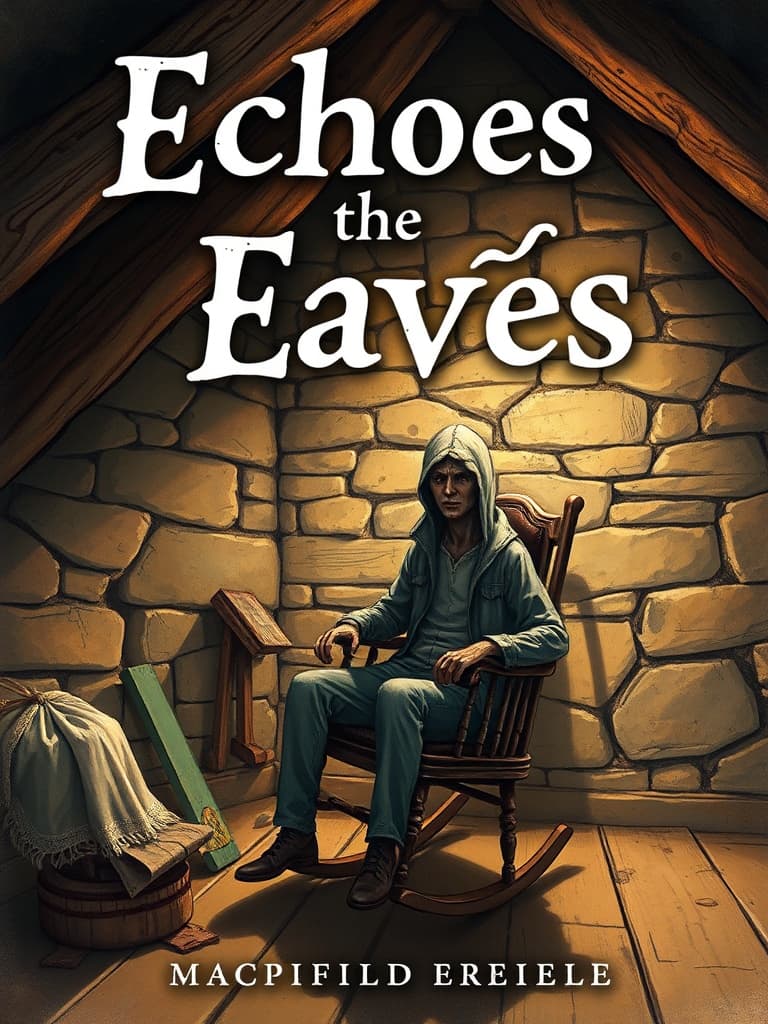
About this book
Echoes in the Eaves: A Mummified Chronicle
91
0
20
0
Back in 1969 My Family visited an Antique shop on Main Street in Knoxville Tennessee.Befire it was an antique shop it was a funeral home long before the Cil War until the late 1950s . Up in the attic which was now an open sales room for the shop sitting in the back corner in a rocking chair was what looked to be a mahogany wood carving of a large man...My brother and I had touched it and asked the owner ..it was then We learned the horrific truth it was a perfectly mummified man who naturally in its own turned into wood..needless to say Jeff and I ran screaming to Our Parents car ...
Chapters
- 1The Serpent's Coil of SummerThe year is 1969. The air in Knoxville, Tennessee, hangs thick and heavy, a syrupy blend of honeysuckle and pre-storm humidity, a quintessential Southern summer day that promises endless childhood adventures. For ten-year-old Jeff and his older brother, the narrator (let's call him Alex, for narrative ease, though he remains unnamed in the original prompt), this particular sweltering afternoon is ripe for exploration. Their parents, seeking respite from the oppressive heat, have suggested a browse through the eclectic offerings of an antique shop on Main Street. This isn't just any shop; it's a building with a history that predates the brothers' young lives, a place that once served a solemn, somber purpose: a funeral home. The transition from mortuary to marketplace has left an indelible mark, a subtle, almost imperceptible aura of melancholy clinging to the aged wood and forgotten trinkets. The exterior, a faded Victorian facade, gives little hint of the deeper secrets within. Alex, already prone to a fascination with the unusual, feels an immediate, almost magnetic pull towards the building, a sense of anticipation that belies the mundane purpose of a shopping trip. Jeff, ever-eager to follow his older brother's lead, bounces with a mixture of excitement and trepidation. The shop's interior is a labyrinth of shadows and dust motes dancing in the shafts of sunlight that pierce the grimy windows. The scent of old paper, potpourri, and something indefinably musty permeates the air, a sensory overload that heightens the atmosphere of mystery. They move through the downstairs rooms, a kaleidoscope of antique furniture, porcelain dolls with vacant stares, tarnished silverware, and stacks of yellowed books. Each object seems to possess a story, a whisper of a life lived long ago. Alex finds himself drawn to the corners, the places where dust bunnies gather and shadows deepen, imagining hidden compartments and forgotten treasures. Jeff, meanwhile, is more captivated by the sheer volume of oddities, his eyes wide with wonder, occasionally nudging Alex with a whispered observation about a peculiar hat or a chipped teacup. Their parents are momentarily distracted, haggling over a brass lamp, leaving the brothers to their own devices. The building's former life as a funeral home is subtly present – a grand, dark staircase leading to the upper floors, the hushed reverence of the space, the inherent sense of stillness that even the bustling antique trade cannot entirely erase. Alex notices the way the light falls, creating long, distorted shadows that seem to writhe and shift, as if the building itself is breathing. He imagines the quiet processions, the somber ceremonies that once took place here, a stark contrast to the cheerful, if slightly eerie, present. The allure of the unknown is palpable, an invisible current drawing them deeper into the shop's embrace. They pass a particularly imposing grandfather clock, its chimes silent, its face frozen at a forgotten hour. Alex feels a pang of unease, a sense of time suspended, of moments trapped within the wood and brass. Jeff, sensing his brother's mood, grips his arm, his own nascent fears momentarily amplified by Alex's contemplation. The contrast between the vibrant, sun-drenched summer outside and the dim, history-laden interior creates a sense of entering a different realm, a place where the past is not merely remembered but tangibly present. The discovery of the attic, a space usually off-limits in such establishments, becomes the immediate, unspoken objective, a whispered pact between the two brothers as they exchange glances, their shared curiosity a silent, irresistible force pulling them towards the unknown.
- 2The Ascent to the UnseenThe imposing, dark wood staircase leading from the main floor of the antique shop beckons Alex and Jeff like a portal to another world. It’s a staircase that once carried the weight of grief and solemnity, now repurposed for the casual browsing of curious customers. The wood is worn smooth by countless feet, each step a silent testament to the building's long and varied history. As they ascend, the ambient noise of the shop downstairs fades, replaced by the creak and groan of the old timbers, a symphony of age and neglect. The air grows cooler, tinged with a different kind of dust, a more concentrated scent of forgotten things. The attic, Alex surmises, must be the ultimate repository of the shop’s cast-offs, the items too peculiar, too obscure, or too damaged to be displayed on the more accessible floors. He imagines it as a treasure trove, albeit one potentially filled with the mundane detritus of countless lives. Jeff, his hand tightly clutched in Alex’s, follows with wide, apprehensive eyes. His initial excitement has begun to wane, replaced by a growing sense of unease that seems to emanate from the very structure of the house. The attic is not a typical attic; it has been transformed into an extension of the sales floor, a sprawling, unpartitioned space under the eaves. Light filters in through a few dusty dormer windows, casting long, distorted shadows that dance and play tricks on the eyes. The space is less cluttered than the downstairs, with a deliberate arrangement of larger items – old furniture, stacked crates, and a few imposing pieces that seem to command the room. It’s here, in the furthest, dimmest corner, that their eyes fall upon it. It’s not merely a carving; it’s a figure, seated in a weathered, rocking chair, as if waiting for someone. The sheer size of it is striking, easily that of a full-grown man. The material, at first glance, appears to be dark, richly grained mahogany, intricately carved into the likeness of a seated male figure. The detail is astonishing – the folds of clothing, the suggestion of facial features, the posture of repose. Yet, there is something fundamentally unsettling about it, an unnerving stillness that transcends mere inanimate object. Alex feels a prickle of gooseflesh crawl up his arms. It’s not just the craftsmanship; it’s the unnerving realism, the way the light seems to be absorbed by its surface rather than reflected. It doesn't possess the smooth, polished sheen of typical wood carving. Instead, it has a matte, almost desiccated quality, as if it has aged for centuries, not merely been crafted. The rocking chair itself seems ancient, its wood warped and faded, adding to the tableau of forgotten time. Jeff, his fear now a tangible presence, shrinks closer to Alex. He whispers, “It looks… real, Alex. Too real.” Alex, though equally disturbed, feels a surge of morbid curiosity. He approaches cautiously, his sneakers silent on the dusty floorboards. The figure’s hands rest on the arms of the chair, carved with an unsettlingly lifelike texture, the knuckles prominent, the nails suggested. He can almost feel the texture of the wood beneath his fingertips, a texture that seems denser, more solid than he expects. He notices the subtle variations in grain, the way it seems to mimic the patterns of human skin and muscle. The face, though carved, possesses an almost vacant expression, as if the sitter has long since lost the capacity for emotion. It’s the quiet, the profound silence emanating from the figure that is most disturbing. It’s a silence that seems to absorb all other sound, creating a pocket of stillness within the already hushed attic. Alex glances at Jeff, whose face is pale, his eyes wide with a dawning horror. The initial excitement of exploration has curdled into a more primal emotion: fear. The figure in the rocking chair is not just a carving; it is an anomaly, a presence that defies easy explanation, and its silent vigil in the dusty attic of a former funeral home is a chilling prelude to a revelation that will forever mark their childhood memories. The narrative builds tension through the brothers' shared unease, the oppressive atmosphere of the attic, and the unsettling visual details of the carved figure, culminating in Alex’s decision to touch it, a gesture that will unleash the full horror of its identity.
- 3The Unveiling of Petrified FleshThe air in the attic crackles with a palpable tension. Alex, driven by an insatiable curiosity that often overrides his fear, reaches out a tentative hand towards the wooden figure. His fingertips brush against the carved surface. It’s not the smooth, cool feel of polished wood he expects. Instead, it’s strangely dry, almost brittle, with a texture that feels uncannily like aged, leathery skin stretched taut over bone. A shiver races down his spine, a visceral reaction to the unexpected sensation. Jeff, standing a few feet back, lets out a small, choked gasp, his eyes glued to his brother’s hand and then to the figure’s face. He whispers, his voice trembling, “Alex, don’t. It feels… wrong.” Alex pulls his hand back, a knot of unease tightening in his stomach. He looks closer, scrutinizing the details of the carving, the way the light catches certain planes, revealing textures that seem too organic, too lifelike for mere wood. The grain of the mahogany seems to swirl and twist in patterns that mimic musculature, the subtle indentations appearing like wrinkles or scars. It’s as if the wood itself has been shaped by an unseen force, imbued with a disturbing semblance of life. It is at this precise moment, as the brothers stand frozen in a mixture of awe and dread, that the shop owner appears. He seems to materialize from the shadows, his presence announced not by footsteps, but by a subtle shift in the atmosphere. He’s an older man, perhaps in his late sixties or early seventies, dressed in a tweed jacket that seems perpetually out of season. His eyes, behind thick spectacles, hold a peculiar glint – a mixture of weariness, wisdom, and something akin to morbid amusement. He observes the boys, his gaze lingering on their faces, then on the figure in the rocking chair. A slow, almost imperceptible smile plays on his lips. “Curious about my centerpiece, are we?” he asks, his voice a low, raspy murmur that seems to blend with the creaking of the old house. Alex, startled by the owner’s sudden appearance, stammers, “We… we thought it was a carving. A very good one.” The owner chuckles, a dry, rustling sound. “It is a carving, in a manner of speaking. But not in the way you might think.” He walks closer, his movements slow and deliberate, stopping beside the rocking chair. He places a hand, gnarled and liver-spotted, on the figure’s shoulder. The touch seems to have no effect on the stillness of the object. “This,” he begins, his voice dropping to a conspiratorial whisper, “is Bartholomew. Or what’s left of him.” Jeff whimpers, instinctively moving behind Alex. Alex, though his heart is hammering against his ribs, forces himself to meet the owner’s gaze. “What do you mean, ‘what’s left of him’?” he asks, his voice barely audible. The owner’s smile widens, revealing a set of surprisingly white teeth against his weathered face. “Bartholomew,” he explains, his tone matter-of-fact, almost clinical, “was a… resident. Back when this place was a funeral home. A very particular kind of resident.” He pauses, letting the implication hang in the air. “He died in a rather… unusual manner. And his body, well, it didn’t decay like most. It… changed. Over time. Slowly. The wood, you see, it’s not mahogany. It’s him.” The revelation hits Alex like a physical blow. The textural oddities, the unsettling realism, the profound stillness – it all clicks into place with horrifying clarity. This isn’t a carving. It’s a man. A mummified man, whose flesh and bone have somehow transformed, petrified, into something resembling wood. The concept is so alien, so grotesque, that Alex’s mind struggles to process it. He looks at Jeff, whose face is a mask of pure terror, his breath coming in shallow gasps. The owner watches them, his expression unreadable, as if he’s accustomed to this reaction. He seems to take a perverse pleasure in the horror he has just unleashed. “Naturally mummified,” the owner elaborates, as if providing a scientific explanation for a natural phenomenon. “And then… this. A transformation. Turned to wood, you might say. Perfectly preserved. A rather unique specimen, wouldn’t you agree?” The words “perfectly preserved” and “turned to wood” echo in Alex’s mind, each syllable a hammer blow against his fragile sense of reality. The image of Bartholomew, the man who became wood, is seared into his memory, a macabre tableau that will haunt his dreams for years to come. The owner’s calm, almost detached delivery only amplifies the horror, suggesting a familiarity with the unnatural that is deeply unsettling. The chapter ends with Alex’s mind reeling, struggling to comprehend the impossible truth, the foundation of his innocent understanding of the world irrevocably fractured by the owner’s chilling confession.
- 4The Screaming Dash for SanityThe owner's words hang in the dusty attic air, heavy and suffocating: 'Turned to wood.' The phrase reverberates in Alex’s mind, a grotesque echo of the impossible truth. His gaze snaps back to the figure in the rocking chair, no longer a peculiar carving but a horrifying testament to an unimaginable fate. The texture he felt, the unsettling stillness, the lifelike details – they are not the work of a craftsman, but the terrifying reality of a man transformed. His childhood perception of the world, a landscape of predictable rules and discernible dangers, shatters into a million irreparable pieces. He sees Bartholomew not as an object, but as a victim, trapped in an eternal, petrified state. The realization is too much, too profound, too terrifying for his ten-year-old mind to fully process. Beside him, Jeff lets out a strangled cry, a sound of pure, unadulterated terror. His eyes are wide, fixed on the mummified figure, his small body trembling uncontrollably. The fear that had been simmering beneath the surface erupts, overwhelming any semblance of curiosity or bravery. He clutches Alex’s arm with a vice-like grip, his nails digging into his brother’s skin. “We have to go, Alex! NOW!” Jeff’s voice is shrill, a desperate plea that cuts through Alex’s own daze. The owner, his expression unchanging, merely watches them, a faint, almost imperceptible nod of understanding in his eyes. He seems to anticipate their reaction, as if this is a predictable outcome, a standard response to the unveiling of Bartholomew. Alex, jolted by Jeff’s raw panic, feels a primal instinct surge through him: escape. The antique shop, once a place of potential wonder, has transformed into a den of horrors. The shadows in the attic seem to deepen, the silence to press in on them, and the figure of Bartholomew, forever frozen in his rocking chair, feels like a silent, watchful guardian of unspeakable secrets. He doesn’t need to articulate the decision; it’s an unspoken pact, a shared, visceral need to flee. “Run!” Alex shouts, his own voice cracking with a fear he has never known. He pulls Jeff along, his grip tight, propelling them towards the staircase. They stumble, their feet clumsy in their haste, the creaking of the attic floorboards sounding like frantic whispers chasing them. The owner makes no move to stop them, no attempt to reassure or explain further. He remains a silent, enigmatic figure, his knowledge of Bartholomew a heavy burden that seems to weigh down the very air around him. The brothers scramble down the stairs, their descent a chaotic, breathless rush. The familiar sights of the downstairs antique shop now seem alien and menacing. The porcelain dolls’ stares are accusatory, the antique furniture looms like silent sentinels, and the scent of old things is now laced with the phantom odor of decay and petrification. They burst through the front door, the bright afternoon sun a jarring contrast to the gloom they have just escaped. The familiar street outside, filled with the sounds of normal life – children playing, cars passing, distant laughter – offers a fleeting sense of normalcy, a stark reminder of the world they are desperately trying to return to. But the image of Bartholomew is seared into Alex’s mind, an indelible imprint of the impossible. His brother, Jeff, is already halfway to their parents’ car, a small, terrified figure running with all his might. Alex follows, his own legs pumping, his lungs burning. He glances back at the antique shop, its facade now seeming more sinister, more foreboding than ever. The building holds its secrets close, the attic a silent vault containing the petrified man. As they reach the car, fumbling with the door handles, the sheer terror of the experience washes over Alex in a fresh wave. He sees the chipped paint on the car, the familiar worn upholstery, and feels a desperate need for the comfort of the mundane, the predictable. But he knows, with a certainty that chills him to the bone, that the world he knew before entering that shop no longer exists. The innocence of that summer afternoon has been irrevocably stained by the macabre reality of Bartholomew, the man turned to wood. The chapter culminates with the brothers scrambling into their parents' car, the image of Bartholomew and the owner’s chilling words echoing in their minds, their flight a desperate, physical manifestation of their shattered innocence and the dawning of a lifelong haunting.
- 5The Lingering Shadow of BartholomewThe summer of 1969 fades into a kaleidoscope of childhood memories, each one tinged with the indelible, unnerving image of Bartholomew, the man who became wood. For Alex, the narrator, the encounter in the antique shop’s attic is not a fleeting childhood fright; it’s a foundational trauma, a moment that lodges itself deep within his psyche, festering and growing with the passage of time. Years bleed into decades. Alex leaves Knoxville, pursuing a life far removed from the humid charm and shadowed histories of his hometown. He builds a career, forms relationships, and attempts to bury the unsettling memory beneath the weight of adult responsibilities. Yet, Bartholomew remains. He exists not as a clear, distinct memory, but as a persistent, nebulous dread, a shadow that flickers at the periphery of Alex’s consciousness. It manifests in unexpected ways: a sudden chill on a warm day, an inexplicable aversion to antique furniture, a recurring dream of dusty attics and silent, staring figures. The fear he felt as a child, the sheer visceral terror, has evolved into a deep-seated, almost existential unease. This unease, over time, coalesces into an obsession. The unanswered questions surrounding Bartholomew begin to gnaw at him. Who was he? How did this impossible transformation occur? What did the antique shop owner know? The mystery, once a source of pure terror, now becomes a puzzle, a dark enigma that Alex feels compelled to solve. It’s more than just intellectual curiosity; it’s a deeply personal quest, a need to confront the ghost of his own shattered innocence. He finds himself drawn back to Knoxville, not for any specific reason initially, but as if guided by an unseen force. The city, once a backdrop to a single terrifying event, now holds the key to unlocking a lifelong mystery. He revisits Main Street, the antique shop a distant memory, perhaps gone, perhaps transformed itself. The building’s physical presence, if it still exists, holds a magnetic pull. He feels a strange sense of responsibility towards Bartholomew, a silent obligation to give voice to the man trapped in petrified silence. This obsession is not easily explained. It’s a compulsion that disrupts his daily life, coloring his thoughts and influencing his decisions. He starts researching, poring over old newspaper archives, local history books, anything that might shed light on the building's past. The funeral home aspect, once a detail that added to the creepiness, now becomes a focal point. He wonders about the types of people who might have been served by such an establishment, the kinds of lives and deaths that might have occurred within its walls. The owner, too, becomes a significant figure in his obsessive quest. The man’s unnerving calm, his matter-of-fact delivery of such a horrific revelation, suggests a deeper knowledge, perhaps even a complicity, that Alex cannot ignore. He remembers the owner's unsettling smile, the peculiar glint in his eyes. Was he merely a purveyor of morbid curiosities, or something more? The obsession is a double-edged sword. It drives Alex forward, fueling his determination, but it also isolates him. He finds it difficult to articulate the depth of his fixation to others. How can he explain that the memory of a mummified man, encountered briefly in childhood, has become the defining quest of his adult life? The haunting is no longer just about the fear of the unknown; it’s about the need to understand, to bring order to the chaos that Bartholomew represents. The chapter traces the evolution of Alex's childhood terror into adult obsession, highlighting the persistent nature of the memory and the compelling, almost magnetic, pull that draws him back to the source of his trauma. It establishes his current state of mind – determined, haunted, and driven by an insatiable need for answers, setting the stage for his deeper investigation into the building's dark history.
- 7Whispers in the ArchivesAlex’s investigation deepens as he delves into the more obscure corners of Knoxville’s history, seeking fragments of information that might illuminate Bartholomew’s existence. The initial broad strokes of the funeral home’s history are proving insufficient. He needs specifics, names, dates, anything that can anchor the phantom to a tangible past. His trips to the library archives become more frequent, his research more focused. He begins to examine property records, building permits, and old business licenses, looking for clues about the funeral home’s proprietors and any significant events associated with the property. He discovers that the funeral home, established long before the Civil War, had changed hands several times, each owner adding their own chapter to its legacy. The most recent owner before its conversion to an antique shop, a Mr. Silas Croft, becomes a primary subject of Alex’s inquiry. Croft managed the funeral home for nearly three decades, from the late 1920s until its sale in the late 1950s. Alex finds sparse personal information about Croft, suggesting a man who valued his privacy, much like the owner Alex encountered in 1969. However, he does find old newspaper clippings detailing Croft’s business practices – his meticulous attention to detail, his reputation for handling difficult cases with utmost discretion. This discretion, Alex suspects, might have extended to matters far more unusual than standard mortuary services. He also begins to uncover fragmented accounts from older residents, piecing together local lore that often surrounds places of death and mourning. These stories are often contradictory and tinged with superstition, but a recurring theme emerges: the funeral home was known for handling ‘difficult’ bodies, individuals whose preservation presented unusual challenges. Some tales speak of bodies that resisted embalming, others of peculiar decomposition patterns. These whispers, initially dismissed by Alex as folklore, begin to gain weight as he considers Bartholomew’s unique state. He starts cross-referencing names and dates, trying to connect these vague accounts to any specific families or individuals who might have been associated with the funeral home during Croft’s tenure. He learns of a prominent local family, the Abernathys, who suffered a significant loss around the mid-1940s. A young man, Elias Abernathy, died under mysterious circumstances, and his death was reportedly accompanied by rumors of strange rituals and an unusual desire for his body to be preserved in a specific manner. Alex feels a jolt of recognition; the Abernathy name has surfaced in a few of the more hushed conversations he’s had with older townsfolk. He tracks down descendants of the Abernathy family, approaching them with caution and framing his inquiry as a historical research project. He finds a reclusive elderly woman, Eleanor Abernathy, Elias’s younger sister, who is initially hesitant to speak. However, Alex’s persistent, yet respectful, demeanor eventually loosens her tongue. Eleanor, her voice frail but her memories sharp, recounts the profound grief and shock surrounding Elias’s death. She speaks of his fascination with ancient preservation techniques, his morbid curiosity about the body’s resilience, and his expressed wishes for a unique burial that would ensure his ‘lasting presence.’ She reveals that Elias was a man of peculiar interests, often spending time alone in the woods surrounding their family’s farm, dabbling in obscure texts and experimenting with natural remedies and preservation methods. Eleanor recalls their parents’ distress over Elias’s eccentricities and their eventual, reluctant agreement to honor his final wishes as best they could, entrusting his care to Silas Croft and his funeral home. She mentions that the funeral home was chosen specifically because of Croft’s reputation for handling ‘special cases’ with absolute confidentiality. Eleanor admits that the circumstances surrounding Elias’s death were never fully explained, adding to the family’s enduring pain and confusion. She also recalls her parents’ hushed conversations, their guilt, and their eventual decision to move away from Knoxville shortly after Elias’s interment, seeking to escape the painful memories. Alex listens intently, the pieces of the puzzle beginning to fall into place. Elias Abernathy, the eccentric young man with a fascination for preservation, his mysterious death, his peculiar wishes, and Silas Croft’s discreet handling of the situation – it all aligns alarmingly with the existence of Bartholomew. The chapter ends with Alex feeling a profound sense of discovery, a chilling certainty that he is on the verge of uncovering the truth about Elias Abernathy, the man who may have become the mummified figure in the rocking chair. The narrative focuses on the painstaking process of historical research, the importance of oral history, and the gradual piecing together of a narrative from fragmented clues. The emotional stakes are raised as Alex connects with a living descendant, bringing the past into the present with poignant effect. The ending hook leaves the reader anticipating the confirmation of Elias Abernathy’s identity and the details of his fate.
- 8The Proprietor's Cryptic VeilArmed with the tantalizing possibility that Elias Abernathy is the man known as Bartholomew, Alex’s next logical step is to seek out the antique shop owner he encountered in 1969. The owner, who he recalls only as a nondescript older man, represents the last direct link to the moment of revelation. Alex knows finding him might be difficult; decades have passed, and businesses, like people, change. He begins by inquiring at the current antique shop, hoping the new owners might have information about their predecessor. This leads him on a small trail, a series of referrals and dead ends, until he finally learns the owner’s name: Mr. Abernathy. The irony is not lost on Alex; the name echoes the family he’s been investigating. He discovers that the owner, whose full name is Arthur Abernathy, was Silas Croft’s nephew and had inherited the antique shop, and possibly some of its more peculiar contents, from his uncle. Arthur, Alex learns, had worked with Silas at the funeral home during its final years, giving him a unique perspective and direct knowledge of its operations, including whatever transpired with Elias. Locating Arthur proves challenging. He’s described as a private man, someone who keeps to himself. Alex eventually finds him living in a modest, secluded house on the outskirts of Knoxville. Arthur Abernathy is now an elderly gentleman, his sharp features softened by age, but his eyes still hold that same unsettlingly calm, knowing glint Alex remembers. Alex approaches him cautiously, explaining his long-standing fascination with the mummified man and his research into the building’s history. He mentions the name Elias Abernathy, and Arthur’s demeanor shifts subtly. A flicker of recognition, perhaps a hint of weariness, crosses his face. He invites Alex inside, a testament to his own sense of historical duty or perhaps a desire to finally unburden himself. The interior of Arthur’s home is filled with antiques, meticulously arranged, but without the chaotic clutter of the shop. It feels curated, each object holding a story. Arthur offers Alex a cup of tea, and they begin to talk. Alex lays out his findings, his theory about Elias Abernathy, and his childhood memory of the encounter. Arthur listens patiently, nodding occasionally, his silence punctuated by long pauses. When Alex asks directly about Bartholomew, Arthur sighs. “Bartholomew,” he repeats, the name sounding foreign on his tongue. “That was Silas’s… nickname for him. A morbid joke, I suppose, for the man who became wood.” Arthur confirms that Elias Abernathy was indeed the individual in question. He explains that Silas Croft, his uncle, was a man fascinated by the darker aspects of mortality and preservation, a man who possessed an uncanny understanding of chemistry and natural processes. Elias, Arthur explains, was Silas’s secret project, a willing participant in an experiment that blurred the lines between life and death. Arthur recounts how Elias, ill and facing a slow, painful demise, had approached Silas with a desperate proposition. Elias had a profound fear of oblivion, a desire to leave a tangible, enduring mark on the world. He believed that through a combination of obscure natural compounds, specific environmental conditions, and Silas’s expertise, his body could be preserved in a unique, almost indestructible state – a living monument to his existence. Arthur admits that Silas was initially hesitant, but Elias’s persistence and his substantial family wealth, which Silas stood to benefit from, eventually swayed him. He reveals that Elias spent his final weeks at the funeral home, not as a patient, but as a willing subject. Silas, using his knowledge of embalming fluids, herbal concoctions, and perhaps even more esoteric substances, began the process. Arthur was a young man then, helping his uncle, and he witnessed parts of the process, though Silas kept the most critical details from him, perhaps to protect him or perhaps because he didn’t fully trust Arthur’s discretion. Arthur describes the gradual changes in Elias’s body – the hardening of the skin, the darkening of the flesh, the gradual transformation into a wood-like substance. He speaks of a specific chamber within the funeral home, a temperature-controlled environment where Elias was kept after his death, allowing the natural processes, manipulated by Silas’s interventions, to take their course. Arthur expresses a complex mix of emotions: a lingering unease about the unnaturalness of it all, a grudging respect for Silas’s morbid ingenuity, and a deep sadness for Elias’s desperate desire for immortality. He clarifies that the rocking chair was added later, a prop to make the figure more presentable, more like a piece of morbid art for the antique shop. Arthur’s reluctance to speak stems from Silas’s strict instructions for absolute secrecy, a pact that Arthur has kept for decades, burdened by the knowledge. He reveals that Silas saw Bartholomew as his ultimate achievement, a testament to his unique skills, and he intended to keep him as a private collection, a dark secret. It was only after Silas’s death and the subsequent sale of the funeral home that Arthur, needing to liquidate assets, decided to display Bartholomew in the antique shop, albeit with a carefully constructed narrative of him being a carving. The chapter ends with Arthur’s confession, a comprehensive explanation of Elias Abernathy’s transformation, delivered with a heavy heart. He provides Alex with the final, chilling confirmation of his suspicions, but also introduces new layers of complexity regarding Silas Croft’s role and the ethical implications of such an experiment. The hook is Arthur’s final statement, perhaps a warning or a plea, hinting that the story of Bartholomew is not entirely concluded, or that there are still lingering consequences of Silas’s actions.
- 9The Weaver of a Wooden LifeThe narrative shifts focus, delving into the life and psyche of Elias Abernathy, the man who orchestrated his own transformation into Bartholomew. Alex’s investigation has unearthed the *how* and *who*, but now the story demands an exploration of the *why*. Elias was not a victim of circumstance, but an architect of his own macabre fate, driven by a profound existential unease. Born into a wealthy Knoxville family in the early 20th century, Elias was an anomaly from the start. While his siblings embraced the social and financial expectations of their status, Elias was drawn to the esoteric, the unconventional, and the deeply philosophical. He was a voracious reader, his library filled not with the latest novels or business journals, but with ancient texts on alchemy, Egyptian funerary practices, theories of life extension, and obscure philosophical treatises on the nature of consciousness and permanence. His family, particularly his parents, viewed his interests with a mixture of concern and exasperation. They saw his solitary nature, his intense focus on morbid subjects, and his preference for the quiet solitude of the family farm’s wooded outskirts as signs of eccentricity, perhaps even illness. They encouraged him towards more conventional pursuits, but Elias remained resolutely detached from their expectations. His fascination with death was not born of a death wish, but rather a profound terror of oblivion. He feared the cessation of consciousness, the complete erasure of his existence. The idea of a soul’s journey was not comforting to him; instead, he was preoccupied with the physical vessel, the tangible evidence of a life lived. He believed that true immortality lay not in spiritual transcendence, but in physical persistence, in leaving behind an undeniable, enduring form. This conviction intensified as he grew older and began to experience the first signs of a debilitating illness, likely a degenerative condition that affected his motor control and caused chronic pain. The prospect of a slow decline, of his physical capabilities diminishing until he was no longer himself, was unbearable. He saw his illness as a race against time, a deadline for achieving his ultimate goal: to defy the natural decay of the human body. He began to experiment, initially in secret, using his family’s isolated farm as his laboratory. His early attempts involved studying natural mummification processes, dissecting small animals, and researching historical methods of preservation. He corresponded with Silas Croft, the man who would become his confidant and collaborator, through discreet letters. Silas, a mortician with a keen, unconventional mind and a reputation for handling ‘difficult’ cases, was intrigued by Elias’s radical proposition. Elias saw Silas not merely as a funeral director, but as a potential alchemist, someone who understood the body’s vulnerabilities and the secrets of its preservation. He proposed a pact: his wealth and his body, in exchange for Silas’s expertise and discretion in achieving a unique form of physical immortality. The narrative would detail Elias’s motivations, exploring his intellectual journey, his growing desperation as his illness progressed, and his philosophical justifications for his extreme plan. It would highlight his peculiar charisma, the way he managed to convince Silas, and perhaps even his own family, to a degree, of the validity of his quest. His interactions with Silas would be portrayed as a meeting of minds, albeit minds drawn to the darker, more unconventional aspects of existence. The story would emphasize the internal conflict within Elias – the drive for permanence battling the physical decay, the intellectual ambition clashing with the limitations of his failing body. His sessions with Silas would be depicted not as medical procedures, but as a series of carefully orchestrated experiments, a meticulous process designed to transform flesh into something enduring. The chapter would culminate in Elias’s final days, his acceptance of his fate, and his resolute commitment to the project, knowing that his consciousness would likely cease, but his physical form would endure, a testament to his singular will. The narrative voice would shift to reflect Elias’s perspective, using language that conveys his intellectual intensity, his philosophical musings, and his almost detached acceptance of his impending transformation. The ending hook would be Elias’s final moments, his last conscious thoughts focused not on fear, but on the anticipated success of his grand experiment, leaving the reader with a profound sense of the complex and disturbing nature of human ambition.
- 10The Alchemist's Brew of PreservationThis chapter delves into the scientific, or perhaps more accurately, the pseudo-scientific and occult underpinnings of Elias Abernathy's transformation. It dissects the methods employed by Silas Croft, guided by Elias’s radical vision, to achieve the unnatural preservation of his body. The focus shifts from the philosophical motivations to the tangible, albeit mysterious, processes involved. Silas Croft, as Arthur Abernathy alluded, was not an ordinary mortician. He possessed a deep, almost obsessive, knowledge of chemistry, anatomy, and the natural world, augmented by a fascination with ancient preservation techniques that bordered on the arcane. Elias, with his own extensive research into obscure texts, provided Silas with a blueprint, a collection of theories and proposed ingredients that pushed the boundaries of conventional mortuary science. The chapter would detail the ‘alchemist’s brew’ – the complex cocktail of substances Silas prepared. This would likely involve a combination of traditional embalming fluids, but heavily modified. Alex, through his research and perhaps by piecing together fragmented notes or chemical analyses if any were ever performed (though unlikely given the secrecy), would try to reconstruct these components. Potential ingredients could include: potent, fast-acting preservatives, perhaps derived from potent plant extracts known for their astringent or antimicrobial properties; mineral compounds, like salts or specific metallic elements, known for their ability to desiccate and harden organic tissue; and perhaps even volatile organic compounds that could alter the cellular structure of the body, leading to a petrification-like effect. The process would be depicted as meticulous and time-consuming. It wouldn't be a single injection, but a series of treatments applied over a period. Elias’s death would be the pivotal moment, not the end of the process, but the beginning of its most critical phase. Silas would have likely performed a specialized embalming, focusing on introducing the unique preservative mixture deep into Elias’s tissues. Following death, Elias's body would have been subjected to controlled environmental conditions. Arthur’s mention of a ‘temperature-controlled chamber’ becomes key. This chamber, likely a specially constructed or adapted room within the funeral home, would have been used to regulate humidity, temperature, and perhaps even air composition. The goal would be to desiccate the body slowly and evenly, preventing putrefaction while allowing the chemical agents to work their transformative magic. The narrative would explore the scientific plausibility, or lack thereof, of such a process. Alex, as the narrator, might consult with experts in forensic science or historical chemistry, who would likely express skepticism, but perhaps acknowledge that certain extreme environmental conditions and chemical agents *could* lead to unusual forms of preservation, though not typically to a wood-like state. The chapter would also touch upon the more esoteric or occult elements that Elias might have explored. Were there rituals involved? Specific astrological alignments Silas observed? Did Elias believe certain incantations or symbols were necessary for the transformation to take hold? These elements would add to the mystery and the sense of the unnatural. Alex might uncover references in Elias’s personal notes (if any survived) or in Silas’s cryptic journals to practices that go beyond conventional science. The emphasis would be on the *unnaturalness* of the preservation, the way it defies biological norms. The transformation into ‘wood’ is the crux of the mystery. It’s not just preserved flesh; it’s a fundamentally altered state. The narrative would describe the visual and textural changes as they occurred – the darkening of the skin, the tightening of the tissues, the development of a grain-like pattern, and the hardening to a density that mimics wood. This would be presented as a slow, progressive change, a terrifying metamorphosis that occurred over weeks and months following Elias’s death. The chapter concludes with Alex piecing together the most plausible, albeit still highly speculative, explanation for Elias’s petrification. He might find a crucial piece of evidence – a hidden laboratory notebook belonging to Silas, a chemical formula scribbled in Elias’s journal, or an old photograph hinting at the chamber used for preservation. The ending hook would leave the reader with a chilling understanding of *how* Elias became Bartholomew, but still grappling with the profound ethical and existential questions raised by such an experiment. The focus remains on the bizarre science and the unsettling dedication required for such a transformation.
- 11The Folklore of the Funeral HomeAs Alex delves deeper into the history of the building and its former life as a funeral home, he realizes that quantifiable facts are only part of the story. The true resonance of the place, and perhaps the key to understanding Bartholomew’s enduring presence, lies in the local folklore and the whispered rumors that have clung to it for generations. He shifts his investigative focus from official records to the collective memory of the Knoxville community. Alex begins by seeking out the oldest residents, those who can recall the funeral home’s operational years, or whose parents and grandparents spoke of it. These interviews are conducted in a deliberate, patient manner, Alex understanding that folklore is often passed down orally, evolving with each retelling. He visits community centers, attends local historical society meetings, and even strikes up conversations with people in quiet cafes, always steering the conversation towards the old building on Main Street. The stories he uncovers are a tapestry of the eerie and the mundane, the sensational and the understated. Some tales are simple accounts of unease: the feeling of being watched when passing the building at night, unexplained cold spots within its walls, or the faint sound of weeping heard on the wind. Others are more elaborate, bordering on the supernatural. One recurring legend speaks of a ‘shadow man’ who could be seen pacing the upper windows after dark, a figure never identified but always associated with the funeral home. Another story involves a series of unexplained disappearances in the vicinity during the funeral home’s heyday, with hushed suggestions that some of the missing might have met their end within its walls, their bodies never recovered. Alex meticulously records these accounts, noting the commonalities and the divergences. He recognizes that folklore often distills complex events or anxieties into memorable narratives. The persistence of certain themes – the feeling of dread, the presence of unseen entities, the suggestion of hidden depths – speaks to a collective unease surrounding the funeral home, an awareness of its somber purpose and the potential for darkness within. He learns that the funeral home, particularly under Silas Croft’s proprietorship, was known for its discretion, which in the fertile ground of local gossip, could easily morph into suspicion. Rumors circulated about unusual practices, about bodies that were kept longer than necessary, or about private viewings that were shrouded in secrecy. These rumors, while lacking concrete evidence, contribute to the building’s sinister reputation. Alex also encounters stories that might be directly or indirectly related to Elias Abernathy. Some tales speak of a wealthy, eccentric young man who died mysteriously and whose family insisted on a highly unusual burial, one that defied conventional understanding. The details are vague – a ‘special casket,’ a ‘sealed vault,’ or a ‘secret burial plot’ – but the underlying theme of an extraordinary end aligns with Alex’s findings. He might even hear whispers of a ‘man made of wood,’ a morbid curiosity that some claim Silas Croft sometimes alluded to, either as a dark joke or as a veiled reference to his most unusual ‘client.’ Alex’s challenge is to sift through these layers of myth and embellishment to extract any potential kernels of truth. He understands that folklore is not history, but it often reflects the cultural anxieties and unspoken fears of a community. The persistent legends surrounding the funeral home, he believes, are a testament to the profound impact such an establishment has on the collective psyche, especially when coupled with rumors of unconventional practices. The chapter concludes with Alex gaining a deeper appreciation for the intangible history of the building, recognizing that the folklore, while not factual proof, provides crucial context for understanding why a mummified man, even one transformed into wood, might have been accepted, or at least tolerated, within this particular community. He might find a particularly compelling legend that offers a new avenue of investigation, perhaps pointing towards a specific ritual or a forgotten aspect of Elias Abernathy’s life that the folklore has preserved. The ending hook leaves the reader with the impression that the truth about Bartholomew is intertwined with the very fabric of Knoxville’s local legends, a story whispered but rarely fully understood.
- 13The Echoes in the Empty ShopDriven by a need to connect with the physical space that birthed his lifelong obsession, Alex returns to the site of the original encounter: the building on Main Street. The antique shop, the scene of his childhood trauma and the former funeral home, is now under new management, or perhaps it has fallen into disuse altogether. Alex approaches the building with a mixture of trepidation and anticipation, his heart pounding with the weight of decades of unanswered questions. He finds the building still standing, its Victorian facade perhaps a little more weathered, its windows perhaps a bit more opaque with dust. The transition in ownership, or its potential abandonment, represents a crucial point in his investigation. If it’s still an antique shop, the new owners might be oblivious to its darker history, or they might possess fragmented knowledge passed down from previous proprietors. If it’s abandoned, it becomes a more challenging, but potentially more rewarding, site for exploration. Alex enters the shop, the familiar scent of aged wood and dust immediately transporting him back to 1969. The layout might have changed significantly, with new displays and different merchandise, but the underlying structure, the bones of the building, remain the same. He looks for any remnants of the former funeral home – the grand staircase, the arrangement of rooms, the general ambiance. He might even find subtle clues, a particularly old piece of furniture that seems out of place, or a section of flooring that appears more worn than the rest. His primary objective is to find the attic. He navigates the shop, his eyes scanning for the access point, his senses heightened, searching for any sign of the space where Bartholomew resided. If the shop is still operational, he must navigate the presence of current patrons and staff, making his search discreet. He might strike up a conversation with the current owner or an employee, subtly probing for information about the building’s history, its previous occupants, and any unusual stories associated with it. He’s looking for any lingering whispers of the funeral home, any mention of a particularly eccentric former owner, or any oddities that were perhaps left behind. If the building is abandoned, Alex faces a different set of challenges. He might have to gain access illicitly, navigating decaying structures and the potential dangers of an unsafe environment. In this scenario, the attic becomes a more pristine, untouched space, a time capsule of sorts. He searches for any physical remnants of Bartholomew’s presence: the rocking chair, perhaps, or any markings on the floor or walls that might indicate where the figure was placed. He might find discarded items from Silas Croft’s era or even from the funeral home’s earlier days – old ledgers, embalming tools, or personal effects that offer a glimpse into the lives that passed through this place. The goal is to find tangible evidence, something that corroborates Arthur Abernathy’s story and Elias Abernathy’s existence, or perhaps something that contradicts it, leading Alex in a new direction. The atmosphere of the chapter is one of suspense and discovery. Alex is retracing his steps, confronting the physical manifestation of his childhood fear. He might experience moments of intense déjà vu, or the unsettling sensation of being watched, echoes of the past seemingly embedded in the very fabric of the building. He might find a hidden compartment, a loose floorboard, or a forgotten relic that offers a direct link to Bartholomew or Silas Croft. The chapter culminates with Alex finding a significant clue within the building itself. This could be the actual rocking chair, now weathered and empty, a silent testament to Bartholomew’s presence. Or perhaps he discovers a hidden cache of Silas Croft’s personal effects – journals, photographs, or even chemical samples that provide concrete evidence of the preservation process. The ending hook leaves Alex in possession of a tangible piece of the puzzle, something that solidifies his convictions or presents a new, unexpected mystery. It might be a photograph of Elias Abernathy, or a cryptic note from Silas hinting at the true extent of his experiments.
- 14The Unraveling of Ancestral ThreadsAs Alex’s investigation into Bartholomew intensifies, a disquieting realization begins to dawn: the mystery might be more personal than he initially believed. The sheer force of his obsession, the inexplicable pull towards this particular story, suggests a connection deeper than mere childhood curiosity. This chapter explores the possibility of a familial link between the narrator’s own family and the mummified man, Elias Abernathy, or the funeral home’s enigmatic former owner, Silas Croft. Alex begins to meticulously examine his own family history, a task he likely avoided due to its perceived irrelevance to the Bartholomew mystery. He pores over old family photographs, letters, and documents, searching for any mention of Knoxville, the funeral home, or individuals connected to its past. He might consult with older relatives, particularly those who might have a more distant memory of family history, posing seemingly innocuous questions about their ancestors’ lives and connections in East Tennessee. The process is painstaking, filled with dead ends and mundane details. He discovers that his own family has deep roots in the Knoxville area, stretching back several generations. He learns that his paternal grandfather, a man he barely remembers, was a physician who practiced in Knoxville during the mid-20th century, the very period when Silas Croft managed the funeral home. This revelation sparks a new line of inquiry. Could his grandfather have known Silas Croft? Did he ever encounter Elias Abernathy or his family? Alex starts cross-referencing his grandfather’s known associates and professional contacts with records pertaining to Silas Croft and the funeral home. He searches for any overlap, any shared acquaintances, or any professional interactions. He might find old medical journals or practice records that mention Silas Croft, perhaps as a colleague who handled certain difficult cases, or as someone whose unconventional methods were known, if not approved of, within the medical community. The tension mounts as Alex uncovers a potential connection. He might discover that his grandfather was privy to certain ‘sensitive’ cases handled by Silas, perhaps even consulted on them due to the unusual nature of the individual or the circumstances of their death. This could explain his grandfather’s potential reluctance to discuss certain aspects of his practice, or perhaps a subtle unease that Alex vaguely remembers sensing from him in childhood. The narrative would explore the ethical dilemmas his grandfather might have faced. As a physician, he would have been bound by professional ethics and a duty of care. Silas Croft’s methods, particularly concerning Elias Abernathy, would have been highly questionable, bordering on unethical experimentation. Alex begins to question whether his grandfather was aware of the full extent of Silas’s actions, or if he was merely a peripheral figure, aware of the rumors but lacking concrete proof. The possibility of his grandfather’s indirect involvement, even if only through professional acquaintance or knowledge of Silas’s reputation, adds a significant layer of personal stake to Alex’s investigation. It transforms the quest from an external mystery to an internal reckoning. He might find a letter or a diary entry from his grandfather that alludes to a ‘peculiar case’ or a ‘disturbing situation’ involving Silas Croft, hinting at a burden of knowledge he carried. The chapter could also explore the possibility of a more distant familial connection, perhaps through a less direct relative who had dealings with the Abernathy family or Silas Croft. However, the connection through his grandfather, a direct ancestor, carries the most emotional weight. The chapter concludes with Alex uncovering a definitive, albeit perhaps ambiguous, link. This could be a photograph of his grandfather and Silas Croft together at a professional gathering, or a reference in his grandfather’s professional correspondence to a ‘unique preservation case’ handled by Silas. The revelation is not necessarily a complete exoneration or condemnation of his grandfather, but it firmly establishes a personal connection that deepens Alex’s resolve and adds a complex emotional dimension to his quest. The ending hook is Alex’s realization that understanding Bartholomew means understanding a part of his own family’s hidden history, a history that may have been deliberately buried.
- 15The Farmer's Solitude and SacrificeWith the possibility of a familial connection and the intriguing role of Silas Croft firmly established, Alex now considers the specific circumstances of Elias Abernathy’s life prior to his transformation. While his wealth and eccentricities are known, Alex seeks to understand the man Elias was on a more fundamental level, separate from his morbid ambitions. The narrative shifts focus to Elias’s life as a landowner, exploring his connection to the rural landscape surrounding Knoxville and the solitude that characterized much of his existence. Alex investigates Elias’s family farm, a property that likely provided much of his wealth and his private sanctuary. He visits the area, perhaps finding remnants of the old estate, overgrown fields, or a decaying farmhouse. He learns that the Abernathy farm was a significant agricultural holding, known for its fertile land and perhaps a particular crop or livestock that contributed to the family’s prosperity. Elias, despite his intellectual pursuits, inherited the responsibility of managing this land, a task he approached with a detached pragmatism. He wasn't a hands-on farmer in the traditional sense, but he understood the value of the land and its resources. The farm provided him with both his financial independence and the isolation he craved for his experiments. The narrative would explore Elias’s relationship with the land itself. Was he a steward of nature, or did he view it merely as a resource to be exploited? His studies in obscure texts might have given him a unique perspective on the restorative and transformative powers of the earth, perhaps influencing his desire for a natural, albeit manipulated, form of preservation. Alex might uncover records of Elias’s interactions with local farmers or tenants, revealing glimpses of his personality beyond his reputation for eccentricity. These interactions might portray him as aloof, demanding, or perhaps surprisingly insightful, depending on the context. The solitude of the farm is a key element. Elias likely spent long hours alone, immersed in his studies and experiments, his thoughts turning inward. This isolation would have amplified his fears of oblivion and his desire for a tangible legacy. The narrative would depict scenes of Elias walking the fields, observing the cycles of nature, and contemplating the transient nature of life, all while driven by his secret ambition. The chapter could also explore the idea of ‘sacrifice’ in relation to Elias’s plan. He was sacrificing his own future, his potential for a normal life, and ultimately his consciousness, for the sake of physical permanence. This sacrifice might be framed through his interactions with the land – perhaps he saw his transformation as a way of becoming one with the earth, a permanent fixture in the landscape he oversaw. Alex might find evidence of Elias’s specific agricultural interests or experiments, perhaps related to soil composition, plant preservation, or even early forms of natural pest control, hinting at his scientific curiosity extending beyond the morbid. This exploration of his life as a farmer serves to humanize Elias, presenting him not just as a madman, but as a complex individual grappling with profound existential questions and the limitations of his own mortality. The narrative would contrast the outward appearance of a wealthy landowner with the secret, desperate ambition burning within him. The chapter concludes with Alex finding a tangible connection to Elias’s life on the farm. This could be an old tool shed containing remnants of Elias’s experiments, a collection of dried plants or minerals he gathered, or even a hidden journal entry detailing his observations of the natural world and his growing determination to defy death. The ending hook is Alex realizing that Elias’s connection to the land, his profound solitude, and his desire for permanence are inextricably linked to his ultimate fate, suggesting that the farm itself might hold clues to the preservation process or Elias’s final moments.
- 16The Soldier's Grim LegacyAs Alex continues to explore the potential identities and backgrounds of Bartholomew, he considers another significant possibility: that Elias Abernathy, or the man who became him, was a soldier. This avenue of investigation opens up a new lens through which to view Elias’s life, his possible motivations, and the circumstances that might have led to his peculiar fate. Alex delves into Elias’s family history, searching for any military service within his lineage, or perhaps Elias himself having served. He examines records from various conflicts that would have been contemporaneous with Elias’s life, looking for any mention of an Abernathy serving. The narrative would explore the psychological impact of military service on an individual, particularly the exposure to death, trauma, and the fragility of life. If Elias was a soldier, his experiences on the battlefield could have profoundly shaped his views on mortality and his desire for permanence. He might have witnessed horrors that fueled his fear of oblivion, or perhaps seen comrades perish in ways that seemed particularly brutal or meaningless. This could have ignited his fascination with preservation, seeing it as a way to defy the chaos and destruction of war. Alex might uncover evidence of Elias having served in World War I, a conflict known for its brutal trench warfare and unprecedented casualties. His time in the service could have exposed him to rudimentary field medicine, the grim realities of mass graves, and the desperate attempts to preserve bodies under unimaginable conditions. This exposure might have sparked his interest in the science of preservation, leading him down a path of seeking more permanent, more radical solutions. Alternatively, Elias might have served in a less direct capacity, perhaps in a medical or logistical role, still exposed to the consequences of conflict but with a more analytical perspective. The narrative would explore how military discipline and structure might have influenced Elias’s approach to his transformation project. The meticulous planning, the adherence to a strict regimen, and the sheer determination required for survival in war could have translated into his unwavering commitment to achieving his goal of physical preservation. Alex might find Elias’s military records, revealing details about his service, his rank, and any commendations or disciplinary actions, offering insights into his character and experiences. He might also uncover personal correspondence, letters written home from the front, that reveal his thoughts, fears, and evolving worldview during his service. These letters could provide a poignant counterpoint to the detached, philosophical persona Alex has begun to construct. The chapter would also consider the possibility that Elias’s military experiences led to physical or psychological wounds that contributed to his desire for a different kind of existence. Perhaps he suffered an injury that left him in chronic pain, or a trauma that made him seek a state of being beyond the reach of physical suffering. The narrative would carefully weigh the evidence, considering whether the ‘soldier’ hypothesis aligns with the known facts about Elias Abernathy and Silas Croft’s involvement. It’s possible that Elias was not a soldier himself, but his family had a strong military tradition, and his fascination with permanence was influenced by stories of soldiers’ legacies or the enduring nature of military monuments. The chapter concludes with Alex finding a piece of evidence that either strongly supports or significantly weakens the ‘soldier’ theory. This could be a photograph of a young Elias in uniform, a medal found among his belongings, or a letter from a fellow soldier that sheds light on his wartime experiences. Alternatively, he might find definitive proof that Elias never served, ruling out this particular avenue but reinforcing the importance of exploring all possibilities. The ending hook is Alex’s realization that even if Elias wasn’t a soldier, the *idea* of a soldier’s enduring legacy, their sacrifice, and their place in history, may have profoundly influenced his ultimate decision, adding another layer to his complex motivations.
- 17The Weight of Unspoken ChainsAlex’s investigation into Bartholomew’s identity must confront the uncomfortable, yet critical, possibility that Elias Abernathy, or the man whose body was preserved, was a slave. This avenue of inquiry introduces a profound layer of historical injustice and suffering, fundamentally altering the narrative from one of eccentric ambition to one of systemic oppression and potential exploitation. Alex begins by scrutinizing the Abernathy family history, specifically looking for any mention of enslaved individuals associated with their estate. He meticulously examines property deeds, census records from before the Civil War, and any surviving family documents that might shed light on the labor practices of the Abernathy family in earlier generations. The Abernathys, as a prominent Southern family, likely owned enslaved people. The narrative must handle this aspect of history with sensitivity and historical accuracy. Alex’s research would involve delving into archives that document the lives of enslaved individuals, often through fragmented records, plantation inventories, and legal documents that treated people as property. He would be searching for any names, any hints of individuals whose lives were intertwined with the Abernathy family, particularly those who might have lived on the family farm or worked in proximity to the Abernathys. The challenge here is the inherent lack of agency and documentation for enslaved people. Their stories are often buried, their identities obscured by the dehumanizing nature of slavery. Alex might find records of the sale or purchase of enslaved individuals by the Abernathy family, identifying names that are otherwise lost to history. He would then need to trace any potential descendants of these individuals, a task fraught with difficulty and potential for error. The narrative would explore the possibility that the man preserved as Bartholomew was not Elias Abernathy himself, but an enslaved individual whose life and death were of little consequence to the Abernathy family, except perhaps in a utilitarian sense. Silas Croft, with his interest in unusual preservation, might have acquired the body of an enslaved person, either through dubious means or as a discarded ‘specimen.’ This scenario shifts the narrative from Elias’s personal quest for immortality to a story of exploitation and the silencing of a marginalized voice. Alex would need to investigate Silas Croft’s background more deeply, looking for any connections he might have had to the institution of slavery or its lingering effects. Did Silas have any personal ties to families who were enslavers? Did his funeral home handle the remains of enslaved individuals in a way that suggested a different ethical framework? The chapter would grapple with the profound injustice of such a possibility. If Bartholomew was an enslaved person, his transformation into a grotesque curiosity would represent the ultimate act of dehumanization, his very existence reduced to a macabre exhibit. Alex’s investigation would become a quest not just for identity, but for recognition and remembrance of a life brutally erased. He might uncover evidence of Elias Abernathy’s own complicity, perhaps through his family’s history as enslavers, or through his later dealings with Silas Croft, who might have continued the legacy of exploitation. The narrative would explore the ethical implications of Elias’s ambition in the context of slavery. Was his desire for permanence a selfish act, built upon the suffering of others? The chapter concludes with Alex finding a piece of evidence that strongly suggests or definitively proves the enslaved status of the man preserved as Bartholomew. This could be a name identified in an old inventory list, a slave narrative that mentions the Abernathy family, or a cryptic note from Silas Croft referring to a ‘difficult acquisition’ with racial undertones. The discovery would be devastating, forcing Alex to reframe the entire mystery and confront a dark chapter of American history. The ending hook leaves Alex grappling with the profound moral implications of his discovery, realizing that the story of Bartholomew is not just about an unusual death, but about the enduring legacy of slavery and the silencing of countless voices.
- 18The Convergence of ShadowsAll the disparate threads of Alex’s investigation – the childhood encounter, the funeral home’s history, Elias Abernathy’s eccentricities, Silas Croft’s morbid artistry, the local folklore, his own family’s potential involvement, and the stark possibility of slavery – begin to converge in this pivotal chapter. Alex has gathered fragments of information from multiple sources, and now he must synthesize them, piecing together the most plausible, and likely most disturbing, narrative of Bartholomew’s existence. The chapter opens with Alex reviewing all his findings, perhaps in a quiet study, surrounded by notes, documents, and photographs. He meticulously cross-references names, dates, and locations, looking for the irrefutable connections that will lead him to the truth. He revisits Arthur Abernathy, armed with new knowledge, to press for more definitive answers, particularly regarding Silas Croft’s motivations and the identity of the preserved individual. Arthur, perhaps sensing that the time for secrets has passed, might reveal crucial details he previously withheld, either out of loyalty to his uncle or fear of repercussions. This could involve Silas Croft’s own personal history, his potential motivations for undertaking such a radical preservation, and any documented evidence he kept of his ‘work.’ Alex might also revisit Eleanor Abernathy, Elias’s sister, or other descendants, presenting them with his consolidated findings to elicit their reactions and potentially uncover final, forgotten memories. The narrative would explore the complex interplay between Elias’s ambition and Silas’s actions. Was Elias a willing participant in a dangerous experiment, or was he a victim of Silas’s manipulations? The evidence might suggest a scenario where Elias, driven by his fear of oblivion and his failing health, willingly entered into an agreement with Silas. However, Silas’s methods might have gone beyond Elias’s original intentions, or perhaps Silas saw an opportunity to conduct his own radical experiments, using Elias as his subject. The chapter would also address the possibility of the enslaved person hypothesis. If Alex has found strong evidence pointing to this, the narrative must confront the horrifying reality of exploitation. Silas Croft, with his access to bodies and his disregard for conventional ethics, might have used the remains of an enslaved individual for his experiments, a practice that would have been easier to conceal given the societal devaluation of Black lives during that era. The convergence of these possibilities creates a multifaceted mystery. The truth might not be a single, simple answer, but a layered narrative involving multiple actors and motivations. Alex must weigh the evidence for each scenario, considering which best fits the known facts and the historical context. He might discover a key document – a hidden journal belonging to Silas Croft, a confession from Arthur, or a newly unearthed record that definitively identifies the preserved individual and the circumstances of their death. The chapter builds towards a moment of profound revelation. Alex, through his synthesis of information, arrives at a definitive conclusion about Bartholomew’s identity and the events that led to his unique preservation. This revelation is likely to be chilling, complex, and emotionally taxing. It might involve the realization that Elias Abernathy indeed underwent the transformation, but perhaps with darker undertones than initially suspected, or that the preserved individual was a victim of profound injustice. The chapter concludes with Alex understanding the complete story, the intertwined lives and choices that led to the creation of Bartholomew. The revelation is presented not as a neat resolution, but as a somber understanding of a tragic and disturbing history. The ending hook is Alex’s final, clear picture of Bartholomew’s identity and fate, leaving the reader with the full weight of the mystery’s resolution and the ethical questions it raises.
- 19Elias in the Embrace of WoodThis chapter shifts perspective to fully inhabit the consciousness and experience of Elias Abernathy during his final days and the subsequent process of his transformation into Bartholomew. It moves beyond Alex’s investigative findings to offer a visceral, internal account of Elias’s last breaths and his final, desperate act of will. The narrative voice becomes Elias’s, conveying his thoughts, fears, and philosophical justifications in the moments leading up to and immediately following his death. The focus is on his internal state: the physical pain of his illness, the gnawing fear of annihilation, and the resolute determination to achieve his goal of physical permanence. He reflects on his life, his studies, and his profound dissatisfaction with the ephemeral nature of human existence. He sees his impending death not as an end, but as a transition, a necessary step towards achieving his ultimate ambition. His interactions with Silas Croft are depicted from his perspective – Silas as the indispensable collaborator, the alchemist who holds the key to unlocking the secret of eternal preservation. Elias trusts Silas implicitly, believing him to be a kindred spirit, albeit one with a more practical, morbid inclination. He views the ‘experiment’ not as a violation, but as a necessary sacrifice, a means to an end. The chapter details the final days spent at the funeral home, the strange atmosphere of the embalming room, and the chemical concoctions being prepared. Elias might experience moments of lucidity where he questions the process, or perhaps moments of intense pain that test his resolve. However, his overriding motivation – the terror of oblivion – keeps him focused. His final thoughts would be centered on the act of dying, not with fear of ceasing to be, but with anticipation of becoming something enduring. He might visualize the transformation, the hardening of his flesh, the darkening of his skin, imagining himself as a living monument, a testament to his will. Following his death, the narrative would shift to the physical process of transformation, still from Elias’s subjective, albeit now disembodied, perspective. He experiences the strange sensations of the preservation fluids, the controlled environment of the chamber, and the gradual, inexorable change in his physical form. This is not a horrifying descent into decay, but a deliberate, albeit unnatural, metamorphosis. He might perceive the process as a hardening, a solidifying, a journey towards an everlasting state. The narrative would use sensory language to describe this transformation – the feeling of tightening skin, the scent of the chemicals, the gradual loss of sensation, and the eventual immobility. The ‘wood-like’ transformation would be described as a fusion, a merging of his organic matter with the chemical agents, resulting in a state that mimics the permanence of wood. He might perceive this as a victory, a successful defiance of natural law. The chapter would explore the paradox of his existence: his consciousness fading, yet his physical form persisting, becoming an object of morbid fascination. He achieves a form of immortality, but at the cost of his sentience, his ability to experience, to grow, to change. The chapter concludes with Elias Abernathy fully transformed into Bartholomew, his consciousness extinguished, his physical form now a hardened, wood-like effigy seated in a rocking chair. The final moments would convey a sense of eerie finality, the completion of his grand, terrible ambition. The ending hook is the silent, petrified figure now fully realized, ready to endure the passage of time, a chilling testament to Elias’s ultimate act of will and his profound fear of being forgotten.
- 20The Unnatural Science of Stone FleshThis chapter delves deeper into the scientific and potentially occult explanations for Elias Abernathy’s unique preservation, moving beyond the narrative of Elias’s personal journey to explore the mechanics of his transformation. Alex, driven by his insatiable need for understanding, seeks out experts in fields that might shed light on such an extraordinary phenomenon. He consults with forensic anthropologists, chemists specializing in decomposition and preservation, and perhaps even historians of obscure scientific and alchemical practices. The goal is to provide a plausible, albeit speculative, framework for how a human body could transform into a wood-like substance. The narrative would detail Alex’s consultations, presenting the expert opinions with a mixture of scientific rigor and acknowledgment of the sheer improbability of the situation. Forensic experts would likely explain that natural mummification occurs under specific environmental conditions (extreme dryness, cold, or anaerobic environments) that inhibit bacterial decomposition. However, they would emphasize that this process results in desiccated tissue, not a transformation into a wood-like material. The idea of petrification, the process by which organic matter is gradually replaced by minerals, might be discussed, but typically this results in stone, not wood. Alex might learn about rare cases of natural lignification, where certain plant tissues can take on woody characteristics, but applying this to a human body is unprecedented. Alex then turns his attention to the chemical interventions employed by Silas Croft. He might present Silas’s potential ingredients (reconstructed from his research) to a chemist. The chemist would analyze the properties of such substances, explaining how they might accelerate desiccation, alter tissue composition, or even react with the body’s own organic compounds. The focus would be on the *unnatural* aspect of the process – the deliberate manipulation of biological and chemical processes to achieve an outcome that defies natural decay. The chapter would explore the possibility of extreme chemical reactions, perhaps involving heavy metals, potent dehydrating agents, or unique organic compounds that could fundamentally alter the protein structures of the body, leading to a hardening and darkening effect that mimics wood grain. Alex might also delve into the more esoteric side of Silas Croft’s practices, exploring historical accounts of alchemical experiments or folk remedies that claimed to achieve forms of preservation or transformation. He might uncover references to substances that were believed to imbue organic matter with mineral-like qualities or to mimic the resilience of natural materials. The narrative would emphasize the speculative nature of these explanations. Alex is not finding a textbook answer, but constructing a hypothesis based on limited evidence and expert conjecture. The chapter would highlight the boundary between science and the unknown, the point where natural processes are pushed to their extreme or manipulated by unconventional means. The transformation into ‘wood’ remains the central enigma. The narrative would offer potential explanations, such as a unique form of chemical tanning combined with extreme desiccation, or a rare biological anomaly triggered by specific chemical agents. The focus is on the *process* and the *science* (or pseudoscience) behind it, attempting to rationalize the seemingly impossible. The chapter concludes with Alex arriving at a comprehensive, albeit speculative, scientific or quasi-scientific explanation for Bartholomew’s transformation. He might find a single, crucial piece of evidence – a surviving sample of Silas Croft’s preservative mixture, a detailed chemical formula in a hidden document, or an analysis that reveals unusual elemental compositions within Bartholomew’s remains (if such analysis were somehow possible and accessible). The ending hook is Alex’s intellectual satisfaction at having constructed a plausible explanation for the unnatural science, but also his lingering awe and unease at the sheer audacity and dark ingenuity involved in Elias Abernathy’s petrification.
More Mystery stories
Browse all Mystery →- Where Shadows Bleed
Some secrets don't stay buried. When strange things begin happening in a quiet town surrounded by woods, seventeen-year-old , Skylia, knows something is wrong. People whisper about disappearances that were never solved, strange shadows moving where no one should be, and a place in the forest locals refuse to talk, Then someone close to her disappears. Determined to find the truth, she follows a trail of clues that leads deeper into the town's darkest history—and closer to something that was never meant to be found. But the deeper she goes, the more she realizes the shadows aren't simply hiding something. They're watching her. And whatever is waiting in the darkness knows her name. Some mysteries are meant to be solved. Others are meant to stay buried. Because when the shadows bleed, something always comes looking.
- The Unexpected
Terra is a girl who got a job.she made a friend who seemed nice.but the next was a mystery so she and her best friend Liam went to get food.there was her friend from work Kayleigh
- A silent plead
Elise a weapon created for destruction by verdigard the don of the hurros mafia group is taking hostage by her"mother" as a expected verdigsrd saves her but now it's her turn to decide whose side she's on how is she supposed to decide when she doesn't even remember
- Parallel Sleep
A boy takes pills to fall asleep better, when it takes a turn when falling asleep puts him in a trance of a parallel world where a clown tests him.... And eventually kill.
- Enchanted forest
### The Secret of the Enchanted Forest An adventurous story about two best friends ### Chapter 1: The Mysterious Map Once upon a time, in a small village surrounded by tall mountains, lived two adventurous best friends named Mia and Lily. Mia was brave and curious, while Lily was clever and loved solving mysteries. They spent their days exploring hidden caves, climbing trees, and discovering unusual things. One sunny afternoon, while searching through Mia's grandmother's dusty attic, they discovered an old wooden box hidden beneath a pile of blankets. Inside the box was a mysterious map with golden edges. At the top, written in strange letters, were the words: The Enchanted Forest — Where Magic Never Sleeps. "This must be a treasure map!" Mia exclaimed excitedly. Lily studied the map carefully. "Maybe, but why would someone hide it in your grandmother's attic?" Before they could investigate further, the map began to glow. A tiny golden arrow appeared, pointing towards the dark forest beyond their village. Without wasting another minute, the two friends packed some sandwiches, a bottle of water, a flashlight, and a notebook. They promised to return before sunset and set off on their adventure. Neither of them knew that this journey would change their lives forever. ### Chapter 2: The Forest That Whispered As Mia and Lily entered the forest, they noticed something strange. The trees shimmered with silver leaves, flowers glowed in the shadows, and tiny blue butterflies floated through the air like sparkling stars. "This place is beautiful," Lily whispered. Suddenly, they heard someone calling their names. "Mia... Lily..." The girls froze. "Did you hear that?" Mia asked. "Yes," Lily replied nervously. "But how does this forest know our names?" They followed the mysterious voice until they reached a sparkling river. On the other side stood an enormous tree with a doorway carved into its trunk. Beside the doorway sat a small fox with bright purple eyes. "At last!" the fox said. "The two chosen explorers have arrived." Mia stared at it in amazement. "You can talk?" "Of course," the fox replied. "But talking isn't the strangest thing about this forest." The fox introduced himself as Ember and explained that the forest was protected by an ancient magical crystal. The crystal kept the forest alive, allowing animals to speak, flowers to sing, and trees to move. But the crystal had disappeared three days earlier. Without it, the forest's magic was slowly fading. ### Chapter 3: The Hidden Secret Ember led the girls through a narrow passage behind the enormous tree. Inside was a secret library filled with floating books, glowing candles, and shelves that stretched towards the ceiling. At the centre of the room stood a stone table. Carved into it was a message: Only those who trust each other can find what darkness has hidden. Lily examined the map and noticed three symbols: a moon, a key, and a heart. "The map isn't showing us where the crystal is," she said. "It's showing us what we need to find first!" Their first challenge was to locate a silver key hidden beneath the Whispering Waterfall. After searching between the slippery rocks, Mia spotted something shining underwater. Working together, the girls retrieved the key. Their second challenge led them to a hill where the moonflowers bloomed. They had to solve a riddle before the flowers would reveal the next clue. "What has no voice but can tell a thousand stories?" Ember asked. Lily thought carefully. "A book!" she answered. The moonflowers opened, revealing a small golden heart-shaped pendant. When Mia held the pendant beside the map, a hidden message appeared. The crystal lies beneath the roots of the oldest tree, guarded by the one who fears the light. Suddenly, the forest grew silent. A shadow moved between the trees. Someone—or something—was following them. ### Chapter 4: The Guardian of Shadows Following the map, the girls arrived at the oldest tree in the forest. Its enormous roots twisted around a stone staircase leading underground. At the bottom, they discovered a hidden chamber. In the middle stood a beautiful crystal, glowing faintly inside a glass cage. But guarding it was a giant creature covered in dark leaves and twisted branches. "Leave this place!" it growled. Mia stepped forward, but Lily gently pulled her back. "Wait," Lily whispered. "What if it's not trying to hurt us? What if it's protecting something?" Lily noticed tears shining in the creature's eyes. "Why did you take the crystal?" she asked softly. The creature lowered its head. "My name is Thorn," it replied. "Long ago, I protected this forest. But when the crystal's light began to fade, everyone feared me because my appearance changed. I hid the crystal, hoping its magic would make me beautiful again." Mia and Lily exchanged a sad glance. "You don't have to look a certain way to be important," Mia told him. "The forest needs you because you're its guardian, not because of how you look." For the first time in many years, Thorn smiled. He unlocked the glass cage and carefully handed them the crystal. But just as they reached for it, the entire chamber began to shake. A crack appeared in the ceiling. They had to hurry. ### Chapter 5: The Magic Returns The girls raced up the stone staircase with Thorn and Ember close behind. They reached the oldest tree just as the last rays of sunlight disappeared. At the centre of the forest stood a magnificent stone pedestal. "Place the crystal there!" Ember shouted. Mia and Lily carefully set it in place. For a moment, nothing happened. Then a brilliant golden light burst from the crystal, spreading through the forest like a wave of sunshine. The trees shimmered, the flowers opened, and the river sparkled with thousands of tiny lights. Birds sang from the branches, and magical creatures emerged from their hiding places. Thorn's dark branches transformed into beautiful green leaves, but his most important change was the smile on his face. "You saved our home," he said gratefully. The forest animals gathered around Mia and Lily, celebrating their bravery and friendship. Before the girls left, Ember gave them a small silver bell. "Whenever you need help," he explained, "ring this bell, and the forest will hear you." The girls thanked their new friends and followed the map back to their village. When they arrived home, they discovered something astonishing: although they had spent what felt like hours exploring, only a few minutes had passed in the ordinary world. They hid the map safely in the wooden box, promising to keep the forest's secret. From that day forward, Mia and Lily continued their adventures, knowing that somewhere beyond the mountains, an enchanted forest was waiting for them. And whenever the wind whispered through the trees, they could hear a familiar voice calling: "Until our next adventure, brave explorers..." The End. ✨
- The Whispering Gallery Echoes
A young archivist stumbles upon a coded message hidden within a forgotten manuscript, igniting a desperate race to uncover a conspiracy before history itself is rewritten. He must decipher the truth, or become another silenced voice.
Want to write a story like this?
Learn the craft in our free AI story generator, then draft your first chapter with an AI co-writer.
What stayed with you?
Read a chapter and leave the author a comment.
Reader notes
Loading reader notes…