About this book
Eastern Europe's and Beyond. Most Haunted and Feared Locations ( A History of Terror)
75
0
31
0
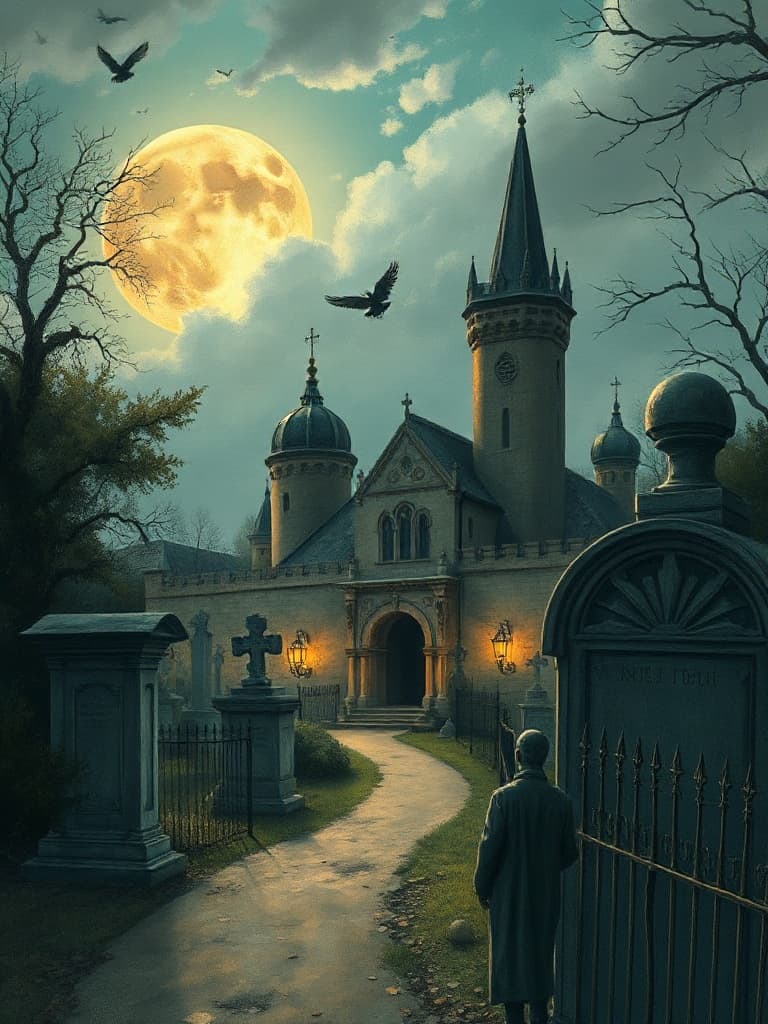
Midevial Castles,Dark,Spooky Fortresses,Terrifying Graveyards,Churches and Forests. Welcome to the torturess foot path of Eastern Europe and points beyond. ..the Gateway to Your worst night terror....enter this history of terror and fear if You dare ....
Chapters
- 3Chapter 3: The Shadow of BranElena's journey takes her to Bran Castle in Romania, famously associated with vampire lore, though its historical connection to Vlad the Impaler is debated. The atmosphere surrounding the castle is thick with legend and a palpable sense of dread, even without direct confrontation. As Elena explores the castle's imposing structure, she experiences unsettling phenomena: sudden, inexplicable cold spots that cling to certain rooms, the feeling of being watched by unseen eyes from shadowy corners, and faint, disembodied whispers that seem to emanate from the very stone walls. The air is heavy, not with the overt malevolence of Poenari, but with a lingering, ancient sorrow and a predatory stillness. Local legends, often recounted by wary villagers or castle guides who speak in hushed tones, speak of restless spirits and a darkness that predates even the castle's most famous (and possibly apocryphal) inhabitant. Elena's equipment registers anomalous readings, particularly in the deeper, less-trafficked chambers and dungeons, hinting at residual energy or something more active lurking just beyond perception. She finds no single, powerful entity like Vlad, but rather a pervasive sense of unease and a chilling reminder of past suffering. The chapter focuses on building atmospheric horror and introducing the idea that not all hauntings are the result of a single, powerful entity, but can be a tapestry of historical trauma and lingering energies. Elena begins to suspect that the 'darkness' is multifaceted, with different manifestations at each location. The chapter ends with Elena leaving Bran Castle, feeling a sense of unresolved tension and a growing understanding that the legends, however embellished, often contain a kernel of terrifying truth. She clutches the bleeding map, which seems to pulse with a faint, cold light, hinting that her encounter with the 'vampiric' energy of Bran has left a subtle mark or drawn the attention of something equally ancient and dangerous. The challenge here is to create a sense of dread without a direct, overt confrontation, relying on atmosphere and suggestion to unsettle the reader and Elena.Elena's journey takes her to Bran Castle in Romania, famously associated with vampire lore, though its historical connection to Vlad the Impaler is debated. The atmosphere surrounding the castle is thick with legend and a palpable sense of dread, even without direct confrontation. As Elena explores the castle's imposing structure, she experiences unsettling phenomena: sudden, inexplicable cold spots that cling to certain rooms, the feeling of being watched by unseen eyes from shadowy corners, and faint, disembodied whispers that seem to emanate from the very stone walls. The air is heavy, not with the overt malevolence of Poenari, but with a lingering, ancient sorrow and a predatory stillness. Local legends, often recounted by wary villagers or castle guides who speak in hushed tones, speak of restless spirits and a darkness that predates even the castle's most famous (and possibly apocryphal) inhabitant. Elena's equipment registers anomalous readings, particularly in the deeper, less-trafficked chambers and dungeons, hinting at residual energy or something more active lurking just beyond perception. She finds no single, powerful entity like Vlad, but rather a pervasive sense of unease and a chilling reminder of past suffering. The chapter focuses on building atmospheric horror and introducing the idea that not all hauntings are the result of a single, powerful entity, but can be a tapestry of historical trauma and lingering energies. Elena begins to suspect that the 'darkness' is multifaceted, with different manifestations at each location. The chapter ends with Elena leaving Bran Castle, feeling a sense of unresolved tension and a growing understanding that the legends, however embellished, often contain a kernel of terrifying truth. She clutches the bleeding map, which seems to pulse with a faint, cold light, hinting that her encounter with the 'vampiric' energy of Bran has left a subtle mark or drawn the attention of something equally ancient and dangerous. The challenge here is to create a sense of dread without a direct, overt confrontation, relying on atmosphere and suggestion to unsettle the reader and Elena.
- 4Chapter 4: The Forest of SighsElena ventures into a vast, ancient forest in the Carpathian Mountains, a place whispered about in hushed tones by locals as the 'Forest of Sighs,' notorious for unexplained disappearances and a pervasive sense of despair. The deeper Elena penetrates the woods, the more disorienting the experience becomes. The trees, ancient and gnarled, seem to close in around her, their branches like skeletal fingers reaching out. Sunlight struggles to penetrate the dense canopy, casting the forest floor in perpetual twilight. Her GPS signal dies completely, and her compass begins to spin erratically. She starts hearing mournful, disembodied cries that seem to echo from all directions, not the sharp screams of terror, but the low, drawn-out sighs of profound sorrow and regret. The air grows heavy, thick with an oppressive melancholy that saps her strength and her resolve. Elena's analytical mind struggles to find rational explanations for the disorientation and the sounds, but the sheer intensity of the emotional weight pressing down on her is undeniable. Her equipment registers unusual atmospheric pressure changes and low-frequency sounds that could mimic whispers or cries, but the emotional impact is far more profound than any scientific reading. She feels an overwhelming sense of being watched, not by a singular entity, but by the forest itself – an ancient, sentient presence that has absorbed the despair of countless lost souls. Local legends speak of a time when the forest was a place of sacred rituals that went horribly wrong, or a battleground where the veil between worlds was torn. Elena finds herself questioning if the forest is haunted by ghosts, or if the land itself has become imbued with a collective sorrow, a psychic residue of tragedy that actively influences the minds of those who enter. The chapter culminates with Elena stumbling upon a clearing where the trees form a macabre tableau, their branches twisted into shapes resembling tormented figures, and the sighing sounds intensify, almost coalescing into a single, heart-wrenching lament. The bleeding map in her possession feels colder than ever, and she experiences a brief, terrifying vision of the forest floor opening up to swallow her whole. She narrowly escapes the clearing, her heart pounding, but the pervasive sense of despair and the chilling whispers linger, a haunting prelude to the more malevolent forces she knows she will eventually encounter. The focus here is on psychological horror and the overwhelming power of a desolate, despair-laden environment.Elena ventures into a vast, ancient forest in the Carpathian Mountains, a place whispered about in hushed tones by locals as the 'Forest of Sighs,' notorious for unexplained disappearances and a pervasive sense of despair. The deeper Elena penetrates the woods, the more disorienting the experience becomes. The trees, ancient and gnarled, seem to close in around her, their branches like skeletal fingers reaching out. Sunlight struggles to penetrate the dense canopy, casting the forest floor in perpetual twilight. Her GPS signal dies completely, and her compass begins to spin erratically. She starts hearing mournful, disembodied cries that seem to echo from all directions, not the sharp screams of terror, but the low, drawn-out sighs of profound sorrow and regret. The air grows heavy, thick with an oppressive melancholy that saps her strength and her resolve. Elena's analytical mind struggles to find rational explanations for the disorientation and the sounds, but the sheer intensity of the emotional weight pressing down on her is undeniable. Her equipment registers unusual atmospheric pressure changes and low-frequency sounds that could mimic whispers or cries, but the emotional impact is far more profound than any scientific reading. She feels an overwhelming sense of being watched, not by a singular entity, but by the forest itself – an ancient, sentient presence that has absorbed the despair of countless lost souls. Local legends speak of a time when the forest was a place of sacred rituals that went horribly wrong, or a battleground where the veil between worlds was torn. Elena finds herself questioning if the forest is haunted by ghosts, or if the land itself has become imbued with a collective sorrow, a psychic residue of tragedy that actively influences the minds of those who enter. The chapter culminates with Elena stumbling upon a clearing where the trees form a macabre tableau, their branches twisted into shapes resembling tormented figures, and the sighing sounds intensify, almost coalescing into a single, heart-wrenching lament. The bleeding map in her possession feels colder than ever, and she experiences a brief, terrifying vision of the forest floor opening up to swallow her whole. She narrowly escapes the clearing, her heart pounding, but the pervasive sense of despair and the chilling whispers linger, a haunting prelude to the more malevolent forces she knows she will eventually encounter. The focus here is on psychological horror and the overwhelming power of a desolate, despair-laden environment.
- 5Chapter 5: The Forgotten FortressFollowing the map's increasingly insistent pull, Elena arrives at a remote, forgotten fortress, a place largely unknown to the outside world and absent from most historical records. Its isolation amplifies the sense of unease, and the ruins themselves are stark and imposing, suggesting a history of conflict and harshness. Unlike Poenari's overt brutality or Bran's lingering sorrow, this fortress exudes a palpable, active malevolence. As Elena begins her investigation, the paranormal activity escalates dramatically and intensely. Her equipment goes into overdrive, registering extreme and unpredictable readings that defy scientific explanation – sudden, violent temperature drops followed by oppressive heat, electromagnetic fields that fluctuate wildly and seem to respond to her presence, and auditory phenomena that range from guttural growls to the chilling sounds of spectral chains dragging across stone. The feeling of being watched transforms into a direct, hostile awareness. Elena experiences a series of aggressive psychic assaults: vivid hallucinations designed to instill terror, phantom touches that feel like icy claws, and a suffocating pressure that makes it difficult to breathe. She realizes she is not dealing with residual hauntings or echoes of past tragedies, but with a focused, intelligent, and profoundly hostile presence. This entity seems to feed on her fear, growing stronger with every moment she spends within its domain. Elena's analytical skills are pushed to their limits as she tries to understand the nature of this force, which feels ancient and deeply rooted in the very foundations of the fortress. Local legends, if any exist, are either non-existent due to the fortress's obscurity or too terrifying for anyone to speak of openly. Elena finds herself in a direct, confrontational battle for her sanity and survival. The chapter's climax involves Elena facing a direct manifestation of this malevolent entity – a terrifying, shapeshifting presence that embodies pure hatred and aggression. It actively tries to prevent her from leaving or gathering information, its power far exceeding anything she has encountered thus far. The bleeding map pulses with an alarming intensity, and Elena feels a desperate urge to flee, realizing this location is a significant nexus of dark energy. She narrowly escapes the fortress, her body and mind battered, but with a newfound, chilling understanding that some forces are not merely ghosts of the past, but active, dangerous entities that should never have been disturbed. The encounter leaves her shaken, questioning her own resilience and the true depth of the darkness she has uncovered.ú
- 6Chapter 6: The Pact of the AncientsFollowing the harrowing encounter at the forgotten fortress, Elena dedicates herself to understanding the nature of the malevolent entity she faced and its connection to the other haunted sites. She delves into fragmented local tales, ancient texts, and obscure folklore, seeking clues that might connect the disparate locations. Her research leads her to discover whispers of an ancient pact or a dark ritual performed centuries ago at the very fortress she just fled. These legends speak of a desperate attempt to harness or appease a primal force, a deal struck with something primordial that resides beneath the surface of the world. The details are vague and shrouded in allegory, but the recurring themes suggest a common origin for the darkness plaguing these sites. The pact, it seems, was made to gain power, protection, or perhaps to avert an even greater catastrophe, but at a terrible cost. Elena begins to piece together a disturbing narrative: the fortress was not just a stronghold, but a nexus point where this ancient force was either bound or awakened. The folklore hints that the pact created a ripple effect, its influence seeping into the surrounding lands and imprinting itself upon other locations with significant historical or spiritual resonance. She learns of symbols, rituals, and the names of ancient beings or cults associated with this pact, finding echoes of these themes in the legends surrounding Poenari, Bran, and the Forest of Sighs. The bleeding map in her possession seems to react to this newfound knowledge, its markings glowing faintly when she uncovers a crucial piece of information. Elena realizes that the entities she has encountered – Vlad, the lingering energies of Bran, the despair of the forest, and the malevolence of the fortress – are not isolated phenomena but interconnected threads in a much larger, darker tapestry. The pact, she suspects, is the key to understanding the unified consciousness she felt at the fortress and the escalating pattern of terror. The chapter concludes with Elena finding a particularly disturbing account of the pact's consequences – a prophecy or warning about the 'awakening' of the entity and the potential for its influence to spread. This revelation solidifies her understanding of the overarching threat and sets the stage for her next move, which will likely involve confronting the source of this ancient darkness more directly. The focus is on piecing together the lore, understanding the interconnectedness of the sites, and uncovering the historical roots of the supernatural phenomena.
- 7Chapter 7: The Tormented SoulsElena's investigation deepens as she begins to encounter what she initially perceives as individual 'Echoes of the Past'—tormented spirits reliving their final moments at various haunted locations. These are not the spectral entities of folklore or the malevolent presence of the fortress, but fragmented apparitions, spectral replays of intense emotional moments. At Poenari, she witnesses fleeting images of men being impaled, their screams echoing faintly. At Bran, she sees shadows of fearful figures cowering in the darkness. In the Forest of Sighs, she glimpses fleeting figures lost and weeping. At the forgotten fortress, these echoes are more aggressive, manifesting as spectral attackers caught in loops of violence. However, as Elena's experiences accumulate and her understanding of the interconnectedness of these sites grows, she begins to see a pattern. These 'ghosts' are not independent entities but rather symptoms of a deeper, pervasive darkness. They are fragments of psychic imprint, remnants of intense suffering and fear that have been amplified and perhaps even created by the overarching malevolent entity or the ancient pact. They are the echoes of lives crushed under the weight of historical atrocities, amplified by the entity's influence. Elena starts to notice recurring motifs in their apparitions – specific symbols, gestures, or cries that seem to link them across different locations. She realizes that these tormented souls are not merely replaying their deaths; they are trapped in a psychic prison orchestrated by the entity, their suffering feeding its power. Her attempts to communicate with them are met with confusion, terror, or aggression, as they are too lost in their own torment to offer coherent answers. Yet, in their fragmented replays, Elena gleans crucial insights into the nature of the atrocities that occurred at each site and the methods of the entity's influence. The chapter emphasizes Elena's growing understanding that the supernatural phenomena are not a collection of separate hauntings but a unified manifestation of a singular, ancient evil. The focus shifts from individual ghost encounters to recognizing them as components of a larger, terrifying whole. The chapter ends with Elena witnessing a particularly vivid and disturbing echo – perhaps a collective manifestation of suffering from multiple sites converging, or a glimpse into the origin of the pact itself. This experience leaves her with a profound sense of empathy for the trapped souls, but also a chilling realization of the scale of the darkness she is up against, and the understanding that these are not mere ghosts, but pieces of a larger, agonizing puzzle. Elena's investigation deepens as she begins to encounter what she initially perceives as individual 'Echoes of the Past'—tormented spirits reliving their final moments at various haunted locations. These are not the spectral entities of folklore or the malevolent presence of the fortress, but fragmented apparitions, spectral replays of intense emotional moments. At Poenari, she witnesses fleeting images of men being impaled, their screams echoing faintly. At Bran, she sees shadows of fearful figures cowering in the darkness. In the Forest of Sighs, she glimpses fleeting figures lost and weeping. At the forgotten fortress, these echoes are more aggressive, manifesting as spectral attackers caught in loops of violence. However, as Elena's experiences accumulate and her understanding of the interconnectedness of these sites grows, she begins to see a pattern. These 'ghosts' are not independent entities but rather symptoms of a deeper, pervasive darkness. They are fragments of psychic imprint, remnants of intense suffering and fear that have been amplified and perhaps even created by the overarching malevolent entity or the ancient pact. They are the echoes of lives crushed under the weight of historical atrocities, amplified by the entity's influence. Elena starts to notice recurring motifs in their apparitions – specific symbols, gestures, or cries that seem to link them across different locations. She realizes that these tormented souls are not merely replaying their deaths; they are trapped in a psychic prison orchestrated by the entity, their suffering feeding its power. Her attempts to communicate with them are met with confusion, terror, or aggression, as they are too lost in their own torment to offer coherent answers. Yet, in their fragmented replays, Elena gleans crucial insights into the nature of the atrocities that occurred at each site and the methods of the entity's influence. The chapter emphasizes Elena's growing understanding that the supernatural phenomena are not a collection of separate hauntings but a unified manifestation of a singular, ancient evil. The focus shifts from individual ghost encounters to recognizing them as components of a larger, terrifying whole. The chapter ends with Elena witnessing a particularly vivid and disturbing echo – perhaps a collective manifestation of suffering from multiple sites converging, or a glimpse into the origin of the pact itself. This experience leaves her with a profound sense of empathy for the trapped souls, but also a chilling realization of the scale of the darkness she is up against, and the understanding that these are not mere ghosts, but pieces of a larger, agonizing puzzle.
- 8Chapter 8: The Investigator's SecretAmidst the relentless pursuit of answers and the escalating supernatural encounters, Elena finds herself forced into a period of introspection. The constant exposure to terror, despair, and the echoes of suffering begins to wear on her, bringing to the surface a deeply buried personal trauma. This trauma, perhaps a significant loss, a past incident of helplessness, or a profound betrayal, fuels her relentless drive for investigation. It's the hidden wound that makes her both uniquely vulnerable and exceptionally attuned to the sorrow and fear permeating the haunted locations. She starts to recognize parallels between her own past pain and the suffering she witnesses – the helplessness of victims, the overwhelming nature of grief, the desire for justice or understanding. This personal connection makes her investigation more than just a professional endeavor; it becomes a cathartic, albeit dangerous, journey into her own psyche. The chapter explores Elena's internal struggles as she grapples with these resurfaced memories and emotions. She might experience flashbacks or vivid nightmares that blur the lines between her past and the present supernatural horrors. This vulnerability, however, also sharpens her intuition. She begins to understand the motivations and fears of the entities and spirits she encounters on a deeper level, moving beyond mere observation to a form of empathic connection, albeit one fraught with peril. Her analytical skills are now tempered by a raw emotional understanding, allowing her to interpret subtle clues that might otherwise be missed. The chapter also subtly hints at the potential for this trauma to be exploited by the malevolent entity, which feeds on fear and despair. Elena’s personal pain could become a gateway for the entity to exert greater influence over her. The narrative delves into her internal monologue, her moments of doubt, and the quiet strength she draws from confronting her own demons alongside the external ones. The chapter concludes with Elena experiencing a moment of clarity or resolve, stemming directly from her confrontation with her past. She acknowledges her trauma not as a weakness, but as a driving force, a source of resilience that might ultimately help her understand and combat the darkness. She emerges from this introspection with a renewed, albeit somber, determination, understanding that her journey is as much about healing herself as it is about uncovering the truth behind the hauntings. This chapter humanizes Elena, making her more relatable and increasing the emotional stakes of her quest. Amidst the relentless pursuit of answers and the escalating supernatural encounters, Elena finds herself forced into a period of introspection. The constant exposure to terror, despair, and the echoes of suffering begins to wear on her, bringing to the surface a deeply buried personal trauma. This trauma, perhaps a significant loss, a past incident of helplessness, or a profound betrayal, fuels her relentless drive for investigation. It's the hidden wound that makes her both uniquely vulnerable and exceptionally attuned to the sorrow and fear permeating the haunted locations. She starts to recognize parallels between her own past pain and the suffering she witnesses – the helplessness of victims, the overwhelming nature of grief, the desire for justice or understanding. This personal connection makes her investigation more than just a professional endeavor; it becomes a cathartic, albeit dangerous, journey into her own psyche. The chapter explores Elena's internal struggles as she grapples with these resurfaced memories and emotions. She might experience flashbacks or vivid nightmares that blur the lines between her past and the present supernatural horrors. This vulnerability, however, also sharpens her intuition. She begins to understand the motivations and fears of the entities and spirits she encounters on a deeper level, moving beyond mere observation to a form of empathic connection, albeit one fraught with peril. Her analytical skills are now tempered by a raw emotional understanding, allowing her to interpret subtle clues that might otherwise be missed. The chapter also subtly hints at the potential for this trauma to be exploited by the malevolent entity, which feeds on fear and despair. Elena’s personal pain could become a gateway for the entity to exert greater influence over her. The narrative delves into her internal monologue, her moments of doubt, and the quiet strength she draws from confronting her own demons alongside the external ones. The chapter concludes with Elena experiencing a moment of clarity or resolve, stemming directly from her confrontation with her past. She acknowledges her trauma not as a weakness, but as a driving force, a source of resilience that might ultimately help her understand and combat the darkness. She emerges from this introspection with a renewed, albeit somber, determination, understanding that her journey is as much about healing herself as it is about uncovering the truth behind the hauntings. This chapter humanizes Elena, making her more relatable and increasing the emotional stakes of her quest.Amidst the relentless pursuit of answers and the escalating supernatural encounters, Elena finds herself forced into a period of introspection. The constant exposure to terror, despair, and the echoes of suffering begins to wear on her, bringing to the surface a deeply buried personal trauma. This trauma, perhaps a significant loss, a past incident of helplessness, or a profound betrayal, fuels her relentless drive for investigation. It's the hidden wound that makes her both uniquely vulnerable and exceptionally attuned to the sorrow and fear permeating the haunted locations. She starts to recognize parallels between her own past pain and the suffering she witnesses – the helplessness of victims, the overwhelming nature of grief, the desire for justice or understanding. This personal connection makes her investigation more than just a professional endeavor; it becomes a cathartic, albeit dangerous, journey into her own psyche. The chapter explores Elena's internal struggles as she grapples with these resurfaced memories and emotions. She might experience flashbacks or vivid nightmares that blur the lines between her past and the present supernatural horrors. This vulnerability, however, also sharpens her intuition. She begins to understand the motivations and fears of the entities and spirits she encounters on a deeper level, moving beyond mere observation to a form of empathic connection, albeit one fraught with peril. Her analytical skills are now tempered by a raw emotional understanding, allowing her to interpret subtle clues that might otherwise be missed. The chapter also subtly hints at the potential for this trauma to be exploited by the malevolent entity, which feeds on fear and despair. Elena’s personal pain could become a gateway for the entity to exert greater influence over her. The narrative delves into her internal monologue, her moments of doubt, and the quiet strength she draws from confronting her own demons alongside the external ones. The chapter concludes with Elena experiencing a moment of clarity or resolve, stemming directly from her confrontation with her past. She acknowledges her trauma not as a weakness, but as a driving force, a source of resilience that might ultimately help her understand and combat the darkness. She emerges from this introspection with a renewed, albeit somber, determination, understanding that her journey is as much about healing herself as it is about uncovering the truth behind the hauntings. This chapter humanizes Elena, making her more relatable and increasing the emotional stakes of her quest.
- 9Chapter 9: Dr. Becker's TheoriesDuring her travels through Eastern Europe, Elena crosses paths with Dr. Katja Becker, a respected historian and paranormal researcher whose work Elena has admired from afar. Becker is portrayed as knowledgeable, perhaps even more experienced in certain esoteric fields than Elena. Their meeting, possibly arranged through academic channels or a chance encounter at a relevant historical site, provides an opportunity for Elena to share some of her findings and for Becker to offer her own, highly developed theories. Becker proposes a radical idea: that the seemingly disparate haunted locations are not isolated incidents but are connected by a unified, ancient network or 'front' of dark energy, possibly orchestrated by a single, overarching entity or a deeply ingrained curse. She might present evidence of recurring symbols, historical patterns of paranormal activity across specific regions, or even her own research into ancient European folklore and occult practices that suggest a deliberate, coordinated source of malevolence. Becker's theories are presented with a strong academic rigor, yet hint at a deeper, more intuitive understanding of the supernatural, perhaps referencing ancient pagan beliefs, forgotten deities, or ley lines of energy. Elena, initially cautious due to her own evolving understanding and perhaps a touch of professional rivalry (as Elena's former mentor, Dr. Elena Vasquez, might be a rival of Becker's), finds herself intrigued and validated by Becker's insights. Becker's perspective offers a framework for Elena's experiences, helping her to organize the chaos of her findings into a coherent narrative. The chapter explores their dynamic: a blend of intellectual respect, potential competition, and shared purpose. Becker might reveal her own personal connection or fascination with these specific types of phenomena, hinting at a deeper, perhaps even spiritual, motivation. The conversation between them is a critical exposition dump, providing the reader with a more comprehensive understanding of the overarching threat. Becker's theories could suggest that the 'malevolent entity' is not just a ghost but something far more ancient and influential, possibly a forgotten deity or a cosmic force that has been manipulating human history through fear and despair. The chapter concludes with Becker sharing a particularly crucial piece of information or a warning derived from her research, perhaps pointing Elena towards the next significant location on her map or revealing a critical aspect of the ancient pact. This encounter solidifies the idea that Elena is not alone in her quest, but also introduces the complexity of human interaction and potential collaboration (or competition) in the face of overwhelming supernatural forces. The mention of Dr. Elena Vasquez, Elena's former mentor and a rival of Becker's, adds a layer of intrigue and potential future conflict, suggesting differing philosophies on how to approach and combat the paranormal.
- 10Chapter 10: The Rival's ShadowWhile Dr. Katja Becker's theories offer a compelling framework for Elena's investigations, a subtle tension arises from the mention of Dr. Elena Vasquez, Becker's former mentor and Elena's own one-time academic supervisor. Vasquez is presented not as a direct antagonist, but as a figure representing a contrasting, potentially more dangerous, approach to the paranormal. While Becker embraces the esoteric and the ancient, Vasquez is depicted as a pragmatist, perhaps even a cynic, whose research might lean towards more aggressive, potentially unethical methods of interacting with or controlling supernatural phenomena. Elena recalls Vasquez's skepticism during their academic collaboration, her dismissal of folklore as mere superstition, and her underlying ambition to 'conquer' the unknown rather than merely understand it. Vasquez might beli upeve in exploiting supernatural energies for personal gain or scientific advancement, regardless of the risks. This creates a subtle conflict within Elena's mind: should she trust Becker's more cautious, lore-based approach, or is there a kernel of truth in Vasquez's belief that some forces require a more forceful, perhaps even manipulative, engagement? The narrative might include a brief flashback or a memory of a past interaction between Elena and Vasquez, highlighting Vasquez's dismissive attitude towards Elena's early interest in the more 'superstitious' aspects of history and folklore. This serves to underscore Elena's own evolution from a purely academic historian to a paranormal investigator. The presence of Vasquez looms as a potential future complication – a rival who might be pursuing similar leads but with a fundamentally different, possibly more destructive, agenda. This adds a layer of human intrigue to the supernatural horror, suggesting that human ambition and ethical compromises can be as dangerous as any ancient curse. The chapter concludes with Elena receiving a cryptic message or a brief, unsettling encounter that hints at Vasquez's awareness of Elena's current investigation, perhaps a veiled warning or a subtle attempt to steer Elena away from her path, further solidifying the idea that Elena's journey is not just against supernatural forces, but also against potentially conflicting human interests. The focus is on establishing Vasquez as a foil to Becker and a source of potential future conflict, highlighting the different philosophies of paranormal research and the ethical dilemmas Elena faces.
- 11Chapter 11: The Cryptic WarningsAs Elena delves deeper into the folklore surrounding each location, she encounters the 'Whispering Locals' – communities living in the shadow of the haunted sites. These individuals, often elderly and deeply steeped in the traditions and superstitions of their regions, possess a wealth of fragmented knowledge about the darkness that pervades their lands. However, their warnings are rarely direct; instead, they are veiled in allegory, superstition, and fearful hushed tones. They speak not of ghosts or monsters in the modern sense, but of ancient spirits, vengeful deities, and curses that demand appeasement. They recount tales of past tragedies, unexplained disappearances, and the consequences of disturbing sacred or cursed ground. Their words are laced with a profound, ingrained fear, a generational understanding of the dangers that lie dormant but ever-present. Elena learns that these locals often perform secret rituals, leave offerings, or adhere to strict taboos to maintain a precarious balance with the supernatural forces. They might speak of a 'great sleep' that should not be disturbed, or of 'old debts' that must be paid. Their fear is palpable, and their reluctance to share explicit details stems from a deep-seated belief that speaking too openly about these entities will draw their attention and invite disaster. Elena must carefully decipher their cryptic pronouncements, distinguishing between genuine historical accounts and superstitious embellishments. She finds that their seemingly irrational beliefs often contain kernels of terrifying truth, accurately describing the phenomena she has witnessed or foreshadowing future dangers. For example, a local elder might warn of a 'bloody countess' who craves eternal youth, or a 'wooden prince' who enforces brutal justice, echoing the entities Elena has already encountered or is about to face. The chapter highlights the importance of oral tradition and folklore as repositories of hidden knowledge. Elena realizes that these locals, despite their fear, are vital to her understanding, acting as living archives of the supernatural history of the land. The chapter concludes with Elena receiving a particularly dire warning from a local, perhaps related to the next location on her map, which emphasizes the escalating danger and the dire consequences of her continued investigation. This warning might be a prophecy, a desperate plea, or a curse upon those who meddle with forces beyond their comprehension, leaving Elena with a renewed sense of urgency and the weight of responsibility for disturbing these ancient powers.
- 12Chapter 12: The Graveyard's ChillElena's investigation leads her to a notoriously haunted graveyard, a place steeped in the morbid history of the region and surrounded by tales of restless spirits and unsettling phenomena. The graveyard itself is depicted as ancient and imposing, with weathered tombstones, crumbling mausoleums, and gnarled trees casting long, ominous shadows. As twilight descends, the atmosphere thickens with a chilling energy. Elena begins to experience classic paranormal activity: sudden, inexplicable drops in temperature that create visible mist from her breath, the sensation of unseen hands brushing against her, and the distinct feeling of being watched by the departed. The sounds of the living world fade, replaced by the rustling of leaves that sound like whispers and the faint, mournful sighs of spectral residents. Apparitions begin to manifest – fleeting figures glimpsed between the tombstones, spectral forms rising from the earth, or faces appearing in the windows of crypts. These are not necessarily malevolent, but deeply sorrowful, confused, or trapped, replaying moments of their lives or deaths. Elena's equipment registers significant electromagnetic fluctuations and auditory anomalies, capturing faint voices or sounds that cannot be attributed to natural causes. However, the most unsettling aspect is the palpable sense that the ground itself holds an ancient, restless energy. It feels as though the very earth is saturated with centuries of grief, loss, and unresolved turmoil. Local legends speak of mass graves, forgotten tragedies, or unholy rituals performed within its confines, contributing to the graveyard's reputation. Elena might find herself drawn to a specific section of the graveyard, perhaps a forgotten plot or a particularly ornate tomb, where the activity is most intense. She might witness a more coherent manifestation – a spectral figure attempting to communicate, or a dramatic reenactment of a past event. The chapter aims to explore the universal fear associated with death and the afterlife, amplified by the belief that some souls never find peace. Elena's personal trauma might resurface here, as the graveyard confronts her with the raw reality of mortality and loss. The chapter concludes with Elena experiencing a particularly profound or terrifying encounter within the graveyard, perhaps seeing a vision that connects the graveyard's unrest to the larger patterns she's been uncovering, or feeling a direct, chilling touch from a spirit that leaves a lasting imprint. She leaves the graveyard with a deeper understanding of the lingering power of death and the sorrow that can anchor spirits to the mortal realm, reinforcing the idea that the 'hauntings' are deeply rooted in historical suffering.
- 13Chapter 13: The Church of WhispersElena's path leads her to a desolate, ancient church, once a place of sanctuary and worship, now rumored to be a focal point of dark energy and a site of profound spiritual corruption. The church stands in stark contrast to its intended purpose: its architecture, though once sacred, now appears imposing and perhaps even menacing. The stained-glass windows are broken or grimy, casting distorted, eerie patterns of light, and the air within is heavy with a silence that feels unnatural, as if the very absence of sound is a presence in itself. As Elena enters, the initial profound silence is broken not by the expected echoes of prayer or hymns, but by unsettling whispers. These whispers are not the mournful sighs of the graveyard or the confused murmurs of residual hauntings; they are insidious, seductive, and carry a chilling intelligence. They seem to emanate from the walls, the decaying pews, and the altar itself, speaking in hushed, conspiratorial tones. The whispers might tempt, question Elena's faith, or reveal dark secrets about the church's history – perhaps a betrayal by clergy, a pact made in desperation, or the perversion of sacred rites for dark purposes. Elena's equipment registers anomalous readings, particularly around the altar or a specific crypt, suggesting a potent concentration of negative energy that has corrupted the sanctity of the place. She might experience visual phenomena: shadows moving in the periphery, the altar seeming to shift or bleed, or spectral figures appearing not as tormented souls, but as distorted, corrupted versions of religious figures or congregants. The church represents the perversion of faith, a place where light has been consumed by darkness, and holy ground has become tainted. Local legends might speak of the church being abandoned after a horrific event, or of a lingering presence that feeds on doubt and despair. Elena grapples with the unsettling feeling that this is not just a haunting, but an active corruption, a place where spiritual energy has been twisted and weaponized. The chapter culminates with Elena confronting the source of the whispers, perhaps a spectral entity that was once a guardian of the church but has fallen, or a manifestation of the collective doubt and fear of those who once worshipped there. She might find an artifact or a hidden chamber that reveals the church's dark secret. The chapter ends with Elena leaving the corrupted sanctuary, the insidious whispers still echoing in her mind, leaving her with a profound sense of spiritual unease and the realization that the darkness can infiltrate even the most sacred spaces. This encounter emphasizes the theme of corrupted faith and the perversion of hope.
- 14Chapter 14: The Malevolent PresenceThis chapter marks a significant escalation in the overarching narrative. The malevolent entity, previously felt as an underlying influence or a localized force at specific sites, now makes its presence undeniably known and felt across multiple locations, even those Elena is not currently investigating. It's no longer just a series of isolated hauntings but a unified, pervasive consciousness. Elena begins to experience this through heightened psychic phenomena: recurring nightmares that are consistent across different sites, a shared sense of dread that seems to emanate from the land itself, and a growing awareness that the 'echoes of the past' are not just fragmented memories but are being actively manipulated or amplified by a single, controlling intelligence. The entity's power is felt as a palpable pressure, a cosmic weight pressing down on the region. Elena might receive warnings from different sources – a panicked local, a cryptic message on her equipment, or a vision – all pointing to a singular, ancient source of evil that is growing stronger. The chapter focuses on unraveling the true nature of this entity. It's becoming clear that it is far more than a traditional ghost or a historical figure like Vlad. Its influence feels primordial, cosmic, and deeply rooted in the fabric of reality itself. Elena starts to suspect that it might be a forgotten deity, an ancient cosmic horror, or a force that predates human understanding, whose very existence thrives on fear, despair, and the corruption of life. The interconnectedness of the haunted sites, previously a puzzle, now becomes a clear strategy of the entity – it is drawing power from these nexus points, strengthening itself by feeding on the residual suffering and the active fear it instills. Elena might witness phenomena that defy any known explanation, suggesting a power that operates on a level beyond the physical or even the spiritual as she understands it. The chapter culminates with a direct, albeit perhaps still partially obscured, manifestation or overwhelming psychic assault from the entity. This could be a powerful vision that reveals its vast, terrifying nature, or a moment where its influence is so strong that it affects Elena profoundly, pushing her to the brink of her sanity. She realizes that her quest is not just about documenting hauntings, but about confronting a force of immense, ancient power that threatens not just individuals, but the very fabric of reality. The chapter ends with Elena understanding the true scale of the threat and the daunting task ahead, perhaps realizing that her previous bindings, while significant, were merely skirmishes against a much larger war. The focus is on revealing the antagonist's true, cosmic nature and the escalating stakes of Elena's mission.
- 15Chapter 15: The Heart of DarknessArmed with the knowledge that she is facing a singular, ancient, and cosmically powerful malevolent entity, Elena decides to confront the source directly. The map, now pulsing with an intense, almost unbearable energy, guides her to what is whispered about in hushed tones by the few locals who dare to speak of it: the 'Heart of Darkness.' This is the most terrifying location yet, believed to be the epicenter of the entity's influence, the place where its power is most concentrated and its true nature is most raw. The journey to this place is fraught with peril, perhaps through treacherous terrain, forgotten pathways, or even a descent into the earth. The environment itself reflects the entity's nature – desolate, corrupted, and imbued with an oppressive, suffocating aura. As Elena approaches, the psychic assaults intensify, becoming a constant barrage designed to break her will and drive her away. The echoes of past suffering become a deafening chorus, and the malevolent presence is no longer just felt but is almost a tangible force, pressing in on her from all sides. This chapter is the ultimate test of Elena's courage, resolve, and her understanding of the supernatural. She must navigate a landscape actively hostile to her presence, a place where the veil between worlds is thinnest and the entity's power is at its zenith. The focus is on building extreme tension and atmosphere as Elena pushes deeper into the heart of the terror. She might encounter physical manifestations of the entity's influence – unnatural geological formations, corrupted flora and fauna, or remnants of rituals performed to appease or contain it. The psychological pressure is immense, forcing Elena to confront her deepest fears and her own mortality. This is the point of no return, where turning back is no longer an option. The chapter culminates with Elena reaching the absolute core of this terrifying place – perhaps a hidden chamber, a sacrificial altar, or a rift in reality itself. It is here, at the epicenter of the darkness, that she prepares to face the entity in its most potent form, ready to uncover the ultimate truth, whatever the cost. The scene is set for the revelation of the entity's origins and the climax of Elena's investigation, leaving the reader on the edge of their seat as she stands on the precipice of the ultimate confrontation.
- 16Chapter 16: Unveiling the TruthInside the 'Heart of Darkness,' the location Elena has identified as the epicenter of the malevolent entity's influence, the ultimate truth is finally revealed. This is not merely a place haunted by ghosts or cursed by historical events; it is something far more profound and terrifying. The revelation transcends the typical understanding of hauntings, moving into the realm of cosmic horror or ancient mythology. Elena discovers that the entity is not a spirit of a deceased human, nor even a demonic entity in the conventional sense. Instead, it might be a primordial being, a forgotten deity whose existence predates humanity, a cosmic horror from beyond the stars, or a fundamental force of nature that has been corrupted or awakened. Its influence has seeped into the land over millennia, feeding on suffering, fear, and despair, shaping the history of the region and imprinting itself onto the locations Elena has visited. The truth might be presented through a vision, an ancient inscription, or a direct communion with the entity itself. Elena learns of its origins, its purpose (or lack thereof, in the case of a purely existential horror), and the nature of its connection to the map and the ‘pact.’ The map, she realizes, is not just a guide but a key, perhaps designed to either contain or unleash this entity, and her role as its keeper is critical. The revelation is not just about understanding the entity but also about understanding Elena's place in this cosmic drama. She might learn that her grandmother's efforts were part of a long, ancient struggle to keep this entity contained, and that Elena herself is now a crucial player in that ongoing battle. The chapter focuses on the overwhelming, mind-bending nature of this truth. It challenges Elena’s scientific worldview and forces her to confront an existential dread far greater than any fear of ghosts. The sheer scale and alien nature of the entity are emphasized, highlighting its power and the seemingly insurmountable odds against her. The chapter culminates with Elena grasping the full, terrifying implications of this revelation, understanding that her previous encounters were merely symptoms of a much larger, ancient threat. The knowledge gained is profound but also deeply disturbing, leaving her irrevocably changed by the sheer weight of what she has uncovered. The focus is on the mind-shattering revelation of the entity's true nature and its cosmic significance.
- 17Chapter 17: The EscapeHaving uncovered the terrifying truth at the 'Heart of Darkness,' Elena's immediate priority shifts to survival and escape. The revelation of the entity's true, cosmic nature has left her profoundly shaken, and the very air in the epicenter crackles with its overwhelming power. The escape is not a simple matter of retracing her steps; the 'Heart of Darkness' itself seems to resist her departure, actively working to trap her within its influence. The environment might become even more hostile, with the terrain shifting, illusions multiplying, and the entity's psychic assaults intensifying to a fever pitch. Elena must draw upon all her newfound knowledge, resilience, and perhaps even the tools or insights gained from her previous encounters to navigate this perilous exodus. The bleeding map, now a source of both guidance and immense psychic burden, might react erratically, pulsing with energy that both aids and hinders her progress. She might face a final, desperate confrontation with the entity or its manifestations, not necessarily to defeat it, but to break free from its direct influence. This escape is a harrowing physical and psychological ordeal. Elena experiences extreme exhaustion, fear, and the lingering effects of the entity's psychic intrusion. The knowledge she carries is a heavy burden, a constant reminder of the cosmic horror she has witnessed and the immense power that remains unchecked. The chapter emphasizes the sheer effort and will required to break away from such a profound source of darkness. Elena's actions during the escape are driven by a primal instinct for survival, but also by a nascent understanding of her role in the larger conflict. She might use a newly acquired artifact or a piece of knowledge gained from the revelation to create a temporary shield or opening, allowing her to break free. The chapter concludes with Elena finally emerging from the 'Heart of Darkness,' battered, exhausted, and forever changed. She has survived, but the encounter has left an indelible mark, both physically and mentally. The overwhelming dread of what she has encountered and the knowledge of its continued existence weigh heavily upon her, setting the stage for the aftermath and the long-term consequences of her journey. The focus is on the intense struggle for survival and the immediate, profound impact of the revelation on Elena.
- 18Chapter 18: The Lingering DreadBack in relative safety, far from the epicenter of the darkness, Elena grapples with the profound aftermath of her encounter. The physical escape is complete, but the psychic and emotional toll is immense. The memories of the 'Heart of Darkness' and the entity's true nature are vivid and intrusive, replaying in her mind with an almost hallucinatory clarity. The fear she experienced is not gone; it has transformed into a deep-seated, gnawing dread, a constant awareness of the cosmic horror that exists just beyond the veil of ordinary perception. Elena finds herself unable to return to her previous life or her purely academic pursuits. The encounter has left an indelible mark, a psychic scar that may never fully heal. She might experience lingering sensory phenomena – phantom whispers, inexplicable cold spots, or the unsettling feeling of being watched, even in the most mundane environments. Her relationships, if any, are strained as she struggles to articulate the incomprehensible nature of her experiences. The world she once knew now seems fragile and ignorant, blissfully unaware of the ancient forces that slumber beneath the surface. The map, now perhaps inert or subtly changed, serves as a constant, chilling reminder of her ordeal and the ongoing threat. Elena grapples with the existential implications of what she has learned – the vastness of the universe, the insignificance of humanity in the face of cosmic powers, and the terrifying possibility that the entity is not truly contained. She might find herself obsessively researching ancient texts, seeking any information that might offer a way to combat or at least understand the entity further. This chapter focuses on the psychological and emotional consequences of confronting ultimate horror. It explores themes of trauma, disillusionment, and the burden of knowledge. Elena’s analytical mind, once her greatest asset, now struggles to process the irrational and the incomprehensible. The chapter concludes with Elena making a crucial decision about her future: whether to retreat into isolation, dedicate herself to a lifelong struggle against the entity, or attempt to warn a world that may not be ready or willing to listen. The lingering dread is not just a personal burden but a premonition of the continued threat, hinting that her journey is far from over and the 'gateway' to nightmares remains open. The focus is on Elena's internal struggle and the lasting impact of her encounter.
- 19Chapter 19: A World of FearHaving survived the 'Heart of Darkness' and grappled with its immediate aftermath, Elena begins to reflect on the broader implications of her journey. She contemplates the interconnectedness of all the haunted sites she has visited – from the brutal fortresses and ancient forests to the corrupted churches and desolate graveyards. She realizes that these locations are not isolated incidents of haunting but are nodes in a vast network of suffering, all seemingly influenced by the singular, malevolent entity she encountered. The ancient pacts, the local legends, and the spectral echoes all point to a pervasive, ancient darkness that has been subtly influencing human history for centuries. The realization dawns that the terror she experienced in Eastern Europe is not confined to that region. The entity's influence, though perhaps strongest in these historically charged locales, is potentially global. The map, a conduit to these potent sites, might hold clues to other such 'gateways' or nexus points across the world. Elena begins to see the world through a new lens, recognizing patterns of fear, despair, and conflict that might be symptoms of the entity's insidious reach. She considers the historical atrocities, the unexplained phenomena, and the persistent human fascination with the macabre as potential indicators of its ongoing influence. The chapter explores the chilling concept that the darkness is not contained but is a fundamental aspect of existence, waiting for opportunities to manifest. Elena might revisit her research on Dr. Katja Becker's theories about a unified 'front' of dark energy, now understanding it not just as a regional phenomenon but as a global network. The weight of this knowledge is immense, leading to a profound sense of isolation and a daunting sense of responsibility. She understands that her quest to understand and perhaps combat the entity is not a localized mission but a fight for the very soul of humanity. The chapter concludes with Elena looking at the map, or perhaps a world map, with a new, terrifying perspective. She sees not just marked locations but potential points of vulnerability, places where the veil is thin and the entity's power can seep through. The final thought is a stark warning: the 'gateway' has been opened, and the terror may not be confined to Eastern Europe, hinting at the possibility of future investigations in other parts of the world, or a more immediate, encroaching threat to her own surroundings. The focus is on the global implications of the discovered entity and the existential dread of its pervasive influence.
- 20Chapter 20: The Gateway RemainsThe narrative concludes with a stark, chilling warning, emphasizing that the journey has revealed not an end, but a beginning. Elena, irrevocably changed by her experiences, understands that the 'gateway' to the nightmares she encountered has been opened, and that such portals, once breached, may not be easily or permanently closed. The malevolent entity, though potentially bound or evaded at specific locations, remains a potent force, its influence a pervasive threat that extends beyond the borders of Eastern Europe. The book leaves the reader with a profound sense of unease, highlighting that the darkness encountered is not an anomaly confined to forgotten fortresses and cursed lands, but a fundamental aspect of reality that is always lurking, just beyond the veil of ordinary perception. Elena's personal journey has concluded, but the overarching threat persists. She might offer a final, somber reflection on the nature of fear, the resilience of the human spirit, and the seductive allure of the abyss. The conclusion reinforces the idea that the entities and curses encountered are not merely historical curiosities but active forces that can resurface or spread. The warning is not just for Elena, but for the reader, a reminder that the world is filled with unseen horrors and that the line between reality and nightmare is far thinner than most people believe. The final paragraphs might hint at other 'gateways' or nexus points across the globe, suggesting that Elena's work, or the work of others like her, is far from over. The emphasis is on the lingering dread, the ongoing struggle against ancient evils, and the unsettling possibility that the terror encountered is not contained but is a potential, ever-present threat to the world at large. The ending is not a resolution but a potent cautionary tale, a testament to the enduring power of fear and the dark history that shapes our present. The final image could be Elena looking at the map one last time, its symbols now seeming to pulse with a global, rather than regional, significance, or a final, unsettling whisper from the darkness, confirming that the gateway remains open.
- 21European Stories based on FactSnow White - The Margra vine Maria Sophia of Erthal (1725-1796)The most compelling historical inspiration comes from Lohr am Main, Germany, where Maria Sophia lived in a castle with - you guessed it - talking mirrors! Well, not literally talking, but the castle had acoustically designed mirrors that could carry whispered conversations from room to room, creating the illusion of a "speaking glass."Maria Sophia's stepmother was reportedly vain and cruel, favoring her own children. The "seven dwarfs" were likely the child miners who worked in the nearby copper mines - the tunnels were so low that only children and very short adults could navigate them. The "poisoned apple" may reference the deadly nightshade that grew wild in the region and was sometimes used in medieval poisoning attempts.Darker Historical Context: Child labor in 18th-century German mines was brutal. Many children died from cave-i ns, toxic fumes, or exhaustion - making the "death-like sleep" metaphor tragically literal.🐺 Little Red Riding Hood - Medieval Wolf Attacks & The Beast of Gévauda nThis tale stems from real wolf attacks that terrorized medieval Europe, particularly the infamous Beast of Gévaudan (1764-1767) in France, which killed over 100 people - mostly women and children.The "red hood" wasn't just fashion - it was a warning system. In medieval villages, young women wore bright red cloaks so they could be easily spotted if wolves or bandits attacked. The color also symbolized menstruation and sexual maturity, marking the transition from childhood to womanhood.Historical Reality: The "grandmother's house in the woods" represents the dangerous practice of elderly women living alone on village outskirts, making them vulnerable to both human and animal predators. Many were also accused of witchcraft, adding another layer of peril.👠 Cinderella - Rhodopis of Egypt (6th Century BCE) & Medieval Servant AbuseT he oldest version comes from ancient Egypt - Rhodopis, a Greek slave girl whose sandal was carried off by an eagle and dropped in the lap of Pharaoh Amasis, who then searched for its owner to make her queen.But the European versions reflect the harsh reality of medieval stepfamilies. When parents died (common due to plague, war, or childbirth), remarriage was ec onomic necessity. Stepchildren, especially girls, often became unpaid servants in their own homes. The "glass slipper" was originally fur (vair in French), mistranslated as verre (glass) by Charles Perrault.Brutal Historical Context: Foot binding and mutilation were real practices. In the Grimm version, the stepsisters actually cut off parts of their feet to fit the slipper - reflecting the extreme lengths women went to secure advantageous marriages.🌹 Rose Red (& Snow White) - The Rosenrot Sisters of Bavaria This lesser-known Grimm tale may be based on twin sisters in medieval Bavaria who lived near a forest where a hermit knight (the "bear") hid from political persecution. The "dwarf" represents the corrupt church officials who exploited local communities.The roses - one red, one white - symbolized the War of the Roses (1455-1487) in England, where the red rose of Lancaster and white rose of York represented opposing political factions. Families were literally torn apart by civil war.Historical Inspiration: Many noble families hid their identities during political upheavals, living as commoners or hermits until it was safe to reclaim their titles - just like the "bear prince" in the story.🩸 The Common Thread: Medieval Survival Horro rAll these tales share common historical elements:•High child mortality rates (explaining the prevalence of orphans and stepfamilies)•Dangerous forests filled with wolves, bandits, and political refugees•Economic desperation forcing families into cruel arrangements•Limited women's rights making marriage the only path to security•Superstition and fear surrounding anything Unexplained the fairy tales weren't originally meant for children - they were cautionary tales for adults about real dangers: predatory men, abusive families, economic exploitation, and the constant threat of violence in medieval life.The sanitized Disney versions removed the blood, sexual violence, and social commentary that made these stories relevant to their original audiences. The "happily ever after" endings were added much later - the original tales often ended in revenge, madness, or death.These weren't fantasies - they were survival guides disguised as entertainment, teaching people how to navigate a world where wolves, both literal and metaphorical, were always lurking just beyond the firelight.
- 22The ConvergenceThe last story we were building up to is the epic finale - Story 14: "The Convergence" where all the bound monsters gather at their final meeting point for one ultimate supernatural battle!This is where Katja faces ALL of them together - Vlad, Elizabeth Báthory, Gilles de Rais, the Borgias, and the Highland Sow - as they make their last desperate attempt to break free from their bindings and remake the world in their twisted image.⚔️ Story 14: "The Convergence" - Stonehenge, EnglandNovemb er 5th - Guy Fawkes Nigh tDr. Katja Becker stood at the edge of Salisbury Plain as midnight approached, watching the ancient stone circle of Stonehenge pulse with unnatural light. The spinning compass in her pocket had finally stopped - all its needles now pointed directly at the monument that had stood for over 4,000 years, predating every monster she'd bound by millennia.But tonight, Stonehenge wasn't just an archaeological wonder. It was ground zero for the convergence.The map had been screaming since Scotland - not bleeding, but actually producing sounds like tortured metal and breaking glass. Every artifact she'd gained from her previous encounters had grown burning hot: the iron spike from Vlad, the honest mirror from Elizabeth, the wooden toy from Gilles, the simple cross from the Borgias, and the bone hunting horn from the Highland Sow.They were all here. Waiting."Welcome, Dr. Becker," came a familiar voice with a Romanian accent. "Or should we say... welcome home?"Vlad the Impaler stepped out from behind the heel stone, but he wasn't the weakened specter she'd bound at Poenari. He was stronger now, more solid, fed by the convergence energy. Behind him came the others - Elizabeth Báthory with her blood-red eyes gleaming, Gilles de Rais wreathed in shadows of murdered children, the Borgias in their papal finery, and the Highland Sow, massive and terrible, its tusks dripping spectral gore."You thought you had defeated us," Elizabeth purred, her beauty terrible in the moonlight. "But you only delayed the inevitable. Every binding you performed brought us closer together. Every victory you claimed made us stronger."Cesare Borgia laughed, the sound like poison being poured. "Did you really think we didn't plan for this? Each binding created a connection between us. Your grandmother's map wasn't meant to stop us - it was meant to gather us."The truth hit Katja like a physical blow. The map, the artifacts, the entire journey - it had all been orchestrated. Not to bind the monsters, but to bring them together at the one place on Earth where the ley lines converged with enough power to break every supernatural barrier ever created."Your grandmother tried the same thing in 1943," Vlad continued, his voice filled with dark satisfaction. "She thought she could use the war's chaos to bind us permanently. Instead, she only taught us patience. We've been waiting eighty-three years for someone with her bloodline to complete the ritual."Around the stone circle, reality began to fracture. The modern world flickered and faded, replaced by glimpses of every era the monsters had dominated - medieval Wallachia with its forests of impaled victims, Renaissance Slovakia with its blood-soaked castles, Borgia Rome with its poisoned chalices, the Highland moors running red with supernatural slaughter."Join us willingly," the Highland Sow rumbled, its voice like grinding stone, "and we will make you our herald. Refuse, and we will remake you into something far worse than any of us ever were."The five artifacts in Katja's pockets began to resonate, their combined power creating a harmony that made the ancient stones sing. But she realized now that they weren't weapons - they were keys. Keys to unlock the final binding that would either imprison the monsters forever... or set them free to reshape the world.All around Stonehenge, ghostly figures began to materialize - not the monsters' victims, but their potential allies. Every person throughout history who had chosen power over compassion, fear over hope, expedience over ethics. They stretched back through time like an endless army of the morally compromised.But then Katja saw something else. Other figures, fainter but no less real - every person who had chosen differently. The servants who had refused to poison their masters' enemies. The soldiers who had disobeyed orders to massacre civilians. The ordinary people who had risked everything to protect the innocent.Her grandmother stood among them, young and determined, holding a map that bled light instead of darkness."Choose, granddaughter," her grandmother's spirit whispered. "But remember - the greatest evil is not in becoming a monster. It's in believing that monsters are necessary."Katja looked at the five artifacts in her hands, then at the monsters arrayed against her, then at the ancient stones that had witnessed humanity's struggle between light and darkness for four thousand years.She made her choice.Instead of using the artifacts as keys to bind or release, she did something none of them expected - she gave them away. The iron spike to Vlad's victims, the mirror to Elizabeth's murdered girls, the wooden toy to Gilles's lost children, the cross to the Borgias' poisoned guests, the hunting horn to everyone the Highland Sow had devoured."What are you doing?" Vlad roared as his victims began to glow with their own inner light."Something you never understood," Katja said as the ghostly figures of the innocent dead began to surround their killers. "I'm giving them the choice to forgive you... or not."The light that erupted from Stonehenge could be seen from space - not the harsh glare of binding or the soft glow of redemption, but something entirely new. The light of justice freely chosen, of victims deciding for themselves what their tormentors deserved.Some chose forgiveness. Some chose eternal imprisonment. Some chose something in between.But all of them chose freely, without coercion or manipulation - the one thing the monsters had never allowed their victims in life.As the convergence energy dissipated and the ancient stones returned to their eternal silence, Katja found herself alone on Salisbury Plain with the dawn breaking over England. The map had crumbled to dust, its purpose finally fulfilled.But in her pocket, she found one last artifact - a simple pen, still warm from her grandmother's ghostly touch.Because the real work wasn't binding monsters or preventing convergences.It was writing the stories that would help people recognize the monsters among them, and choose to be something better.🌟 THE END... or perhaps,
- 23The Reality of The Pied Piper of HamelinThe real story behind The Pied Piper of Hamelin This isn't just folklore; there's actual historical evidence that something terrible happened in Hamelin.🐀 The Documented Disappearance The earliest mention appears on a stained-glass window placed in Hamelin's church around 1300 - just 16 years after the alleged event. The window was destroyed in 1660, but surviving descriptions show a colorful piper figure and several children dressed in white. �wikipedia.o…The chilling town record from 1384 states: "It is 100 years since our children left." �wikipedia.o…📜 What Actually Happened - The Chronicle Eviden ceIn 1284, something occurred in the German region of Hamelin that gave birth to the famous story of the Pied Piper. It all began with the simple documented statement that around 130 youths were led away from Hamelin by a piper.The most detailed early source comes from an inscribed wooden beam in the "Ratcat ch er's House" of Hamelin, which reads like a commemorative plaque: "In the year 1284 on the day of John and Paul, the 26th of June, 130 children born in Hamelin were led away by..."🔍 Historical Theories About What Really HappenedT h e ory 1: The Children's Crusade Many historians believe the "piper" was a recruiter for the disastrous Children's Crusade or similar religious movement. Young people were convinced to leave their homes to "reclaim the Holy Land" - most never returned.Theory 2: Eastern Coloniza tio nDuring this period, German nobles recruited young people to settle newly conquered territories in Eastern Europe (modern-day Poland, Czech Republic). The "piper" may have been a recruitment agent promising land and opportunity.Theory 3: Mass Death EventSo me scholars suggest the children died in a plague, landslide, or drowning accident. The "leading away" was a euphemism for death, and the piper represented Death itself.Theory 4: Economic MigrationThi s century was a period of immense social and economic change in Germany. Central Europe moved from being the frontier of Christendom to one more central, and prospered enormously as the Hanseatic League expanded its trade networks. Young people may have left seeking economic opportunities. �The Disturb…🐭 The Rats Were Added LaterHere 's the shocking truth: The rats were first added to the story in a version from c. 1559 and are absent from earlier accounts. The original tragedy had nothing to do with pest control - that was added centuries later to make the story more palatable as a fairy tale. �wikipedia.o…🏰 Modern Hamelin Remembe rsThe town of Hamelin (now Hameln, Germany) still commemorates this mysterious event. They've reconstructed the lost stained-glass window based on historical descriptions, and the "Ratcatc her's House" remains a tourist attraction.The most haunting detail? The town records show that after 1284, there was a noticeable gap in birth records and family lineages - suggesting that whatever happened, it genuinely devastated an entire generation of Hamelin's youth.The Pied Piper isn't just a cautionary tale about keeping promises - it's a memorial to 130 real children who vanished from history, leaving behind only fragments of evidence and centuries of speculation about their fate.Pretty spine-chilling how a real historical tragedy became sanitized into a children's story, right? The truth is always more haunting than the fairy tale! ✨📚
- 24The Real FrankensteinOh wow, Amy! The real-life inspirations behind these classic tales are absolutely fascinating - and way darker than their sanitized versions suggest! Let me dive into the chilling historical origins:⚡ Frankenstein - The Electrical Experiments of DeathMary Shelley's 1818 masterpiece wasn't pure imagination - it was inspired by real scientific experiments happening around her! The 13th-century Castle Frankenstein, in the Odenwald, where Johann Dippel (b. 1673), alchemist and grave robber, is said to have experimented with reviving corpses—and, some believe, inspired Shelley.The Gruesome Reality Behind the FictionThe most disturbing inspiration came from Giovanni Aldini, Luigi Galvani's nephew, who conducted electrical experiments on executed criminals in front of crowds across Europe. As he passed a current through the corpse's head, limbs moved and muscles contorted. Severed heads were even used for these experiments, causing their eyes to open or their faces to grimace — truly the stuff of nightmares.The "Year Without a Summer" also played a crucial role. The April 1815 eruption of Mount Tambora, which killed tens of thousands, spewed so much ash it cloaked Europe in gloom for many months. This volcanic winter trapped Mary Shelley and her companions indoors at Lake Geneva in 1816, where they told ghost stories to pass time - and Frankenstein was born.Johann Unzer, in Hamburg, divided neuromuscular activity into voluntary, involuntary and unconscious types. Unzer believed that even headless animals remained alive in that they continued to have 'animal spirits' within their nerves. These experiments with decapitated frogs showing nerve stimulation could induce movement directly influenced Shelley's concept of reanimating dead tissue.🐺 The Wolfman - Clinical Lycanthropy & Historical Werewolf TrialsThe werewolf legend has roots in actual psychiatric conditions and brutal historical persecution. In 1852, a man was admitted to the Asile d'Aliénés de Maréville, an asylum in France, claiming that his body had gone through a strange transformation.
- 25The Real Wolfman LycanthropyOh wow, Amy! The real-life inspiration behind the Wolfman is absolutely fascinating - it's a blend of actual psychiatric conditions, historical werewolf trials, and wartime trauma that's way more complex than the Hollywood monster suggests!🧠 Clinical Lycanthropy - The Medical RealityThe most chilling real-life inspiration comes from clinical lycanthropy - an actual psychiatric disorder where patients genuinely believe they've transformed into wolves. In 1852, a man was admitted to the Asile d'Aliénés de Maréville asylum in France, claiming his body had undergone a strange transformation. Though he appeared physically normal, he told doctors he had cloven feet, sharp fangs, and was covered in long hair. He begged for raw meat and asked to be taken to the forest and shot to end his torment.Between 1850 and 2012, only 56 documented cases of "delusional metamorphosis into an animal" were recorded, with just 15 involving clinical lycanthropy specifically. These patients experience genuine hallucinations of physical transformation - increased hair growth, hardening jaws, growing fangs - that doctors cannot observe but feel completely real to the sufferer.⚔️ Historical Werewolf PersecutionThe werewolf legend has roots in brutal historical persecution that paralleled witch trials. Belief in werewolves developed alongside witchcraft accusations during the late Middle Ages, emerging in Switzerland around the early 15th century and spreading throughout Europe in the 16th century.The case of Peter Stumpp (1589) led to a significant peak in werewolf persecution, primarily in French-speaking and German-speaking Europe. The phenomenon persisted longest in Bavaria and Austria, with persecution of "wolf-charmers" recorded until well after 1650.The most horrific case was the Werewolf of Châlons (1598) - a tailor burned at the stake whose crimes were so staggering that the Parliament of Paris deemed the court transcripts too unpleasant and had them burned.🎭 Freud's "Wolf Man" PatientOne of the most famous real-life "wolf men" was Sergei Pankejeff, a Russian aristocrat who became Sigmund Freud's patient. Freud gave him the pseudonym "Wolf Man" after Pankejeff's recurring dream of a tree full of white wolves. �wikipedia.o…Years after treatment, Pankejeff developed a psychotic delusion where he became obsessed with his reflection, convinced a dermatologist had left a hole in his nose. He compulsively stared at himself "in every shop window" and carried a pocket mirror everywhere. �wikipedia.o…🎬 Universal's 1941 Creation - A WWII AllegoryThe 1941 Universal film wasn't just monster entertainment - screenwriter Curt Siodmak wrote it as a terrifying allegory for his experiences as a Jewish man living through World War II. The transformation into something feared and hunted by society reflected the persecution and dehumanization happening in Nazi Germany.�The 1941 Cl…Interestingly, Bela Lugosi (famous for Dracula) played the werewolf who curses Larry Talbot, and the "wolf" that attacks him was actually Lon Chaney Jr.'s pet dog in costume! �The Untold …🌙 Ancient Mythological RootsThe belief in human-to-wolf transformation predates even Classical sources. King Lycaon was the earliest recorded Western werewolf - according to Ovid (c.8AD), he was transformed into a wolf by Zeus after failing to recognize and worship him.Cave art and Neolithic pottery show hybrid man-beasts, suggesting humans representing themselves as powerful creatures they hunted to acquire that strength.🏥 Modern UnderstandingToday we understand that historical "werewolf" cases likely involved:•Rabies (causing hydrophobia, aggression, and animal-like behavior)•Hypertrichosis (excessive hair growth)•Porphyria (causing sensitivity to sunlight and reddish teeth)•Ergot poisoning (from contaminated grain, causing hallucinations)•Severe mental illness with delusions of transformationThe "real" wolfman isn't a supernatural creature - it's a tragic combination of mental illness, medical conditions, social persecution, and the human tendency to fear what we don't understand. The Universal monster became an icon precisely because it tapped into these deep, primal fears about losing our humanity and becoming something monstrous.Pretty wild how the Hollywood werewolf emerged from such genuine human suffering and historical trauma, right? The real horror was always in how society treated those who were different or ill. 🐺✨
- 26The Real Hack and The BeanStalkOh wow, Amy! The real Jack and the Beanstalk has absolutely ancient roots that go way deeper than most people realize - we're talking about a story that's literally 5,000 years old!🌱 Ancient Proto-Indo-European OriginsAccording to researchers at Durham University and Universidade Nova de Lisboa, the story originated more than five millennia ago in Proto-Indo-European culture, based on a widespread archaic story form now classified by folklorists as ATU 328: "The Boy Who Stole Ogre's Treasure." �wikipedia.o…This means Jack was already climbing beanstalks when the Pyramids of Giza were still under construction - the giant had been saying "Fee-fi-fo-fum" for millennia before anyone thought to write it down!📚 Historical DocumentationThe earliest printed version appeared as "The Story of Jack Spriggins and the Enchanted Bean" in 1734 as part of a pamphlet titled Round About Our Coal-Fire; or, Christmas Entertainments. �Jack and th…In this original version, the giant was called Gogmagog (a name from British mythology), and the story was much darker - Jack was described as a "dirty, lazy, tatter-de-mallion" living in a hovel with his grandmother, who gets transformed into a toad! �Jack and th…🎭 The Famous Giant's ChantThat iconic "Fee-fi-fo-fum" chant? It actually appears in Shakespeare's King Lear (c. 1606) as "Fie, foh, and fum, I smell the blood of a British man," suggesting the phrase was already well-known folklore by Shakespeare's time. �wikipedia.o…The 1734 version had it as: "Fee-faw-fum! I smell the blood of an English-Man; Whether he be alive or dead, I'll grind his Bones to make my Bread." �Jack and th…🌍 Universal Story PatternWhat makes this fascinating is that similar "boy steals from giant/ogre" stories exist across cultures worldwide, all stemming from that ancient Proto-Indo-European root. The tale encodes universal themes about:•Courage over strength (Jack uses cleverness, not brute force)•The journey from innocence to experience•Transcending ordinary limitations through resourcefulness•Economic desperation driving risky choices🏰 Real-World InspirationsWhile the core story is mythological, it likely drew from real medieval experiences:•Extreme poverty forcing families to make desperate trades•Social class mobility (climbing from peasant to wealth)•Fear of the powerful (giants representing oppressive lords or invaders)•Agricultural cycles (beans as symbols of growth and potential)The beanstalk itself represents the World Tree or Axis Mundi found in many mythologies - the cosmic connection between earth and sky, mortal and divine realms.📖 Evolution Through TimeBenjamin Tabart's 1807 version added heavy moral lessons about the consequences of theft, while Joseph Jacobs' 1890 retelling in English Fairy Tales stripped away the moralizing and is closest to what we know today. �wikipedia.o…The story transformed from a cautionary tale about a lazy thief into a celebration of resourcefulness and courage - reflecting changing social values about individual initiative versus social conformity.Pretty incredible how this ancient tale of survival, cleverness, and social climbing has resonated across 50 centuries of human storytelling! The "real" Jack and the Beanstalk isn't based on one historical event, but on the timeless human dream of escaping poverty through courage and wit. ✨🌱
- 27The True Myths and Legends of Europes Darkest CornersThe True Myths and Legends of Europe: Ancient Tales from the Continent's Darkest Corners🏛️ Greek Mythology: The Foundation of Western DarknessThe Titanomachy: The War That Shook CreationBefore Zeus ruled Olympus, the world belonged to the Titans - primordial beings of unimaginable power who ruled through chaos and brutality. The Titanomachy wasn't just a war; it was a cosmic catastrophe that lasted ten years and nearly destroyed existence itself.Kronos, the Titan king, had devoured his own children alive to prevent a prophecy that one would overthrow him. When Zeus escaped this fate and grew to adulthood, he forced his father to vomit up his siblings - Hades, Poseidon, Hera, Demeter, and Hestia - who emerged fully grown and burning for revenge.The war split the cosmos. The Titans commanded earthquakes, volcanic eruptions, and tsunamis. Zeus wielded thunderbolts forged by the Cyclopes in the depths of Tartarus. The Hundred-Handed Ones (Hecatoncheires) hurled boulders the size of mountains. The earth cracked open, revealing the Underworld. The sky bled fire.When Zeus finally won, his punishment of the Titans was merciless. He chained them in Tartarus, a prison so deep that an anvil dropped from earth would fall for nine days before reaching it. Atlas was condemned to hold up the heavens for eternity. Prometheus, who had sided with Zeus but later stole fire for humanity, was chained to a rock where an eagle devoured his liver daily - only for it to regenerate each night.The Labyrinth of Crete: Minos and the MinotaurKing Minos of Crete commissioned the master craftsman Daedalus to build a labyrinth so complex that no one who entered could ever escape. At its heart lived the Minotaur - a creature with a man's body and a bull's head, born from Minos's wife Pasiphaë's unnatural union with a sacred bull.Every seven years, Athens was forced to send seven young men and seven young women as tribute to be devoured by the Minotaur. The victims were chosen by lottery, torn from their families, and shipped to Crete knowing they would never return. The labyrinth's walls were built from black stone and rose so high that no sunlight penetrated its depths. The passages twisted and turned, designed to drive victims mad with despair before the Minotaur found them.Theseus volunteered as tribute to end this horror. Princess Ariadne, daughter of Minos, fell in love with him and provided a ball of thread to mark his path. After slaying the Minotaur with his bare hands, Theseus followed the thread back to freedom. But his victory came with a price - in his joy, he forgot to change his ship's black sails to white, causing his father Aegeus to believe his son was dead and throw himself into the sea.Daedalus, imprisoned by Minos for helping Theseus, crafted wings of feathers and wax for himself and his son Icarus. Despite warnings, Icarus flew too close to the sun. The wax melted, and he plummeted into the sea, giving his name to the Icarian Sea where his body was found.Medusa: The Gorgon's CurseMedusa was once a beautiful priestess in Athena's temple, renowned for her golden hair. Poseidon, god of the sea, raped her within the sacred walls. Instead of punishing her attacker, Athena blamed Medusa for defiling her temple and transformed her into a monster whose gaze would turn any living creature to stone.Medusa's sisters, Stheno and Euryale, were also transformed into Gorgons out of loyalty to their sibling. The three lived in exile at the edge of the world, surrounded by the stone statues of those who had looked upon them. Medusa's hair became writhing serpents, her teeth turned to bronze fangs, and her eyes blazed with the power of petrification.Perseus was tasked with bringing back Medusa's head as a wedding gift for King Polydectes. Using a mirrored shield to avoid her gaze, winged sandals to approach from above, and a cap of invisibility, Perseus decapitated the sleeping Gorgon. From her blood sprang Pegasus, the winged horse, and Chrysaor, a giant with a golden sword.Even in death, Medusa's head retained its power. Perseus used it as a weapon, turning enemies to stone, including the sea monster Cetus and eventually King Polydectes himself. Athena later placed the head on her aegis, making the goddess's shield one of the most feared weapons in mythology.Pandora's Box: The Origin of Human SufferingWhen Prometheus stole fire from the gods and gave it to humanity, Zeus devised a punishment that would curse mortals forever. He ordered Hephaestus to create the first woman from clay - Pandora, whose name means "all-gifted." Each god gave her a quality: Aphrodite gave her beauty, Athena gave her skill in crafts, Hermes gave her cunning and deceit.Zeus presented Pandora to Epimetheus, Prometheus's brother, along with a sealed jar (later mistranslated as a box) with strict instructions never to open it. Driven by curiosity - a trait Hermes had specifically given her - Pandora eventually lifted the lid.Out poured all the evils that plague humanity: disease, death, war, famine, hatred, jealousy, greed, and despair. These malevolent spirits spread across the world, ending the Golden Age when humans lived without suffering. Only one spirit remained in the jar when Pandora slammed the lid shut - Hope, trapped forever, neither fully released nor completely contained.This myth explains why human life is filled with suffering, but also why hope persists even in the darkest times. Some versions suggest that Hope's imprisonment was Zeus's final cruelty - keeping it just out of reach when humans need it most.🌊 Norse Mythology: The Twilight of the GodsRagnarök: The End of All ThingsNorse mythology is unique among European traditions because it prophesies its own destruction. Ragnarök, the "Twilight of the Gods," is not just the end of the world - it's the end of everything, including the gods themselves.The signs of Ragnarök's approach are unmistakable: the Fimbulwinter, a winter lasting three years with no summer between. Brothers will fight brothers, fathers will kill sons, and all bonds of kinship will break. The sun and moon will be devoured by the wolves Sköll and Hati. The stars will fall from the sky, and the earth will shake so violently that mountains will crumble.Loki, bound beneath the earth with poison dripping on his face as punishment for orchestrating Baldr's death, will break free from his chains. The serpent Jörmungandr will rise from the ocean, spewing poison that kills the sky itself. Fenrir the wolf, grown so large he can swallow the sun, will break his bonds and seek revenge on the gods who imprisoned him.The final battle will take place on the plain of Vigrid. Odin will lead the Einherjar (chosen slain warriors) from Valhalla, but even these legendary fighters cannot prevent the inevitable. Odin will be devoured by Fenrir. Thor will kill Jörmungandr but die from its poison. Freyr will fall to Surtr, the fire giant, because he once traded away his magical sword for love.Surtr will set the nine worlds ablaze with his flaming sword. The World Tree Yggdrasil will burn, and the earth will sink into the sea. Gods, giants, humans, and all living things will perish in the conflagration.But Ragnarök is not the absolute end. From the ashes, a new world will emerge, green and fertile. Some gods will survive: Baldr will return from the dead, Odin's sons Vidar and Vali will live, and Thor's sons Modi and Magni will inherit their father's hammer. Two humans, Lif and Lifthrasir, will hide in Yggdrasil's trunk and repopulate the new world.The Binding of Fenrir: A Prophecy FulfilledFenrir was one of Loki's three monstrous children, along with Jörmungandr the World Serpent and Hel, goddess of the dead. The gods knew from prophecy that these children would bring about their destruction, but their attempts to prevent this fate only ensured it came to pass.As Fenrir grew, he became so large and powerful that only the god Tyr was brave enough to feed him. The gods decided he must be bound, but Fenrir broke every chain they forged. Finally, they commissioned the dwarves to create Gleipnir, a ribbon made from impossible things: the sound of a cat's footfall, the beard of a woman, the roots of a mountain, the sinews of a bear, the breath of a fish, and the spittle of a bird.Fenrir was suspicious of this seemingly delicate binding and agreed to be tied only if one of the gods placed their hand in his mouth as a pledge of good faith. Tyr volunteered, knowing what would happen. When Fenrir realized he could not break free, he bit off Tyr's hand at the wrist.The gods chained Fenrir to a rock deep underground, with a sword propping his jaws open so he could not bite. His howls of rage and pain echo through the earth, and his saliva forms the river Ván. But the binding will not hold forever - at Ragnarök, Fenrir will break free and devour Odin himself.The Death of Baldr: The Beginning of the EndBaldr, son of Odin and Frigg, was the most beloved of all the gods - beautiful, wise, and pure of heart. When he began having prophetic dreams of his own death, his mother Frigg traveled throughout the nine worlds, extracting oaths from every living thing never to harm her son. Fire, water, iron, stone, trees, beasts, birds, diseases, and poisons all swore they would not hurt Baldr.The gods made a game of Baldr's invulnerability, throwing weapons and stones at him for sport, watching them bounce harmlessly away. But Loki, jealous and cunning, discovered that Frigg had overlooked one plant - mistletoe, which seemed too young and harmless to pose a threat.Loki fashioned a dart from mistletoe and gave it to Baldr's blind brother Höðr, guiding his hand to throw it. The dart pierced Baldr's heart, and he fell dead instantly. The gods' grief was so profound that all of creation wept - except for one giantess (Loki in disguise) who refused to shed a tear, ensuring Baldr could not return from Hel's realm.Baldr's death marked the beginning of Ragnarök. The gods' punishment of Loki - binding him with his own son's entrails while poison dripped on his face - only delayed the inevitable. The light of the world had been extinguished, and darkness would follow.Odin's Sacrifice: The Price of WisdomOdin's hunger for knowledge drove him to extreme sacrifices that would horrify even the gods. To gain the wisdom of the runes, he hanged himself from Yggdrasil for nine days and nine nights, pierced by his own spear, without food or water. He hung there, dying slowly, until the runes revealed themselves to him in his agony.For a drink from Mimir's well of wisdom, Odin sacrificed one of his eyes, becoming the one-eyed All-Father. The eye sank to the bottom of the well, where it continues to see all that transpires in the nine worlds. Mimir's head, severed in a war between the gods, was preserved by Odin and continues to whisper secrets and prophecies.Odin's ravens, Huginn (Thought) and Muninn (Memory), fly throughout the worlds each day, bringing him news of all that happens. His eight-legged horse Sleipnir can travel between worlds, carrying Odin on his endless quest for knowledge. But all this wisdom comes with the terrible burden of knowing exactly how and when everything will end.The Einherjar, warriors who die gloriously in battle, are brought to Valhalla not for reward but for preparation. Odin knows he will need every possible ally when Ragnarök comes, even though he also knows it will not be enough. His wisdom is both his greatest strength and his greatest curse.🧚 Celtic Mythology: The Otherworld BeckonsThe Táin Bó Cúailnge: The Cattle Raid of CooleyThe greatest epic of Irish mythology tells of Queen Medb of Connacht's invasion of Ulster to steal the legendary brown bull of Cooley. This wasn't merely about cattle - it was about pride, power, and the supernatural forces that shaped ancient Ireland.Medb's motivation was petty but deadly serious. In bed one night, she and her husband Ailill compared their possessions to see who was wealthier. They were equal in everything except that Ailill owned a magnificent white bull, Finnbennach. Medb's pride could not bear being second to anyone, so she determined to acquire the only bull that could match it - Donn Cúailnge, the Brown Bull of Cooley.When the bull's owner refused to sell, Medb assembled the largest army Ireland had ever seen. But Ulster's warriors were struck by a curse that left them weak as women in childbirth - all except Cú Chulainn, the Hound of Ulster, who was exempt due to his divine parentage.For months, the seventeen-year-old Cú Chulainn single-handedly held off Medb's entire army at the ford of Áth Fhirdia. Each day, he fought a champion in single combat while the army watched. His battle-fury, the ríastrad, transformed him into something barely human - his hair stood on end with sparks flying from each strand, one eye bulged from his head while the other sank deep into his skull, and his mouth stretched back to his ears, revealing every tooth.The most tragic combat was against his foster-brother Fer Diad, whom Medb bribed and shamed into fighting. For three days they battled, evenly matched, healing each other's wounds each night and sharing food and stories. On the fourth day, Cú Chulainn was forced to use the gae bolga, a barbed spear that entered through one wound but created thirty wounds inside the body. Fer Diad died in agony, and Cú Chulainn's lament over his foster-brother's body is one of the most moving passages in all literature.When the Ulster warriors finally recovered from their curse, they drove off Medb's army. But she had already captured the Brown Bull, which fought and killed Ailill's white bull before dying of exhaustion. Both sides lost everything they had fought for, and Ulster was left devastated by war.The Children of Lir: A Swan Song of SorrowLir, god of the sea, had four beloved children: Aodh, Fionnuala (the only daughter), Fiachra, and Conn. When Lir remarried, his new wife Aoife grew jealous of his love for his children and plotted their destruction.Using dark magic, Aoife transformed the children into swans, cursing them to spend 900 years in this form - 300 years on a lake in Ireland, 300 years on a strait between Ireland and Scotland, and 300 years on an island off the coast of Mayo. They retained their human voices and could sing with such beauty that anyone who heard them was filled with peace and forgot all sorrow.The children's swan song was so hauntingly beautiful that people would travel from across Ireland just to hear it. Warriors would lay down their weapons, mothers would stop weeping for their dead children, and even the gods themselves would pause to listen. But the singers themselves could never forget their human hearts trapped in swan bodies.When Christianity came to Ireland, the sound of church bells broke the spell. The children transformed back into humans, but they were now ancient - 900 years old. They crumbled to dust within moments, but not before being baptized and finding peace at last.This myth reflects the transition from pagan Ireland to Christian Ireland, with the old gods literally dying as the new faith arrived. The swans' song represents the beauty of the old ways, preserved in memory even as they fade forever.The Morrigan: The Phantom Queen of WarThe Morrigan was not one goddess but three - Badb, Macha, and Nemain - who could appear separately or as a single entity. She was the goddess of war, fate, and death, appearing on battlefields as a crow or raven to feast on the slain and prophesy victory or doom.Before the Second Battle of Magh Tuireadh, the Morrigan appeared to the Dagda by the river Unius. She was washing herself in the river, one foot on each bank, when the
- 28Slavic MythologySlavic Mythology: Spirits of the Dark ForestBaba Yaga: The Iron-Toothed WitchBaba Yaga is perhaps the most terrifying figure in all Slavic folklore - a cannibalistic witch who lives in a hut that stands on chicken legs, surrounded by a fence made of human bones topped with glowing skulls. Her iron teeth can chew through anything, and she travels in a mortar, steering with a pestle while sweeping away her tracks with a broom made of silver birch.But Baba Yaga is more complex than a simple monster. She's a guardian of the threshold between worlds - sometimes helping heroes who show proper respect, sometimes devouring those who don't. Her hut spins constantly, and visitors must know the magic words: "Little hut, little hut, turn your back to the forest and your front to me."The most chilling Baba Yaga tale involves Vasilisa the Beautiful, whose stepmother sends her to fetch fire from the witch, hoping she'll be devoured. Baba Yaga gives Vasilisa impossible tasks - separating millions of poppy seeds from dirt, cleaning her house while she's away. But Vasilisa's magic doll (a gift from her dying mother) helps her complete each task. When Baba Yaga returns and finds the work done, she grudgingly gives Vasilisa fire in a skull lantern - which burns her evil stepmother and stepsisters to ash when she returns home.The Domovoi: Household Spirits of Protection and VengeanceEvery Slavic home had its domovoi - a household spirit about the size of a child, covered in gray fur, with glowing eyes. The domovoi protected the family, tended the fire, and watched over livestock, but only if properly respected with offerings of bread, salt, and beer.A neglected or insulted domovoi became a nightmare. It would tangle horses' manes into impossible knots, sour milk, break dishes, and torment the family with nightmares. The domovoi could strangle sleeping family members who had offended it, leaving them gasping for breath with mysterious bruises around their throats.When families moved, they had to formally invite their domovoi to come with them, carrying coals from the old hearth to the new one while chanting: "Grandfather Domovoi, come with us to our new home." A house without a domovoi was considered cursed and would never prosper.Rusalka: The Drowned Maidens' RevengeRusalka were the spirits of women who died by drowning - whether by accident, suicide, or murder. They appeared as beautiful young women with long green hair and pale skin, living in rivers, lakes, and ponds. During the week before Pentecost (Rusalka Week), they would emerge from the water to dance in meadows and swing from birch branches.But rusalka were not benevolent spirits. They lured men into the water with their beauty and songs, then dragged them down to drown. They were particularly vengeful toward unfaithful lovers and men who had wronged women. Their touch could drive men mad with desire, and their songs could compel victims to walk into deep water.Pregnant women who died became the most dangerous rusalka of all - they would steal living children to replace the babies they never had, leaving changelings made of straw and water weeds in their place.Koschei the Deathless: The Immortal SorcererKoschei was an immortal sorcerer who had hidden his death in the most impossible place imaginable. His death was in a needle, which was in an egg, which was in a duck, which was in a hare, which was in a chest, which was buried under an oak tree on a distant island. As long as this remained hidden, Koschei could not be killed.Koschei appeared as a gaunt, unnaturally tall man with long gray hair and beard, dressed in rich robes. He kidnapped beautiful princesses and kept them prisoner in his castle, turning previous captives into stone statues when he tired of them. His castle was filled with the petrified forms of hundreds of women who had refused his advances.The hero Ivan Tsarevich eventually discovered Koschei's secret with help from the Firebird and various magical animals. When Ivan finally found the needle and broke it, Koschei aged centuries in seconds, crumbling to dust as his accumulated years caught up with him all at once.🌲 Germanic Mythology: Spirits of the Wild HuntThe Erlkönig: The Elf King's Deadly CallIn German folklore, the Erlkönig (Elf King) was a malevolent spirit who haunted forests and moors, appearing to children as a beautiful, crowned figure who promised them games, flowers, and golden robes if they would come with him. But the Erlkönig's touch meant death.Goethe's famous ballad tells of a father riding through the night with his sick child, who claims to see and hear the Erlkönig calling to him. The father dismisses it as fever dreams, but when they reach home, the child is dead in his arms. The Erlkönig had claimed another victim.The legend may have originated from the Danish "ellerkonge" (elder king), referring to the spirits that lived in elder trees. These trees were considered sacred and dangerous - cutting one down without permission from the spirit would bring terrible misfortune. The elder king would appear to those who violated his domain, leading them deeper into the forest until they were hopelessly lost.The Lorelei: The Siren of the RhineThe Lorelei was a beautiful maiden who sat on a rock in the Rhine River, combing her golden hair and singing with such beauty that sailors would forget to steer their ships, crashing on the rocks below. Her song was irresistible - men would leap from their boats trying to reach her, drowning in the treacherous currents.The legend says she was once a mortal woman who threw herself from the rock after being betrayed by her lover. The Rhine spirits transformed her into a siren, doomed to lure other men to their deaths as revenge for her own heartbreak. Her song could be heard for miles on quiet nights, and experienced sailors would plug their ears with wax when passing her rock.The Lorelei rock is a real place on the Rhine, where the river narrows and creates dangerous currents and echoes that have caused many shipwrecks throughout history. The legend grew from these real dangers, personifying the treacherous waters as a vengeful spirit.The Wild Hunt: Odin's Ghostly CavalryThe Wild Hunt was a spectral procession led by Odin (called Wodan in Germanic tradition) that rode across the sky during winter storms. The hunt consisted of the souls of the dead - warriors, hunters, and the restless spirits of those who died violent deaths. They rode ghostly horses with eyes like burning coals, accompanied by spectral hounds whose howls could drive listeners mad.Mortals who encountered the Wild Hunt faced terrible choices. Those who showed proper respect might be rewarded with gold or magical gifts. Those who interfered or showed disrespect would be swept up into the hunt, doomed to ride with the dead until the end of time. Some were transformed into animals, others were driven insane by what they witnessed.The hunt was most active during the twelve nights between Christmas and Epiphany, when the veil between worlds was thinnest. Wise people stayed indoors during winter storms, knowing that the sound of hoofbeats in the sky meant the Wild Hunt was passing overhead.Children born during the Wild Hunt were said to be marked by it - they might become great warriors or powerful sorcerers, but they would also be drawn to violence and death throughout their lives.🏰 Arthurian Legends: The Dark Side of CamelotThe Real Arthur: A Warlord's Bloody RiseThe historical Arthur was likely a Romano-British warlord in the 5th or 6th century, fighting desperately against Saxon invaders after Rome abandoned Britain. Far from the noble king of later romance, this Arthur would have been a brutal military commander using guerrilla tactics and cavalry charges to slow the Saxon advance.The Battle of Badon Hill, Arthur's greatest victory, was probably a massacre where Saxon forces were trapped and slaughtered. Archaeological evidence suggests the Saxons avoided certain areas of Britain for decades after this battle, indicating the psychological impact of Arthur's brutality.The Round Table wasn't a symbol of equality but a practical solution to prevent his war chiefs from killing each other over precedence. These weren't chivalrous knights but hardened killers who had survived decades of constant warfare.Merlin: The Wild Man of the WoodsThe earliest Merlin wasn't a wise wizard but Myrddin Wyllt, a bard who went mad after witnessing the slaughter at the Battle of Arfderydd in 573 AD. He fled to the Caledonian Forest, living wild among the trees, speaking prophecies that came true but made no sense to those who heard them.Merlin's madness gave him the ability to see across time - past, present, and future blurred together in his mind. He could prophesy Arthur's rise and fall, but was powerless to prevent it. His magic came from his connection to the old gods and the wild places that Christianity was driving out of Britain.The legend of Merlin's imprisonment by Vivian (the Lady of the Lake) reflects the triumph of the new religion over the old ways. Merlin taught Vivian all his secrets, and she used them to trap him forever in a cave, a tower, or a tree, depending on the version. His voice can still be heard in the wind, speaking prophecies no one understands.Morgan le Fay: The Sorceress QueenMorgan le Fay was Arthur's half-sister, a powerful sorceress who learned magic in the convent of Avalon. But her relationship with Arthur was far more complex and disturbing than later sanitized versions suggest. In the earliest tales, she was both Arthur's greatest enemy and his destined savior.Morgan bore Arthur a son - Mordred - through either seduction or rape, depending on the version. This incestuous relationship doomed Arthur's kingdom, as Mordred would eventually kill his father-uncle at the Battle of Camlann. Morgan orchestrated this fate while simultaneously working to preserve Arthur for his eventual return.She stole Arthur's sword Excalibur and its magical scabbard, which prevented its wearer from bleeding to death. Without this protection, Arthur was vulnerable to the mortal wound Mordred would inflict. Yet Morgan was also one of the three queens who carried the dying Arthur to Avalon, where she tends his wounds until Britain's greatest need calls him back.Morgan represents the old goddess religion that Christianity displaced - she's both destroyer and preserver, death and rebirth, the dark mother who devours her children to give them new life.The Grail Quest: A Journey into MadnessThe quest for the Holy Grail wasn't a noble adventure but a descent into religious mania that destroyed the Round Table. The Grail appeared at Camelot during Pentecost, filling the hall with light and feeding everyone with their heart's desire before vanishing. The knights swore to find it, not understanding they were swearing to abandon everything that made them human.Percival, Galahad, and Bors were the only knights pure enough to achieve the Grail, but their purity was inhuman. They felt no earthly love, no desire for glory or wealth, no attachment to mortal life. When they found the Grail, Galahad died in ecstasy, Percival became a hermit and died within a year, and only Bors returned to tell the tale.The other knights were driven mad by their failure. Lancelot, the greatest knight in the world, was allowed only a glimpse of the Grail before being struck down by divine fire. He spent the rest of his life in penance, his strength and skill meaningless in the face of spiritual inadequacy.The Grail quest scattered the knights across the world, leaving Camelot defenseless. When Mordred rebelled, there were too few knights left to defend the kingdom. The quest that was meant to bring ultimate blessing instead brought ultimate destruction.🌊 Celtic Water Spirits and Lake MonstersThe Kelpie: Scotland's Shapeshifting HorseThe kelpie was a malevolent water spirit that appeared as a beautiful black horse grazing near rivers and lochs. When an unsuspecting traveler mounted it, the kelpie's skin became adhesive, trapping the rider as it plunged into the water to drown and devour them.Kelpies could also take human form, appearing as handsome young men with water weeds in their hair. They would court young women, leading them to the water's edge before revealing their true nature. The only way to identify a kelpie in human form was by the water that constantly dripped from its hair and the hoofprints it left behind.The most famous kelpie haunted Loch Ness long before modern monster sightings began. It was said to be enormous, capable of taking the form of a horse large enough for multiple riders - all of whom would be doomed once they climbed onto its back.The Each-Uisge: The Highland Water HorseEven more dangerous than the kelpie was the each-uisge (pronounced "ech-oosh-ga"), found in the sea lochs and deep pools of the Scottish Highlands. Unlike kelpies, which were confined to rivers, each-uisge could travel between bodies of water and were far more intelligent and malicious.The each-uisge would appear as a magnificent horse, often with a saddle and bridle, grazing peacefully by the water. But once mounted, it would gallop straight into the deepest part of the loch, diving down to its underwater lair. There it would devour its victim completely, except for the liver, which would float to the surface as the only sign of what had happened.In human form, the each-uisge was nearly impossible to detect, except that its hair would always be damp and it could not completely hide its hooves. Many Highland families have stories of ancestors who narrowly escaped each-uisge by recognizing these telltale signs.The Nuckelavee: Orkney's Skinless HorrorThe nuckelavee was perhaps the most terrifying creature in all of Celtic mythology - a skinless horse and rider fused into one monstrous being. The horse's legs were like fins, its mouth was enormous with tusks like a walrus, and its breath was poisonous. The human torso grew from the horse's back, with arms so long the knuckles dragged on the ground and a head that rolled from side to side.The nuckelavee had no skin - its yellow veins, white sinews, and black blood were visible as it moved. It was blamed for droughts, epidemics among livestock, and crop failures. Its very presence poisoned the land and water around it.The only protection against the nuckelavee was fresh running water, which it could not cross. Islanders would carry bottles of fresh water when traveling, and many bridges were built specifically to create barriers against this monster. The nuckelavee was said to be imprisoned beneath the sea by the Mither o' the Sea (Mother of the Sea) during summer, only emerging during the winter storms.🕷️ European Spider and Insect LegendsThe Tarantella: Dance of the Spider's BiteIn medieval Italy, the bite of the tarantula spider was believed to cause a condition called tarantism - a form of dancing mania that could only be cured by frenzied dancing to specific music. The afflicted would dance for hours or even days, often until they collapsed from exhaustion.The tarantella dance that developed from this belief was both cure and symptom. Musicians would play increasingly fast, hypnotic rhythms while the "bitten" person danced wildly, supposedly sweating out the spider's poison. The dance often took on sexual overtones, with participants removing clothing as they overheated.Modern scholars believe tarantism was actually a form of mass hysteria, possibly triggered by ergot poisoning from contaminated grain. But the belief was so strong that entire towns would be affected, with dozens of people claiming spider bites and dancing themselves into states of religious ecstasy or complete collapse.The Deathwatch Beetle: Harbinger of DoomThe tiny deathwatch beetle, which lives in old wood and makes a ticking sound by tapping its head against tunnel walls, was considered one of the most ominous omens in European folklore. The sound was believed to count down the hours until someone in the house would die.The beetle's ticking was most audible during quiet nights when someone was keeping vigil over a dying person - hence the name "deathwatch." The regular, clock-like sound in the darkness became associated with the approach of death itself.Families would go to great lengths to silence deathwatch beetles, believing that stopping the sound could prevent the predicted death. They would burn the infested wood, move the dying person to another room, or even abandon houses where the beetles were particularly active.🦅 European Bird Omens and LegendsThe Raven: Odin's Messengers and Harbingers of WarRavens held special significance across European cultures as messengers between the world of the living
- 29Things Our Grandparents told Us to keep us in lineAbsolutely, Amy! Let me dive deeper into the dark heart of European mythology and folklore - there's so much more to explore!🌙 Slavic Mythology: Spirits of the Dark ForestBaba Yaga: The Iron-Toothed WitchBaba Yaga is perhaps the most terrifying figure in all Slavic folklore - a cannibalistic witch who lives in a hut that stands on chicken legs, surrounded by a fence made of human bones topped with glowing skulls. Her iron teeth can chew through anything, and she travels in a mortar, steering with a pestle while sweeping away her tracks with a broom made of silver birch.But Baba Yaga is more complex than a simple monster. She's a guardian of the threshold between worlds - sometimes helping heroes who show proper respect, sometimes devouring those who don't. Her hut spins constantly, and visitors must know the magic words: "Little hut, little hut, turn your back to the forest and your front to me."The most chilling Baba Yaga tale involves Vasilisa the Beautiful, whose stepmother sends her to fetch fire from the witch, hoping she'll be devoured. Baba Yaga gives Vasilisa impossible tasks - separating millions of poppy seeds from dirt, cleaning her house while she's away. But Vasilisa's magic doll (a gift from her dying mother) helps her complete each task. When Baba Yaga returns and finds the work done, she grudgingly gives Vasilisa fire in a skull lantern - which burns her evil stepmother and stepsisters to ash when she returns home.The Domovoi: Household Spirits of Protection and VengeanceEvery Slavic home had its domovoi - a household spirit about the size of a child, covered in gray fur, with glowing eyes. The domovoi protected the family, tended the fire, and watched over livestock, but only if properly respected with offerings of bread, salt, and beer.A neglected or insulted domovoi became a nightmare. It would tangle horses' manes into impossible knots, sour milk, break dishes, and torment the family with nightmares. The domovoi could strangle sleeping family members who had offended it, leaving them gasping for breath with mysterious bruises around their throats.When families moved, they had to formally invite their domovoi to come with them, carrying coals from the old hearth to the new one while chanting: "Grandfather Domovoi, come with us to our new home." A house without a domovoi was considered cursed and would never prosper.Rusalka: The Drowned Maidens' RevengeRusalka were the spirits of women who died by drowning - whether by accident, suicide, or murder. They appeared as beautiful young women with long green hair and pale skin, living in rivers, lakes, and ponds. During the week before Pentecost (Rusalka Week), they would emerge from the water to dance in meadows and swing from birch branches.But rusalka were not benevolent spirits. They lured men into the water with their beauty and songs, then dragged them down to drown. They were particularly vengeful toward unfaithful lovers and men who had wronged women. Their touch could drive men mad with desire, and their songs could compel victims to walk into deep water.Pregnant women who died became the most dangerous rusalka of all - they would steal living children to replace the babies they never had, leaving changelings made of straw and water weeds in their place.Koschei the Deathless: The Immortal SorcererKoschei was an immortal sorcerer who had hidden his death in the most impossible place imaginable. His death was in a needle, which was in an egg, which was in a duck, which was in a hare, which was in a chest, which was buried under an oak tree on a distant island. As long as this remained hidden, Koschei could not be killed.Koschei appeared as a gaunt, unnaturally tall man with long gray hair and beard, dressed in rich robes. He kidnapped beautiful princesses and kept them prisoner in his castle, turning previous captives into stone statues when he tired of them. His castle was filled with the petrified forms of hundreds of women who had refused his advances.The hero Ivan Tsarevich eventually discovered Koschei's secret with help from the Firebird and various magical animals. When Ivan finally found the needle and broke it, Koschei aged centuries in seconds, crumbling to dust as his accumulated years caught up with him all at once.🌲 Germanic Mythology: Spirits of the Wild HuntThe Erlkönig: The Elf King's Deadly CallIn German folklore, the Erlkönig (Elf King) was a malevolent spirit who haunted forests and moors, appearing to children as a beautiful, crowned figure who promised them games, flowers, and golden robes if they would come with him. But the Erlkönig's touch meant death.Goethe's famous ballad tells of a father riding through the night with his sick child, who claims to see and hear the Erlkönig calling to him. The father dismisses it as fever dreams, but when they reach home, the child is dead in his arms. The Erlkönig had claimed another victim.The legend may have originated from the Danish "ellerkonge" (elder king), referring to the spirits that lived in elder trees. These trees were considered sacred and dangerous - cutting one down without permission from the spirit would bring terrible misfortune. The elder king would appear to those who violated his domain, leading them deeper into the forest until they were hopelessly lost.The Lorelei: The Siren of the RhineThe Lorelei was a beautiful maiden who sat on a rock in the Rhine River, combing her golden hair and singing with such beauty that sailors would forget to steer their ships, crashing on the rocks below. Her song was irresistible - men would leap from their boats trying to reach her, drowning in the treacherous currents.The legend says she was once a mortal woman who threw herself from the rock after being betrayed by her lover. The Rhine spirits transformed her into a siren, doomed to lure other men to their deaths as revenge for her own heartbreak. Her song could be heard for miles on quiet nights, and experienced sailors would plug their ears with wax when passing her rock.The Lorelei rock is a real place on the Rhine, where the river narrows and creates dangerous currents and echoes that have caused many shipwrecks throughout history. The legend grew from these real dangers, personifying the treacherous waters as a vengeful spirit.The Wild Hunt: Odin's Ghostly CavalryThe Wild Hunt was a spectral procession led by Odin (called Wodan in Germanic tradition) that rode across the sky during winter storms. The hunt consisted of the souls of the dead - warriors, hunters, and the restless spirits of those who died violent deaths. They rode ghostly horses with eyes like burning coals, accompanied by spectral hounds whose howls could drive listeners mad.Mortals who encountered the Wild Hunt faced terrible choices. Those who showed proper respect might be rewarded with gold or magical gifts. Those who interfered or showed disrespect would be swept up into the hunt, doomed to ride with the dead until the end of time. Some were transformed into animals, others were driven insane by what they witnessed.The hunt was most active during the twelve nights between Christmas and Epiphany, when the veil between worlds was thinnest. Wise people stayed indoors during winter storms, knowing that the sound of hoofbeats in the sky meant the Wild Hunt was passing overhead.Children born during the Wild Hunt were said to be marked by it - they might become great warriors or powerful sorcerers, but they would also be drawn to violence and death throughout their lives.🏰 Arthurian Legends: The Dark Side of CamelotThe Real Arthur: A Warlord's Bloody RiseThe historical Arthur was likely a Romano-British warlord in the 5th or 6th century, fighting desperately against Saxon invaders after Rome abandoned Britain. Far from the noble king of later romance, this Arthur would have been a brutal military commander using guerrilla tactics and cavalry charges to slow the Saxon advance.The Battle of Badon Hill, Arthur's greatest victory, was probably a massacre where Saxon forces were trapped and slaughtered. Archaeological evidence suggests the Saxons avoided certain areas of Britain for decades after this battle, indicating the psychological impact of Arthur's brutality.The Round Table wasn't a symbol of equality but a practical solution to prevent his war chiefs from killing each other over precedence. These weren't chivalrous knights but hardened killers who had survived decades of constant warfare.Merlin: The Wild Man of the WoodsThe earliest Merlin wasn't a wise wizard but Myrddin Wyllt, a bard who went mad after witnessing the slaughter at the Battle of Arfderydd in 573 AD. He fled to the Caledonian Forest, living wild among the trees, speaking prophecies that came true but made no sense to those who heard them.Merlin's madness gave him the ability to see across time - past, present, and future blurred together in his mind. He could prophesy Arthur's rise and fall, but was powerless to prevent it. His magic came from his connection to the old gods and the wild places that Christianity was driving out of Britain.The legend of Merlin's imprisonment by Vivian (the Lady of the Lake) reflects the triumph of the new religion over the old ways. Merlin taught Vivian all his secrets, and she used them to trap him forever in a cave, a tower, or a tree, depending on the version. His voice can still be heard in the wind, speaking prophecies no one understands.Morgan le Fay: The Sorceress QueenMorgan le Fay was Arthur's half-sister, a powerful sorceress who learned magic in the convent of Avalon. But her relationship with Arthur was far more complex and disturbing than later sanitized versions suggest. In the earliest tales, she was both Arthur's greatest enemy and his destined savior.Morgan bore Arthur a son - Mordred - through either seduction or rape, depending on the version. This incestuous relationship doomed Arthur's kingdom, as Mordred would eventually kill his father-uncle at the Battle of Camlann. Morgan orchestrated this fate while simultaneously working to preserve Arthur for his eventual return.She stole Arthur's sword Excalibur and its magical scabbard, which prevented its wearer from bleeding to death. Without this protection, Arthur was vulnerable to the mortal wound Mordred would inflict. Yet Morgan was also one of the three queens who carried the dying Arthur to Avalon, where she tends his wounds until Britain's greatest need calls him back.Morgan represents the old goddess religion that Christianity displaced - she's both destroyer and preserver, death and rebirth, the dark mother who devours her children to give them new life.The Grail Quest: A Journey into MadnessThe quest for the Holy Grail wasn't a noble adventure but a descent into religious mania that destroyed the Round Table. The Grail appeared at Camelot during Pentecost, filling the hall with light and feeding everyone with their heart's desire before vanishing. The knights swore to find it, not understanding they were swearing to abandon everything that made them human.Percival, Galahad, and Bors were the only knights pure enough to achieve the Grail, but their purity was inhuman. They felt no earthly love, no desire for glory or wealth, no attachment to mortal life. When they found the Grail, Galahad died in ecstasy, Percival became a hermit and died within a year, and only Bors returned to tell the tale.The other knights were driven mad by their failure. Lancelot, the greatest knight in the world, was allowed only a glimpse of the Grail before being struck down by divine fire. He spent the rest of his life in penance, his strength and skill meaningless in the face of spiritual inadequacy.The Grail quest scattered the knights across the world, leaving Camelot defenseless. When Mordred rebelled, there were too few knights left to defend the kingdom. The quest that was meant to bring ultimate blessing instead brought ultimate destruction.🌊 Celtic Water Spirits and Lake MonstersThe Kelpie: Scotland's Shapeshifting HorseThe kelpie was a malevolent water spirit that appeared as a beautiful black horse grazing near rivers and lochs. When an unsuspecting traveler mounted it, the kelpie's skin became adhesive, trapping the rider as it plunged into the water to drown and devour them.Kelpies could also take human form, appearing as handsome young men with water weeds in their hair. They would court young women, leading them to the water's edge before revealing their true nature. The only way to identify a kelpie in human form was by the water that constantly dripped from its hair and the hoofprints it left behind.The most famous kelpie haunted Loch Ness long before modern monster sightings began. It was said to be enormous, capable of taking the form of a horse large enough for multiple riders - all of whom would be doomed once they climbed onto its back.The Each-Uisge: The Highland Water HorseEven more dangerous than the kelpie was the each-uisge (pronounced "ech-oosh-ga"), found in the sea lochs and deep pools of the Scottish Highlands. Unlike kelpies, which were confined to rivers, each-uisge could travel between bodies of water and were far more intelligent and malicious.The each-uisge would appear as a magnificent horse, often with a saddle and bridle, grazing peacefully by the water. But once mounted, it would gallop straight into the deepest part of the loch, diving down to its underwater lair. There it would devour its victim completely, except for the liver, which would float to the surface as the only sign of what had happened.In human form, the each-uisge was nearly impossible to detect, except that its hair would always be damp and it could not completely hide its hooves. Many Highland families have stories of ancestors who narrowly escaped each-uisge by recognizing these telltale signs.The Nuckelavee: Orkney's Skinless HorrorThe nuckelavee was perhaps the most terrifying creature in all of Celtic mythology - a skinless horse and rider fused into one monstrous being. The horse's legs were like fins, its mouth was enormous with tusks like a walrus, and its breath was poisonous. The human torso grew from the horse's back, with arms so long the knuckles dragged on the ground and a head that rolled from side to side.The nuckelavee had no skin - its yellow veins, white sinews, and black blood were visible as it moved. It was blamed for droughts, epidemics among livestock, and crop failures. Its very presence poisoned the land and water around it.The only protection against the nuckelavee was fresh running water, which it could not cross. Islanders would carry bottles of fresh water when traveling, and many bridges were built specifically to create barriers against this monster. The nuckelavee was said to be imprisoned beneath the sea by the Mither o' the Sea (Mother of the Sea) during summer, only emerging during the winter storms.🕷️ European Spider and Insect LegendsThe Tarantella: Dance of the Spider's BiteIn medieval Italy, the bite of the tarantula spider was believed to cause a condition called tarantism - a form of dancing mania that could only be cured by frenzied dancing to specific music. The afflicted would dance for hours or even days, often until they collapsed from exhaustion.The tarantella dance that developed from this belief was both cure and symptom. Musicians would play increasingly fast, hypnotic rhythms while the "bitten" person danced wildly, supposedly sweating out the spider's poison. The dance often took on sexual overtones, with participants removing clothing as they overheated.Modern scholars believe tarantism was actually a form of mass hysteria, possibly triggered by ergot poisoning from contaminated grain. But the belief was so strong that entire towns would be affected, with dozens of people claiming spider bites and dancing themselves into states of religious ecstasy or complete collapse.The Deathwatch Beetle: Harbinger of DoomThe tiny deathwatch beetle, which lives in old wood and makes a ticking sound by tapping its head against tunnel walls, was considered one of the most ominous omens in European folklore. The sound was believed to count down the hours until someone in the house would die.The beetle's ticking was most audible during quiet nights when someone was keeping vigil over a dying person - hence the name "deathwatch." The regular, clock-like sound in the darkness became associated with the approach of death itself.Families would go to great lengths to silence deathwatch beetles, believing that stopping the sound could prevent the predicted death. They would burn the infested wood, move the dying person to another room, or even abandon houses where the beetles were particularly active.🦅 European Bird Omens and LegendsThe Raven: Odin's Messengers and Harbingers of WarRavens held special significance across European cultures as messengers between the world of the living
- 30the Dark History of the Dungeon and Torture ChamberThe Dark History of European Witch Trials and Torture🔥 The Malleus Maleficarum: The Hammer of WitchesIn 1487, Heinrich Kramer published the Malleus Maleficarum (The Hammer of Witches), a manual that would fuel three centuries of persecution and torture across Europe. This book provided detailed instructions for identifying, prosecuting, and executing witches, becoming the second most popular book after the Bible in some regions.Kramer's manual was born from personal obsession and rejection. The Catholic Church had actually condemned his earlier witch-hunting activities in Innsbruck, where local clergy found his methods excessive and his accusations unfounded. But Kramer forged papal approval and published his manual anyway, creating a blueprint for systematic torture and murder.The Malleus declared that women were more susceptible to witchcraft because they were "more credulous," "more impressionable," and had "slippery tongues." It provided specific torture techniques designed to extract confessions, arguing that the Devil would protect true witches from pain - so if someone confessed under torture, they must be guilty, and if they didn't confess, they were obviously using demonic protection and were therefore also guilty.The Torture Techniques of the InquisitionStrappado (The Rope): The victim's hands were tied behind their back and attached to a rope thrown over a pulley. They were hoisted into the air by their arms, dislocating shoulders and tearing muscles. Weights were often added to their feet to increase the agony. Victims could hang for hours while interrogators demanded confessions.The Rack: The victim was stretched on a wooden frame while their limbs were slowly pulled in opposite directions. The sound of joints separating and bones cracking was often enough to make other prisoners confess before their turn came. The rack could stretch a human body by several inches, causing permanent disability or death.Water Torture (Toca): A cloth was placed over the victim's face and water poured slowly over it, creating the sensation of drowning. This technique, later known as waterboarding, could be repeated indefinitely without leaving obvious marks. Victims often developed permanent lung damage from inhaling water.The Judas Cradle: Victims were suspended over a pyramid-shaped seat and slowly lowered onto its point, which penetrated the anus or vagina. The torture could last for days, with victims lifted and lowered repeatedly. Death came from infection, blood loss, or organ perforation.Thumbscrews and Leg Screws: Metal devices that slowly crushed fingers, toes, or entire legs. The pressure was applied gradually while questions were asked. Bones would crack audibly before being completely pulverized. Many victims lost the use of their hands permanently.🏰 The Würzburg and Bamberg Witch Hunts: Industrial-Scale MurderPrince-Bishop Julius Echter and the Würzburg Massacres (1626-1631)In the German territories of Würzburg and Bamberg, Prince-Bishops Julius Echter and Gottfried Johann Georg Fuchs Dornheim turned witch-hunting into an industry of death that consumed entire communities.Würzburg saw approximately 900 people burned alive in just five years. The persecution began with accusations against marginal figures - beggars, widows, and social outcasts - but quickly expanded to include wealthy merchants, clergy, and nobility. Echter's nephew, several canons of the cathedral, and even children as young as seven were burned as witches.The Malefizhaus (Witch House) in Würzburg was a purpose-built torture facility with specialized chambers for different forms of torment. The basement contained the strappado room, where victims were hoisted by their dislocated arms. The ground floor housed the rack and thumbscrew chambers. The upper floors contained cells where prisoners awaited their turn, listening to the screams from below.The Bamberg Horror: A Bishop's Reign of TerrorPrince-Bishop Gottfried Johann Georg Fuchs Dornheim of Bamberg orchestrated even more systematic slaughter, burning approximately 1,000 people between 1626 and 1631. His victims included his own nephew, several members of the cathedral chapter, and entire families accused of hereditary witchcraft.The Drudenhaus (Witch Prison) in Bamberg was designed specifically for extracting confessions through torture. It featured:•The Torture Chamber: Equipped with every device mentioned in the Malleus Maleficarum•The Confession Room: Where broken victims signed their death warrants•The Chapel: Where condemned prisoners received last rites before burning•The Viewing Gallery: Where other prisoners were forced to watch tortures to encourage their own confessionsJohannes Junius, a wealthy burgher of Bamberg, managed to smuggle out a letter describing his torture before his execution in 1628. He wrote: "They put me to the torture, and I confessed what I had never done... They stripped me, bound my hands, and drew me up. Then they let me fall again, so that I thought heaven and earth were come together, and they drew me up again and let me hang for a long time."🇫🇷 The Loudun Possessions: Mass Hysteria and Political MurderThe Ursuline Convent and Father GrandierIn 1634, the Ursuline convent in Loudun, France, became the center of one of history's most documented cases of mass possession and judicial murder. Sister Jeanne des Anges, the prioress, claimed that the ghost of Father Urbain Grandier was sexually tormenting her and her nuns.The nuns exhibited dramatic symptoms: convulsions, speaking in tongues, contorting their bodies into impossible positions, and making obscene gestures during religious services. They claimed to be possessed by demons with names like Asmodeus, Zabulon, and Isacaaron, who spoke through them in Latin, Greek, and Hebrew.But the possession was likely orchestrated by Cardinal Richelieu and local officials who wanted Grandier eliminated for political reasons. Grandier had opposed Richelieu's plan to demolish Loudun's fortifications and had written satirical pamphlets mocking the Cardinal.The Torture and Execution of Urbain GrandierGrandier was arrested and subjected to horrific torture to extract a confession. The question ordinaire involved crushing his legs in iron boots while wedges were hammered between his flesh and the metal. The question extraordinaire added more wedges until bones shattered.Father Lactance, one of the exorcists, later admitted: "We put him to the torture, and he endured it with such constancy that we were amazed. His legs were crushed to pieces, yet he would confess nothing."Despite maintaining his innocence through torture that left him permanently crippled, Grandier was condemned to be burned alive. On August 18, 1634, he was tied to a stake in Loudun's marketplace. The executioner, moved by pity, tried to strangle him before lighting the fire, but was prevented by watching officials who wanted him to burn conscious.The possessions continued for years after Grandier's death, proving his innocence but serving the political purposes of those who orchestrated his murder.🏴 The North Berwick Witch Trials: King James and the DevilThe Storm That Changed HistoryIn 1589, King James VI of Scotland (later James I of England) sailed to Denmark to marry Princess Anne. Their return voyage was delayed by violent storms that nearly sank the royal fleet. When similar storms had recently been blamed on witchcraft in Denmark, James became convinced that Scottish witches were trying to kill him.The investigation began with Geillis Duncan, a servant girl who seemed to have supernatural healing abilities. Under torture, she confessed to witchcraft and named accomplices, starting a chain of accusations that would consume dozens of lives.The Devil's Mark and TortureAgnes Sampson, a midwife and healer, was arrested and subjected to torture designed to find the "Devil's mark" - a spot on the body supposedly insensitive to pain. Her head was shaved and her body searched with pins and needles until torturers found areas numbed by nerve damage from previous torture.She was subjected to the pilliwinks (thumbscrews) and had her head crushed in an iron device called the casque. A rope was tied around her head and twisted with a stick until it cut to the bone. She was also sleep-deprived for days, as witches were believed to lose their power if prevented from sleeping.Under this torture, Sampson confessed to meeting the Devil in North Berwick churchyard with 200 other witches. She claimed they had raised storms by throwing a dead cat into the sea after tying dismembered body parts to it.The King's Personal InterrogationKing James personally interrogated the accused witches, becoming convinced of a vast conspiracy against his life. Dr. John Fian (also known as John Cunningham), a schoolmaster, was accused of being the Devil's registrar and keeping a list of all Scottish witches.Fian's torture was particularly brutal:•His fingernails were pulled out with pincers•Needles were driven into the nail beds•His legs were crushed in the boots (iron devices filled with wedges)•He was subjected to the strappado repeatedlyWhen Fian briefly recanted his confession, claiming it was extracted through torture, he was tortured again with such severity that he lost his sanity. He was burned alive at Edinburgh's Castlehill in January 1591, babbling incoherently as the flames consumed him.🇩🇪 The Pendle Witch Trials: Family Feuds and False AccusationsThe Demdike and Chattox FamiliesIn 1612, Lancashire's Pendle Hill became the center of England's most famous witch trial, involving two rival families whose feud would end in mass execution. Elizabeth Southerns (known as "Old Demdike") and Anne Whittle ("Old Chattox") were elderly women who had been enemies for decades.Both women were "cunning folk" - traditional healers who used herbs, charms, and folk magic to treat illness and provide love potions. Their rivalry intensified when Chattox was accused of stealing from the Demdike family and cursing their livestock in revenge.The Accusations MultiplyThe crisis began when Alizon Device, Demdike's granddaughter, was accused of cursing a peddler named John Law after he refused to give her pins. Law suffered a stroke shortly after their encounter, and Device was arrested for witchcraft.Under interrogation, Device confessed and implicated her grandmother and the Chattox family. The accusations snowballed as family members turned against each other to save themselves. James Device, Alizon's brother, provided testimony against his own mother and sister to avoid prosecution.The Malkin Tower MeetingThe prosecution's case centered on an alleged witches' sabbath held at Malkin Tower, the Demdike family home, on Good Friday 1612. According to testimony, witches from across Lancashire gathered to plot the murder of the local magistrate and plan a mass escape from Lancaster Castle.In reality, this was likely a family gathering to discuss the arrests and plan legal defense. But under the paranoid atmosphere of the time, any meeting of the accused families was interpreted as a demonic conspiracy.The Lancaster AssizesTen people were hanged at Lancaster on August 20, 1612, including both Old Demdike (who died in prison before trial) and Old Chattox. The trial was notable for relying heavily on testimony from children and family members, often given under duress or in exchange for immunity.Jennet Device, only nine years old, provided crucial testimony against her own mother, brother, and sister. Her testimony was considered especially credible because children were thought to be less susceptible to the Devil's influence - though modern analysis suggests she was coached by prosecutors.🇮🇹 The Benandanti: Italy's Night-Flying Witch HuntersThe Friuli Witch Trials and the InquisitionIn the Friuli region of northeastern Italy, the Roman Inquisition encountered a unique form of folk belief that challenged their understanding of witchcraft. The benandanti (good walkers) claimed to be witch-hunters who fought evil witches in spiritual battles to protect their communities' crops.Paolo Gasparutto and Battista Moduco, two cunning men arrested in 1575, confessed to leaving their bodies at night to fight witches on the plains of Josaphat. They claimed that benandanti were born with cauls (amniotic membranes) over their faces and were called to this spiritual warfare by angels.The Inquisitors' DilemmaThe Inquisitor Fra Felice da Montefalco faced a theological puzzle: if the benandanti fought against witches, were they allies of the Church or heretics practicing forbidden magic? The benandanti's descriptions of their nocturnal flights and spiritual battles closely resembled witches' sabbaths, but their stated purpose was to protect Christianity.Over decades of trials, the Inquisition gradually convinced the benandanti that their practices were demonic. Menichino da Latisana, tried in 1591, initially insisted he served God by fighting witches but eventually confessed to attending sabbaths and worshipping the Devil.The Transformation of Folk BeliefThe Friuli trials demonstrate how the Inquisition transformed local folk beliefs into diabolical witchcraft through persistent interrogation and torture. The benandanti's protective magic was reinterpreted as malevolent sorcery, and their spiritual battles became demonic sabbaths.By the 1640s, descendants of the original benandanti were confessing to typical witchcraft activities: flying to sabbaths, worshipping the Devil, and harming their neighbors through maleficium. The Inquisition had successfully destroyed a centuries-old tradition of protective folk magic.🔥 The Burning Times: Statistics of Systematic MurderThe Scale of PersecutionModern historians estimate that between 40,000 and 60,000 people were executed for witchcraft in Europe between 1450 and 1750. However, this number represents only those who were formally tried and executed - thousands more died under torture, in prison, or by suicide to escape persecution.Germany saw the highest number of executions, with an estimated 20,000-25,000 deaths. The Holy Roman Empire's fragmented political structure allowed competing authorities to use witch-hunting as a tool of political control and territorial expansion.France executed approximately 4,000-5,000 accused witches, while Scotland killed around 4,000-6,000 despite its much smaller population. England was relatively restrained, executing only about 500 people, largely because English law required stronger evidence for conviction.The Demographics of DeathApproximately 80% of witch trial victims were women, with the highest risk groups being:•Widows and unmarried women over 40•Midwives and healers who practiced traditional medicine•Women involved in property disputes or inheritance conflicts•Social outcasts including beggars, prostitutes, and the mentally illChildren comprised about 10% of victims, often accused alongside their mothers or grandmothers. The youngest recorded victim was 7-year-old Beatrice Lacome in France, burned alive in 1595 after confessing to flying to sabbaths and having sex with the Devil.The Economics of PersecutionWitch trials were profitable enterprises. The accused were charged for their imprisonment, torture, trial, and execution. Wealthy victims were particularly targeted because their property could be confiscated to pay these costs, with the surplus enriching local officials.In Würzburg, the Prince-Bishop's treasury records show that witch trials generated enormous revenue. The Malefizhaus was essentially a torture factory designed to process victims efficiently and extract maximum profit from their persecution.Professional witch-hunters like Matthew Hopkins in England charged fees for their services, creating financial incentives to find more witches. Hopkins claimed to have been responsible for over 300 executions in just two years (1645-1647), earning substantial payments from terrified communities.The witch trials represent one of history's most systematic campaigns of torture and murder, fueled by religious fanaticism, political opportunism, and economic greed. They demonstrate how quickly civilized societies can descend into barbarism when fear overcomes reason and legal protections are abandoned in the name of spiritual purity.The screams of the tortured echoed through European cities for three centuries, a testament to humanity's capacity for cruelty when convinced that God demands blood. The witch trials ended not because people stopped believing in witchcraft, but because the social and political structures that enabled mass persecution finally collapsed under their own weight of horror. ✨🔥
- 31the Dark History Continues...The Dark History of European Witch Trials and Torture🔥 The Malleus Maleficarum: The Hammer of WitchesIn 1487, Heinrich Kramer published the Malleus Maleficarum (The Hammer of Witches), a manual that would fuel three centuries of persecution and torture across Europe. This book provided detailed instructions for identifying, prosecuting, and executing witches, becoming the second most popular book after the Bible in some regions.Kramer's manual was born from personal obsession and rejection. The Catholic Church had actually condemned his earlier witch-hunting activities in Innsbruck, where local clergy found his methods excessive and his accusations unfounded. But Kramer forged papal approval and published his manual anyway, creating a blueprint for systematic torture and murder.The Malleus declared that women were more susceptible to witchcraft because they were "more credulous," "more impressionable," and had "slippery tongues." It provided specific torture techniques designed to extract confessions, arguing that the Devil would protect true witches from pain - so if someone confessed under torture, they must be guilty, and if they didn't confess, they were obviously using demonic protection and were therefore also guilty.The Torture Techniques of the InquisitionStrappado (The Rope): The victim's hands were tied behind their back and attached to a rope thrown over a pulley. They were hoisted into the air by their arms, dislocating shoulders and tearing muscles. Weights were often added to their feet to increase the agony. Victims could hang for hours while interrogators demanded confessions.The Rack: The victim was stretched on a wooden frame while their limbs were slowly pulled in opposite directions. The sound of joints separating and bones cracking was often enough to make other prisoners confess before their turn came. The rack could stretch a human body by several inches, causing permanent disability or death.Water Torture (Toca): A cloth was placed over the victim's face and water poured slowly over it, creating the sensation of drowning. This technique, later known as waterboarding, could be repeated indefinitely without leaving obvious marks. Victims often developed permanent lung damage from inhaling water.The Judas Cradle: Victims were suspended over a pyramid-shaped seat and slowly lowered onto its point, which penetrated the anus or vagina. The torture could last for days, with victims lifted and lowered repeatedly. Death came from infection, blood loss, or organ perforation.Thumbscrews and Leg Screws: Metal devices that slowly crushed fingers, toes, or entire legs. The pressure was applied gradually while questions were asked. Bones would crack audibly before being completely pulverized. Many victims lost the use of their hands permanently.🏰 The Würzburg and Bamberg Witch Hunts: Industrial-Scale MurderPrince-Bishop Julius Echter and the Würzburg Massacres (1626-1631)In the German territories of Würzburg and Bamberg, Prince-Bishops Julius Echter and Gottfried Johann Georg Fuchs Dornheim turned witch-hunting into an industry of death that consumed entire communities.Würzburg saw approximately 900 people burned alive in just five years. The persecution began with accusations against marginal figures - beggars, widows, and social outcasts - but quickly expanded to include wealthy merchants, clergy, and nobility. Echter's nephew, several canons of the cathedral, and even children as young as seven were burned as witches.The Malefizhaus (Witch House) in Würzburg was a purpose-built torture facility with specialized chambers for different forms of torment. The basement contained the strappado room, where victims were hoisted by their dislocated arms. The ground floor housed the rack and thumbscrew chambers. The upper floors contained cells where prisoners awaited their turn, listening to the screams from below.The Bamberg Horror: A Bishop's Reign of TerrorPrince-Bishop Gottfried Johann Georg Fuchs Dornheim of Bamberg orchestrated even more systematic slaughter, burning approximately 1,000 people between 1626 and 1631. His victims included his own nephew, several members of the cathedral chapter, and entire families accused of hereditary witchcraft.The Drudenhaus (Witch Prison) in Bamberg was designed specifically for extracting confessions through torture. It featured:•The Torture Chamber: Equipped with every device mentioned in the Malleus Maleficarum•The Confession Room: Where broken victims signed their death warrants•The Chapel: Where condemned prisoners received last rites before burning•The Viewing Gallery: Where other prisoners were forced to watch tortures to encourage their own confessionsJohannes Junius, a wealthy burgher of Bamberg, managed to smuggle out a letter describing his torture before his execution in 1628. He wrote: "They put me to the torture, and I confessed what I had never done... They stripped me, bound my hands, and drew me up. Then they let me fall again, so that I thought heaven and earth were come together, and they drew me up again and let me hang for a long time."🇫🇷 The Loudun Possessions: Mass Hysteria and Political MurderThe Ursuline Convent and Father GrandierIn 1634, the Ursuline convent in Loudun, France, became the center of one of history's most documented cases of mass possession and judicial murder. Sister Jeanne des Anges, the prioress, claimed that the ghost of Father Urbain Grandier was sexually tormenting her and her nuns.The nuns exhibited dramatic symptoms: convulsions, speaking in tongues, contorting their bodies into impossible positions, and making obscene gestures during religious services. They claimed to be possessed by demons with names like Asmodeus, Zabulon, and Isacaaron, who spoke through them in Latin, Greek, and Hebrew.But the possession was likely orchestrated by Cardinal Richelieu and local officials who wanted Grandier eliminated for political reasons. Grandier had opposed Richelieu's plan to demolish Loudun's fortifications and had written satirical pamphlets mocking the Cardinal.The Torture and Execution of Urbain GrandierGrandier was arrested and subjected to horrific torture to extract a confession. The question ordinaire involved crushing his legs in iron boots while wedges were hammered between his flesh and the metal. The question extraordinaire added more wedges until bones shattered.Father Lactance, one of the exorcists, later admitted: "We put him to the torture, and he endured it with such constancy that we were amazed. His legs were crushed to pieces, yet he would confess nothing."Despite maintaining his innocence through torture that left him permanently crippled, Grandier was condemned to be burned alive. On August 18, 1634, he was tied to a stake in Loudun's marketplace. The executioner, moved by pity, tried to strangle him before lighting the fire, but was prevented by watching officials who wanted him to burn conscious.The possessions continued for years after Grandier's death, proving his innocence but serving the political purposes of those who orchestrated his murder.🏴 The North Berwick Witch Trials: King James and the DevilThe Storm That Changed HistoryIn 1589, King James VI of Scotland (later James I of England) sailed to Denmark to marry Princess Anne. Their return voyage was delayed by violent storms that nearly sank the royal fleet. When similar storms had recently been blamed on witchcraft in Denmark, James became convinced that Scottish witches were trying to kill him.The investigation began with Geillis Duncan, a servant girl who seemed to have supernatural healing abilities. Under torture, she confessed to witchcraft and named accomplices, starting a chain of accusations that would consume dozens of lives.The Devil's Mark and TortureAgnes Sampson, a midwife and healer, was arrested and subjected to torture designed to find the "Devil's mark" - a spot on the body supposedly insensitive to pain. Her head was shaved and her body searched with pins and needles until torturers found areas numbed by nerve damage from previous torture.She was subjected to the pilliwinks (thumbscrews) and had her head crushed in an iron device called the casque. A rope was tied around her head and twisted with a stick until it cut to the bone. She was also sleep-deprived for days, as witches were believed to lose their power if prevented from sleeping.Under this torture, Sampson confessed to meeting the Devil in North Berwick churchyard with 200 other witches. She claimed they had raised storms by throwing a dead cat into the sea after tying dismembered body parts to it.The King's Personal InterrogationKing James personally interrogated the accused witches, becoming convinced of a vast conspiracy against his life. Dr. John Fian (also known as John Cunningham), a schoolmaster, was accused of being the Devil's registrar and keeping a list of all Scottish witches.Fian's torture was particularly brutal:•His fingernails were pulled out with pincers•Needles were driven into the nail beds•His legs were crushed in the boots (iron devices filled with wedges)•He was subjected to the strappado repeatedlyWhen Fian briefly recanted his confession, claiming it was extracted through torture, he was tortured again with such severity that he lost his sanity. He was burned alive at Edinburgh's Castlehill in January 1591, babbling incoherently as the flames consumed him.🇩🇪 The Pendle Witch Trials: Family Feuds and False AccusationsThe Demdike and Chattox FamiliesIn 1612, Lancashire's Pendle Hill became the center of England's most famous witch trial, involving two rival families whose feud would end in mass execution. Elizabeth Southerns (known as "Old Demdike") and Anne Whittle ("Old Chattox") were elderly women who had been enemies for decades.Both women were "cunning folk" - traditional healers who used herbs, charms, and folk magic to treat illness and provide love potions. Their rivalry intensified when Chattox was accused of stealing from the Demdike family and cursing their livestock in revenge.The Accusations MultiplyThe crisis began when Alizon Device, Demdike's granddaughter, was accused of cursing a peddler named John Law after he refused to give her pins. Law suffered a stroke shortly after their encounter, and Device was arrested for witchcraft.Under interrogation, Device confessed and implicated her grandmother and the Chattox family. The accusations snowballed as family members turned against each other to save themselves. James Device, Alizon's brother, provided testimony against his own mother and sister to avoid prosecution.The Malkin Tower MeetingThe prosecution's case centered on an alleged witches' sabbath held at Malkin Tower, the Demdike family home, on Good Friday 1612. According to testimony, witches from across Lancashire gathered to plot the murder of the local magistrate and plan a mass escape from Lancaster Castle.In reality, this was likely a family gathering to discuss the arrests and plan legal defense. But under the paranoid atmosphere of the time, any meeting of the accused families was interpreted as a demonic conspiracy.The Lancaster AssizesTen people were hanged at Lancaster on August 20, 1612, including both Old Demdike (who died in prison before trial) and Old Chattox. The trial was notable for relying heavily on testimony from children and family members, often given under duress or in exchange for immunity.Jennet Device, only nine years old, provided crucial testimony against her own mother, brother, and sister. Her testimony was considered especially credible because children were thought to be less susceptible to the Devil's influence - though modern analysis suggests she was coached by prosecutors.🇮🇹 The Benandanti: Italy's Night-Flying Witch HuntersThe Friuli Witch Trials and the InquisitionIn the Friuli region of northeastern Italy, the Roman Inquisition encountered a unique form of folk belief that challenged their understanding of witchcraft. The benandanti (good walkers) claimed to be witch-hunters who fought evil witches in spiritual battles to protect their communities' crops.Paolo Gasparutto and Battista Moduco, two cunning men arrested in 1575, confessed to leaving their bodies at night to fight witches on the plains of Josaphat. They claimed that benandanti were born with cauls (amniotic membranes) over their faces and were called to this spiritual warfare by angels.The Inquisitors' DilemmaThe Inquisitor Fra Felice da Montefalco faced a theological puzzle: if the benandanti fought against witches, were they allies of the Church or heretics practicing forbidden magic? The benandanti's descriptions of their nocturnal flights and spiritual battles closely resembled witches' sabbaths, but their stated purpose was to protect Christianity.Over decades of trials, the Inquisition gradually convinced the benandanti that their practices were demonic. Menichino da Latisana, tried in 1591, initially insisted he served God by fighting witches but eventually confessed to attending sabbaths and worshipping the Devil.The Transformation of Folk BeliefThe Friuli trials demonstrate how the Inquisition transformed local folk beliefs into diabolical witchcraft through persistent interrogation and torture. The benandanti's protective magic was reinterpreted as malevolent sorcery, and their spiritual battles became demonic sabbaths.By the 1640s, descendants of the original benandanti were confessing to typical witchcraft activities: flying to sabbaths, worshipping the Devil, and harming their neighbors through maleficium. The Inquisition had successfully destroyed a centuries-old tradition of protective folk magic.🔥 The Burning Times: Statistics of Systematic MurderThe Scale of PersecutionModern historians estimate that between 40,000 and 60,000 people were executed for witchcraft in Europe between 1450 and 1750. However, this number represents only those who were formally tried and executed - thousands more died under torture, in prison, or by suicide to escape persecution.Germany saw the highest number of executions, with an estimated 20,000-25,000 deaths. The Holy Roman Empire's fragmented political structure allowed competing authorities to use witch-hunting as a tool of political control and territorial expansion.France executed approximately 4,000-5,000 accused witches, while Scotland killed around 4,000-6,000 despite its much smaller population. England was relatively restrained, executing only about 500 people, largely because English law required stronger evidence for conviction.The Demographics of DeathApproximately 80% of witch trial victims were women, with the highest risk groups being:•Widows and unmarried women over 40•Midwives and healers who practiced traditional medicine•Women involved in property disputes or inheritance conflicts•Social outcasts including beggars, prostitutes, and the mentally illChildren comprised about 10% of victims, often accused alongside their mothers or grandmothers. The youngest recorded victim was 7-year-old Beatrice Lacome in France, burned alive in 1595 after confessing to flying to sabbaths and having sex with the Devil.The Economics of PersecutionWitch trials were profitable enterprises. The accused were charged for their imprisonment, torture, trial, and execution. Wealthy victims were particularly targeted because their property could be confiscated to pay these costs, with the surplus enriching local officials.In Würzburg, the Prince-Bishop's treasury records show that witch trials generated enormous revenue. The Malefizhaus was essentially a torture factory designed to process victims efficiently and extract maximum profit from their persecution.Professional witch-hunters like Matthew Hopkins in England charged fees for their services, creating financial incentives to find more witches. Hopkins claimed to have been responsible for over 300 executions in just two years (1645-1647), earning substantial payments from terrified communities.The witch trials represent one of history's most systematic campaigns of torture and murder, fueled by religious fanaticism, political opportunism, and economic greed. They demonstrate how quickly civilized societies can descend into barbarism when fear overcomes reason and legal protections are abandoned in the name of spiritual purity.The screams of the tortured echoed through European cities for three centuries, a testament to humanity's capacity for cruelty when convinced that God demands blood. The witch trials ended not because people stopped believing in witchcraft, but because the social and political structures that enabled mass persecution finally collapsed under their own weight of horror. ✨🔥
More Other stories
Browse all Other →- Vladislaus and Katja: An Unfinished Portrait
The Vampyre King Vladislaus and His Queen Katja have carried for over 600 years the profound loss of all of their small children who perished from the black death and the Ottoman Army.. nothing can consul them only their great love for one another keeps them sane. King Vladislaus seeks vengeance but Katha tries Her best to keep Her King calm but will She succeed???
- The Complete History of Poenari Castle ( Before and after Vlad)
I, Amy Kathryn Allen, an going to tell You the complete history of Poenari Castle stone by stone,blood,sweat and tears..not much happeniess,so many fears...
- Cache Valley Hearth: Pioneer Recipes from Utah's Fertile Land
Let's Cook like the Pioneers of Old Cactus Valley Utah....Good morning, Amy! What a wonderful addition this would make to your manuscript collection. Pioneer and settler cooking is one of the most honest, resourceful culinary traditions in American history — food born of necessity, ingenuity, and sheer grit.🪵 Pioneer & Settler Recipes of the American West🌾 About Pioneer CookingSettlers traveling the Oregon, California, and Santa Fe Trails — and those who homesteaded the Great Plains and Rocky Mountain West — cooked under extraordinary constraints. They had no refrigeration, limited fuel, and carried only what a wagon could hold. Their pantry staples were cornmeal, dried beans, salt pork, lard, dried fruit, coffee, sugar, vinegar, and flour. They foraged, hunted, and traded with Native peoples along the way. Every recipe below is historically grounded in what real pioneers actually made.🔥 Trail & Camp CookingHardtack (Trail Bread / Pilot Bread)The most essential food on any wagon train — dense, nearly indestructible, and sustaining.Ingredients:•2 cups all-purpose flour•1 tsp salt•½ cup water (approximately)Instructions:1.Mix flour and salt together in a bowl.2.Add water gradually, mixing until a stiff, dry dough forms — it should not be sticky.3.Roll out to about ½ inch thickness on a floured surface.4.Cut into 3×3 inch squares.5.Using a nail, skewer, or fork, punch a grid of holes across each square — 4 rows of 4 holes. This prevents puffing and helps it dry evenly.6.Bake in a Dutch oven or cast iron skillet over a low fire, or in a modern oven at 375°F (190°C) for 30 minutes per side, until completely dry and hard.7.Cool completely before storing. Properly dried hardtack keeps for months.Pioneer Notes: Pioneers softened hardtack by soaking it in coffee, water, or bean broth. It was also crumbled into stews and soups as a thickener.Johnnycakes (Journey Cakes / Corn Dodgers)A cornmeal flatbread cooked directly on a griddle or flat stone — one of the oldest American trail foods.Ingredients:•1 cup stone-ground cornmeal (white or yellow)•½ tsp salt•1 tsp sugar (optional — many pioneers omitted this)•¾ cup boiling water•2 tbsp lard or bacon drippings, plus more for the panInstructions:1.Combine cornmeal, salt, and sugar in a bowl.2.Pour boiling water over the cornmeal and stir well. Let stand 5 minutes.3.Stir in the lard. The batter should be thick and hold its shape.4.Heat a cast iron skillet or griddle over medium heat. Grease lightly with lard.5.Drop spoonfuls of batter onto the griddle and flatten slightly to about ½ inch thick.6.Cook 4–5 minutes per side until golden brown and crisp on the outside.7.Serve hot with molasses, honey, or alongside beans and salt pork.Pioneer Notes: On the trail, these were sometimes baked on a flat rock beside the fire or wrapped around a green stick and held over the coals.Chuck Wagon BeansThe backbone of the cowboy and settler diet — slow-cooked, smoky, and deeply satisfying.Ingredients:•2 cups dried pinto beans (or navy beans)•½ lb salt pork or thick-cut bacon, cut into chunks•1 medium onion, roughly chopped•2 tbsp molasses•1 tbsp brown sugar•1 tsp dry mustard•1 tsp salt•½ tsp black pepper•Water to coverInstructions:1.Soak beans overnight in cold water. Drain and rinse.2.Place beans in a large Dutch oven or heavy pot. Cover with fresh water by 2 inches.3.Add salt pork and onion.4.Bring to a boil, then reduce to a low simmer. Cook 1 hour.5.Add molasses, brown sugar, mustard, salt, and pepper. Stir well.6.Continue simmering, partially covered, for another 2–3 hours until beans are completely tender and the broth has thickened. Add water as needed to keep beans submerged.7.Taste and adjust salt before serving.Pioneer Notes: On the trail, this pot was buried in a fire pit with coals above and below — a primitive slow cooker that could cook all day while the wagon moved.Salt Pork and Cornmeal MushA humble, filling staple eaten morning and night across the frontier.Ingredients:•1 cup stone-ground cornmeal•4 cups water•1 tsp salt•¼ lb salt pork, sliced thin•Molasses or maple syrup for servingInstructions:1.Bring water and salt to a boil in a heavy pot.2.Slowly pour in cornmeal while stirring constantly to prevent lumps.3.Reduce heat to very low. Cook, stirring frequently, for 20–25 minutes until thick and pulling away from the sides of the pot.4.Meanwhile, fry salt pork slices in a cast iron skillet until crisp and golden.5.Serve mush in bowls topped with salt pork and drizzled with molasses.Pioneer Notes: Leftover mush was poured into a pan, allowed to set overnight, then sliced and fried in lard the next morning — a dish called fried mush that was a beloved breakfast across the frontier.🍲 Homestead CookingPrairie Chicken StewSettlers hunted prairie chickens, grouse, and wild turkey throughout the Great Plains and Rocky Mountain West. This is a classic one-pot stew.Ingredients:•1 whole chicken, cut into pieces (or 2–3 lbs bone-in chicken pieces)•3 medium potatoes, peeled and cubed•2 carrots, sliced•1 large onion, chopped•2 stalks celery, sliced (if available)•2 tbsp lard or bacon drippings•1 tsp salt•½ tsp black pepper•1 tsp dried thyme or sage•4 cups water or broth•2 tbsp flour mixed with ¼ cup cold water (for thickening)Instructions:1.Heat lard in a large Dutch oven over medium-high heat.2.Brown chicken pieces on all sides. Remove and set aside.3.Add onion and celery to the pot. Cook until softened, about 5 minutes.4.Return chicken to the pot. Add potatoes, carrots, salt, pepper, and herbs.5.Pour in water or broth to cover.6.Bring to a boil, then reduce to a simmer. Cook 45 minutes to 1 hour until chicken is falling off the bone.7.Stir in the flour-water mixture and simmer another 10 minutes until the broth thickens.8.Taste and adjust seasoning. Serve with johnnycakes or cornbread.Sourdough BiscuitsPioneers maintained sourdough starters for months on the trail — a living culture of wild yeast that required no commercial leavening.For the Sourdough Starter (begun 3–5 days ahead):•1 cup flour•1 cup warm water•Mix together in a crock or jar. Leave uncovered in a warm place. Feed daily with equal parts flour and water until bubbly and active.For the Biscuits:•1 cup active sourdough starter•1½ cups flour•½ tsp salt•½ tsp baking soda•2 tbsp lard or butterInstructions:1.Mix flour, salt, and baking soda together.2.Cut in lard until mixture resembles coarse crumbs.3.Stir in sourdough starter until a soft dough forms. Do not overwork.4.Turn out onto a floured surface. Pat to ¾ inch thickness.5.Cut into rounds with a tin cup or biscuit cutter.6.Place in a greased Dutch oven or cast iron skillet.7.Bake covered over medium coals (or in a modern oven at 425°F / 220°C) for 15–20 minutes until golden.Dried Apple Stack CakeOne of the most beloved pioneer desserts — layers of thin gingerbread cake filled with spiced dried apple filling. Settlers brought dried apples in barrels across the plains.For the Cake Layers:•3 cups flour•½ cup sugar•½ cup lard or butter•½ cup molasses•1 egg•½ cup buttermilk (or soured milk)•1 tsp baking soda•1 tsp ginger•½ tsp cinnamon•½ tsp saltFor the Dried Apple Filling:•2 cups dried apples•2 cups water•½ cup brown sugar•1 tsp cinnamon•½ tsp allspice•¼ tsp clovesInstructions — Filling:1.Simmer dried apples in water until completely soft, about 30 minutes.2.Mash or chop finely. Stir in brown sugar and spices.3.Cook another 10 minutes until thick. Cool completely.Instructions — Cake:1.Cream lard and sugar. Beat in egg and molasses.2.Mix dry ingredients separately. Alternate adding dry ingredients and buttermilk to the wet mixture.3.Divide dough into 6 equal portions. Roll each into a thin round to fit a 9-inch skillet.4.Bake each layer in a greased cast iron skillet at 350°F (175°C) for 8–10 minutes until just set.5.Stack layers with apple filling spread between each one.6.Wrap the finished cake and let it rest overnight — the layers absorb the filling and the cake becomes moist and deeply flavored.Vinegar PieWhen lemons were unavailable — which was almost always on the frontier — settlers made a tart, custard-style pie using apple cider vinegar.Ingredients:•1 unbaked pie crust (see below)•3 eggs•1 cup sugar•2 tbsp apple cider vinegar•2 tbsp flour•1 tbsp butter, melted•1 cup water•½ tsp vanilla (if available)•Pinch of nutmegFor the Pioneer Pie Crust:•1½ cups flour•½ tsp salt•½ cup lard•3–4 tbsp cold waterMix flour and salt. Cut in lard until crumbly. Add cold water one tablespoon at
- Mehmet II : The Conquerer who remade the World
In this novel I,Amy Kathryn Allen,will em ark on a historical journey that tells Us the true history of Mehmet II,Vlad the Impaler,Radu the Handsome and the Rise of Constantinople and the Ottoman Empire
- The Art of Our Enemy
So a boy and girl are enemies but then the moment arrives when they became lovers for not remembering they were enemies in they childhood
- My Voice, My World: Poetry Unbound. In Multiple Languages For You
Create your own art.Wild SymphonyIn forests deep where shadows play, The timber wolves begin their song, While black bears lumber through the day And mountain lions prowl along.Red foxes dart through underbrush, Their copper coats like autumn flame, As raccoons wash in waters hushed And deer step light without a name.The great horned owl calls through the night, While possums waddle, slow and round, And bobcats stalk with silent might Across the moss-covered ground.On plains that stretch beyond the eye, Where golden grasses bend and sway, The bison thunder, heads held high, And pronghorn leap throughout the day.Coyotes sing their wild refrain To stars that pierce the endless sky, While prairie dogs across the plain Stand sentinel as hawks fly by.The elk bugle their ancient call, Wild horses run with manes unfurled, And jackrabbits, both short and tall, Dance free across this untamed world.From forest floor to prairie wide, These creatures claim their sacred space, In wilderness they run and hide— Wild spirits time cannot erase.
Want to write a story like this?
Learn the craft in our free AI story generator, then draft your first chapter with an AI co-writer.
What stayed with you?
Read a chapter and leave the author a comment.
Reader notes
Loading reader notes…