About this book
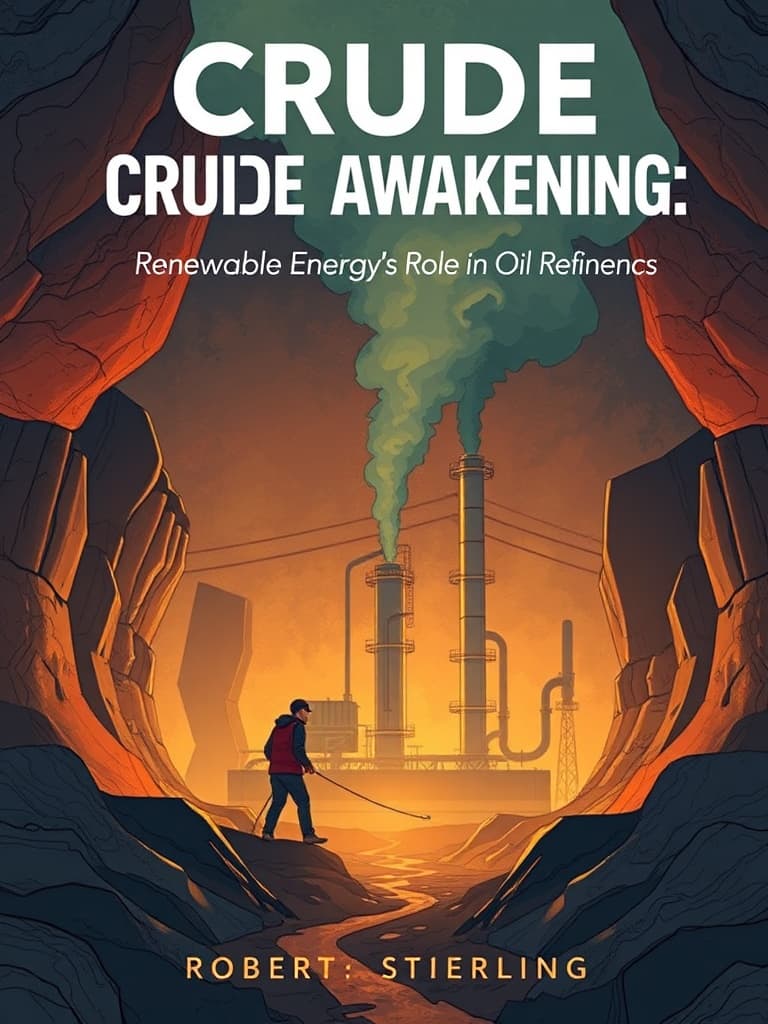
Crude Awakening: Renewable Energy's Role in Oil Refinement
11
0
6
0
A startup oil refinery that combines underground heat and a sterling engine to generate electricity, then uses this renewable energy to refine crude oil.
Chapters
- 1A Spark of Geothermal GeniusIntroducing GeoHeat Energy, a startup with a radical idea: using the Earth's heat and a Sterling engine to power oil refining. Their vision promises a cleaner, more sustainable future for a traditionally polluting industry.
- 2The Sterling SolutionDelving into the heart of GeoHeat's innovation. We explore how they harness underground thermal energy and the ingenious Sterling engine to generate electricity, making oil refinement surprisingly green.
- 3Against the TideGeoHeat Energy faces a storm of doubt. Established players scoff, regulators hesitate, and investors shy away from their unconventional approach. Funding and approval seem like distant dreams.
- 4The Pilot's PromiseA small-scale success story ignites hope. The pilot program proves GeoHeat's concept is not just viable but cost-effective, capturing attention and finally attracting the investment needed.
- 5Building the Green RefineryWith funding secured, GeoHeat Energy breaks ground on its first full-scale refinery. This tangible project signals a significant shift, demonstrating a real-world application of renewable energy in oil processing.
- 6A New Dawn for EnergyExamining the ripple effects of GeoHeat's triumph. Their success could redefine oil refining's energy sources, paving the way for a broader integration of renewables into heavy industries.
More Non-fiction stories
Browse all Non-fiction →- Bible learning
This book offers a practical, accessible guide to understanding the Bible, moving beyond rote memorization to foster genuine spiritual growth. It addresses the common challenges of biblical interpretation and application by providing clear explanations and relatable examples. Unlike other study Bibles or commentaries, this work focuses on equipping the reader with the tools for lifelong personal study and reflection.
- PART 1&2 From Conception to Consciousness
Seeing my Mother and hearing her voice for the first time
- Beyond Steel: The Dawn of Super-Span Bridges
This book explores the radical potential of a novel coaxial, Titanium Carbide-armoured Carbon Nanotube-Fullerene Hyper-Lattice cable to revolutionize suspension bridge design. Current engineering limitations, dictated by the weight of conventional steel cables, prevent bridges from spanning vast distances. The proposed hyper-lattice cable, significantly lighter and stronger than steel, would enable the construction of "Super-Span Suspension Bridges" capable of crossing previously impossible oceanic expanses.
- Tiled Pores, Tidal Hopes: The Fullerene Desalination Revolution
Scientists aim to create a highly efficient desalination system using a novel fullerene tetramer building block that forms precisely sized sub-nanometer pores when arranged into a 2D sheet. Current filtration methods are energy-intensive and less precise, hindering widespread access to clean water. This new approach promises a revolutionary leap in molecular sieving for desalination due to the unique, regular pore structure of the tiled fullerene squares.
- The Buckyball Tank: Revolutionizing Armored Warfare
Scaling this hierarchical buckyball-nanotube metamaterial up to build a main battle tank would completely revolutionize armored warfare physics. A standard modern battle tank, like the M1A2 Abrams, is a logistical nightmare. It weighs a massive 65 to 70 metric tons, requiring an incredibly thirsty gas turbine engine to move, and it cannot cross weaker bridges or be easily airlifted. Replacing its heavy steel and depleted-uranium composite armor with a Titanium-Carbide (TiC) coated buckyball-CNT framework would change everything: 1. The Shocking Weight Reduction Because this carbon lattice contains up to 80% hollow space while maintaining sp² covalent bonds, the density drops from steel's 7.85 g/cm³ to roughly 0.55 g/cm³. * The Result: The total structural mass of the tank would plummet from 70 tons down to roughly 6 to 8 metric tons. * Tactical Mobility: At this weight, the tank is no longer bound to railways or massive cargo ships. A single military transport plane could carry six tanks at once instead of just one. 2. A "Superelastic" Hull That Bends But Won't Break Instead of attempting to stop an incoming anti-tank missile through brute thickness, the metamaterial tank uses elastic energy absorption: * When an explosive warhead strikes the side, the 3D hexagonal network compresses locally. * The C₆₀ nodes flatten momentarily, and the carbon nanotube pillars undergo widespread, coordinated elastic buckling to absorb and dissipate the entire kinetic shockwave across the vehicle's frame. * Within microseconds of the explosion, the hull snaps cleanly back into its original shape, completely unharmed. 3. Infinite Range and Amphibious Capabilities Because the tank is so incredibly light, the physics of how it moves completely change: * Water Floating: Since the bulk density of the tank (0.55 g/cm³) is much lower than the density of water (1.0 g/cm³), the tank would naturally float. It could drive straight off a transport ship into the ocean and propel itself to shore without any modifications. * Engine Optimization: Instead of a massive, roaring engine, it could run on a tiny, quiet electric powertrain. The drastically lower weight means it can accelerate like a supercar, cross muddy terrain without sinking, and consume a fraction of the fuel. The Defensive Outer Shell To prevent the carbon nanotubes from burning or degrading in combat, the entire vehicle would be treated with a 100-micrometer thick Titanium-Carbide (TiC) armor coating. This hard ceramic shell would provide a Mohs hardness of 9+ to deflect heavy machine-gun fire and act as a thermal insulator against high-temperature plasma, anti-tank explosives, or laser targeting systems. Would you like to explore: * How the design of the tank's tracks would change now that it weighs less than a pickup truck? * What kind of futuristic weapon systems (like railguns) could be mounted on it thanks to the extra weight capacity? By dropping the tank’s weight from a massive 70 tons to a mere 6 to 8 metric tons, the standard engineering rules for military vehicles are completely rewritten. Dropping below the weight of a commercial pickup truck changes how the vehicle interfaces with the ground and unlocks incredible energy potential for heavy weaponry.
- The Fullerene Filter: A New Dawn in Water Purification
This essay explores the transformative potential of a novel nanofiltration membrane built from cyclic fullerene tetramers, capable of creating precisely sized sub-nanometer pores for advanced molecular sieving. The challenge lies in effectively designing and implementing a water treatment system utilizing this unique technology. The innovation offers an unprecedented level of control in water purification through its regular array of identical molecular sieves.
Want to write a story like this?
Learn the craft in our free AI story generator, then draft your first chapter with an AI co-writer.
What stayed with you?
Read a chapter and leave the author a comment.
Reader notes
Loading reader notes…