Explore storiesStart my first chapter
About this book
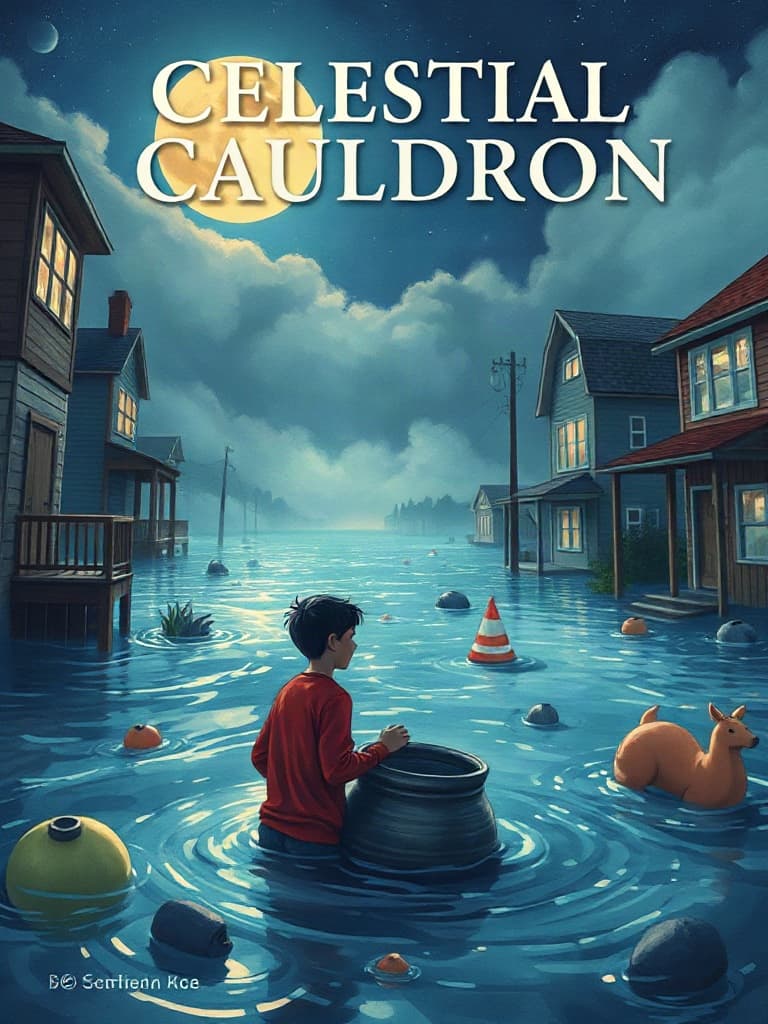
Celestial cauldron
Scientifical realism
Views
4
Likes
0
Chapters
20
Comments
0
Young Travis wakes up to find the ocean at his front door and all of him neighbors and entire neighborhood completely underwater then checks social media to not just his towel it's the entire world that is now underwater and getting a lot warmer
Chapters
- 1The Uninvited OceanChapter 1: The Tide That Never Receded **Scene 1: Dawn's False Promise** Travis stirs in his sleep, a faint, rhythmic lapping sound disturbing his slumber. He dismisses it as a particularly high tide, a common occurrence in his low-lying coastal town. The morning sun, filtered through his bedroom curtains, paints a warm, deceptive glow across his room. He stretches, expecting the familiar routine: coffee, a quick scan of local news, perhaps a chat with his elderly neighbor, Mrs. Gable, about her prize-winning roses. His house, a modest, salt-weathered bungalow, has always been a stone's throw from the beach. The sound persists, however, growing louder, more insistent. It’s not the gentle ebb and flow of a normal tide; it has an unnatural persistence, a relentless presence. **Scene 2: The Unveiling** Travis ambles to his kitchen, the sound of water now undeniable, seeping from under his back door. He frowns, a prickle of unease starting to form. He opens the door, and his breath catches. The world outside is not his familiar, sun-drenched street. Instead, a vast expanse of murky, grey water stretches before him, reaching halfway up his porch steps. His neighbor's meticulously manicured lawn is submerged, their garden gnomes bobbing like macabre buoys. The street itself is a river. Panic, cold and sharp, begins to replace confusion. He rushes to his front window, his heart hammering against his ribs. The houses across the street are islands, their lower floors vanishing beneath the encroaching tide. A car drifts lazily, its tires submerged. The air feels heavy, humid, and carries an unfamiliar salty tang, far stronger than usual. **Scene 3: The Digital Echo Chamber** His first instinct is to reach for his phone, to check local emergency alerts, to see if this is a localized storm surge. He unlocks the screen, his thumb hovering over the news app. But before he can tap it, a cascade of notifications floods his lock screen. Social media. His feed is a chaotic, overwhelming torrent of images and videos. A skyscraper in New York City, its lower floors disappearing under a churning sea. The canals of Venice, no longer picturesque waterways but raging torrents. The Eiffel Tower, its base lapped by waves. The images are terrifyingly similar to his own street, but on a global scale. He scrolls frantically, his hands trembling. News channels flash breaking news banners: 'Unprecedented Global Sea Level Rise,' 'Coastal Catastrophe Unfolds Worldwide,' 'Record High Temperatures Reported.' The sheer volume of information, the global scope of the disaster, is paralyzing. It’s not just his town; it’s everything. The confusion solidifies into a dawning, gut-wrenching horror. **Scene 4: The Heat of the Matter** Interspersed with the flooding reports are increasingly alarming details about the temperature. News anchors, their faces etched with disbelief, report record-breaking heatwaves across continents. The water itself feels unnaturally warm when a wave sloshes against his leg. He notices the air is thick with a suffocating humidity, a palpable warmth that feels wrong for early morning. The usual cool, crisp sea breeze is absent, replaced by a heavy, stagnant heat. He checks a weather app; the temperature is already ten degrees higher than it should be for this time of year, with a 'feels like' temperature even higher. The combination of the rising water and the oppressive heat creates a terrifying synergy. His home, once a comforting sanctuary, now feels like a fragile vessel on an alien ocean, under a sun that seems too close, too intense. He feels a primal fear, an instinctual understanding that the rules of his world have fundamentally changed, and he is utterly unprepared. **Character Intent:** Travis's primary intent in this chapter is to understand the immediate, surreal situation unfolding around him. He moves from initial confusion and disbelief to dawning horror as he grasps the scale of the disaster. His goal is to gather information, to make sense of the impossible, and to assess his personal safety. He is driven by a need for answers, a desire to find an explanation for the watery invasion. **Setting Details:** The setting shifts from Travis's familiar, comfortable home to the immediate, terrifyingly altered external environment. The focus is on the visual and sensory details of the flood: the lapping water, the submerged street, the encroaching tide. The contrast between the interior warmth and the exterior dampness and heat is crucial. The digital world of social media and news feeds serves as a secondary, overwhelming setting, amplifying the sense of global crisis. **Emotional Turns:** The chapter begins with a sense of mild annoyance and confusion, quickly escalating to unease, then to outright panic and horror. There's a profound sense of disbelief as the impossible becomes reality. The overwhelming influx of information triggers a feeling of helplessness and dread. The final emotional state is one of stunned terror, a realization of the immense and unprecedented nature of the catastrophe. **Continuity Notes:** This chapter establishes the inciting incident. The rapid, global nature of the sea-level rise and temperature increase is introduced. Travis's initial shock and his reliance on digital information are key. The chapter must clearly differentiate between a normal high tide and this unprecedented, persistent flooding. The unusual warmth of the air and water needs to be subtly introduced, hinting at the broader climate implications. The chapter ends with Travis in a state of shock, facing the immediate reality of his flooded home and the global catastrophe he’s just discovered. **Ending Hook:** Travis stands at his window, the phone still clutched in his hand, the images of a drowned world burning into his retinas. The water outside his door has risen another inch. He is trapped, and the world is drowning. The question isn't *if* things will get worse, but *how much* and *how fast*.
- 2The Digital DelugeChapter 2: Digital Deluge **Scene 1: The Endless Scroll** Travis remains rooted to his spot by the window, his phone screen a mesmerizing, terrifying portal. The initial shock has subsided, replaced by a frantic need to consume every piece of information. He scrolls through social media feeds – Twitter, Instagram, Facebook – each platform a chaotic tapestry of disaster. Videos show people wading through knee-deep water in cities he recognizes from travel shows: Tokyo, Sydney, Miami. News anchors, their voices strained, report from precarious perches as water surges behind them. The sheer volume is overwhelming. It’s not just isolated incidents; it's a coordinated, global assault by the ocean. The consistency of the reports, from independent sources across the globe, hammers home the undeniable reality. This isn't a localized storm or a freak tide; it's something far larger, far more sinister. **Scene 2: The News Cycle's Relentless Grip** He clicks on a live news stream. A journalist, drenched and shivering despite the apparent heat, stands in front of the Statue of Liberty, the water reaching the iconic statue's pedestal. The reporter’s voice cracks as she describes the impossible speed of the inundation. "This isn't a predicted storm surge," she states, her eyes wide with a mixture of fear and disbelief. "This is happening faster than any model predicted. Coastlines are vanishing. We're seeing levels rise by feet, not inches, in mere hours." Travis zooms in on a graphic showing projected sea-level rise compared to current levels. The difference is stark, the current rise far exceeding even the most pessimistic long-term forecasts. He switches to another channel. A meteorologist, looking pale, discusses anomalous temperature readings. "We're not just seeing coastal flooding," he explains, gesturing at a map dotted with alarming red and orange hues. "We're seeing a global heat anomaly. Temperatures are soaring in regions that should be experiencing seasonal cooling. The oceans themselves are registering unprecedented warmth." The scientific jargon, usually abstract, now has a terrifyingly tangible context. The numbers and charts are no longer theoretical; they are the grim statistics of his new reality. **Scene 3: The Human Element** Beyond the official reports, the raw, unfiltered content from ordinary people is perhaps the most disturbing. A shaky selfie video shows a family being evacuated by boat from their suburban home, their faces a mask of terror. A drone shot captures a bird's-eye view of a once-bustling city now resembling a vast, shallow lake, with only the tallest buildings visible. He sees posts from friends of friends, people he vaguely knows, expressing shock and fear. "My parents' house in Florida is gone," one reads. "Completely underwater. No power, no contact." Another laments, "We drove for hours, but the highway is flooded. We're trapped." The collective panic is palpable, a digital scream echoing across the globe. It’s no longer about understanding the 'why'; it’s about the immediate, visceral impact on human lives. The scale of the loss – homes, livelihoods, potentially lives – begins to sink in, a crushing weight on his chest. He sees images of people desperately trying to salvage belongings, their faces etched with despair. The disaster is not an abstract concept; it is a deeply personal tragedy unfolding for millions. **Scene 4: The Dwindling Options** Travis’s mind races. His own home is still above the immediate waterline, but the water is still rising. How long can it hold? He glances at the supplies in his pantry – a few cans of soup, some pasta, a half-empty box of cereal. It’s not enough. He thinks of his neighbors, of the elderly Mrs. Gable next door. Is she safe? Can she even get out? The thought of being trapped, of succumbing to the rising water and suffocating heat, sends a fresh wave of panic through him. He needs to do something, but what? The world outside is a chaotic, drowning mess. Evacuation orders are likely being issued, but where would he even go? The news reports paint a picture of widespread chaos, of roads blocked and shelters overwhelmed. The initial confusion has fully transformed into a chilling, existential dread. The digital deluge has confirmed his worst fears, painting a stark picture of a world irrevocably altered. **Character Intent:** Travis's intent is to fully comprehend the scope and nature of the disaster. He is driven by a need for information, a desperate attempt to grasp the enormity of what has happened. He moves beyond personal confusion to a global realization, witnessing the widespread impact through digital media. His goal shifts from simply understanding his immediate surroundings to understanding the global catastrophe and its implications for his own survival. He is seeking confirmation of his worst fears, and the digital world provides it in overwhelming abundance. **Setting Details:** The primary setting is Travis's home, but the 'external' setting is now the digital world – social media feeds, live news streams, online articles. The visual descriptions are of flooded cities, submerged landmarks, and desperate human scenes captured via video and photos. The contrast between the immediate, localized threat in his home and the global, overwhelming digital representation of the disaster is key. The sense of heat and humidity, previously noted, is reinforced through descriptions of the weather reports. **Emotional Turns:** The emotional arc moves from shock and disbelief to a frantic, almost obsessive need for information. This is followed by a growing sense of dread and despair as the global scale of the disaster becomes apparent. The raw, human element in the shared content evokes empathy and a deepening sense of fear for humanity. The chapter culminates in a state of chilling realization and existential dread, as the abstract threat becomes a concrete, overwhelming reality. **Continuity Notes:** This chapter builds directly on the initial shock of Chapter 1, expanding the scope of the disaster globally. It introduces the idea that the events are happening much faster than scientific models predicted. The connection between sea-level rise and rising global temperatures is explicitly made through news reports. The human cost of the disaster begins to be illustrated. Travis's growing sense of urgency and the inadequacy of his current resources are highlighted, setting the stage for future decisions. **Ending Hook:** Travis lowers his phone, the screen going dark in his trembling hand. The silence in his house feels deafening after the cacophony of the digital world. He looks out the window again. The water is still there, still rising. He knows, with a certainty that chills him to the bone, that his old life is over. The question now is not whether he can survive here, but *if* he can survive at all, and where 'here' even is anymore in a world that is literally melting and drowning.
- 3Whispers of the IceChapter 3: Whispers of the Ice **Scene 1: The Scientific Speculation** Amidst the deluge of panic and raw footage, scattered voices of authority begin to emerge, attempting to contextualize the unfolding catastrophe. Travis, still glued to his phone and any available screen, catches snippets of scientific commentary. News anchors, desperate for authoritative voices, interview climate scientists and oceanographers. The initial explanations, though couched in academic language, are chilling. "We're seeing an unprecedented acceleration in ice melt," states a geologist, her face grim as she gestures towards satellite images of Greenland and Antarctica. "It appears the ice sheets, particularly in West Antarctica, have passed a critical tipping point. We're observing calving events of a magnitude never before recorded. This isn't just surface melt; it's a destabilization of the entire ice shelf." The term 'tipping point' hangs heavy in the air, a harbinger of irreversible change. Travis struggles to fully grasp the implications, his mind still grappling with the immediate visual evidence of water lapping at his door. **Scene 2: Land Ice vs. Sea Ice** Another expert, an oceanographer, clarifies a crucial distinction that Travis hadn't considered. "It's vital to understand that the primary driver of this rapid rise is the meltwater from *land-based* ice – the massive ice sheets and glaciers sitting on continents," she explains. "Floating sea ice, like the Arctic sea ice cap, doesn't significantly raise sea levels when it melts because it's already displacing water. But the land ice? That's pure volume added to the oceans. And the rate at which these colossal ice masses are disintegrating is frankly terrifying. We're talking about ice that has been locked away for millennia, now pouring into the oceans at an alarming pace." This distinction is critical. Travis remembers seeing images of melting Arctic ice, but the focus now shifts to the colossal, continent-sized ice sheets. The idea of ancient ice, millennia old, suddenly becoming a source of global flooding is a concept almost too vast to comprehend. He tries to visualize the sheer scale – mountains of ice, larger than entire countries, melting and flowing into the sea. **Scene 3: Thermal Expansion's Silent Threat** Beyond the ice melt, the scientists repeatedly mention another factor: thermal expansion. "The oceans have absorbed an enormous amount of heat over the past decades," a climatologist states, her voice weary. "As water warms, it expands. It's a fundamental property of physics. Even a small increase in temperature across the vast volume of the world's oceans translates into significant sea-level rise. And this warming is happening faster than anticipated, supercharging the expansion." Travis feels the oppressive heat around him, the muggy air clinging to his skin. He looks at the water outside his home; it feels unnervingly warm to the touch, not the cool embrace of the sea he’s used to. The idea that the very water causing his inundation is also expanding due to heat adds another layer of insidious danger. It’s a double-edged sword: ice melt adds volume, and warmer water takes up more volume. **Scene 4: The Feedback Loop Whispers** Hints of more complex, frightening mechanisms begin to surface. Scientists mention 'feedback loops' and 'accelerated warming.' "The loss of reflective ice and snow cover, the declining albedo, means more solar radiation is absorbed by the Earth's surface and oceans, leading to further warming," one scientist explains, almost as an aside, before being pulled back to discuss immediate evacuation logistics. "This creates a positive feedback loop: warming melts ice, less ice means more heat absorption, which leads to more warming and more melting." This concept, the idea of a self-reinforcing cycle of disaster, is deeply unsettling. It suggests that the problem is not just escalating but actively feeding itself, accelerating beyond human control. Travis feels a growing sense of helplessness, a realization that the scientific underpinnings of this disaster are complex, interconnected, and terrifyingly potent. **Scene 5: Grasping the Unfathomable** Travis finds himself pausing the news, rewinding segments, trying to piece together the scientific puzzle. He’s never been particularly scientifically inclined, but the stakes are now impossibly high. He searches for definitions online: 'ice sheet instability,' 'thermal expansion,' 'albedo.' The scientific terms, once abstract, now represent the very forces reshaping his world. He looks at his hands, then at the water creeping higher up his porch. The scientific explanations, however complex, are no longer just words on a screen; they are the tangible, terrifying forces that have invaded his home. The confusion isn't entirely gone, but it's now overlaid with a profound sense of dread and a dawning, terrifying understanding of the mechanisms at play. His world is literally being reshaped by ancient ice melting at an unnatural rate and oceans warming to an unprecedented degree. **Character Intent:** Travis's intent in this chapter is to begin understanding the scientific 'why' behind the disaster. He is driven by a need for a more concrete explanation beyond the immediate visual of flooding. He tries to connect the abstract scientific concepts with the tangible reality he’s experiencing. His goal is to demystify the catastrophe, to find a logical framework for the chaos, even if that framework is terrifying. He is actively seeking knowledge, even if it overwhelms him. **Setting Details:** The setting remains largely Travis's home, but the focus shifts to the information he is consuming – news reports, scientific interviews, online research. The visual elements are now dominated by satellite imagery of ice sheets, diagrams explaining thermal expansion, and charts illustrating temperature anomalies. The physical sensations of heat and humidity, and the tactile experience of the unnaturally warm water, serve as anchors to the scientific explanations. **Emotional Turns:** The emotional journey moves from overwhelming panic to a more analytical, albeit fearful, curiosity. There's a sense of dawning comprehension mixed with deep unease and a growing feeling of helplessness as the complexity and interconnectedness of the disaster become clearer. The concept of 'tipping points' and 'feedback loops' introduces a new level of existential dread. The frustration of not fully understanding is tempered by the desperate need to learn. **Continuity Notes:** This chapter introduces the key scientific mechanisms driving the disaster: accelerated melting of land-based ice sheets (specifically mentioning Greenland and West Antarctica), thermal expansion due to ocean warming, and the albedo feedback loop. The distinction between land ice and sea ice is made clear. The idea of 'tipping points' and 'accelerated' processes is crucial. Travis's personal struggle to understand these concepts should be emphasized. The chapter should end with Travis feeling a mixture of dread and a growing, albeit fearful, understanding of the scientific forces at play. **Ending Hook:** Travis leans back from his screen, the glow reflecting in his wide eyes. The scientific explanations, once distant and academic, now feel like a personal threat. He understands, at least partially, that the world isn't just flooding; it's fundamentally changing, driven by forces he's only just beginning to comprehend. He looks out at the water, still patiently rising, and wonders if understanding the cause makes him any more prepared for what comes next, or if it simply makes the inevitable more terrifying.
- 4The Evacuation OrderChapter 4: The Evacuation Order **Scene 1: The Siren's Song** As the sun climbs higher, casting an oppressive heat, the surreal normalcy of the submerged streets is shattered by a new sound: the wailing of sirens. Not the intermittent, localized sirens of a fire or accident, but a sustained, urgent, city-wide alarm. It’s a sound that chills Travis to the bone, a universally recognized signal of imminent danger. He rushes back to the window, his heart pounding. The water level has risen further; it now reaches the windowsills of the ground floor of his house. The drifting car from earlier is now completely submerged. He sees a police boat, its lights flashing, navigating the watery avenues, its loudspeaker crackling with an urgent, distorted message. "Attention all residents. This is an official evacuation order for all low-lying coastal areas. Repeat, evacuation order is in effect. Proceed immediately to designated emergency shelters inland. Do not delay. The situation is critical. Repeat, critical." **Scene 2: The Dilemma of Departure** Travis turns from the window, his mind racing. Evacuate. The word itself feels fraught with peril. Where to? His town, once a familiar and safe haven, is now a trap. The roads are likely flooded, choked with debris, or already impassable. He looks at Maria, his neighbor from across the street, who has managed to wade over to his porch, her face pale and determined. She's clutching a small, waterproof bag. "Travis! We have to go. My kids… they're at my sister's place further inland, but I need to get to them. The water's rising too fast here." Beside her, Ben, a younger neighbor, his eyes wide with fear, clings to Maria's arm. "My mom told me to stay put if anything happened," Ben whispers, his voice trembling. "But… it's all underwater now." The immediate threat of drowning is now coupled with the urgent need to move. But moving means leaving behind the only home Travis has ever known, venturing into an unknown and chaotic landscape. He glances back at his house, the water now lapping at the base of his front door. Staying feels like a death sentence. Leaving feels like stepping into a larger, more uncertain danger. **Scene 3: The Chaos of Departure** Outside, the scene is one of burgeoning panic. Neighbors are emerging, some in boats, others wading through the waist-deep water, carrying what few possessions they can. There’s a desperate scramble for boats, for higher ground, for any means of escape. A few brave souls are attempting to use kayaks and paddleboards, navigating the submerged streets. Others are trying to drive, their vehicles struggling through the rising water, creating dangerous wakes that flood adjacent properties. The sense of order is dissolving rapidly, replaced by a primal instinct for self-preservation. Travis sees arguments erupting over boat space, hears cries of desperation. The familiar faces of his neighbors are contorted with fear and urgency. **Scene 4: The Crossroads** Maria looks at Travis, her gaze sharp. "We can try to get to the old highway overpass. It's higher ground. We might be able to find a way inland from there. But we have to go *now*. The water's not stopping." Ben nods vigorously, his fear momentarily overshadowed by a desperate hope. Travis feels a heavy weight settle in his stomach. His instincts scream at him to flee, to get to safety. But a part of him, the part that feels responsible for his home, for his community, hesitates. He sees the fear in Ben's eyes, the determination in Maria's. He knows he can't stay here. But the thought of venturing into the unknown, with the world seemingly collapsing around them, is terrifying. **Scene 5: A Fleeting Decision** He makes a decision, driven by the immediate threat and the faces of his younger neighbors. "Okay," Travis says, his voice firmer than he feels. "Okay, Maria. Let's go. Ben, stay close. We'll try for the overpass." He quickly grabs a sturdy backpack, stuffing in a few essentials he can reach – a first-aid kit, a flashlight, some bottled water from the fridge that's still accessible. The water is now a few inches deep inside his house. The familiar scent of his home is being replaced by the sharp, sterile smell of salt and dampness. He knows this is likely the last time he will see his house as it was. The familiar comfort of his home is now a liability, a weight holding him back from survival. The evacuation order has transformed his world from one of confused observation to one of desperate, immediate action. The familiar town has become a treacherous obstacle course, and the journey inland is a leap into the terrifying unknown. **Character Intent:** Travis's intent is to heed the evacuation order and find immediate safety. He is driven by the escalating threat of drowning and the chaotic reality unfolding outside. His goal is to escape his flooded home and reach higher ground, guided by Maria's more pragmatic survival instincts. He grapples with the difficult decision to leave his home and the fear associated with venturing into the unknown chaos. He feels a sense of responsibility towards Ben and Maria. **Setting Details:** The setting shifts from Travis's interior to the rapidly deteriorating exterior environment of his town. The focus is on the visual and auditory cues of chaos: sirens, loudspeakers, police boats, panicked neighbors, submerged vehicles, and the steadily rising water. The interior of Travis's home is also depicted as becoming increasingly flooded and less habitable. The oppressive heat remains a constant environmental factor. **Emotional Turns:** The chapter moves from a state of fearful realization to urgent panic and a sense of desperate resolve. The initial confusion and dread are replaced by the immediate need for action. There's a strong sense of loss as Travis leaves his home, coupled with the fear of the unknown and the responsibility he feels for Ben and Maria. The growing chaos outside amplifies the emotional tension. **Continuity Notes:** This chapter depicts the official response to the escalating disaster: the evacuation order. It highlights the practical difficulties and dangers of such an order in a rapidly flooding environment. The immediate threat of drowning is now the primary motivator. The chapter establishes the formation of a small group (Travis, Maria, Ben) and their immediate goal: reaching higher ground inland. The inadequacy of immediate resources and the chaotic nature of the evacuation are key elements. The chapter must show the water level continuing to rise, making staying untenable. **Ending Hook:** Travis wades out of his front door, the cool, salty water now up to his waist. He glances back one last time at his home, a place of comfort and memories now slowly succumbing to the relentless tide. With Maria and Ben beside him, he turns towards the submerged street, the distant wail of sirens and the desperate cries of other survivors echoing in his ears. The known world behind him is disappearing; the unknown world ahead is a terrifying gamble. Their journey has begun.
- 5A Fragile HavenChapter 5: A Fragile Haven **Scene 1: The Treacherous Inland Trek** The journey from Travis's submerged home to the designated evacuation point – an old highway overpass several miles inland – is a harrowing ordeal. The water, though receding slightly in some areas further from the coast, remains a constant, treacherous presence. Streets are impassable, forcing them to navigate through backyards, over fences, and through the interiors of abandoned buildings. Debris – furniture, cars, personal belongings – litters the landscape, creating dangerous obstacles. The oppressive heat intensifies under the midday sun, making the physical exertion exhausting. They encounter other groups of survivors, some dazed and disoriented, others desperately trying to organize. The air is thick with the scent of salt, dampness, and the faint, acrid smell of something burning in the distance. Travis uses his nascent resourcefulness, helping Maria guide Ben, pointing out safer routes, and using a fallen branch to test the depth of submerged sections. **Scene 2: The Overpass Sanctuary** They finally reach the highway overpass, a concrete behemoth rising significantly above the surrounding flooded plains. It's a stark, exposed place, but crucially, it’s dry. Here, a growing number of displaced people have gathered. Families huddle together, makeshift shelters constructed from salvaged tarps and blankets. The atmosphere is a tense mixture of relief and anxiety. They have escaped the immediate threat of drowning, but the reality of their situation is stark. The overpass offers elevation, but little else. There are no facilities, no organized support system beyond the shared desperation of the survivors. **Scene 3: The Scarcity Scramble** As the initial relief of reaching safety fades, the pressing concerns of survival come into sharp focus. Clean drinking water is the most immediate need. The water that surrounds them, though no longer actively rising on the overpass, is saltwater, contaminated and undrinkable. Survivors share what little bottled water they managed to bring, rationing it carefully. Food is another critical issue. Many, like Travis, had little time to pack. The few grocery stores accessible were either flooded or ransacked. People begin organizing small foraging parties, venturing cautiously into the less flooded areas, hoping to find untouched supplies or edible vegetation, though the unfamiliarity of the landscape and the rapidly changing ecosystem make this dangerous. Maria, ever practical, begins assessing the skills and resources within the assembled group, trying to establish some semblance of order. **Scene 4: The Lingering Heat and Dampness** The heat is relentless. Without shade or proper shelter, the survivors bake under the sun. The concrete of the overpass radiates heat, making it difficult to rest. The constant dampness from their clothes and the humid air contribute to a pervasive discomfort, increasing the risk of heatstroke and other heat-related illnesses. The psychological toll of the disaster, the loss, the uncertainty, combined with these physical hardships, begins to wear on people. Ben, visibly shaken, stays close to Travis, his initial fear replaced by a quiet, persistent unease. He misses his home, his toys, the normalcy that now seems like a distant dream. **Scene 5: A New Reality Dawns** Travis, looking out from the overpass, sees the extent of the flooding. The familiar landscape of his town is gone, replaced by a vast, shimmering expanse of water. The tops of trees and buildings poke out like islands. In the distance, the ocean seems to have advanced miles inland. The scale of the change is staggering. This isn't a temporary flood; it feels permanent. The old world, the world of his home, his routine, his expectations, is irrevocably lost. They are survivors, stranded on a concrete island, facing a future defined by scarcity and uncertainty. The immediate panic of evacuation has subsided, replaced by the grim, long-term challenge of survival in a world transformed. The hope of returning to normalcy is fading, replaced by the daunting prospect of adapting to this new, waterlogged reality. **Character Intent:** Travis's intent is to secure immediate safety for himself and those he feels responsible for (Maria, Ben) and to begin assessing the next steps for survival. He is driven by the need for basic resources – water, food, shelter – now that the immediate threat of drowning has been averted. His goal is to find a semblance of stability and to begin understanding the new challenges of their environment. He is observing the dynamics of the survivor group and the harsh realities of their new situation. **Setting Details:** The primary setting is the highway overpass, depicted as a large, elevated, concrete structure offering temporary refuge but lacking essential resources. The surrounding landscape is a vast, flooded plain, with the remnants of submerged towns and the encroaching sea visible in the distance. The oppressive heat and humidity are constant environmental factors. The atmosphere on the overpass is one of anxious community, resourcefulness born of desperation, and the palpable absence of basic necessities. **Emotional Turns:** The emotional arc moves from the frantic urgency of escape to a cautious relief, followed by growing anxiety and a grim sense of realization. The initial hope of reaching safety is tempered by the stark reality of scarcity and the daunting challenges ahead. There's a sense of loss for the familiar world and a dawning understanding of the long-term nature of the crisis. Travis experiences a growing sense of responsibility and a need for practical solutions. **Continuity Notes:** This chapter depicts the immediate aftermath of the evacuation, focusing on the challenges of survival for displaced populations. The scarcity of clean water and food is established as a primary concern. The concept of 'higher ground' as a temporary refuge is introduced. The psychological impact of displacement and loss is highlighted. The permanence of the sea-level rise is hinted at. The chapter sets the stage for the challenges of community building and resource management among survivors. **Ending Hook:** Travis watches the sun begin to dip below the horizon, painting the vast expanse of water in hues of orange and purple. The concrete overpass feels less like a sanctuary and more like a precarious perch overlooking a drowned world. He shares a meager ration of water with Ben, the silence between them heavy with unspoken fears. They have survived the initial surge, but the real struggle – the struggle for sustenance, for hope, for a future on this transformed planet – has just begun.
- 6The Albedo EffectChapter 6: The Albedo Effect **Scene 1: The Sun's Unforgiving Gaze** The survivors on the overpass are experiencing the full brunt of the relentless heat. The concrete radiates warmth long after sunset, and the midday sun is almost unbearable. Travis notices how the surfaces around them – the grey concrete, the dull metal of abandoned cars visible through the water – seem to absorb the sun's energy rather than reflect it. This observation, combined with the constant, oppressive warmth, prompts him to recall snippets of the scientific explanations he’d overheard. He remembers the term 'albedo' being mentioned, something about reflectivity. **Scene 2: Dr. Thorne's Arrival and Explanation** Amidst the growing disarray and the simmering anxieties about dwindling resources, a new presence emerges. A small, rugged research vehicle, equipped with advanced monitoring equipment, carefully navigates the partially submerged access roads and arrives at the overpass. Out steps Dr. Aris Thorne, a man with the focused intensity of someone accustomed to dealing with complex data under pressure. He introduces himself and his small team, explaining that they are conducting urgent climate research, documenting the unprecedented changes. He speaks with a calm, measured tone, but his words carry the weight of grave scientific discovery. He notices the survivors’ suffering from the heat and begins to explain one of the key factors exacerbating the global warming: the decline in Earth's albedo. "What you're feeling," Dr. Thorne begins, gesturing around them, "is amplified by a phenomenon known as the albedo effect. Albedo refers to the reflectivity of a surface. Bright, white surfaces, like ice and snow, reflect a large portion of the sun's energy back into space, helping to keep our planet cool. Conversely, darker surfaces, like open water and exposed land, absorb more solar radiation." **Scene 3: The Melting Cycle** Dr. Thorne elaborates, his explanation rooted in observable, real-world science. "As the planet warms, primarily due to greenhouse gas emissions, we see significant melting of ice and snow cover, especially in the Arctic and polar regions. This is primarily land-based ice contributing to sea-level rise, as we’ve discussed, but the loss of reflective ice caps has another critical consequence. Imagine a white sheet covering a dark surface. The white sheet reflects sunlight. Remove it, and the dark surface beneath absorbs much more heat. The same is happening on a global scale. As vast expanses of ice and snow disappear, they are replaced by darker oceans and land, which absorb more solar energy." He pulls up a satellite image on a tablet, showing a stark contrast between the bright white of pre-melt ice sheets and the dark blue of the exposed ocean. "This creates a powerful positive feedback loop," he continues. "The initial warming causes ice melt, which reduces the planet's overall reflectivity (its albedo). Less reflectivity means more solar energy is absorbed, leading to further warming, which in turn melts more ice. It's a self-reinforcing cycle that accelerates the warming trend far beyond what might be expected from greenhouse gases alone." **Scene 4: The Impact on Their Reality** The survivors listen intently, the scientific explanation resonating with their immediate experience. The oppressive heat they are enduring is not just a symptom of general warming; it's being actively amplified by the very changes causing the floods. The loss of the Arctic ice cap, the glaciers, the snowfields – these weren't just distant environmental issues; they were contributing factors to the unbearable heat radiating from the concrete beneath their feet. Travis looks at the vast expanse of dark water surrounding the overpass, realizing it’s now a massive heat absorber, contributing to the suffocating conditions. **Scene 5: A Glimmer of Understanding, A Deeper Fear** Dr. Thorne’s explanation provides a crucial piece of the puzzle, connecting the melting ice sheets with the unbearable heat and the rising seas. It’s a scientific grounding for the chaos they are experiencing. However, the concept of a 'positive feedback loop' also introduces a new layer of fear. It suggests a system spiraling out of control, a process that is becoming increasingly self-sustaining and difficult to halt. While the explanation offers clarity, it also deepens the sense of helplessness. They are not just victims of a change; they are living within a system that is actively amplifying its own destructive potential. The scientific realism of Dr. Thorne’s words, while informative, underscores the terrifying magnitude of the crisis. **Character Intent:** Travis's intent is to understand the scientific drivers of the disaster, particularly the role of warming temperatures and melting ice. He is actively seeking explanations from Dr. Thorne, connecting the abstract scientific concepts to his lived experience. His goal is to gain a deeper understanding of the 'why' behind the escalating catastrophe, even if that understanding brings more fear. He is also observing Dr. Thorne and his team, recognizing their potential role in providing solutions or insights. **Setting Details:** The setting is the highway overpass, now a temporary refuge for survivors. Dr. Thorne's research vehicle and equipment are introduced, symbolizing the scientific investigation. The visual focus is on the contrast between reflective surfaces (like the imagined ice) and absorptive surfaces (concrete, dark water), and the harsh glare of the sun. Satellite imagery is used as a visual aid in Dr. Thorne's explanation. The oppressive heat and humidity are palpable. **Emotional Turns:** The emotional arc moves from discomfort and anxiety due to the heat to a focused curiosity and a dawning comprehension as Dr. Thorne explains the albedo effect. The scientific explanation provides a sense of clarity but also introduces a new level of fear and helplessness related to the concept of self-accelerating feedback loops. There's a growing respect for Dr. Thorne's knowledge and a nascent hope that understanding might lead to solutions. **Continuity Notes:** This chapter introduces and explains the albedo effect and its role as a positive feedback loop in accelerating global warming. It directly links the melting of ice (land-based ice contributing to sea-level rise) with increased heat absorption. Dr. Aris Thorne is introduced as a key scientific figure. The chapter should emphasize the scientific realism of the explanation, grounding it in observable phenomena. The survivors' direct experience of the heat should be linked to this scientific principle. The implication of a self-sustaining cycle of warming is a critical takeaway. **Ending Hook:** Dr. Thorne packs away his tablet, the satellite images of melting ice replaced by the grim reality of the survivors huddled on the hot concrete. Travis watches him, the explanation of the albedo effect settling heavily in his mind. He understands now that the sun is not just shining; it’s actively contributing to their predicament, amplified by the very changes that have drowned their homes. The world is not just warming; it’s trapped in a dangerous cycle, and the implications for their survival on this increasingly dark, heat-absorbing planet are profound and terrifying.
- 7Ocean's EmbraceChapter 7: Ocean's Embrace **Scene 1: The Unnatural Warmth** As the days pass on the overpass, the survivors are constantly reminded of the unnatural warmth. It permeates everything – the air, the concrete, their very bodies. Travis, while helping to distribute the meager rations of water, notices how quickly the water bottles, even those kept in the shade, seem to lose their coolness. He recalls the scientists mentioning 'ocean warming' and 'thermal expansion' in the same breath as ice melt. He seeks out Dr. Thorne, who is busy setting up more sophisticated monitoring equipment near the edge of the overpass, his team collecting atmospheric and water samples. **Scene 2: Dr. Thorne Explains Thermal Expansion** Travis approaches Dr. Thorne cautiously. "Doctor," he begins, his voice hoarse from the dry, hot air, "you mentioned the oceans warming… and expanding? How does that work? It feels like… the water is just getting higher, but it’s also so hot." Dr. Thorne looks up from his work, his expression one of weary patience. He wipes a bead of sweat from his brow. "That's an excellent observation, Travis. It's a critical component of what's happening. We call it thermal expansion. Simply put, when water heats up, its molecules move faster and spread out, causing the water to occupy more volume. It’s a fundamental principle of physics. Even a small increase in temperature across the immense volume of the world's oceans results in a significant rise in sea level." He gestures towards the vast body of water below and around them. "Think of it like heating a pot of water on the stove. As it gets hotter, the water level rises slightly, even before it boils. Now, imagine that happening to every ocean on Earth, continuously, for decades. The oceans have absorbed an enormous amount of excess heat trapped by greenhouse gases in the atmosphere. This absorbed heat is now causing the water itself to expand." **Scene 3: The Double Whammy** Dr. Thorne emphasizes the compounding effect. "So, we have two primary mechanisms driving the unprecedented sea-level rise: first, the meltwater from land-based ice sheets pouring into the oceans, and second, the thermal expansion of the ocean water itself due to increased temperatures. Both are happening at accelerated rates, far exceeding previous projections. It's a devastating combination." He explains that the rate of warming in the oceans has been accelerating, particularly in recent decades. This means that the thermal expansion effect is not just a steady, gradual increase but is also speeding up, contributing to the rapid inundation they are witnessing. The heat absorbed by the ocean is not just a passive consequence; it's an active contributor to the rising waters. **Scene 4: The Unseen Pressure** Travis tries to visualize this. He imagines the vastness of the ocean, miles deep in places. The idea that this immense body of water is literally expanding, pushing outwards, is a powerful, almost terrifying image. It's a silent, relentless pressure, invisible to the naked eye but devastating in its cumulative effect. It’s not just about ice melting *into* the ocean; the ocean itself is growing. He asks, "So, even if the ice melt slowed down, the oceans would still rise because they're getting hotter?" "Precisely," Dr. Thorne confirms. "And the reverse is also true. Even if we somehow stopped all further warming today – which is impossible – the oceans would continue to warm for decades due to the heat already absorbed, and sea levels would continue to rise from thermal expansion. We've essentially committed ourselves to a certain amount of future sea-level rise just from the heat already in the system. And on top of that, we have the ongoing melt of ice sheets, which is itself accelerating." The scientific explanation paints a picture of a planet locked into a dangerous trajectory. **Scene 5: A Deeper Understanding of the Threat** As Dr. Thorne continues his work, collecting samples of the warm ocean water, Travis reflects on this. The ocean, the source of so much life and beauty, has become a formidable adversary. Its rising temperature is not just an abstract metric; it’s a direct contributor to their current predicament, pushing the waters higher, making the air hotter, and amplifying the disaster. The scientific explanation, while complex, provides a crucial understanding of the forces at play. It’s not just a flood; it’s a multifaceted planetary transformation driven by interconnected physical processes. The warmth they feel is the ocean’s embrace, a deadly hug that is slowly but surely reclaiming the land. **Character Intent:** Travis's intent is to understand the role of ocean warming and thermal expansion in the current disaster. He is driven by the tangible experience of the heat and the rising water. His goal is to connect these physical sensations to the scientific explanations provided by Dr. Thorne. He seeks to grasp the interconnectedness of the climate crisis, understanding that multiple factors are at play simultaneously. He is motivated by a desire for knowledge that might offer a path to survival. **Setting Details:** The setting remains the highway overpass. The focus is on the tangible presence of the warm water surrounding them and the oppressive heat. Dr. Thorne's scientific equipment, particularly instruments for measuring water temperature and composition, are key details. Visuals include the vast, dark expanse of the warm ocean and the physical act of collecting samples. The oppressive heat and humidity are constant environmental factors. **Emotional Turns:** The emotional journey moves from a state of physical discomfort and lingering anxiety to a more focused, albeit fearful, understanding. The scientific explanation of thermal expansion provides a sense of intellectual clarity but also deepens the sense of dread by revealing another powerful, self-sustaining mechanism driving the catastrophe. There's a growing realization of the planet's systemic changes and the profound implications for humanity's future. **Continuity Notes:** This chapter focuses on the scientific principle of thermal expansion as a major contributor to sea-level rise. It explicitly links ocean warming to this expansion and emphasizes that it is a significant, ongoing factor independent of ice melt. The chapter reinforces the idea of interconnected feedback loops and the long-term commitment to future sea-level rise already baked into the climate system. Dr. Thorne's role as an educator and researcher is further solidified. The chapter must clearly distinguish thermal expansion from the volume added by melting land ice. **Ending Hook:** Travis watches Dr. Thorne carefully seal a sample of the warm ocean water. The vial glints in the harsh sunlight, a small container holding a force of immense destructive power. He understands now that the ocean is not just a passive recipient of meltwater; it's an active participant in the planet's transformation, its very warmth a weapon. The thought that this vast, expanding body of water is inexorably pressing against the remaining land fills him with a profound sense of unease. They are not just dealing with a flood; they are facing the planet's fever, and the ocean's hot embrace is a chilling prospect for survival.
- 8The GatheringChapter 8: The Gathering **Scene 1: A Community Forged in Crisis** Days have turned into a week since the evacuation order. The initial shock and frantic escape have given way to a grim routine on the overpass. The survivors, once strangers or mere acquaintances, are now bound by their shared ordeal. Travis, Maria, and Ben have naturally fallen into a small unit, relying on each other for support and comfort. Maria, with her natural leadership qualities, has taken a more prominent role, organizing shared resources, coordinating scavenging efforts, and mediating disputes. She’s surprisingly adept at managing the small, desperate community, her pragmatism a steady anchor in the swirling chaos. **Scene 2: Shared Scarcity, Shared Fears** The most pressing issue remains the scarcity of resources. Clean water is rationed strictly, each drop precious. Food supplies are dwindling rapidly. The scavenging parties, initially yielding some canned goods and non-perishables from flooded homes, are becoming less successful. The accessible areas are picked clean, and venturing further afield is increasingly dangerous due to submerged roads, unpredictable currents, and the lingering threat of further inundation. The constant dampness, the oppressive heat, and the lack of proper sanitation are taking a toll on everyone's health and morale. Ben, though still scared, has found a measure of comfort in Travis's presence and Maria's firm guidance. He helps where he can, carrying water, keeping watch. **Scene 3: The Human Equation** Travis finds himself observing the dynamics of the survivor group. There are those who are paralyzed by despair, resigned to their fate. Others exhibit a fierce, almost desperate resilience, clinging to any glimmer of hope. He sees acts of incredible kindness – sharing the last of a food ration, offering a shoulder to cry on, helping an injured survivor. But he also witnesses friction, arguments over supplies, and growing suspicion towards outsiders, including Dr. Thorne and his team, who possess resources and knowledge far beyond the average survivor. Maria’s pragmatism, while essential, sometimes clashes with the raw desperation of others. She insists on strict rationing and organized efforts, which can be perceived as authoritarian by those who feel they have nothing left to lose. Travis, however, sees the necessity in her methods, recognizing that without structure, the group would quickly descend into anarchy. **Scene 4: Whispers of the Past, Echoes of the Future** Conversations among the survivors often drift to the 'before times' – memories of stable homes, plentiful food, predictable weather. These reminiscences are bittersweet, a painful reminder of what has been lost. Travis finds himself sharing stories with Maria, comparing notes on the changes they observed in their town even before the catastrophic flood – unusually warm winters, stronger storms, subtle shifts in wildlife patterns. He realizes now that these were not isolated incidents but early warning signs, ignored or downplayed. Ben, meanwhile, often sits quietly, clutching a small, waterproof trinket he managed to salvage – a smooth, grey stone he believes brings him luck. He rarely speaks of his fears, but his wide eyes and nervous fidgeting betray his anxiety. Travis tries to offer him reassurance, reminding him of their shared survival and the strength they find in each other. **Scene 5: The Need for Direction** As the days blend together under the relentless sun, the lack of a clear future weighs heavily on everyone. The overpass is a temporary solution, a holding pen. The constant threat of dwindling resources and the uncertainty of what comes next create a pervasive sense of unease. People look to Dr. Thorne, hoping his scientific knowledge will offer a solution, a way out, a promise of safety. They look to Maria, hoping her organizational skills can maintain order and extend their survival. And they look to Travis, who, through his quiet observation and growing resourcefulness, has become a steady presence. The gathering on the overpass is more than just a collection of survivors; it's a nascent community, grappling with loss, scarcity, and the terrifying prospect of rebuilding a life on a fundamentally altered planet. **Character Intent:** Travis's intent is to adapt to the new reality of survival and observe the formation of a survivor community. He is driven by the need for stability and the desire to understand the human dynamics in the face of disaster. His goal is to contribute to the group's survival efforts, support Maria and Ben, and begin to understand the long-term implications of their situation. He is actively seeking connection and purpose within the chaos. **Setting Details:** The setting remains the highway overpass, now depicted as a makeshift settlement. The details emphasize the scarcity: rationed water, meager food supplies, makeshift shelters, and the ongoing struggle against the elements (heat, dampness). The interactions between survivors are central, highlighting both cooperation and conflict. The surrounding flooded landscape serves as a constant reminder of their predicament. **Emotional Turns:** The emotional arc moves from the immediate relief of escape to a more sustained state of anxiety, tempered by moments of camaraderie and shared resilience. There's a sense of growing interconnectedness within the survivor group, but also underlying tensions and fears. Travis experiences a deepening sense of responsibility and a growing awareness of the psychological impact of the disaster on individuals and the community. **Continuity Notes:** This chapter focuses on the social and practical aspects of survival in the immediate aftermath of a large-scale disaster. The formation of a makeshift community, the challenges of resource management, and the psychological toll on survivors are key themes. Maria's leadership qualities are further developed. Ben's reliance on Travis and his coping mechanisms are highlighted. The chapter should underscore the precariousness of their situation and the growing need for a long-term plan. **Ending Hook:** As another sweltering day draws to a close, Travis sits with Maria and Ben, watching the last vestiges of sunlight glint off the endless expanse of water. The shared silence is comfortable, a testament to their growing bond. Yet, beneath the surface of this fragile camaraderie, a deeper unease persists. They have found a temporary haven, but the question of where they go from here, and if there is anywhere safe to go, looms larger than ever. The gathering on the overpass is a microcosm of humanity's struggle, but for how long can this fragile community hold?
- 9Doubt and DespairChapter 9: Doubt and Despair **Scene 1: The Gnawing Emptiness** The initial relief of finding refuge on the overpass has long since evaporated, replaced by the gnawing reality of scarcity. The meager food supplies are nearly gone. The scavenging parties return with less and less, the easily accessible caches of canned goods and preserved items having been depleted. The constant hunger is a dull ache, a pervasive reminder of their precarious existence. Travis finds his thoughts constantly drifting to food, to the simple meals he used to take for granted. The oppressive heat, combined with the lack of nutrition, saps their energy, making even simple tasks feel monumental. **Scene 2: The Thirst for More Than Water** Clean water, though strictly rationed by Maria, is also becoming a concern. The supply they managed to salvage is finite. While they are located above the saltwater, finding reliable sources of fresh water inland is proving difficult. The flooding has contaminated many natural sources, and the heat increases evaporation rates. Dehydration becomes a constant threat, exacerbating fatigue and irritability among the survivors. Travis notices the parched lips and hollow eyes of those around him, a silent testament to their growing thirst. **Scene 3: The Dampness and the Heat's Toll** The environment itself is a constant enemy. The pervasive dampness, a result of the omnipresent water and humidity, has led to mold growing on salvaged materials and clothing. It breeds discomfort and contributes to respiratory issues. The heat, however, is the most relentless tormentor. Without adequate shelter or shade, the survivors are exposed to its full fury. Heatstroke becomes a growing concern, and those who succumb often lack the strength to recover. Travis himself feels lethargic, his mind often clouded by the heat and hunger. The constant physical discomfort wears down their spirits. **Scene 4: Ben's Fraying Nerves** Ben, in particular, is struggling. The initial shock has worn off, replaced by a deeper, more persistent fear. He jumps at every unexpected sound, his eyes constantly scanning the horizon for new threats. The loss of his home and the constant uncertainty have taken a significant toll on his young mind. He clings to Travis, seeking reassurance that is becoming increasingly difficult for Travis to provide. Ben’s fear is palpable, a contagion that threatens to spread through the already stressed community. He begins to question the point of it all, his youthful optimism replaced by a bleak fatalism. **Scene 5: Travis's Guilt and Growing Despair** Travis grapples with his own internal demons. He feels a profound sense of guilt, not just for his past complacency regarding climate change, but for his inability to provide a better solution for his community. He sees Maria’s tireless efforts, her unwavering pragmatism, but even she seems to be showing signs of strain. The hope that sustained them in the immediate aftermath of the evacuation is beginning to fray. He looks at the faces around him, etched with hunger, exhaustion, and despair, and wonders if they have any chance of survival at all. The scientific explanations, while informative, offer no immediate solace; they only highlight the magnitude of the forces against them. The fear is no longer a sharp, acute panic, but a dull, persistent dread, a creeping despair that threatens to engulf them all. The question of 'if' they will survive is slowly being replaced by 'how long' they can possibly endure. **Character Intent:** Travis's intent is to cope with the escalating hardships of survival and confront his own feelings of guilt and despair. He is driven by the diminishing resources and the deteriorating physical and mental state of the survivors, particularly Ben. His goal is to maintain hope and find a way forward, but he struggles against the overwhelming sense of futility. He is experiencing the psychological toll of prolonged crisis and the burden of responsibility. **Setting Details:** The setting remains the overpass, but the focus shifts to the degradation of conditions. Details emphasize the physical discomfort: the gnawing hunger, the thirst, the pervasive dampness, the oppressive heat, and the resulting physical and mental exhaustion. The dwindling supplies and the general decline in the survivors' well-being are central. The visual of the surrounding flooded landscape now represents not just a past disaster but a barren, resource-poor environment. **Emotional Turns:** The emotional arc moves from anxiety and urgency to a deeper, more pervasive sense of despair and hopelessness. The initial resilience begins to crumble under the weight of prolonged hardship and scarcity. Travis experiences a crisis of confidence, grappling with guilt and the fear of failure. Ben's fear intensifies, bordering on fatalism. The overall mood is one of weariness and encroaching despair. **Continuity Notes:** This chapter focuses on the long-term consequences of resource scarcity and environmental hardship on survivors. It highlights the psychological impact of prolonged crisis, including despair, guilt, and fear. The physical toll of heat, hunger, and dampness is emphasized. Ben's vulnerability and Travis's internal struggles are central. The chapter should underscore the fragility of their current situation and the growing need for a decisive plan, as the current mode of survival is unsustainable. **Ending Hook:** Travis watches Ben huddle miserably under a makeshift tarp, his small shoulders shaking. The last of the canned beans has been divided, and the water supply is critically low. The sun beats down relentlessly, a mocking reminder of the heat that has become their constant companion. Travis feels a hollow ache in his stomach, a mirror of the emptiness growing in his heart. He looks at Maria, her face etched with exhaustion but her eyes still holding a flicker of defiance. But even that flicker seems to be dimming. The hope that sustained them is a fading ember, and the fear that they are simply waiting to die on this concrete island is becoming a deafening reality.
- 10The Scientist's ArrivalChapter 10: The Scientist's Arrival **Scene 1: A Distant Hum, A Growing Hope** Just as despair threatens to fully engulf the survivors on the overpass, a new sound cuts through the oppressive silence – the distinct hum of an engine. It's not the sputtering noise of a makeshift raft or the roar of a distant, inaccessible plane. This is a more sustained, powerful sound, growing steadily louder. Heads lift, eyes squint towards the horizon. A vehicle, larger and more robust than anything they've seen since the disaster began, is approaching. It’s moving with purpose, navigating the treacherous, partially submerged access routes with practiced ease. A wave of tentative hope washes over the weary survivors. Could this be rescue? Organized aid? Or just another group struggling to survive? **Scene 2: The Arrival of Dr. Thorne and His Team** The vehicle, a specialized, rugged research van with various scientific instruments mounted on its roof, pulls up near the edge of the overpass. The doors open, and out step Dr. Aris Thorne and his team, dressed in practical, climate-resistant gear. They are not the cavalry, not a military rescue operation, but they carry an air of competence and purpose that is immediately noticeable. Dr. Thorne, his face weathered but his eyes sharp and observant, surveys the makeshift settlement on the overpass. He sees the exhaustion, the hunger, the despair, but also the resilience. He approaches Maria, who has emerged as the de facto leader, with a respectful demeanor. **Scene 3: Explanations and Observations** "We've been monitoring the situation," Dr. Thorne explains, his voice calm and clear, cutting through the low murmur of the crowd. "My name is Aris Thorne. I'm a climatologist. We're here to document the changes and, if possible, offer some insights based on our research. We’ve observed the accelerated ice melt, the thermal expansion, the albedo changes… it’s a confluence of factors happening faster than anyone predicted." His team begins to deploy additional sensors, collecting atmospheric data, water samples, and mapping the surrounding flooded terrain with advanced drones. Their presence is a stark contrast to the survivors' rudimentary existence. They have technology, knowledge, and a mission that extends beyond immediate survival. Travis watches them, a mixture of awe and suspicion in his heart. They represent a potential source of answers, but also a reminder of the world's advanced capabilities that seem so distant from their current reality. **Scene 4: The Human Cost and Scientific Imperative** Dr. Thorne doesn't just talk about data; he observes the human cost. He speaks with survivors, listening to their stories, documenting their experiences. He sees the fear in Ben's eyes, the weariness in Maria's posture, the quiet desperation of the crowd. He understands that his scientific imperative is intertwined with a profound humanitarian responsibility. He explains, "What we're witnessing is an extreme, accelerated manifestation of climate change. The models were right, but the timing… the speed… it's unprecedented. We're seeing feedback loops kick in with alarming ferocity. Our goal is to understand these mechanisms fully, to predict future changes, and to identify any potential refuges or survival strategies." His presence shifts the atmosphere on the overpass. While some survivors remain skeptical, viewing the scientists as detached observers, others cling to them as a beacon of hope. The scientific explanations, once abstract, now have a face, a team, and a tangible mission. Travis feels a renewed sense of purpose, a desire to understand more, to assist Dr. Thorne if he can. The arrival of the scientists marks a turning point, moving the narrative from pure survival to a quest for understanding and a potential future. **Scene 5: A New Layer of Uncertainty** However, Dr. Thorne’s presence also introduces a new layer of uncertainty. His team is not a rescue mission; they are researchers. While they offer explanations and observe, they cannot magically solve the survivors' immediate problems of food and water. Their focus is on data, on understanding the global phenomenon. The survivors are left with the knowledge that their plight is part of a much larger, terrifying picture, and that the solutions, if they exist, might be complex and far from guaranteed. The scientists are here to study the disaster, not necessarily to save everyone caught in its path. This realization tempers the initial surge of hope with a dose of pragmatic caution. **Character Intent:** Travis's intent is to seek answers and potential solutions from the arriving scientific team. He is driven by the hope that Dr. Thorne and his colleagues possess the knowledge to explain the disaster and perhaps guide them towards safety. His goal is to understand the scientific underpinnings more deeply and to potentially assist in their research, seeing it as a path to a better future. He also observes the dynamic between the scientists and the survivors, recognizing the complexities of their interaction. **Setting Details:** The setting is the highway overpass, now visited by advanced scientific equipment and personnel. The contrast between the survivors' makeshift settlement and the researchers' high-tech gear is significant. Visuals include scientific instruments, drones, data readouts, and the researchers actively collecting samples and data. The oppressive heat and the surrounding flooded landscape remain constant. **Emotional Turns:** The emotional arc moves from despair and hopelessness to a cautious surge of hope and curiosity with the arrival of the scientists. There's a sense of awe at their knowledge and technology, but also a tempering of that hope with the realization that they are researchers, not rescuers. Travis experiences a renewed sense of purpose and a desire to engage with the scientific process, while others remain skeptical or place unrealistic expectations on the team. **Continuity Notes:** This chapter introduces Dr. Aris Thorne and his scientific team, establishing them as key figures who provide explanations and conduct research. It reinforces the scientific mechanisms of the disaster, framing it as an accelerated manifestation of climate change. The chapter highlights the distinction between scientific research and immediate rescue operations. The survivors' mixed reactions to the scientists – hope, skepticism, reliance – are important. Travis's engagement with Dr. Thorne begins here. **Ending Hook:** Dr. Thorne shares a brief, knowing glance with Travis, acknowledging the unspoken question in the young man's eyes: *What now?* The scientists are here, gathering data, observing the unfolding catastrophe, but their presence doesn't magically fill empty stomachs or conjure clean water. As they begin their work, the survivors are left with a new understanding, a scientific framework for their suffering, but the fundamental question of their survival remains unanswered. The scientists offer knowledge, but knowledge alone cannot quench thirst or fill the void of despair. The journey towards understanding has begun, but the path to safety remains shrouded in uncertainty.
- 11Circulation's ShiftChapter 11: Circulation's Shift **Scene 1: Unpredictable Weather Patterns** The survivors on the overpass have noticed the weather becoming increasingly erratic, even beyond the oppressive, constant heat. Sudden, violent downpours erupt with little warning, only to cease as abruptly as they began, leaving behind saturated ground and a temporary respite from the sun before the heat returns with renewed intensity. These unpredictable shifts are making their already difficult existence even more challenging. Travis finds himself seeking out Dr. Thorne, who is often found monitoring atmospheric conditions with his sophisticated equipment. **Scene 2: Dr. Thorne Explains Ocean Currents** Travis finds Dr. Thorne calibrating a sensor array near the edge of the overpass, the wind whipping around them. "Doctor," Travis begins, gesturing to the turbulent sky, "the weather… it’s so strange. One minute it's scorching, the next it's like a monsoon. Is this connected to… everything else?" Dr. Thorne nods, his gaze fixed on a readout displaying wind speeds and atmospheric pressure. "Absolutely, Travis. It's all interconnected. One of the most significant, and perhaps least understood, consequences of this rapid warming and ice melt is the disruption of major ocean circulation patterns. Specifically, we're seeing changes in systems like the Atlantic Meridional Overturning Circulation, or AMOC." He explains that ocean currents act like a global conveyor belt, transporting heat, nutrients, and moisture around the planet. The AMOC, for instance, plays a crucial role in regulating climate in the Northern Hemisphere by carrying warm surface waters northward and colder, deeper waters southward. This circulation is driven by differences in temperature and salinity. **Scene 3: The Impact of Freshwater Influx** "The massive influx of freshwater from the melting Greenland ice sheet is a major disruptor," Dr. Thorne continues, his voice serious. "This cold, fresh water is less dense than the salty ocean water. It can effectively 'cap' the surface, preventing the warmer, saltier water from sinking and driving the circulation. If this system slows down significantly or even shuts down, it has profound implications for global weather patterns." He elaborates that a slowdown in the AMOC could lead to more extreme weather events in certain regions. For the Northern Hemisphere, it could mean colder winters (counterintuitively, despite global warming), while other areas might experience more intense heatwaves and droughts. It fundamentally alters how heat is distributed across the planet. **Scene 4: A Chaotic Climate System** Travis listens, trying to process the complex interplay of factors. It's not just the melting ice and expanding oceans; it's the very systems that regulate the planet's climate that are being thrown into disarray. The ocean currents, once a predictable force, are becoming erratic, leading to unpredictable and extreme weather. This adds another layer of chaos to their already desperate situation. They are not just dealing with rising seas and heat; they are facing a climate system in turmoil, where established patterns are breaking down. "So, the floods and the heat are one part," Travis muses, "and these crazy storms are another part, all caused by the same fundamental changes?" "Exactly," Dr. Thorne confirms. "The Earth's climate is a complex, interconnected system. When you destabilize one part – like the ice sheets or the ocean’s salinity balance – the effects ripple through the entire system, leading to widespread and often unpredictable consequences. We're witnessing a fundamental shift in how the planet regulates temperature and distributes heat." **Scene 5: The Uncertainty Deepens** Dr. Thorne's explanation, while scientifically sound, deepens the sense of uncertainty and vulnerability. The predictable rhythms of weather, however harsh they might have been before, are gone. Now, they must contend with a climate that is actively hostile and unpredictable. This makes any long-term planning or prediction incredibly difficult. They cannot rely on historical weather patterns; they must constantly adapt to a new, chaotic reality. The scientific understanding is growing, but with it comes the chilling realization of how fundamentally unstable their environment has become. The planet's systems are in flux, and humanity is caught in the unpredictable currents of this change. **Character Intent:** Travis's intent is to understand the connection between the melting ice, rising seas, and the increasingly erratic weather patterns. He is driven by the observable changes in their immediate environment and seeks clarification from Dr. Thorne. His goal is to grasp the broader implications of climate system disruption for their survival. He is actively trying to build a comprehensive understanding of the catastrophe. **Setting Details:** The setting is the overpass, with a focus on the unpredictable weather – sudden downpours, intense heat, strong winds. Dr. Thorne's scientific instruments for atmospheric monitoring are key details. Visuals include turbulent skies, rain, and the researchers working amidst challenging weather conditions. The surrounding flooded landscape serves as a backdrop to the atmospheric phenomena. **Emotional Turns:** The emotional arc moves from confusion and discomfort regarding the erratic weather to a more profound sense of unease and vulnerability as the scientific explanation reveals the systemic nature of the climate disruption. The understanding of disrupted ocean currents and feedback loops introduces a new level of fear related to the unpredictability of their environment. The growing complexity of the disaster amplifies the sense of helplessness. **Continuity Notes:** This chapter introduces the concept of disrupted ocean circulation patterns (specifically mentioning AMOC) as a consequence of rapid warming and freshwater influx from melting ice. It explains how this disruption leads to more extreme and unpredictable weather events globally. The chapter reinforces the idea of a complex, interconnected climate system and the cascading effects of destabilization. Dr. Thorne's role as an explainer of these complex phenomena is central. The chapter must emphasize that these are real scientific mechanisms, accelerated by current events. **Ending Hook:** Dr. Thorne gestures towards the dark, churning clouds gathering on the horizon. "We're not just dealing with higher sea levels anymore, Travis," he says, his voice barely audible above the rising wind. "We're dealing with a planet whose climate regulation systems are breaking down. It means we have to be prepared for anything, anywhere, at any time." Travis looks at the sky, then at the vast expanse of water below. The uncertainty is no longer just about where to find safety, but about what kind of weather, what kind of climate, they will face tomorrow, next week, or next year. The ground beneath them might be stable for now, but the sky above is a tempest of unknowns.
- 12The Search for AnswersChapter 12: The Search for Answers **Scene 1: A Deeper Dive into the Mechanisms** Travis finds himself increasingly drawn to Dr. Thorne and his team. The initial awe has evolved into a genuine desire to understand the intricate web of climate science that is unraveling their world. He spends hours observing their work, asking questions, and poring over the simplified data displays they sometimes share. He sees their dedication, their tireless efforts to collect information, and he feels a growing respect for their mission. He realizes that simply surviving day-to-day is not enough; understanding the 'why' is crucial for finding a path forward, for any hope of rebuilding or adapting. **Scene 2: Assisting the Scientists** Dr. Thorne, recognizing Travis's genuine curiosity and nascent understanding, begins to involve him in small ways. Travis helps with basic tasks: organizing samples, maintaining equipment, carrying supplies. More importantly, Dr. Thorne starts explaining the complex feedback loops in more detail, using Travis as a sounding board. "See this data, Travis?" Dr. Thorne might say, pointing to a graph showing rising ocean temperatures correlating with increased atmospheric water vapor. "Warmer oceans release more water vapor into the atmosphere. Water vapor is a potent greenhouse gas. So, warmer oceans lead to more water vapor, which traps more heat, leading to warmer oceans and more water vapor… another positive feedback loop." Travis absorbs this, his mind working to connect the dots. He learns about the permafrost thaw releasing methane, a powerful greenhouse gas, further accelerating warming. He learns about the diminishing cloud cover in certain regions, reducing the Earth's reflectivity and allowing more solar radiation to be absorbed. Each new piece of information is both illuminating and terrifying, painting a picture of a planet spiraling into a new, unstable equilibrium. **Scene 3: The Human Element in Scientific Data** Travis brings his own observations to Dr. Thorne. He talks about the specific changes he witnessed in his town before the flood – the unusual algae blooms in the bay, the migration patterns of birds shifting, the subtle but persistent increase in average temperatures year after year. He recounts how his neighbors dismissed these signs, how he himself didn't grasp their significance. Dr. Thorne listens intently, validating Travis's observations. "Your personal experiences, Travis, are invaluable. They are the ground truth that confirms our models and satellite data. The changes you saw were the early whispers of this catastrophe. It's crucial to remember that this isn't just abstract science; it's happening to people, to communities, to entire ecosystems." This exchange deepens Travis's understanding of the scientific process and its relevance to their lived reality. He sees how the vast, impersonal data collected by the scientists is inextricably linked to the immediate, personal struggles of the survivors. **Scene 4: The Acceleration of Known Science** Dr. Thorne is careful to ground all explanations in established scientific principles. He emphasizes that these mechanisms – ice melt, thermal expansion, feedback loops, albedo changes, ocean current shifts – are all well-documented phenomena within climate science. The shocking aspect is not the invention of new science, but the *acceleration* and *intensification* of these known processes. "We've understood these potential risks for decades," Dr. Thorne explains, a note of frustration in his voice. "The IPCC reports have been warning us. But the speed at which these systems are responding, the ferocity of the feedback loops… it’s beyond the upper bounds of most earlier projections. It's as if the Earth's climate system has been pushed past a threshold, and now it's reacting with a force we are only beginning to comprehend." This explanation is both a relief (it’s not magic or unknown forces) and a terror (known forces are acting with unprecedented speed and power). **Scene 5: A Glimmer of Purpose** Travis feels a sense of purpose he hasn't experienced since the disaster began. By assisting Dr. Thorne and actively seeking to understand, he feels less like a passive victim and more like an active participant in navigating this crisis. He realizes that knowledge is a form of power, a tool that can help them make better decisions, even if those decisions are fraught with uncertainty. The search for answers, for the scientific truth behind the catastrophe, has become his primary driver, a way to combat the encroaching despair. He understands that while Dr. Thorne's team is here to study, their findings might hold the keys to survival, not just for his small group, but for others. **Character Intent:** Travis's intent is to gain a deeper, more comprehensive understanding of the scientific mechanisms driving the climate disaster. He is driven by a need for knowledge as a tool for survival and a way to combat despair. His goal is to actively assist Dr. Thorne and learn from him, seeing this as a path towards finding solutions or at least making informed decisions. He wants to contribute to the collective understanding of the crisis. **Setting Details:** The setting is the overpass, where Dr. Thorne's research operations are becoming more established. The focus is on the scientific equipment, data displays, and the process of research. Travis is shown participating in these activities. Visuals include graphs, charts, samples, and the researchers actively working. The surrounding environment (heat, water) serves as a constant, real-world context for the scientific data. **Emotional Turns:** The emotional arc moves from passive observation and hope to active engagement and a sense of purpose. Travis experiences a shift from despair to a form of intellectual empowerment. He feels a growing sense of responsibility and determination. The understanding of the accelerated nature of known science brings a mix of relief and increased fear. **Continuity Notes:** This chapter deepens the scientific exposition by detailing more feedback loops (water vapor, permafrost thaw) and emphasizing the *acceleration* of known climate science rather than invented phenomena. Travis's role evolves from observer to active participant in the scientific process. Dr. Thorne's role as mentor and explainer is solidified. The chapter should clearly communicate that the disaster is driven by known scientific principles acting with extreme and unexpected speed and intensity. **Ending Hook:** As the sun begins to set, casting long shadows across the flooded landscape, Dr. Thorne shows Travis a complex simulation on his screen – a projection of future sea-level rise based on current melt rates. The numbers are staggering, depicting a world significantly different from the one they inhabit even now. "This is what we're up against, Travis," Dr. Thorne says, his voice heavy. "Understanding it is the first step. But knowing what comes next… that’s the real challenge." Travis stares at the projected future, a world reshaped by water. The search for answers has led him to a terrifying precipice, a glimpse of a future he must now help navigate.
- 13A Glimmer of Hope?Chapter 13: A Glimmer of Hope? **Scene 1: The Weight of Data** Days turn into weeks on the overpass. The routine of survival, punctuated by Dr. Thorne's scientific endeavors, has become their new normal. Travis continues to assist Dr. Thorne, his understanding of the climate crisis deepening with each passing day. He's become adept at interpreting data streams, recognizing patterns, and even anticipating Dr. Thorne's lines of inquiry. The constant influx of grim data – accelerating melt rates, rising temperatures, disrupted currents – weighs heavily on everyone, including the scientific team. The magnitude of the disaster is overwhelming, and the lack of immediate, large-scale solutions is a source of constant anxiety. **Scene 2: Dr. Thorne's Focused Analysis** Dr. Thorne and his team have been dedicating significant resources to analyzing current conditions and projecting future scenarios. They are not just documenting the disaster; they are actively searching for patterns, for anomalies, for anything that might offer a pathway to safety or at least a more stable existence. They are using sophisticated climate models, integrating real-time data from their sensors with satellite imagery and historical climate records. Their work is meticulous, painstaking, and driven by an urgent need to provide some form of guidance. **Scene 3: Identifying a Potential Refuge** One evening, as the oppressive heat finally begins to relent slightly, Dr. Thorne calls Travis over to his van. The mood is different; there's a palpable sense of focused intensity, a departure from the usual grim data analysis. "Travis," Dr. Thorne begins, his voice carefully measured, "we've been running extensive simulations, cross-referencing elevation data, hydrological models, and projected climate shifts. We're looking for areas that might offer a significantly higher probability of long-term stability." He pulls up a detailed topographical map overlaid with climate projections on his screen. "Based on current data and our most conservative projections," he continues, pointing to a specific region several hundred miles inland, "this area shows a confluence of favorable factors. It has significantly higher elevation, minimizing direct inundation from sea-level rise. Crucially, our models indicate it has access to substantial, relatively uncontaminated freshwater sources – likely fed by deep aquifers or a large, resilient river system that hasn't been compromised by saltwater intrusion." **Scene 4: The Fragile Possibility** Dr. Thorne emphasizes the tentative nature of this discovery. "This is not a guarantee, Travis. The planet is in flux. Unforeseen feedback loops could still impact this region. Weather patterns are becoming increasingly unpredictable. But compared to coastal areas, or even many inland regions that are vulnerable to extreme weather or dwindling resources, this area presents a statistically higher chance of remaining viable. It has the elevation, the water, and potentially the infrastructure remnants from pre-disaster settlements that might offer some basic resources." He explains that the models suggest this inland region might also experience less extreme temperature fluctuations than other areas, partly due to its distance from the heat-absorbing oceans and potential microclimates. It’s a fragile possibility, a calculated gamble based on the best available scientific data, but it's the first concrete piece of potential good news they've had since the disaster began. **Scene 5: A Beacon of Direction** Travis stares at the map, a flicker of something akin to hope igniting within him. For weeks, they have been trapped, surviving, but without a clear direction or a tangible future. This identified region, though distant and uncertain, offers a goal, a destination. It’s more than just vague ‘inland’; it’s a specific location, supported by scientific analysis. The idea of finding a place with clean water and higher ground, a place potentially shielded from the worst of the rising seas and extreme heat, is incredibly compelling. It’s a fragile beacon in the overwhelming darkness, a scientific hypothesis that could translate into a lifeline for the survivors on the overpass. He understands that this is not a guaranteed solution, but it is the first real possibility of a future beyond mere existence. **Character Intent:** Travis's intent is to find a viable path towards long-term safety and survival. He is driven by the desperation of their current situation and the lack of a clear future. His goal is to understand the scientific findings that might offer hope, specifically focusing on Dr. Thorne's analysis of potential safe zones. He is actively seeking a tangible direction for the group, a concrete plan that moves beyond mere day-to-day survival. **Setting Details:** The setting is still the overpass, but the focus shifts to Dr. Thorne's research van and the data being analyzed. Visuals include detailed topographical maps, climate projection models, and the scientists intently studying them. The surrounding environment (heat, water) serves as a constant reminder of the stakes. The identified 'safe zone' is depicted as a distant, abstract location on a map, representing a future possibility. **Emotional Turns:** The emotional arc moves from a state of chronic despair and uncertainty to a cautious, fragile flicker of hope. The scientific data, previously a source of dread, now offers a potential pathway forward. Travis experiences a renewed sense of purpose and determination, fueled by the possibility of a tangible goal. However, the inherent uncertainty of the 'safe zone' also maintains a level of underlying anxiety. **Continuity Notes:** This chapter introduces the concept of a potential 'safe zone' based on scientific analysis (elevation, freshwater access, climate projections). Dr. Thorne presents this as a statistically probable refuge, not a guaranteed one, emphasizing the ongoing uncertainty and potential for unforeseen factors. The chapter highlights the crucial role of scientific modeling and data analysis in guiding survival efforts. Travis's engagement with Dr. Thorne deepens, and he becomes a conduit for this hopeful, yet uncertain, information. **Ending Hook:** Travis traces the projected path on Dr. Thorne's map, his finger landing on a cluster of contour lines indicating high elevation. "So, if this is right," he says, his voice filled with a mixture of hope and trepidation, "this is where we need to go?" Dr. Thorne meets his gaze, his expression serious. "It's the best chance we have, Travis. The most scientifically sound possibility we've identified. But it's a long journey, and the world between here and there is changing by the hour. We can only hope the models hold true." The map, once just a representation of land, now holds the weight of their collective future. It’s a glimmer of hope, a destination, but one fraught with immense peril and uncertainty. The question isn’t just *if* they can reach it, but *what* they will find when they do.
- 14The Community's DecisionChapter 14: The Community's Decision **Scene 1: Sharing the Glimmer** Dr. Thorne, with Travis acting as an informal liaison, decides to present his findings to the assembled survivors on the overpass. He understands that any proposed move requires collective buy-in, or at least a significant portion of the group's agreement. The news is delivered with careful scientific nuance, emphasizing probabilities rather than certainties. Dr. Thorne projects the topographical maps and climate models onto a makeshift screen, explaining the rationale behind identifying this particular inland region as a potential refuge – its high elevation, its projected freshwater access, and its relative insulation from the immediate coastal inundation. He stresses that it’s based on the best available data, but acknowledges the inherent unpredictability of the rapidly changing planet. **Scene 2: The Seeds of Division** The announcement is met with a mixture of reactions. For many, exhausted by the hardships of the overpass and desperate for any sign of hope, it’s a lifeline. They cling to the idea of a tangible destination, a place where survival might be more than just a day-to-day struggle. Whispers of excitement and planning begin to circulate. However, not everyone is convinced. Skepticism, born from weeks of hardship and disappointment, runs deep. **Scene 3: Maria's Pragmatism and Doubt** Maria, ever the pragmatist, is among the most vocal in her reservations. "Inland? Hundreds of miles?" she questions, her arms crossed, her brow furrowed. "We don't know what the journey will be like. The roads are gone, the land might be flooded, or worse. And what if this 'safe zone' isn't so safe? These scientists have been wrong before, haven't they? Their models predicted this, but not this fast, not this bad. We've survived here, haven't we? We have a community, we have some supplies. Maybe we should focus on improving our situation *here*, fortifying this place, finding more water, rather than embarking on a desperate trek into the unknown." Her concerns resonate with a segment of the group who are wary of leaving the relative, albeit precarious, stability they’ve established. They fear the journey itself might be more dangerous than staying put. The thought of abandoning their hard-won community, their familiar (if grim) surroundings, for an uncertain promise is daunting. **Scene 4: The Desperate Seek Direction** Others, however, are swayed by the sheer desperation of their current circumstances. The dwindling food and water, the relentless heat, the constant fear – these are tangible, immediate threats that staying put cannot solve. They see the overpass as a temporary holding pen, a place where they are slowly withering away. The idea of a place with clean water and higher ground, a place potentially capable of supporting life beyond mere subsistence, represents a chance at a future, not just survival. Travis notices Ben looking at him, his eyes wide with a mixture of fear and a desperate hope for a definitive answer. **Scene 5: A Community Divided** The debate intensifies over the next few days. Small groups form, arguing the merits of staying versus going. Dr. Thorne patiently answers questions, reiterates his data, and acknowledges the risks, but he cannot offer guarantees. He explains that while adapting to the overpass might be possible for a small, well-resourced group, sustaining the current population with dwindling supplies is unsustainable in the long term. Maria’s perspective, focused on immediate, tangible needs and community cohesion, clashes with the forward-looking, risk-assessed hope offered by Dr. Thorne’s projections. The community on the overpass is faced with a stark choice: remain in a slowly deteriorating present, or risk everything on a scientifically calculated, yet profoundly uncertain, future. **Character Intent:** Travis's intent is to help facilitate a decision regarding the potential move to the 'safe zone' and to understand the differing perspectives within the survivor community. He is driven by the need for a collective decision that offers the best chance of survival. His goal is to support Dr. Thorne's findings while also respecting Maria's pragmatic concerns, acting as a bridge between the scientific possibility and the community's immediate needs and fears. **Setting Details:** The setting is the overpass, serving as the stage for the community's debate. The discussions take place amidst the ongoing struggles of survival – the heat, the scarcity, the makeshift shelters. Visuals include the maps and data projections used by Dr. Thorne, contrasted with the weary faces of the survivors. The surrounding flooded landscape remains a constant reminder of the stakes. **Emotional Turns:** The emotional arc moves from cautious hope to division and intense debate. Fear, skepticism, desperation, and a fragile hope are all present within the community. Travis experiences the stress of mediating differing viewpoints and the weight of the decision. Maria's pragmatism and protective instincts are highlighted as she voices valid concerns. **Continuity Notes:** This chapter focuses on the human element of decision-making in a crisis. It presents a clear conflict between the desire for immediate, tangible stability (staying on the overpass) and the riskier, but potentially more rewarding, prospect of a future-oriented move (to the 'safe zone'). Maria's character is further developed as a voice of caution and community pragmatism. Dr. Thorne's role is to present the scientific rationale, acknowledging the inherent uncertainties. The chapter must leave the decision unresolved, highlighting the difficulty of the choice. **Ending Hook:** Travis watches as a group of survivors huddle together, debating animatedly. Maria stands apart, her expression a mixture of concern and stubborn resolve. Dr. Thorne looks on, his scientific certainty tempered by the human realities of fear and doubt. The overpass, once a symbol of escape, has become a crossroads, and the path forward is anything but clear. The community is fractured, and the decision, if it can even be made, will carry immense consequences for everyone.
- 15Seeds of DoubtChapter 15: Seeds of Doubt **Scene 1: A Private Conversation** Amidst the heated debates and growing divisions among the survivors, Travis finds himself seeking out Dr. Thorne for a more personal conversation. He feels the weight of the impending decision, the responsibility of helping guide the group, and he senses a deeper current of concern beneath Dr. Thorne's scientific presentation. He finds the doctor alone, staring out at the vast, shimmering expanse of water, his usual scientific composure tinged with a weariness that goes beyond physical exhaustion. **Scene 2: Thorne's Confession** Travis approaches cautiously. "Doctor," he begins, "people are scared. They need to know… they need certainty. But you keep saying 'probability,' 'potential.'" Dr. Thorne turns, a flicker of surprise in his eyes, quickly replaced by a somber understanding. He sighs, running a hand through his hair. "Travis, you've been paying attention. That's good. And you're right to press. Certainty… in this world, now? It's a luxury we can't afford. My projections for the 'safe zone' are based on the best data we have, on established models. But the truth is, this entire planet is in uncharted territory." He gestures towards his equipment. "We're seeing feedback loops that are more aggressive, more interconnected than we ever fully modeled. Even the most robust models have limitations when the system itself is behaving in ways that defy historical precedent. My biggest fear… the one I don't broadcast widely because it would shatter any remaining hope… is that there are cascading effects, unforeseen consequences, that we haven't even begun to identify." **Scene 3: Unforeseen Feedback Loops** Dr. Thorne elaborates, his voice low and serious. "Imagine another ice sheet, one we thought was relatively stable, suddenly showing signs of rapid destabilization. Or a shift in atmospheric composition that drastically alters solar radiation absorption in ways we haven't predicted. These aren't wild fantasies, Travis; they are possibilities within a system experiencing such rapid, fundamental change. The models predict a certain outcome for that inland region based on *current* understanding. But what if the ocean currents shift more dramatically? What if a massive methane release from thawing permafrost triggers an even more rapid warming spike? These events, however improbable they might seem in isolation, could alter the conditions in that 'safe zone' faster than we can react." He looks directly at Travis, his eyes conveying the gravity of his confession. "I believe it's the best option, the most *likely* safe option we've identified. But I cannot, in scientific honesty, guarantee it. It's a gamble. A calculated one, perhaps, but a gamble nonetheless. And the weight of that uncertainty… it's a heavy burden." **Scene 4: The Human Dilemma** Travis listens, the earlier flicker of hope now tempered by a profound sense of dread. He understands Dr. Thorne's scientific integrity, but the confession reveals the true depth of their precarious situation. They are not being led to salvation, but to a calculated risk. The 'safe zone' is not a sanctuary, but a slightly less dangerous gamble in a world of escalating risks. He thinks of Ben, of Maria, of the others on the overpass. How can he convey this nuanced truth to them? How can he ask them to risk everything on a possibility, when the certainty of their slow decline is so agonizingly present? The seeds of doubt planted by Dr. Thorne’s confession are beginning to sprout in Travis’s mind, growing alongside the fragile hope. **Scene 5: The Burden of Knowledge** Travis thanks Dr. Thorne, his mind reeling. He now carries a heavier burden of knowledge. He understands the scientific basis for hope, but he also understands the profound, perhaps even existential, uncertainties that lie beneath it. The decision to move, or to stay, is no longer just about weighing probabilities; it’s about confronting the limits of human knowledge in the face of a planetary crisis. The scientific pursuit of answers has led him to a place where the answers themselves are fraught with doubt, making the path forward even more treacherous. **Character Intent:** Travis's intent is to understand the full extent of the uncertainty surrounding the proposed 'safe zone' and to grapple with the implications of Dr. Thorne's private doubts. He is driven by a need for truth, even if that truth is uncomfortable. His goal is to process this new information and figure out how to navigate the decision-making process with this added layer of doubt, especially concerning the well-being of the community. **Setting Details:** The setting is the overpass, but the focus is on a private, somber conversation between Travis and Dr. Thorne. The visuals are of Dr. Thorne looking out at the water, his equipment in the background, and the exchange of serious, intimate dialogue. The oppressive heat and the surrounding flooded landscape serve as a constant reminder of the stakes and the precariousness of their situation. **Emotional Turns:** The emotional arc moves from cautious hope towards a more profound and complex sense of dread and uncertainty. Travis experiences a disillusionment with the idea of a guaranteed 'safe zone,' replaced by the heavy burden of understanding the true risks. Dr. Thorne's confession reveals his own anxieties and the limitations of scientific prediction in an unprecedented crisis. **Continuity Notes:** This chapter introduces significant doubt regarding the long-term viability of the proposed 'safe zone.' Dr. Thorne confesses his private fears about unforeseen feedback loops and the limitations of current models. This adds a crucial layer of realism and complexity to the narrative, emphasizing that even the best scientific projections are uncertain in a rapidly changing world. Travis's role as a confidant and a bearer of this difficult truth is established. **Ending Hook:** Travis walks away from Dr. Thorne, the doctor's words echoing in his mind. "A gamble." That's what it is. He looks at the survivors, some still arguing, others staring blankly into the distance, clinging to the hope of the 'safe zone.' He knows he can't present this uncertainty as a simple fact; it would crush them. But how can he lead them towards a destination, towards a future, without acknowledging the profound doubts that now cloud his own mind? The path forward, once illuminated by a fragile light, is now shrouded in an even deeper, more unsettling fog.
- 16Preparing for the JourneyChapter 16: Preparing for the Journey **Scene 1: The Decision Crystallizes** The debates on the overpass have reached a crescendo. Dr. Thorne’s candid confession, though not widely shared, has filtered through Travis and perhaps a few others, adding a layer of gravity to the discussions. Despite the profound uncertainties, the growing consensus leans towards taking the calculated risk. The conditions on the overpass are unsustainable: food and water are critically low, the heat remains oppressive, and the long-term prospects are bleak. The 'safe zone,' however uncertain, represents the only viable path toward a future, however perilous. **Scene 2: A Contingent Forms** A significant portion of the survivors decides to follow Dr. Thorne. This group includes Travis, Maria, Ben, and those who feel the immediate dangers of staying outweigh the risks of the journey. Maria, despite her initial skepticism, has been swayed by the undeniable logic of long-term unsustainability on the overpass and her fierce desire to protect her children, who she believes might have a better chance in the projected safe zone. Ben, looking to Travis for guidance, readily agrees, his fear of the unknown somewhat mitigated by the prospect of a concrete destination. **Scene 3: Gathering Meager Supplies** The preparation is a somber affair. The survivors have little to begin with. They pool their remaining resources: the last of the canned goods, precious bottles of water, salvaged tools, medical supplies, and any functional clothing. Travis helps organize the distribution, ensuring that essential items are prioritized. He packs his own small backpack with a first-aid kit, a multi-tool, a water purification filter he managed to salvage, and a few high-energy food bars. The weight of the supplies is light, but the weight of the decision, the enormity of the journey ahead, feels immense. **Scene 4: The Weight of Departure** There's a palpable sense of finality as they prepare to leave. They are not just leaving the overpass; they are leaving behind the remnants of their old lives, the familiar (though now submerged) landscape of their home. Some survivors choose to stay, opting to adapt to their current surroundings or believing they can carve out an existence on the overpass. This division, though necessary, creates a somber parting. Travis exchanges a look with Maria; they understand the potential consequences for those who stay, but they must focus on their own survival. **Scene 5: Facing the Unknown** Dr. Thorne briefs the departing group on the planned route, using his advanced mapping technology and real-time satellite data to identify the safest, albeit still challenging, path. He outlines potential hazards – areas of deeper flooding, unstable terrain, and regions known for extreme weather events. The journey will be arduous, requiring them to navigate flooded highways, traverse makeshift bridges, and potentially trek through unfamiliar wilderness. As they gather their belongings, the setting sun casts long shadows, mirroring the uncertainty that lies ahead. The air is thick with a mixture of apprehension and a fragile, desperate hope. The decision has been made; the preparation is complete. The journey towards the uncertain 'safe zone' is about to begin, marking a definitive step away from the drowned world they know and into a future that remains terrifyingly undefined. **Character Intent:** Travis's intent is to prepare for the arduous journey to the proposed safe zone and to support the decision made by the majority of the survivors. He is driven by a sense of responsibility towards Maria, Ben, and the rest of the group, as well as a commitment to Dr. Thorne’s guidance. His goal is to ensure the group is as well-equipped as possible for the challenging trek, acknowledging the risks but embracing the necessity of moving forward. **Setting Details:** The setting is the overpass, depicted as a temporary settlement on the verge of dissolution. The focus is on the practicalities of preparation: packing meager supplies, organizing resources, and the somber atmosphere of departure. Visuals include salvaged items, maps, and the weary but determined faces of the survivors. The surrounding flooded landscape and the setting sun emphasize the transition from a known (though dire) present to an unknown future. **Emotional Turns:** The emotional arc moves from a state of tense debate and division to a somber resolve and a fragile, determined hope. There's a sense of loss and finality associated with leaving the overpass, but also an underlying excitement and trepidation about the journey ahead. Travis experiences a growing sense of leadership and responsibility, while Ben's fear is now mixed with a nascent sense of adventure. **Continuity Notes:** This chapter depicts the practical steps taken by the survivors to embark on the journey to the potential safe zone. It highlights the scarcity of resources and the challenges of organizing such an undertaking. The division within the community (those who go, those who stay) is made clear. Dr. Thorne's role shifts to that of a guide and strategist for the journey. The chapter sets the stage for the physical and logistical challenges of the trek. **Ending Hook:** Travis tightens the straps on his worn backpack, the meager weight a stark contrast to the immense burden of hope and fear he carries. He looks at Maria, her face set in a determined mask, and at Ben, who offers a shaky smile. Dr. Thorne stands by his vehicle, a map spread out, his finger tracing the initial route. The sun has dipped below the horizon, plunging the flooded world into twilight. The survivors who are leaving gather their belongings, a silent, determined exodus from the overpass. The old world is receding, and the journey into the new, uncertain one is about to begin.
- 17Leaving the Drowned HomeChapter 17: Leaving the Drowned Home **Scene 1: The First Steps** The journey begins at dawn. The air is still heavy with the residual heat of the previous day, but a cool breeze, a rare commodity, offers a slight reprieve. Travis, Maria, Ben, and the small contingent of determined survivors step off the concrete expanse of the overpass and onto the treacherous, waterlogged terrain that lies between them and their uncertain destination. Their vehicles, a mix of modified trucks and sturdy SUVs salvaged and repaired by Dr. Thorne's team, navigate the initial flooded access roads with caution. The sound of engines sputtering through shallow water is a stark contrast to the silence they’ve grown accustomed to. **Scene 2: Navigating the Submerged Landscape** Their initial path takes them through the outskirts of what was once Travis's town. The sight is one of profound devastation. Houses are submerged up to their second stories, their roofs serving as makeshift islands for displaced animals. Cars lie half-buried in silt, their once-familiar forms now alien and grotesque. The water, though no longer actively rising here, is a vast, stagnant expanse, teeming with debris. They see the ghostly outlines of submerged streets, the tops of lampposts poking out like skeletal fingers. The silence is broken only by the lapping of water against their vehicles and the occasional cry of a seabird, now far inland. **Scene 3: Encounters and Reminders** As they move inland, they encounter pockets of other survivors. Some are isolated individuals or small families, struggling to find their bearings. Others have formed makeshift communities, attempting to survive in the higher ground, but clearly facing similar resource challenges. There are moments of cautious interaction, shared glances of understanding, and sometimes, a palpable tension born of desperation and dwindling resources. Travis sees a familiar house, partially visible through the water – his own. A pang of loss shoots through him, a visceral reminder of everything left behind. He quickly turns away, focusing on the road ahead, on the necessity of moving forward. **Scene 4: The Perils of the Journey** The journey is fraught with peril. They encounter sections where the water is deeper than anticipated, forcing them to reroute or use specialized equipment. A sudden, violent storm erupts, testing the resilience of their vehicles and their resolve, turning the already treacherous terrain into a muddy, impassable mire. They witness the devastating effects of the changing climate firsthand: areas that were once farmland are now waterlogged marshlands, forests show signs of widespread drought stress, and the air carries an unusual humidity that makes the heat feel even more suffocating. Dr. Thorne’s real-time data from his sensors helps them navigate the worst of the immediate hazards, but the larger environmental shifts are beyond their control. **Scene 5: A World Transformed** With every mile traveled inland, the scale of the transformation becomes more apparent. Coastlines have vanished, replaced by vast inland seas. Ecosystems are visibly disrupted. The familiar geography of their world is being redrawn by water and heat. Travis watches the landscape change, a profound sense of loss mingling with a growing determination. The old world is irrevocably gone, and they are now pioneers, navigating a planet that is actively, dramatically reshaping itself. The journey is not just a physical trek; it is a passage from one era to another, a transition into a new, uncertain age. **Character Intent:** Travis's intent is to navigate the perilous journey towards the potential safe zone, supporting the group and learning to adapt to the transformed landscape. He is driven by the necessity of survival and the commitment to reaching their destination. His goal is to contribute to the group's progress, assist in overcoming obstacles, and observe the profound environmental changes occurring around them. **Setting Details:** The setting is the journey inland, depicted as a treacherous and transformative experience. Visuals include submerged towns, flooded roads, makeshift shelters of other survivors, and dramatic environmental changes (waterlogged land, stressed forests). Dr. Thorne's advanced vehicles and technology are key elements in their navigation. The oppressive heat and unpredictable weather remain constant challenges. **Emotional Turns:** The emotional arc moves from a somber resolve at the start of the journey to a mix of awe, fear, and determination as they witness the scale of the disaster and face its immediate perils. Travis experiences a growing sense of the profound loss of the old world, coupled with a burgeoning resilience and focus on the task at hand. The encounters with other survivors evoke empathy and a sense of shared struggle. **Continuity Notes:** This chapter focuses on the physical act of migration and the immediate challenges of traversing a disaster-stricken landscape. It visually depicts the impact of sea-level rise and climate change on human settlements and the environment. The role of technology (Dr. Thorne's vehicles and data) in facilitating the journey is highlighted. The encounters with other survivors underscore the widespread nature of the crisis. The chapter emphasizes the irretrievable loss of the 'old world.' **Ending Hook:** As the sun sets, casting an eerie orange glow over the vast, watery expanse that was once dry land, Travis looks at the dwindling fuel gauge in their lead vehicle. They have made progress, but the journey is far from over, and the challenges are mounting. He sees a herd of deer, disoriented and struggling in the shallow waters, a poignant symbol of nature's own desperate adaptation. The old world is a memory; the new one is a harsh, unforgiving reality, and the path ahead is as uncertain as the tides themselves.
- 18The Transforming PlanetChapter 18: The Transforming Planet **Scene 1: New Coastlines, New Realities** The journey continues, pushing further inland. The survivors are now hundreds of miles from their original homes, traversing landscapes that have been dramatically reshaped by the relentless rise of the oceans. What were once familiar coastal plains are now shallow seas, dotted with the skeletal remains of submerged towns and cities. New, ephemeral coastlines are forming, and the very definition of 'land' and 'sea' is becoming blurred. Dr. Thorne’s drones constantly map the changing terrain, identifying safe passages and warning of newly formed hazards, such as submerged structures or areas prone to flash flooding from unpredictable storms. **Scene 2: Ecosystems in Flux** Beyond the direct impact of inundation, the survivors witness the profound disruption of natural ecosystems. Forests that were once dense and vibrant now show signs of stress, with trees succumbing to prolonged waterlogging or the increased salinity of groundwater. Wildlife is displaced and struggling to adapt. Travis observes flocks of birds migrating in unusual patterns, seemingly lost or disoriented. Marine life, once confined to the ocean, is now found in unexpected freshwater environments, its delicate balance thrown into chaos. The sounds of nature are different – fewer familiar calls, more sounds of distress or adaptation. **Scene 3: The Pervasive Heat and Humidity** The oppressive heat and humidity remain a constant, inescapable reality. Even miles inland, the temperature rarely dips below levels that are uncomfortable and potentially dangerous. The air feels thick, heavy, and saturated with moisture. This sustained warmth affects everything: it accelerates the decomposition of submerged materials, contributes to the rapid spread of mold and mildew on their salvaged gear, and exacerbates the physical toll of the journey. The constant dampness is a breeding ground for insects, many of which are new and unfamiliar, adding another layer of discomfort and potential disease. **Scene 4: The Hum of a Warming World** There's a subtle, pervasive 'hum' to this transforming planet – a constant reminder of the underlying energy driving these changes. It’s in the relentless heat, the erratic storms, the visible expansion of water, and the subtle shifts in atmospheric pressure that Dr. Thorne’s instruments detect. This isn't just a localized disaster; it's a global phenomenon, a planet undergoing a fundamental shift in its climate system. Travis begins to internalize this, the constant exposure to these altered conditions slowly re-calibrating his perception of what is 'normal.' The world they are traveling through is the new normal, a testament to the profound and rapid alterations driven by climate change. **Scene 5: The Irrevocable Loss** As they press onward, the sheer scale of the transformation becomes overwhelming. The remnants of the world they knew – the familiar towns, the predictable weather, the stable ecosystems – are not just damaged; they are fundamentally erased or altered beyond recognition. The journey is a continuous visual narrative of loss. Travis finds himself looking at maps, comparing them to the reality unfolding before his eyes, and realizing how obsolete the old cartography has become. The planet is not just experiencing a disaster; it is actively transforming into something new, something alien, and they are merely passing through its unsettling metamorphosis. **Character Intent:** Travis's intent is to observe and understand the profound, planet-wide transformations occurring as a result of the climate crisis. He is driven by a need to comprehend the scope of the changes they are witnessing during their journey. His goal is to document, in his own mind, the extent to which the world has been reshaped, recognizing that this new reality is their present and future. **Setting Details:** The setting is the ongoing journey inland, characterized by dramatically altered landscapes. Visuals include new 'inland seas,' submerged cities, stressed forests, unusual wildlife behavior, and the pervasive heat and humidity. Dr. Thorne's advanced mapping and environmental monitoring tools are crucial for navigation and understanding. The atmosphere is one of constant environmental flux and profound ecological disruption. **Emotional Turns:** The emotional arc moves from a focus on immediate survival to a deeper, more profound sense of awe and dread at the sheer scale of planetary transformation. Travis experiences a growing sense of the irreversible nature of the changes, leading to a complex mix of resignation, determination, and a stark realization of humanity's diminished place in this new world. **Continuity Notes:** This chapter emphasizes the global and systemic nature of the climate crisis, moving beyond localized flooding to depict a world undergoing fundamental environmental change. It highlights the disruption of ecosystems and the creation of new, dangerous landscapes. The pervasive heat and humidity are presented as persistent environmental stressors. The concept of the 'old world' being irrevocably gone is reinforced, preparing the ground for the challenges of adapting to the 'new world.' **Ending Hook:** As they crest a ridge, revealing a vast, shimmering expanse of water where rolling hills once stood, Travis feels a profound sense of displacement. The landscape is alien, a testament to forces far greater than human endeavor. He looks at the determined faces of his fellow travelers, their hope now a fragile shield against the overwhelming reality. They are not just moving towards a destination; they are traversing the ruins of a lost world, a planet actively remaking itself, and they are utterly at its mercy.
- 19The Uncertain PathChapter 19: The Uncertain Path **Scene 1: New Obstacles, New Challenges** The journey towards the projected safe zone is far from linear. Dr. Thorne's meticulous planning and real-time data are invaluable, but the planet's rapid transformation constantly throws new obstacles in their path. A seemingly stable route might suddenly become impassable due to a sudden flash flood or a newly formed inundation. They encounter regions where the heat is so intense that travel during daylight hours becomes nearly impossible, forcing them to adapt their schedule and push through the cooler, though still oppressive, nights. **Scene 2: Resource Depletion and Strain on Unity** The dwindling supplies, a constant concern since leaving the overpass, become even more critical. The arduous travel, the extreme conditions, and the unpredictable nature of their route mean that their rations are being consumed faster than anticipated. Finding uncontaminated freshwater sources inland proves more challenging than the models suggested in some areas, forcing them to rely heavily on their purification filters and to seek out less conventional sources. The strain of constant hardship, hunger, and thirst begins to wear on the group's unity. Tensions rise, arguments flare over minor issues, and the shared purpose starts to fracture under the immense pressure. **Scene 3: Testing Resilience** Travis finds himself increasingly stepping into a leadership role, not by design, but by necessity. He uses his growing understanding of the situation and his innate resourcefulness to mediate disputes, encourage flagging spirits, and find practical solutions to immediate problems. He works closely with Maria, whose pragmatic approach and unwavering focus on the group's well-being remain a vital anchor. Ben, though still fearful, has developed a surprising resilience, often volunteering for tasks that require quiet determination, like tending to their limited supplies or keeping watch during their brief rest periods. His youthful optimism, though fragile, is a welcome counterpoint to the pervasive despair. **Scene 4: The 'Safe Zone' Recedes** As they draw closer to the projected region, Dr. Thorne’s data indicates subtle but concerning shifts. The models, while still pointing to the area as the most viable option, now show slightly increased probabilities of extreme weather events or minor fluctuations in freshwater availability. The 'safe zone' itself seems to be a moving target, its perceived security diminishing with each new piece of data. This uncertainty weighs heavily on the group. The destination, once a beacon of hope, now feels more like a gamble with an ever-shifting set of odds. Travis sees the doubt creeping into Dr. Thorne’s eyes, mirroring his own. **Scene 5: A Fragile Hope Endures** Despite the mounting challenges and the receding certainty of their destination, a core group, including Travis, Maria, and Ben, remains committed to reaching the location. They have come too far, endured too much, to turn back now. Their hope, though battered and bruised, has transformed from a naive expectation of safety to a fierce determination to persevere. They understand that 'safe' might not mean 'easy' or 'comfortable,' but simply 'survivable.' The journey itself is forging them, testing their resilience and their capacity for adaptation. They are no longer just survivors; they are pioneers, navigating an unknown future on a planet that demands constant vigilance and unwavering resolve. **Character Intent:** Travis's intent is to persevere through the increasingly difficult journey and to maintain the group's morale and unity in the face of mounting challenges. He is driven by the commitment to reaching the potential safe zone and by his sense of responsibility towards the group. His goal is to adapt to the evolving situation, overcome obstacles, and keep the fragile hope alive, even as the certainty of their destination wavers. **Setting Details:** The setting is the ongoing journey, characterized by a series of new and unexpected obstacles. Visuals include treacherous terrain, extreme weather, dwindling resources, and the visible strain on the travelers. The 'safe zone' is depicted as a receding goal, its projected stability becoming less certain with each new data point. The atmosphere is one of relentless hardship and testing resilience. **Emotional Turns:** The emotional arc moves from determined hope to a more complex state of anxiety, resilience, and pragmatic resolve. The challenges of the journey test the group's unity, leading to friction but also fostering a deeper sense of shared purpose among those who remain committed. Travis develops a stronger sense of leadership and adaptability. The 'safe zone' becomes less a promised land and more a symbol of their enduring struggle. **Continuity Notes:** This chapter focuses on the physical and psychological challenges of a long-distance migration in a disaster zone. It highlights the unpredictability of the environment and the constant need for adaptation. Resource management and group dynamics under extreme stress are key themes. The 'safe zone' is presented as a dynamic and uncertain prospect, reinforcing the idea that there are no guarantees. Travis's leadership qualities are further developed. **Ending Hook:** As they make camp for the night, huddled together against a sudden, chilling wind that belies the day's oppressive heat, Travis looks at the faces around him. They are gaunt, weary, but their eyes hold a flicker of defiance. Dr. Thorne, hunched over his equipment, reports that recent satellite data suggests a significant, unexpected atmospheric disturbance developing in the general direction of their intended destination. The path ahead has just become even more uncertain. The 'safe zone' remains their goal, but the journey itself is now the true test, and the outcome is more unpredictable than ever.
- 20Into the New WorldChapter 20: Into the New World **Scene 1: The Final Push** The journey has been long, arduous, and punctuated by near-disasters. The group, now smaller and more hardened by their experiences, pushes onward. They have learned to read the subtle signs of the transforming planet – the unusual patterns of bird flight, the peculiar scent of the air, the subtle shifts in wind direction that presage a storm. Their vehicles, though battered, are maintained with a shared sense of purpose. Travis, Maria, and Ben, having weathered the worst together, move with a practiced synchronicity, anticipating each other’s needs and actions. **Scene 2: Approaching the Destination** As they finally approach the region identified by Dr. Thorne’s projections, the landscape begins to subtly shift. The elevation noticeably increases, and the pervasive dampness of the lower-lying areas lessens, replaced by a drier, though still warm, atmosphere. They spot signs of human habitation – not the sprawling cities of the past, but smaller, more resilient settlements, built with an awareness of the changed environment. Evidence of freshwater sources, perhaps a river or a large, clear lake, becomes more apparent. The air feels different, less heavy, and the oppressive heat, while still present, seems to have a more manageable intensity. **Scene 3: A Glimpse of the Future** They encounter people living in these new settlements. These are not the panicked survivors of the initial disaster, but individuals and communities who have already begun to adapt. They live in structures designed to withstand extreme weather, utilize innovative water collection and purification systems, and cultivate hardy, climate-resilient crops. There’s a quiet resilience about them, a sense of hard-won stability. They are pioneers of this new world, living in a state of perpetual adaptation. **Scene 4: Uncertainty Lingers** Dr. Thorne, using his instruments, confirms that the region does indeed offer higher elevation and access to freshwater, aligning with his projections. However, he also notes that the atmospheric conditions are still volatile, and the long-term stability is not guaranteed. The planet remains in flux, and even this seemingly viable area is not immune to future changes. The 'safe zone' is not a paradise, but a place where survival is more probable, a testament to human ingenuity and adaptation in the face of overwhelming environmental change. **Scene 5: The Beginning of a New Era** Travis, Maria, and Ben, along with the remaining survivors, look towards the horizon. They have reached a destination, but their journey is far from over. This is not an end, but a beginning. They have survived the initial catastrophe and the perilous journey, and now they face the challenge of integrating into this new world, of rebuilding not just their lives, but a new way of living on a transformed planet. The old world is gone, a memory etched in the waterlogged ruins they left behind. The new world is here, uncertain, challenging, but also, perhaps, holding the seeds of a different kind of hope – the hope of resilience, of adaptation, and of humanity's enduring will to survive. **Character Intent:** Travis's intent is to reach the potential safe zone and begin the process of adapting to this new, transformed world. He is driven by the culmination of their arduous journey and the need to find a place of relative stability. His goal is to assess the viability of the destination, to begin the process of integration, and to embrace the challenge of building a future in this new era, carrying with him the lessons learned from the past. **Setting Details:** The setting is the arrival at the projected safe zone. Visuals include higher elevation, drier land, signs of resilient human settlements, freshwater sources, and a climate that is still challenging but less extreme than their journey. The atmosphere is one of cautious arrival, a sense of accomplishment tempered by the realization that this is just the beginning of a new phase of adaptation. **Emotional Turns:** The emotional arc moves from exhaustion and a fragile sense of accomplishment to a complex mix of relief, trepidation, and determined optimism. Travis experiences a profound sense of transition, acknowledging the end of one chapter and the daunting beginning of another. There's a sense of having endured, but also of the immense work that lies ahead. **Continuity Notes:** This chapter marks the arrival at the destination, but underscores that it is not a final resolution. The 'safe zone' is presented as a place of greater probability for survival, not absolute safety, reflecting the ongoing uncertainty of the planet's state. The focus shifts from immediate survival to long-term adaptation and rebuilding. The contrast between the old, drowned world and the new, transforming world is stark. Travis, Maria, and Ben have evolved as characters, demonstrating resilience and adaptability. **Ending Hook:** Travis stands on a rise, looking out over a valley dotted with innovative, climate-resilient structures and fields of hardy crops. The sun, though still warm, feels less like an enemy and more like a persistent, powerful force they must learn to live with. Dr. Thorne is already in communication with the local inhabitants, assessing their technology and knowledge. Maria is talking with Ben, her expression one of weary but determined hope. They have arrived, but the real work of building a future on this dramatically altered planet has just begun. The journey ends, but the story of survival and adaptation in the new world is just unfolding, a testament to humanity's persistent, albeit fragile, hope.
Want to write a story like this?
Learn the craft in our free AI story generator, then draft your first chapter with an AI co-writer.
What stayed with you?
Read a chapter and leave the author a comment.
Reader notes
Loading reader notes…