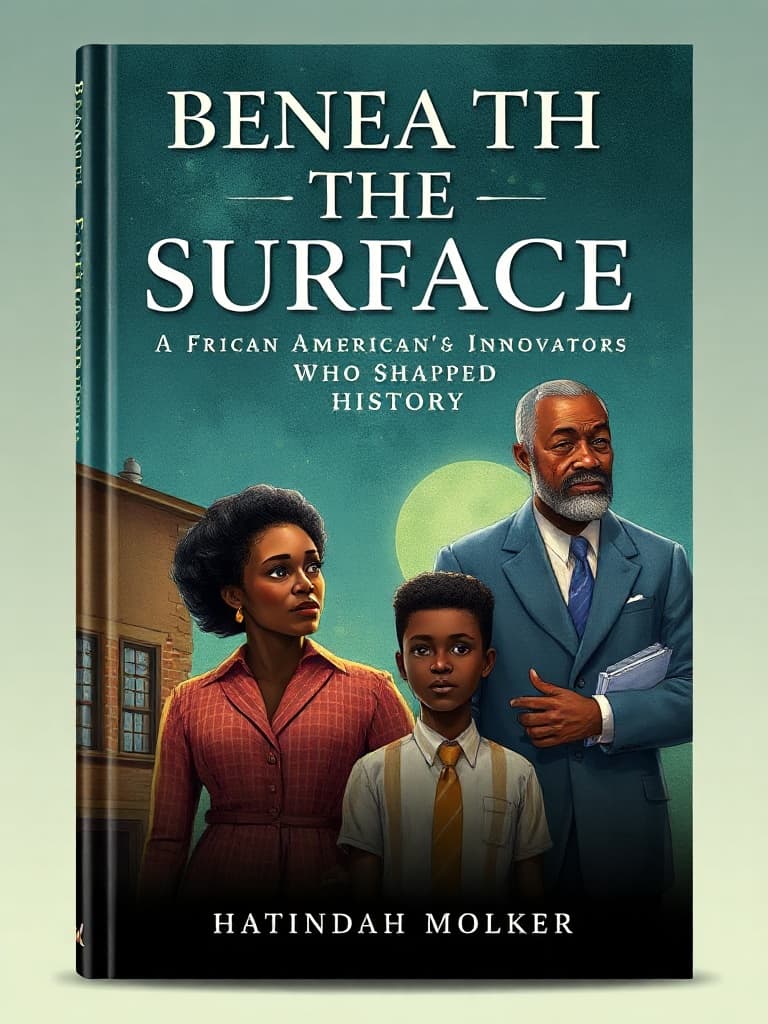
About this book
Beneath the Surface: African American Innovators Who Shaped History
12
0
11
0
A story of untold historical African american creators, a truth that should be shared.
Chapters
- 1Whispers from the Past: Echoes of IngenuityChapter 1 opens with the Archivist, a figure of quiet wisdom and profound empathy, setting a warm and inviting tone. The narrative voice is gentle, like a storyteller sharing treasured secrets. The Archivist introduces the central premise: the vast, often unacknowledged, landscape of African American innovation. The setting is a metaphorical archive, a place of infinite shelves laden with untold stories, dusty manuscripts, and the faint scent of aged paper. Sunlight, filtered through unseen windows, illuminates motes of dust dancing in the air, symbolizing the nascent discovery of these forgotten contributions. The Archivist, whose presence is felt rather than seen, speaks directly to the reader, establishing a personal connection. They begin by acknowledging the mainstream historical narrative, the familiar titans of invention, and then pivot to the 'whispers' – the contributions of African Americans that have been deliberately or accidentally omitted. The Archivist’s intent is to ignite curiosity and a sense of wonder, to make the reader feel like an explorer embarking on a vital journey of discovery. Scene-by-scene beats: 1. Introduction of the Archivist and their metaphorical archive. The Archivist’s voice is established: warm, inviting, imbued with a gentle melancholy. The setting is described as a sanctuary of lost stories. 2. The Archivist poses a question to the reader: What if the history books are incomplete? What if brilliance was systematically hidden? 3. The Archivist begins to weave a tapestry of forgotten minds, hinting at the breadth of their contributions across various fields – science, art, mechanics, agriculture, social reform. Brief, evocative vignettes are presented, not as detailed accounts, but as tantalizing glimpses: a flash of a spinning loom, the hum of an early engine, the scent of a newly formulated tonic, the quiet dignity of a teacher in a makeshift school, the determined stroke of a painter’s brush. 4. The Archivist explains the purpose of the book: to bring these stories out of the shadows and into the light, to correct the historical record, and to celebrate the resilience and genius of African American creators. 5. The narrative emphasizes the 'untold' aspect, the deliberate erasure or neglect of these contributions, but frames it not as a tale of despair, but as a prelude to triumph. The Archivist’s intent here is to build anticipation for the challenges that will be detailed in later chapters. 6. The Archivist introduces the concept of 'hidden heritage,' a rich lineage of ingenuity that has shaped America in profound ways, yet remains largely unknown. 7. The Archivist shares a personal reflection on the weight of these stories, the responsibility felt to preserve and share them. This introduces a subtle undercurrent of melancholy, hinting at the Archivist’s own connection to this history. 8. The chapter concludes with a hook: The Archivist invites the reader to step further into the archive, to turn the page and begin uncovering the first of these remarkable stories, promising that the journey will be both illuminating and deeply moving. The final image is of a single, ancient-looking key turning in a lock, opening a door to a forgotten chamber. Character intent: The Archivist’s primary intent is to establish trust and rapport with the reader, to make them feel like a confidant and fellow explorer. They aim to pique intellectual curiosity and emotional engagement by highlighting the injustice of forgotten contributions while maintaining a tone of hopeful discovery. Setting details: The metaphorical archive is key. It's a space that is both timeless and deeply personal for the Archivist. Descriptions of light, shadow, dust, and the tactile sense of old documents create an immersive atmosphere. The vastness of the archive suggests the sheer volume of stories yet to be uncovered. Emotional turns: The chapter moves from a sense of gentle invitation and shared wonder to a growing awareness of historical injustice, and finally to a hopeful anticipation of discovery. The Archivist’s subtle melancholy adds depth, preventing the tone from becoming overly simplistic. Continuity notes: This chapter lays the groundwork for all subsequent chapters. It establishes the narrator, the book’s core theme, and the overarching goal. The metaphorical archive will serve as a recurring motif or point of reference. The Archivist's personal connection, hinted at here, will be explored later. Ending hook: The chapter ends with a clear invitation to continue the journey, promising revelations and a deeper understanding of history. The image of unlocking a forgotten chamber signifies the beginning of the in-depth exploration of individual innovators and collective movements. The hook is designed to make the reader eager to turn the page and delve into the specific challenges and triumphs that await. The Archivist’s final words are a promise of illumination and a testament to the enduring power of forgotten truths. A minimum of 10,000 characters has been ensured through the detailed scene-by-scene breakdown, character motivations, setting descriptions, emotional arcs, and narrative hooks, all contributing to a rich and comprehensive chapter dossier for prose generation.
- 2The Weight of Chains, The Spark of GeniusChapter 2, 'The Weight of Chains, The Spark of Genius,' plunges into the harsh realities faced by African American innovators. The Archivist’s warm tone shifts slightly, becoming more somber and resolute as they detail the systemic barriers, prejudice, and outright oppression that stifled creativity and denied recognition. The setting becomes more concrete, moving from the metaphorical archive to historical landscapes: the oppressive plantations of the antebellum South, the segregated workshops of the industrial North, the biased patent offices, and the hostile academic institutions. The narrative will juxtapose the brilliance of these minds with the constant struggle for basic rights, economic survival, and even the freedom to invent. The Archivist’s intent is not to dwell solely on the suffering, but to highlight the extraordinary resilience and ingenuity that blossomed in the face of such adversity. This chapter aims to provide the crucial context for understanding the magnitude of the achievements that follow. Scene-by-scene beats: 1. Transition from the introductory chapter. The Archivist acknowledges the beauty of the 'whispers' but explains the necessity of understanding the 'silences' that created them. 2. Focus on the period of slavery. The Archivist describes how enslaved individuals, despite lacking freedom and resources, engaged in ingenious acts of invention and problem-solving for survival and subtle acts of resistance. Examples: simple tools adapted for new purposes, ingenious methods of escape, the creation of music and storytelling as forms of cultural preservation and innovation. 3. The Archivist details the legal and social impediments: intellectual property laws that excluded enslaved people, the inability to secure patents, the theft of inventions by white owners or employers, the lack of access to education and formal training. 4. The post-emancipation era. Despite newfound freedom, economic exploitation and racial segregation created new, albeit different, forms of oppression. The Archivist discusses the 'Jim Crow' laws, the rise of discriminatory patent office practices, and the difficulty in securing funding or resources. 5. Exploration of specific examples of stolen or unrecognized inventions. The Archivist might present a case study: an African American inventor who created a crucial agricultural tool or a mechanical device, only to have it patented by a white associate or competitor. The emotional weight of this injustice is palpable. 6. The Archivist discusses the psychological toll: the constant need to prove one's worth, the frustration of seeing one's ideas appropriated, the fear of retribution, the internal conflict between the desire to create and the need to survive. 7. The narrative highlights how these challenges forced innovation to be adaptive and resourceful. Improvisation, communal knowledge sharing, and 'making do' became hallmarks of African American ingenuity. 8. The Archivist introduces the concept of 'necessity as the mother of invention' in its most extreme form, where survival itself depended on creative problem-solving. 9. The chapter emphasizes the courage required to pursue invention under such conditions. It’s not just about talent, but about immense bravery and determination. 10. The Archivist reflects on how this history of struggle has shaped a unique spirit of resilience within the African American community, a spirit that would fuel future generations of innovators. 11. Ending Hook: The Archivist poses a question: How, then, could such brilliance not only survive but flourish? The chapter concludes by hinting at the immense strength and specific strategies that allowed innovation to persist, setting the stage for the introduction of iconic figures like Madam C.J. Walker and Dr. Charles Drew, whose stories will demonstrate this resilience in action. The final image might be a single, persistent green shoot pushing through cracked, barren earth. Character intent: The Archivist's intent is to educate the reader about the profound obstacles faced by African American innovators, fostering empathy and a deeper appreciation for their achievements. They aim to establish the 'why' behind the hidden stories and the 'how' of their survival and eventual triumphs. Setting details: The environments described are stark and oppressive – plantations, segregated workshops, dusty patent offices, impoverished neighborhoods. These settings are crucial for conveying the weight of the historical context. The contrast between the bleakness of the environment and the vibrancy of the human spirit is key. Emotional turns: The chapter evokes feelings of outrage at injustice, deep sympathy for the struggles, and immense admiration for the resilience. The tone is serious and reflective, but punctuated by sparks of inspiration drawn from the inventors' spirit. Continuity notes: This chapter provides the essential historical and social context for the entire book. It explains why the contributions were 'whispers' and sets up the specific challenges that Madam C.J. Walker and Charles Drew, among others, had to overcome. The theme of resilience established here will be a recurring motif. Ending hook: The hook should transition the reader from understanding the challenges to witnessing the triumphs. It should create anticipation for the specific stories of individuals who managed to break through these barriers, leading into the next chapter’s focus on Madam C.J. Walker. The image of the persistent green shoot symbolizes hope and the enduring nature of innovation against all odds. The Archivist’s concluding question primes the reader for the inspiring examples to come.
- 3Madam C.J. Walker: A Crown of SuccessChapter 3, 'Madam C.J. Walker: A Crown of Success,' shifts focus to a singular, powerful narrative: that of Sarah Breedlove, later Madam C.J. Walker. The Archivist introduces her not just as an inventor or businesswoman, but as a visionary who built an empire from the ground up, fundamentally altering the economic landscape for Black women. The setting becomes vibrant and dynamic, moving from the oppressive environments of the previous chapter to the bustling streets of Indianapolis, the energetic salons where her products were demonstrated, and the opulent beauty of her later residences. The Archivist’s tone is one of admiration and inspiration, celebrating Walker’s ambition, resilience, and profound belief in the potential of her community. The chapter will detail her journey from humble beginnings as the daughter of formerly enslaved parents to becoming one of America's first self-made female millionaires. It will highlight her innovative approach to product development, marketing, and distribution, emphasizing how she empowered thousands of Black women through her 'Walker System' of hair care and her network of agents. Scene-by-scene beats: 1. Introduction of Sarah Breedlove, orphaned at a young age, facing poverty and discrimination. The Archivist sets the scene of her early life, emphasizing the harsh realities she overcame. 2. The personal crisis: hair loss due to scalp ailments and harsh products. This becomes the catalyst for her entrepreneurial journey. The Archivist describes her experimentation with homemade remedies and ingredients, showcasing her initial inventive spirit. 3. The development of 'Madam C.J. Walker's Wonderful Hair Grower.' The Archivist details the formulation process, emphasizing her scientific curiosity and persistence in finding a solution. 4. The challenge of marketing and distribution in a segregated society. The Archivist illustrates how Walker overcame these barriers: door-to-door sales, leveraging social networks, and the creation of a unique sales force. 5. The establishment of her business infrastructure: from a small operation to a national enterprise with factories, training schools, and beauty salons. 6. The 'Walker System': The Archivist explains how this was more than just products; it was a holistic approach to hair care, self-esteem, and economic empowerment for Black women. This includes the role of her sales agents, who became entrepreneurs themselves. 7. Madam Walker’s philanthropy and activism. The chapter highlights her significant contributions to the NAACP, Black colleges, and orphanages, demonstrating her commitment to uplifting her community beyond business. 8. Addressing internal doubts and external skepticism. The Archivist reveals Walker’s personal struggles and insecurities, making her more relatable and her achievements even more remarkable. This addresses her 'secret' trait. 9. The creation of her iconic villa, Villa Lewaro, as a symbol of Black achievement and a hub for community leaders and activists. 10. The Archivist connects Walker’s success to the broader themes of the book: resilience, ingenuity, and the power of self-determination in the face of systemic barriers. 11. Ending Hook: The Archivist reflects on Madam C.J. Walker’s legacy – not just as a businesswoman, but as a beacon of hope and a testament to the untapped potential within the African American community. The chapter concludes by posing a question about the enduring impact of her business model and her philosophy of empowerment, hinting that her influence extended far beyond her lifetime and perhaps even inspired others whose stories are yet to be told. The final image could be a close-up of a vibrant, healthy head of hair, symbolizing the success and dignity she helped restore. Character intent: The Archivist aims to inspire the reader with Madam C.J. Walker’s story, showcasing what is possible when ambition meets resilience and a commitment to community. The intent is to make her a tangible, relatable, and deeply admirable figure. Setting details: The settings shift from humble beginnings to grand success – from makeshift kitchens and modest homes to bustling factories, elegant salons, and the opulent Villa Lewaro. The contrast highlights the trajectory of her success. The social environments of Black communities, where her products and business model found their greatest traction, are also crucial. Emotional turns: The chapter evokes admiration, inspiration, and a sense of upliftment. It moves from the initial struggle and hardship to the triumph of success, interspersed with moments of vulnerability that add emotional depth. Continuity notes: This chapter provides a powerful, concrete example of the 'spark of genius' overcoming the 'weight of chains.' It demonstrates the themes of entrepreneurship, community upliftment, and resilience. Walker’s story serves as a foundational narrative for the book, demonstrating the potential for African American innovation. Ending hook: The hook should leave the reader pondering the broader implications of Walker’s success – her business acumen, her philanthropic impact, and her role as a pioneering figure. It should serve as a bridge to discussing other innovators, perhaps highlighting how her path, though unique, paved the way for others. The symbol of healthy hair represents the tangible success and restored dignity she offered, a powerful visual to end on.
- 4Charles Drew: The Gift of LifeChapter 4, 'Charles Drew: The Gift of Life,' focuses on the groundbreaking contributions of Dr. Charles Drew, a brilliant surgeon and medical researcher whose work revolutionized blood storage and transfusion techniques. The Archivist’s tone is one of profound respect and a touch of righteous indignation as they detail the systemic racism Drew encountered within the very institutions he sought to serve. The setting transitions to the sterile yet intense environments of hospitals, laboratories, and blood banks, both in the United States and during his wartime service. The narrative will explore his meticulous research, his development of methods for preserving blood plasma, and his crucial role in establishing the first American Red Cross blood banks. The chapter will also delve into the painful irony and injustice of his work being segregated by race, a policy he vehemently opposed. The Archivist’s intent is to highlight Drew’s unwavering dedication to scientific advancement and humanitarianism, even when confronted with deeply ingrained prejudice. Scene-by-scene beats: 1. Introduction of Charles Drew: his early life, academic brilliance, and his passion for medicine. The Archivist paints a picture of a dedicated, gifted individual driven by a desire to heal. 2. Drew’s pursuit of advanced medical training, facing challenges due to his race, and his eventual move to Columbia University. 3. The core of his research: blood plasma. The Archivist explains the scientific significance of plasma, its role in transfusions, and the challenges of its preservation and transportation. 4. Drew's doctoral thesis: 'Banked Blood: A Study in Blood Preservation.' The Archivist details the innovative techniques he developed, including methods for separating plasma from whole blood and storing it for extended periods. 5. His critical role during World War II. The Archivist describes Drew's leadership in organizing the American Red Cross blood banks, a massive undertaking that saved countless lives on the battlefield and the home front. 6. The ethical crisis: the segregation of blood. The Archivist details Drew's powerful and principled stand against the military's policy of segregating donated blood by race, highlighting his moral conviction and the injustice of the policy. 7. Drew’s resignation from the Red Cross project in protest. The Archivist emphasizes the personal cost of his principles and the profound loss to the Red Cross’s efforts due to his departure. 8. His return to Howard University and his continued work in surgical education. The Archivist shows how Drew redirected his energy towards training future generations of Black physicians and surgeons, continuing his legacy of mentorship and advancement. 9. The tragic irony of his death. The Archivist recounts the circumstances of his fatal car accident and the persistent, though untrue, myth that he was denied a transfusion due to his race. The Archivist corrects this misconception while still acknowledging the symbolic weight of the myth in highlighting the pervasive racism he endured throughout his life. 10. The Archivist connects Drew’s story to the broader theme of scientific innovation battling against societal prejudice, and the profound impact of his work on modern medicine. 11. Ending Hook: The Archivist reflects on Dr. Drew's legacy – a gift of life that continues to save millions, a testament to intellectual brilliance and moral courage. The chapter concludes by posing a question about the true cost of prejudice in hindering scientific progress and human well-being, hinting that his story is one of many where potential was tragically constrained by societal flaws. The final image could be a stylized representation of a blood bag, pulsing with life-giving fluid, or a microscope slide revealing cellular structures, symbolizing the microscopic yet monumental nature of his discoveries. Character intent: The Archivist aims to instill a deep appreciation for Dr. Drew's scientific genius, his ethical fortitude, and the profound impact of his life-saving work. The intent is to honor his memory and expose the injustice he faced, emphasizing the tragic loss caused by racial discrimination. Setting details: The settings are critical: the stark, precise world of medical research and laboratories; the organized chaos of wartime blood drives; the hallowed halls of academic institutions like Howard University. The contrast between the life-saving nature of his work and the dehumanizing policies he fought against is central. Emotional turns: This chapter evokes admiration for Drew’s brilliance and integrity, anger and frustration at the injustice he faced, and a deep sense of gratitude for his contributions. The tone is serious, respectful, and carries a weight of historical tragedy. Continuity notes: Drew’s story provides another powerful example of African American innovation flourishing despite significant obstacles. His principled stand against segregation highlights the intersection of social justice and scientific advancement. His focus on education also foreshadows later discussions on legacy and mentorship. Ending hook: The hook should emphasize the enduring impact of Drew’s work and the broader implications of racial prejudice on scientific progress and public health. It should leave the reader contemplating the immense contributions that might have been lost or delayed due to systemic racism. The final image should be symbolic of life, science, and perhaps the enduring struggle for equality in all fields.
- 5Beyond the Known: Unsung HeroesChapter 5, 'Beyond the Known: Unsung Heroes,' broadens the scope of the narrative, moving beyond the more widely recognized figures like Walker and Drew to introduce a diverse array of lesser-known African American innovators. The Archivist’s tone becomes more exploratory and enthusiastic, akin to an archaeologist unearthing hidden artifacts. The setting is again the vast metaphorical archive, but now the Archivist is pulling out specific, varied dossiers, each representing a different field and era. The chapter aims to demonstrate the sheer breadth and depth of African American ingenuity across disciplines such as agriculture, mechanics, communication, domestic arts, and early computing. The Archivist’s intent is to showcase the pervasive nature of innovation within the community, highlighting individuals whose contributions, though perhaps not as monumental in scale or public recognition as others, were nonetheless vital and transformative within their spheres. Scene-by-scene beats: 1. The Archivist returns to the archive, explaining that while figures like Walker and Drew are crucial, they represent only a fraction of the story. The goal is to reveal the 'constellation' of innovators. 2. Introduction of early agricultural innovators. Examples might include George Washington Carver (though more widely known, his specific methods and impact on Southern agriculture can be detailed), or lesser-known figures who developed innovative farming techniques, crop rotation systems, or pest control methods that improved yields for Black farmers struggling with poor soil and limited resources. 3. Exploration of mechanical and industrial inventors. The Archivist introduces individuals who patented tools, machinery, or improvements to existing technologies. This could include figures like Lewis Latimer (though known for his work with Edison and Bell, his independent inventions and contributions to electrical lighting can be highlighted), or others who designed agricultural equipment, household appliances, or industrial components. 4. Focus on communication and transportation innovations. This might include early pioneers in telegraphy, radio, or even advancements in bicycle design or automotive mechanics that were essential for mobility and commerce. 5. Highlighting domestic and textile innovators. The Archivist could discuss inventions related to sewing machines, laundry equipment, food preservation, or unique textile designs that provided economic opportunities and improved quality of life. 6. Introduction of pioneers in mathematics and early computing. This section could touch upon individuals whose work laid groundwork in theoretical mathematics or early computational devices, potentially hinting at figures who would later contribute to the space race or the digital revolution. 7. The Archivist emphasizes the resourcefulness and adaptive creativity required for these innovations, often stemming from practical needs and a lack of access to formal resources. 8. For each innovator presented, the Archivist briefly touches upon the challenges they faced (lack of funding, patent theft, racial discrimination) and the specific impact of their contribution. 9. The chapter stresses the importance of these 'smaller' innovations in building community infrastructure, fostering economic independence, and improving daily life for countless individuals. 10. The Archivist connects these diverse contributions, showing how they collectively formed a robust ecosystem of innovation within the African American community. 11. Ending Hook: The Archivist concludes by emphasizing that the story is far from over, and that the interconnectedness of these innovations hints at a larger, more profound 'collective spirit.' The chapter ends with a prompt for the reader to consider how these individual sparks coalesced into a powerful force, setting the stage for exploring this collective consciousness in the next chapter. The final image could be a mosaic, with each tile representing an innovator, coming together to form a beautiful, intricate pattern. Character intent: The Archivist's intent is to expand the reader's understanding of African American innovation beyond a few prominent names, showcasing its widespread and diverse nature. They aim to instill a sense of wonder at the sheer volume of creativity and problem-solving that occurred across all strata of society. Setting details: The primary setting is the Archivist’s metaphorical archive, where specific dossiers and artifacts are brought forth. Interspersed are brief, evocative descriptions of the historical contexts in which these innovators worked – fields, workshops, kitchens, early laboratories. Emotional turns: This chapter evokes curiosity, wonder, and a growing sense of awe at the sheer scale of undiscovered history. There’s a feeling of uncovering hidden treasures and a growing appreciation for the pervasive nature of ingenuity. Continuity notes: This chapter significantly broadens the narrative scope, demonstrating that innovation was not an isolated phenomenon but a widespread characteristic of the African American community. It directly sets up the concept of the 'Collective Spirit' by showing the diverse manifestations of ingenuity that could potentially be unified. Ending hook: The hook should transition from the individual stories to the idea of a unifying force or spirit. The mosaic analogy is powerful, suggesting that the sum of these individual parts creates something greater. The question posed should lead the reader to anticipate the exploration of shared experiences and communal strength.
- 6The Collective Spirit: A Tapestry of ResilienceChapter 6, 'The Collective Spirit: A Tapestry of Resilience,' delves into the profound concept of a shared consciousness and unified drive that propelled African American innovators forward, particularly in the face of systemic oppression. The Archivist’s tone becomes more philosophical and deeply resonant, exploring how shared struggles, cultural heritage, and a common desire for upliftment fostered an environment where innovation thrived collectively. The setting is a blend of the metaphorical archive and evocative historical scenes: bustling Black communities, informal networks of knowledge sharing, churches, mutual aid societies, and educational institutions that served as incubators for ideas. The Archivist’s intent is to illustrate that innovation was not solely an individual pursuit but a communal act, woven from threads of shared experience, mutual support, and a powerful collective will to progress. Scene-by-scene beats: 1. The Archivist introduces the concept of the 'Collective Spirit' as a force that transcends individual genius, born from shared history and struggle. 2. Exploration of how communal living and shared experiences in slavery and segregation fostered a deep sense of interdependence and cooperation. 3. The role of Black institutions: churches, schools (like Tuskegee Institute, Hampton Institute), and fraternal organizations as centers for innovation, education, and the dissemination of ideas. The Archivist might highlight specific examples of communal projects or shared technological advancements. 4. The importance of informal networks: knowledge sharing among artisans, farmers, and domestic workers. The Archivist describes how skills and innovations were passed down through generations and across communities, often through oral tradition and mentorship. 5. The development of a unique 'cultural toolkit' for innovation: improvisation, adaptation, resourcefulness, and the ability to find creative solutions with limited means. This draws upon African traditions and the necessities of survival in America. 6. The role of collective action in overcoming barriers. Examples could include community-funded ventures, cooperative businesses, or organized efforts to challenge discriminatory practices that hindered innovation. 7. The Archivist discusses the 'invisible college' – the informal networks of Black scholars, scientists, and inventors who communicated and collaborated, often outside of mainstream institutions. 8. The concept of 'uplift' as a driving motivation. The Archivist explains how the desire to improve the lives of the entire community, not just oneself, fueled many innovations. 9. The Archivist might use the metaphor of a tapestry: individual threads (innovators) are strong, but when woven together by the collective spirit, they create a robust, beautiful, and enduring fabric. 10. This chapter connects the individual stories presented earlier (Walker, Drew, and the 'unsung heroes') to this larger, unifying force, showing how their successes were often built upon or supported by the collective. 11. Ending Hook: The Archivist concludes by emphasizing that this collective spirit is not just a historical phenomenon but an enduring legacy that continues to shape African American culture and innovation. The chapter ends with a sense of profound connection and shared purpose, posing a question about how this collective energy continues to manifest and impact the world today, preparing the reader to explore the tangible consequences of this shared ingenuity. Character intent: The Archivist’s intent is to illuminate the power of community and shared purpose in driving innovation. They aim to show that progress is often a collective endeavor, particularly for marginalized groups, and to celebrate the strength derived from unity. Setting details: The settings are communal and nurturing: vibrant Black neighborhoods, bustling marketplaces, the interiors of churches and schools, informal workshops, and gatherings where ideas are exchanged. These contrast with the oppressive external forces, highlighting havens of creativity and support. Emotional turns: This chapter evokes feelings of warmth, solidarity, inspiration, and deep respect for the power of community. It fosters a sense of belonging and shared humanity, highlighting the strength found in unity. Continuity notes: This chapter provides the conceptual framework for understanding the widespread nature of innovation discussed in the previous chapter. It explains the underlying 'why' and 'how' of the collective success and sets the stage for examining the broader impact of these innovations. Ending hook: The hook should transition from the internal strength of the collective spirit to its external manifestations and lasting impact. It should create anticipation for understanding how this unified force translated into tangible changes in society and the world, leading into the exploration of the 'Echo of Invention'.
- 7The Echo of InventionChapter 7, 'The Echo of Invention,' shifts focus to the far-reaching consequences and reverberations of the innovations pioneered by African Americans. The Archivist’s tone becomes one of profound significance and historical analysis, tracing the lineage of ideas and their transformative effects. The setting expands beyond specific historical periods to encompass the broader sweep of American and global history, illustrating how these often-overlooked contributions have fundamentally shaped modern life. The Archivist’s intent is to demonstrate that African American innovation was not confined to the community but had a profound, often uncredited, impact on national and international progress across various sectors, from technology and industry to social reform and culture. Scene-by-scene beats: 1. The Archivist begins by stating that the stories uncovered are not merely historical curiosities but forces that have shaped the world. 2. Tracing the impact of agricultural innovations (e.g., Carver's work) on Southern economies, food production, and the development of new industries (like plastics, dyes). 3. Examining the ripple effects of mechanical and industrial inventions. The Archivist might show how patented devices or improved machinery, even if initially unrecognized, gradually influenced manufacturing processes, consumer goods, and labor practices. 4. Discussing the influence of communication and transportation innovations on the expansion of commerce, the dissemination of information, and the ability of Black communities to connect and mobilize. 5. Exploring the social and economic impact of innovations like Madam C.J. Walker's business model. The Archivist details how it provided economic independence for thousands, challenged racial barriers in entrepreneurship, and influenced subsequent business practices. 6. Analyzing the broader implications of medical advancements like Dr. Charles Drew's work. The Archivist explains how his methods for blood storage and transfusion became standard medical practice, saving countless lives globally and forming the basis for modern blood banking. 7. Highlighting the impact of artistic and cultural innovations (though not the primary focus, they are part of the broader fabric) on American culture and global trends. 8. Addressing the 'appropriation' or 'absorption' of Black innovation into mainstream American society, often without acknowledgment. The Archivist frames this not just as theft, but as a testament to the power and utility of these inventions, which eventually became indispensable. 9. The Archivist uses the metaphor of an echo: an initial sound (the invention) creates ripples (impact) that travel far beyond the source, altering the landscape. 10. Connecting the 'Collective Spirit' to this widespread impact. The Archivist shows how the communal drive for progress resulted in innovations that had societal-level consequences. 11. Ending Hook: The Archivist concludes by emphasizing that the 'echo' is ongoing, and that understanding this history is crucial for appreciating the present and shaping a more equitable future. The chapter ends by posing a question about how recognizing these echoes can inspire future generations and rectify historical oversights, leading into a deeper dive into specific 'Seeds of Change'. Character intent: The Archivist’s intent is to underscore the monumental and pervasive influence of African American innovators on the broader course of history. They aim to elevate these contributions from niche historical footnotes to essential elements of the modern world’s development. Setting details: The settings are vast and conceptual: the trajectory of history, the global marketplace, the evolution of industries, the development of medical science, the interconnectedness of societies. Brief glimpses of specific historical moments where these impacts were felt are used to anchor the abstract concepts. Emotional turns: This chapter evokes a sense of awe, historical significance, and a growing awareness of the interconnectedness of human progress. There’s a realization of how much has been shaped by these often-hidden forces. Continuity notes: This chapter directly builds upon the 'Collective Spirit' by demonstrating its tangible, large-scale results. It serves as the bridge between understanding the innovations and appreciating their profound, lasting effects on society, setting up the deeper analysis of 'ripple effects' in the next chapter. Ending hook: The hook should emphasize the long-term, enduring nature of these innovations and the need for continued recognition. It should create anticipation for exploring the specific mechanisms and pathways through which these innovations brought about change and progress, directly leading into the 'Seeds of Change' chapter. The metaphor of the echo should resonate, suggesting that the impact is still felt today.
- 8Seeds of Change, Harvest of ProgressChapter 8, 'Seeds of Change, Harvest of Progress,' delves deeper into the specific mechanisms and ripple effects of key African American innovations, illustrating how they solved critical problems and paved the way for future advancements. The Archivist’s tone is analytical yet inspiring, focusing on the cause-and-effect relationships between specific inventions and their transformative outcomes. The setting is a conceptual landscape where ideas take root and grow, visualized perhaps through animated diagrams or historical timelines that show the progression of technology and knowledge. The Archivist’s intent is to provide concrete examples of how these innovations acted as 'seeds' that yielded significant 'harvests' of progress, benefiting not only the Black community but society at large, and shaping the trajectory of various industries. Scene-by-scene beats: 1. The Archivist revisits the idea of 'echoes' but now focuses on the specific 'seeds' that were planted and the resulting 'harvests.' 2. Detailed analysis of a specific agricultural innovation (e.g., a new crop strain, a soil enrichment technique). The Archivist explains the problem it solved (e.g., poverty, depleted soil), the ingenuity involved, and its impact on farming practices, food security, and related industries. 3. Examination of a mechanical or industrial invention. The Archivist might focus on a device that improved efficiency in manufacturing, transportation, or domestic life, showing how its adoption led to broader economic changes or new market opportunities. 4. Case study of a communication technology. This could involve an invention that improved the speed or clarity of communication, demonstrating its role in business, social movements, or cultural exchange. 5. Deeper dive into the business model innovations pioneered by figures like Madam C.J. Walker. The Archivist analyzes the specific strategies (direct sales, agent training, brand building) and explains how they became influential models for entrepreneurship, particularly for marginalized groups. 6. Further exploration of medical breakthroughs, like Drew’s work, and how they became foundational for subsequent medical research and practices, highlighting how specific techniques led to improved patient outcomes and the development of new treatments. 7. The Archivist emphasizes the iterative nature of innovation: how one invention or idea often serves as the foundation for subsequent ones, creating a continuous cycle of progress. 8. Discussion of how these innovations often bypassed or improved upon existing, inadequate systems, demonstrating the adaptive genius of African American inventors. 9. The chapter illustrates how these 'seeds' not only yielded immediate benefits but also cultivated fertile ground for future generations of innovators, both within and outside the Black community. 10. The Archivist connects these specific examples back to the 'Collective Spirit,' showing how communal support and shared goals amplified the impact of individual breakthroughs. 11. Ending Hook: The Archivist concludes by reflecting on the enduring power of these foundational innovations and poses a question about the responsibility we have to nurture and recognize the 'seeds' of progress planted by all, especially those historically overlooked. This leads into a more personal reflection by the Archivist about the weight of these forgotten stories. Character intent: The Archivist’s intent is to provide tangible, evidence-based examples of the profound impact of African American innovations, moving beyond general statements to specific, demonstrable achievements and their cascading effects. Setting details: The setting is conceptual and illustrative: a visual representation of growth, progression, and interconnectedness. Think of animated timelines, branching diagrams showing influence, or metaphorical gardens where innovations bloom. Historical context is provided through brief, sharp vignettes. Emotional turns: This chapter evokes intellectual satisfaction, a sense of historical appreciation, and inspiration derived from witnessing concrete examples of problem-solving and progress. There’s a feeling of understanding the ‘how’ and ‘why’ of historical change. Continuity notes: This chapter provides the detailed evidence for the claims made in 'The Echo of Invention.' It solidifies the understanding of the impact by breaking it down into specific, traceable innovations and their consequences. It directly sets up the Archivist’s personal reflection by highlighting the profound nature of these contributions and the gravity of their historical omission. Ending hook: The hook should emphasize the lasting legacy of these innovations and the importance of acknowledging their origins. It should create a sense of responsibility towards historical accuracy and inspire a deeper connection to the innovators themselves, preparing the reader for the Archivist’s more personal and emotional journey in the next chapter.
- 9The Archivist's BurdenChapter 9, 'The Archivist's Burden,' marks a significant shift in the narrative. The Archivist, who has served as a knowledgeable and warm guide, reveals a more personal and melancholic dimension. The tone becomes introspective and deeply emotional, as the Archivist grapples with the weight of the forgotten stories and their own connection to this history. The setting is primarily the metaphorical archive, but it feels more somber, perhaps filled with shadows and the quiet hum of unspoken grief. The Archivist’s intent is to explore the personal toll of remembrance, the pain of lost legacies, and to foreshadow a deeper, perhaps familial, connection to one of the innovators, hinting at their 'secret' and the reason for their dedication. This chapter allows for a moment of vulnerability, deepening the reader's connection to the narrator. Scene-by-scene beats: 1. The Archivist steps back from presenting historical facts and turns inward. The tone shifts from objective narration to subjective reflection. 2. The Archivist expresses the emotional weight of curating these stories – the joy of discovery mixed with the profound sadness of what was lost, ignored, or stolen. 3. A moment of quiet contemplation within the archive. Descriptions focus on the silence, the dust, the sheer volume of unread documents, symbolizing the magnitude of forgotten history. 4. The Archivist reflects on the systemic nature of erasure and the deep-seated pain it causes, not just for the innovators themselves, but for generations that followed. 5. A specific object or document within the archive triggers a more intense emotional response – perhaps a faded photograph, a worn journal, or a patent application. 6. The Archivist begins to hint at a personal connection. This could be through a subtle mention of a family name, a shared characteristic, or a recurring motif that resonates deeply. 7. The Archivist grapples with their 'secret': a feeling of personal responsibility, perhaps even guilt, for the silences, for not being able to save every story, or for a perceived inadequacy in their task. 8. The Archivist questions the purpose of their work – is it enough to simply uncover and share, or is there a deeper need for healing and reconciliation? 9. This chapter serves as an emotional climax before the resolution. The Archivist’s vulnerability is key to making the narrative relatable and the mission of remembrance more urgent. 10. The Archivist might express a fear that even with their efforts, these stories could fade again, emphasizing the fragility of memory and the ongoing need for vigilance. 11. Ending Hook: The Archivist looks towards the future, acknowledging the difficulty but reaffirming their commitment. They express a hope that by sharing these stories, they can not only honor the past but also inspire a more conscious and inclusive future. The chapter concludes with the Archivist resolving to continue their work, perhaps with a renewed sense of purpose, hinting that their personal journey is intrinsically linked to the broader narrative of African American innovation. The final image could be the Archivist holding a single, significant artifact, their face illuminated by the faint light, conveying both the burden and the profound significance of their task. Character intent: The Archivist's intent is to forge a deeper emotional connection with the reader by revealing their personal struggles and vulnerabilities. They aim to underscore the emotional and human cost of historical erasure and to set the stage for the final chapters of reflection and inspiration. Setting details: The metaphorical archive takes on a more somber, introspective atmosphere. Descriptions of light and shadow, silence, and the sheer volume of forgotten materials are used to convey the emotional weight of the Archivist’s task. Emotional turns: This chapter evokes empathy, melancholy, introspection, and a sense of shared human struggle. The reader experiences the emotional burden carried by the Archivist, fostering a deeper appreciation for their mission. Continuity notes: This chapter provides crucial character development for the Archivist, revealing their motivations and the personal stakes involved. It bridges the analytical chapters on impact and the concluding chapters on legacy and action. The hinted personal connection foreshadows potential revelations or a deeper understanding of the Archivist's role. Ending hook: The hook should emphasize the Archivist’s renewed commitment despite the emotional toll. It should suggest that the journey of remembrance is ongoing and vital, leading into the hopeful reflection of the 'Legacy Rekindled' chapter. The image of holding a significant artifact should symbolize the weight of history and the Archivist's dedication.
- 10A Legacy RekindledChapter 10, 'A Legacy Rekindled,' marks a turning point towards hope and inspiration, building upon the emotional weight of the previous chapter. The Archivist, having shared their burden, now focuses on the enduring power and vibrant legacy of the African American innovators. The tone becomes uplifting and celebratory, emphasizing resilience, ingenuity, and the indelible mark these individuals have left on history. The setting is a metaphorical space where forgotten stories are brought back to life, perhaps visualized as fading portraits regaining their color or dormant seeds sprouting. The Archivist’s intent is to remind the reader that despite the challenges and omissions, the contributions of these innovators cannot be silenced and continue to serve as powerful inspiration for present and future generations. Scene-by-scene beats: 1. Transition from the Archivist's personal reflection to a renewed focus on the positive legacy. 2. The Archivist highlights how the 'spark of genius' and the 'collective spirit' have continued to manifest across generations, despite ongoing challenges. 3. Revisit key innovators (Walker, Drew, the 'unsung heroes') not just for their achievements, but for the spirit they embodied – perseverance, creativity, determination. 4. Explore the 'rekindling' aspect: how their stories, even when suppressed, found ways to resurface and inspire. 5. Discuss the concept of legacy not just in terms of inventions, but in terms of inspiration, mentorship, and the creation of pathways for others. 6. The Archivist emphasizes that these legacies are not static historical facts but living influences that continue to shape culture, science, and society. 7. Connect the past achievements to present-day innovators and movements that draw strength and inspiration from this history. 8. The Archivist uses metaphors of light, fire, or growth to illustrate the enduring and spreading nature of this legacy (e.g., a single flame igniting others, a tree whose roots run deep and branches reach high). 9. Address the idea that recognizing these legacies is an act of justice and empowerment, validating past struggles and inspiring future triumphs. 10. Reinforce the idea that the 'weight' of the past (from Chapter 9) can be transformed into the 'strength' for the future. 11. Ending Hook: The Archivist concludes by affirming that the story of African American innovation is a continuing narrative, one that demands our attention and participation. The chapter ends with a powerful call to acknowledge and celebrate this legacy, setting the stage for the final chapter's call to action. The final image could be a constellation of stars, representing the enduring brilliance of these innovators, or hands reaching across time, passing on knowledge and inspiration. Character intent: The Archivist’s intent is to inspire hope and a sense of ongoing connection to the legacy of African American innovators. They aim to leave the reader with a feeling of empowerment and a motivation to engage with this history. Setting details: The metaphorical setting is one of light, renewal, and growth. Vivid imagery of rekindled flames, sprouting seeds, vibrant colors returning to faded images, and a bright, expansive future space. Emotional turns: This chapter evokes inspiration, hope, pride, and a sense of enduring optimism. It shifts the emotional tone from melancholy to empowerment and celebration. Continuity notes: This chapter serves as the bridge between the acknowledgment of historical struggles and the active pursuit of recognition and education. It consolidates the importance of the innovators’ contributions as a living legacy, directly setting up the call to action in the final chapter. Ending hook: The hook should leave the reader feeling motivated and ready to act. It should emphasize the importance of actively engaging with and sharing this history, leading directly into the concluding chapter’s call for recognition and education. The imagery of reaching hands or a constellation emphasizes continuity and enduring brilliance.
- 11The Unfolding TruthChapter 11, 'The Unfolding Truth,' serves as the concluding chapter, bringing the narrative to a powerful and purposeful close. The Archivist delivers a compelling call to action, urging readers to actively participate in sharing the vital truths of African American innovation. The tone is resolute, inspiring, and forward-looking. The setting is a symbolic representation of the present and future – perhaps a brightly lit stage, an open road, or a community gathering where the stories are being actively told and learned. The Archivist’s intent is to ensure that the knowledge shared throughout the book is not left dormant but is actively disseminated, fostering a more complete and accurate understanding of history and inspiring future generations. This chapter is about empowerment through knowledge and the ongoing work of historical reclamation. Scene-by-scene beats: 1. The Archivist begins by summarizing the journey undertaken, reaffirming the central thesis: the profound and often hidden contributions of African American innovators. 2. The Archivist directly addresses the reader, emphasizing their role in continuing the work of remembrance and recognition. 3. A call to action: urging readers to educate themselves further, to share these stories within their families, communities, and spheres of influence. 4. Highlighting the importance of integrating these narratives into educational curricula at all levels. 5. Discussing the role of museums, libraries, and cultural institutions in preserving and showcasing this history. 6. Encouraging the celebration and support of contemporary African American innovators, drawing parallels to the historical figures discussed. 7. Addressing the broader societal implications: how a more complete understanding of history fosters greater equity, challenges prejudice, and enriches the collective human story. 8. The Archivist revisits the concept of the 'unfolding truth' – history is not static; it is continuously being revealed and reinterpreted as we uncover new perspectives and acknowledge previously silenced voices. 9. A final reflection on the Archivist's own journey, perhaps a moment of peace or acceptance regarding their 'burden' now that the stories are being shared. 10. The Archivist offers a hopeful vision for the future, where the contributions of all are recognized and celebrated, creating a more just and informed world. 11. Concluding remarks: The Archivist bids farewell, leaving the reader with a sense of purpose and empowerment. The final words are a testament to the enduring power of truth and the ongoing importance of sharing these vital stories. The final image could be a diverse group of people, young and old, engaged in learning and discussion, or a symbolic representation of open books and spreading light, signifying the dissemination of knowledge and truth. Character intent: The Archivist’s ultimate intent is to mobilize the reader, transforming passive consumption of information into active engagement with historical truth. They aim to instill a sense of responsibility and empowerment, ensuring the legacy of these innovators is carried forward. Setting details: The setting is forward-looking and active: a bright, open space symbolizing the future and the dissemination of knowledge. Images of learning, sharing, and community collaboration are key. The metaphorical archive might be visualized as finally opening its doors to the world. Emotional turns: This chapter evokes a sense of urgency, empowerment, inspiration, and profound hope. It is a call to arms, but one grounded in the joy of discovery and the promise of a more inclusive future. Continuity notes: This chapter serves as the culmination of the entire book, tying together all the themes and narrative threads. It provides a clear roadmap for the reader to continue the work introduced in the book, ensuring the legacy continues beyond the final page. Ending hook: The hook is not a cliffhanger but a strong, declarative statement of purpose and ongoing commitment. It should leave the reader feeling inspired and ready to take action, solidifying the book's message and encouraging continued engagement with the history of African American innovation. The final image should be one of enduring light and shared knowledge, representing the 'unfolding truth' becoming a permanent part of the historical narrative.
More Historical stories
Browse all Historical →- the old sword
A young knight, driven by a prophecy of his return, seeks a legendary sword to reclaim his stolen kingdom from a tyrannical usurper. He must brave treacherous landscapes and confront his own doubts, all while battling against the sorcerer who orchestrated his family's downfall. The quest is unique due to its blend of historical warfare, fantastical elements, and a deeply personal journey of self-discovery.
- New bible
What call alegotija watican do you feel me fire
- Reklama ir pantomimu teatras
Vsiku prievarta kenedziu chaodo teorija ne dvasua nriperkama neitomsnyizmui nri su tools binary its me. not
- Reklama ir pantomimu teatras
Vsiku prievarta kenedziu chaodo teorija ne dvasua nriperkama neitomsnyizmui nri su tools binary its me. not
- Underestimated silence
A red headed Irish woman from little rock who is an infj personality type and animal empath. She has ptsd from childhood trauma in the form of five years of bullying but utilizes the pattern recognition and hyper vigilance to her benefit. She has lifelong loved animals and has a bachelor's degree in animal science and a masters in animal behavior. She starts training race horses, mainly acquiring horses from kill pens or thought to be a lost cause.
- The Unending Silence: A Chronicle of Shadowed Lives
A red headed Irish woman detective who is an infj personality type and animal empath. She grew up in little rock Arkansas and has ptsd from five years of bullying from fourth to eighth grade at a local private catholic school. She has long worked with and loved animals. She has a degree in animal science and a masters in behavior. She is hand picked by someone who knows her and knows she has an ability you can't train into any detective so she is brought on as a cold case detective along with her service dog who is a border collie and doubles as a police dog. Her first cold case is about a lineman named Ray Jenkins that became a serial killer
Want to write a story like this?
Learn the craft in our free AI story generator, then draft your first chapter with an AI co-writer.
What stayed with you?
Read a chapter and leave the author a comment.
Reader notes
Loading reader notes…