About this book
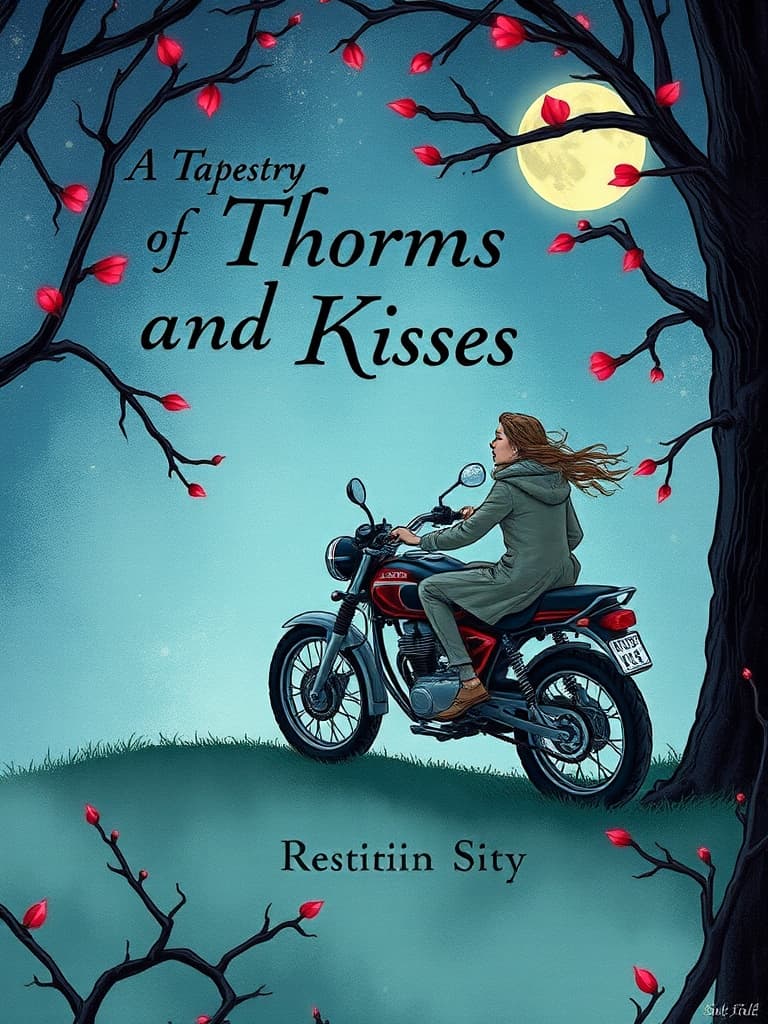
A Tapestry of Thorns and Kisses
13
0
20
0
Create your own romance. Tired of the constant hot and cold her boyfriend Casey is always giving off one hour to the next, Carol decides that she is going to invite Casey to go with her to her family home for their get together in a week. It's in Missouri so it's a 14 hour motorcycle ride but she thinks the trip will really energize their relationship and if not she can atleast line up some arrangements with family for the split
Chapters
- 1The Ultimatum on Two WheelsCarol stares out the window of her apartment, the city lights blurring into streaks of neon and despair. Casey's latest bout of emotional withdrawal – a text message three hours ago that read simply 'busy' in response to her 'I love you' – has pushed her to the brink. The constant oscillation between intense affection and icy detachment has become a torment. She needs a seismic shift, something to either reignite the dying embers of their relationship or provide a clean, albeit painful, break. Her gaze drifts to the motorcycle parked in the corner, a sleek, powerful machine that represents freedom and, perhaps, a much-needed escape. The idea forms, audacious and tinged with desperation: a 14-hour motorcycle ride to her family reunion in Missouri. It's a week away. The journey itself is a brutal test of endurance, a forced proximity that could either amplify their connection or shatter the illusion of it. She knows her family will be there, a built-in support system, and crucially, a network of people who can offer a temporary haven if things go south. She's already mentally cataloging who might offer a spare room, who would understand if she needed to 'stay longer.' This isn't just a trip; it's a strategic maneuver. She needs to know if Casey is truly invested, if he’s capable of consistent effort, or if he’s just a charming phantom in her life. The stark contrast between the exhilarating freedom of the open road and the suffocating uncertainty of her relationship fuels her resolve. She imagines the wind in her hair, the roar of the engine, a physical manifestation of the change she craves. This trip is her ultimatum, delivered not with words, but with a packed saddlebag and a hopeful, yet terrified, heart. She needs to gauge Casey's reaction carefully. Will he see it as an adventure, a true commitment to their shared future? Or will his usual evasiveness surface, confirming her deepest fears? She rehearses the proposal in her head, trying to gauge the right tone – casual enough not to sound like an ultimatum, yet firm enough to convey the seriousness of her intentions. She considers the logistics: the gear, the route, the timing. Every detail is a small victory against the inertia of her current situation. She needs to present it as an opportunity, a fun, spontaneous idea, but the underlying current of 'this is it for us' must be palpable. The family reunion provides the perfect backdrop – a neutral territory, away from their usual routines, where they can be observed, evaluated, and perhaps, rediscovered. She thinks about her Aunt Mildred, her sharp intuition, and wonders if she’ll see through Casey’s charm if it falters. The ride itself is a significant commitment, a test of endurance and shared experience. If Casey balks, or if his enthusiasm feels forced, it will be a clear sign. If he embraces it, truly embraces it, then perhaps there’s hope. This is her gamble, her meticulously planned Hail Mary pass. She needs to be prepared for both outcomes, the exhilarating triumph of rekindled love and the quiet devastation of a necessary end. The sheer physical challenge of the ride is a metaphor for the emotional challenge ahead. It’s a long way to Missouri, and she’s not sure she can stomach the ride back if it’s alone, but the thought of staying in this emotional limbo is even more unbearable. She pulls out a map, tracing the route with her finger, the miles stretching out like the possibilities, both good and bad. The date is set, the proposal is ready, and Carol braces herself for Casey's response. This is more than just a road trip; it's a journey into the heart of their relationship, with the potential for profound discovery or ultimate heartbreak.
- 2Engine's Roar, Heart's DoubtCarol lays the proposal on Casey as casually as she can, presenting the Missouri family reunion and the 14-hour motorcycle ride as a spontaneous, exciting adventure. She watches his face, searching for any flicker of genuine enthusiasm or, conversely, a tell-tale sign of evasion. Casey, true to form, is a study in contradictions. He’s quick to agree, a broad smile spreading across his face, talking about the freedom of the open road and the thrill of the ride. He even volunteers to lead, his confidence seemingly restored. But Carol, attuned to the subtlest shifts in his demeanor, senses an undercurrent of… something. It’s not outright reluctance, but a performative agreement, as if he’s playing a part he’s rehearsed. His eyes, when they meet hers, hold a certain guardedness, a fleeting shadow that vanishes as quickly as it appears. The certainty she desperately craves remains elusive. Later that evening, while packing, Carol can’t shake the feeling of unease. Casey’s texts, when they come, are a mix of playful banter and vague plans, but the underlying erraticism persists. One moment he’s sending a heart-eye emoji, the next he’s canceling their planned dinner to ‘handle some stuff.’ Carol finds herself replaying their conversations, dissecting his words, searching for clues. Is his agreement to the trip a genuine desire to connect, or is it a way to placate her, to buy himself time? The 14-hour journey looms, not as an exciting prospect, but as a vast expanse of time where his true nature will be laid bare. She wonders if he’s hiding something, if this trip is more than just a family reunion for him. The physical preparations for the motorcycle trip – checking the tires, oil, and brakes, organizing riding gear, planning the overnight stops – become a distraction from the gnawing anxiety in her gut. Each task, meant to ensure their safety and comfort, feels like building a bridge over an increasingly wide chasm of doubt. She notices small inconsistencies in his stories about his work schedule and his weekend plans, minor details that, when pieced together, don't quite add up. He’s always been a bit of a mystery, but lately, his evasiveness feels more pronounced, more deliberate. Carol finds herself scrutinizing his social media, looking for any hints, any missed calls or messages that might explain his mood swings. She tries to engage him in conversations about the trip, about her family, about their relationship, but his responses are often superficial, deflecting deeper probes with charm or a change of subject. She begins to question her own judgment. Is she projecting her insecurities onto him, or is her intuition screaming a valid warning? The thrill of the upcoming adventure is overshadowed by a growing sense of dread. She packs her favorite leather jacket, a symbol of her strength and independence, but even that feels less empowering today. The rumble of the motorcycle engine, usually a sound of freedom and exhilaration for her, now seems to echo the turmoil in her heart. She reminds herself of her contingency plan – the family waiting in Missouri, the understanding nods she expects from her aunt. This trip is her last resort, a desperate attempt to salvage something real from the relationship, but the growing realization that Casey might not be the man she believes him to be gnaws at her. The miles ahead feel less like an opportunity for reconnection and more like a long, uncertain road leading to a precipice. She decides to subtly observe his reactions to anything related to her family or his past, looking for any signs of discomfort or hidden knowledge. This journey is no longer just about saving their relationship; it’s about uncovering the truth, whatever that may be.
- 3Miles of MysteryThe roar of the motorcycle engines is the soundtrack to Carol's unfolding unease. The initial hours of the ride are filled with the exhilaration of open road, the wind whipping through their hair, and the shared rhythm of the journey. Casey is in his element, navigating the highways with practiced ease, his usual charm in full display. Yet, beneath the surface of this shared adventure, Carol's suspicions deepen. She finds herself scrutinizing his every word, his every glance, searching for cracks in the facade he so carefully maintains. During a pit stop at a roadside diner, under the guise of stretching their legs, Carol steers the conversation towards his childhood, his family, anything that might offer a glimpse into the man he is. Casey’s answers are vague, peppered with generalizations and anecdotes that feel rehearsed, lacking the spontaneous detail that usually accompanies genuine reminiscence. He deflects questions about his parents with a dismissive wave and a vague mention of them living 'out of state.' When Carol asks about old friends, he changes the subject to the next leg of the journey, his gaze momentarily distant, as if lost in a memory he’s unwilling to share. She notices his phone is rarely out, and when it is, he quickly tucks it away if she glances over, his thumb hovering over the screen as if protecting a secret. He claims it’s to stay focused on the ride, but the furtive movements suggest otherwise. The landscape shifts from rolling plains to picturesque farmlands, the scenery a constant, beautiful distraction. Carol tries to engage him in discussions about their future, about what this trip means for them, but Casey steers the conversation back to the present, focusing on the next town, the best place for lunch, the quality of the asphalt. His focus on practicalities feels like a deliberate avoidance of deeper emotional territory. He seems determined to keep the conversation light, superficial, as if anything more profound might shatter the fragile equilibrium they’ve managed to maintain. Carol recalls a brief mention he’d made weeks ago about a difficult period in his past, a 'rough patch' he’d brushed off when she’d pressed for details. Now, in the forced intimacy of the motorcycle ride, that vagueness feels significant, a deliberate omission rather than casual forgetfulness. She wonders if his erratic behavior stems from something he’s running from, or perhaps something he’s trying to outrun. The subtle inconsistencies in his stories are beginning to form a pattern. He mentions a favorite childhood book, then later refers to a different author with the same fondness. He talks about a summer job in a particular city, then later implies he was elsewhere during that same period. These aren't major lies, but small, almost imperceptible shifts that, when observed by someone paying close attention, create a disquieting dissonance. Carol starts to feel like a detective, piecing together fragmented clues, her mind racing with possibilities. Is he married? Does he have a secret life? Or is something more complex at play, something tied to the very person she is trying to get closer to? She finds herself observing his reactions to passing landmarks, to the radio, to other riders they encounter, searching for any involuntary responses that betray a hidden narrative. The vast, open sky above them, once a symbol of freedom, now feels like a boundless expanse of unanswered questions. The 14-hour journey is becoming a crucible, not just for their relationship, but for unlocking the enigma that is Casey. She notices a particular tension in his shoulders when they pass through a stretch of dense woodland, a subtle clench of his jaw when a certain type of truck rumbles by. These are not conscious reactions, but physical manifestations of a guarded mind. She realizes that the physical act of riding, the constant forward momentum, mirrors Casey's apparent desire to keep moving, to avoid dwelling on anything that might anchor him to his past. The miles are accumulating, but the distance between them, emotionally, seems to be widening. Carol knows she needs to address these inconsistencies, but the fear of potentially shattering the illusion completely, and the uncertainty of what she might uncover, holds her back. She decides to subtly probe him about his family history, asking about traditions or heirlooms, hoping for a slip that might reveal a deeper truth. The scenic beauty of the journey is a stark contrast to the internal turmoil brewing within Carol, each mile bringing them closer to her family, but potentially further from the truth about Casey.
- 4Homecoming HuesThe final stretch of highway into Carol's hometown is a blur of familiar landscapes and mounting anticipation. The air, once filled with the roar of the engines and the thrill of the open road, now carries the subtle scent of honeysuckle and damp earth, the unmistakable perfume of rural Missouri. As they pull into the sprawling property where the family reunion is in full swing, the contrast between the solitary journey and the bustling crowd is immediate. Laughter rings out, children chase each other across the lawn, and the aroma of barbecue wafts from the makeshift kitchen. Carol’s parents rush to greet them, their faces etched with warmth and genuine affection, enveloping Carol in hugs and welcoming Casey with polite, if somewhat reserved, smiles. The initial moments are a whirlwind of introductions and catching up, the demands of family life momentarily pushing Carol's anxieties about Casey to the background. However, as the initial excitement subsides and the afternoon wears on, the underlying strain between Carol and Casey becomes increasingly apparent, like a discordant note in a harmonious melody. Carol notices how Casey’s charm, so potent on the road, feels slightly forced in this intimate family setting. He’s polite, he answers questions about their trip, but his eyes dart around the crowd, his smile not quite reaching them. He seems like an observer, an outsider, rather than an integral part of the scene. He makes a few stilted jokes that fall a little flat, and Carol sees him subtly checking his phone more often than she’d like, his fingers tapping out messages with a practiced quickness that betrays his unease. Carol’s family, a close-knit unit accustomed to observing each other’s subtle cues, begins to pick up on the tension. Her younger cousins whisper and giggle, their innocent observations hinting at the awkwardness. Her father, usually jovial and boisterous, observes Casey with a quiet, appraising gaze. But it is her Aunt Mildred, a woman renowned for her uncanny ability to read people and situations, who seems to notice the most. Mildred, a woman with kind eyes that miss nothing, watches Carol and Casey interact, her head tilted slightly, a thoughtful expression on her face. She sees Carol’s forced smiles, the way she subtly moves closer to Casey when he seems to withdraw, and the almost imperceptible flinch when he pulls away. Mildred doesn’t intervene directly, but her presence is a constant, gentle probe. She offers Carol a knowing glance as she passes, a silent acknowledgment of the unspoken. Later, while Carol is helping her mother in the kitchen, Mildred joins them, her movements unhurried. She casually asks Carol about the ride, her tone light, but her questions are subtly pointed. “Quite a long trip on those bikes, dear. You must have had plenty of time to talk, to get to know each other even better,” she remarks, her eyes twinkling with a knowing depth. Carol feels a blush creep up her neck, unsure how to respond. She manages a noncommittal shrug, mumbling something about the scenery. Mildred nods slowly, her gaze shifting to Casey, who is now engaged in a conversation with Carol’s uncle, his back to them. “He seems… quiet,” Mildred observes, her voice barely above a whisper, but Carol hears the unspoken question beneath the statement. The warmth of the family reunion, the familiar comfort of home, only serves to highlight the growing distance between Carol and Casey. The idyllic setting, meant to be a place of solace and reconnection, has become a stage where the cracks in their relationship are amplified. Carol feels a strange sense of isolation amidst the crowd, caught between the desire to maintain a happy facade for her family and the growing certainty that her relationship with Casey is teetering on the brink. The subtle glances from Aunt Mildred are both comforting and unnerving, a sign that she’s not alone in her observations, but also that the truth of her situation is becoming increasingly visible to others. The reunion is meant to be a celebration of family, but for Carol, it’s becoming a trial by fire, a public examination of her relationship’s fragile state, with her perceptive aunt as the most discerning judge.
- 5Aunt Mildred's Keen EyeThe family reunion hums with a comfortable, familiar energy, yet for Carol, the atmosphere is charged with an undercurrent of apprehension. She’s acutely aware of the subtle glances cast her way by Aunt Mildred, her mother’s sister. Mildred, a woman whose life has been a tapestry of navigating complex family dynamics, possesses a preternatural ability to perceive unspoken truths. Her presence at these gatherings is not just as an aunt, but as a silent observer, a confidante, and, when necessary, a gentle interrogator. Carol feels Mildred’s gaze lingering on her and Casey, a silent assessment that’s both comforting and unnerving. Mildred’s questions, delivered with a disarming sweetness, are designed to peel back layers of pretense. While helping Carol prepare the potato salad, she remarks, “You seem a little… preoccupied, darling. Is everything alright between you and Casey? The ride looked like it was quite the adventure, but sometimes those long journeys can reveal more than you bargain for.” Carol fumbles for a response, her cheeks flushing. “Oh, it was fine, Aunt Mildred. Just… a lot of miles, you know?” Mildred smiles, a knowing crinkle appearing at the corners of her eyes. “Oh, I know miles, dear. Miles can tell stories. And sometimes, they carry burdens.” She pauses, her expression softening. “I’ve known you since you were a little girl, Carol. I’ve seen you light up when you’re happy, and I’ve seen that little shadow of worry creep in when things aren’t quite right. Casey’s a handsome young man, but he’s got a guardedness about him, wouldn’t you say? Like he’s always holding something back, even when he’s smiling.” Carol’s heart pounds. Mildred’s perception is spot on, and it’s both a relief and a source of anxiety that her secret worries are so visible. Mildred continues, her tone laced with gentle curiosity, “Did he talk much about his family on the ride? About where he grew up? Sometimes, knowing where someone comes from helps you understand where they’re going. Or why they might be running.” Carol hesitates, recalling Casey’s evasive answers. “He… he didn’t say much. Just that they’re out of state.” Mildred nods slowly, her gaze drifting towards Casey, who is currently engaged in a somewhat strained conversation with Carol’s Uncle Jim. “Out of state can cover a lot of ground, dear. A lot of different stories.” Mildred’s approach is never accusatory; it’s always framed as concern, as a desire to understand. She subtly encourages Carol to share more, not by demanding answers, but by creating a safe space for vulnerability. She might comment on Casey’s body language, “Notice how he never quite meets your eye when you ask about his past?” or gently question Carol’s own reactions, “You seem to be trying very hard to keep things light, Carol. Are you afraid of what might happen if you don’t?” Carol finds herself confessing, in fragments, the inconsistencies she’s noticed, the feeling of walking on eggshells. Mildred listens intently, her wise eyes offering silent validation. She doesn’t offer solutions, but rather insightful questions that guide Carol towards her own conclusions. “It’s important to know the foundation you’re building on, darling,” Mildred says, stirring her tea thoughtfully. “If the foundation is shaky, the whole house is at risk. And sometimes, the most loving thing you can do is admit when it’s time to reinforce it, or even build anew.” Mildred’s counsel is not about judging Casey, but about empowering Carol to see the situation clearly. She highlights the patterns of behavior, the unspoken tensions, and the importance of genuine connection over superficial charm. The family reunion, with its outward appearance of joy and normalcy, becomes a backdrop for Carol’s internal reckoning, guided by the keen, loving eye of her Aunt Mildred, who sees the thorns beneath the surface of Carol’s romantic tapestry.
- 6Echoes from the PastThe afternoon sun casts long shadows across the manicured lawn of Carol’s family estate. The reunion is in full swing, a lively affair filled with laughter, familiar faces, and the comforting scent of generations mingling. Carol, attempting to recapture a sense of normalcy, circulates through the crowd, offering polite smiles and engaging in small talk. She’s just finished a conversation with her grandmother when she turns to find a figure standing a little too close, a figure she hasn’t seen in years, yet whose presence sends an immediate jolt of recognition and unease through her. It’s Mark, a ghost from her high school days, a boy she’d once been close to, whose abrupt departure from her life had left unanswered questions and a lingering sense of hurt. He’s older now, his features sharper, but the intensity in his eyes is unmistakable. He smiles, a slow, unnerving smile that doesn’t quite reach his eyes. “Carol? Wow. You haven’t changed a bit,” he says, his voice deeper, rougher than she remembers. Carol manages a strained smile, her mind racing. “Mark. What are you doing here?” Before she can process the question, Casey appears at her side, his arm instinctively wrapping around her waist, a gesture that feels more possessive than affectionate. He’d been nearby, but Carol hadn’t noticed him. His sudden presence, his physical assertion, seems almost reactive. Mark’s gaze shifts from Carol to Casey, his smile faltering slightly. There’s a flicker of something unreadable in his eyes – surprise? Recognition? Discomfort? He studies Casey, his expression unreadable, as if cataloging a threat. “And who might this be?” Mark asks, his tone casual, but with an edge that doesn’t go unnoticed by Carol. Carol introduces them, her voice tight. “Casey, this is Mark. Mark, this is my boyfriend, Casey.” The introduction hangs in the air, thick with unspoken tension. Casey’s grip on Carol’s waist tightens almost imperceptibly. He offers Mark a curt nod, his smile tight. Mark returns the nod, but his eyes remain fixed on Casey for a beat too long, a silent communication passing between the two men that Carol cannot decipher. Carol observes Casey’s reaction closely. He’d been relaxed moments before, engaged with her uncle. Now, his posture is stiff, his jaw set. He seems to be studying Mark with an intensity that borders on suspicion, yet also with a strange, almost wary, familiarity. He asks Mark a question, his voice carefully neutral, “Been in town long, Mark?” Mark’s answer is brief, evasive. “Just got in. Passing through, you know.” The phrase ‘passing through’ echoes the vague explanations Casey himself has offered about his own past. Carol notices a subtle shift in Casey’s demeanor. He becomes more withdrawn, his usual easy charm replaced by a quiet vigilance. He stays close to Carol, his arm still around her, but it feels less like a gesture of affection and more like a shield. Mark, meanwhile, seems to be subtly observing their interaction, his gaze flicking between Carol and Casey, a hint of something akin to amusement playing on his lips. Carol feels a prickle of unease. This encounter is more than just a chance meeting with an old acquaintance. The charged atmosphere, Casey’s sudden shift in demeanor, and the lingering, unspoken tension between the two men suggest a deeper, more complex connection she is unaware of. She notices Mark’s gaze linger on a small, almost imperceptible scar above Casey’s left eyebrow, a scar Carol has never seen him acknowledge. Mark’s eyes then drift to Casey’s hands, and he subtly clenches his own fist. Carol’s suspicions, which had been simmering throughout the journey, now boil over. This isn't just Casey being guarded; this is him reacting to something specific, something tied to this man from her past. The 'chance encounter' feels anything but accidental, and the mystery surrounding Casey's true nature deepens with every passing moment.
- 7The Unseen ConnectionThe encounter with Mark has settled over Carol like a suffocating shroud. The initial shock of seeing him has given way to a chilling realization: Casey’s reaction was not one of simple surprise or awkwardness; it was one of recognition, tinged with a wariness that spoke volumes. As Carol and Casey drift away from Mark, seeking refuge near a quiet corner of the porch, the air between them crackles with unspoken questions. Carol can feel Casey’s tension, the rigid set of his shoulders, the way he keeps his gaze fixed on the horizon, deliberately avoiding her eyes. She decides to press, her voice a low murmur, “Casey, what was that? You seemed… to know him.” Casey finally turns to her, his expression a complex mix of apprehension and a flicker of something akin to guilt. “I… I’ve heard of him,” he says, his voice carefully measured, not quite a lie, but a deliberate half-truth. “Heard of him? Casey, he looked at you like he recognized you. And you looked back.” Carol’s voice trembles slightly. “He noticed a scar above your eye. You’ve never told me about that scar.” Casey’s jaw tightens. He runs a hand over the spot, a gesture of subconscious awareness. “It’s old. From a stupid accident.” But his explanation feels hollow, a hastily constructed defense. Carol presses further, her heart pounding with a mixture of dread and determination. “An accident? Or something else? Mark’s reaction, your reaction… it’s not coincidence. There’s something between you two, isn’t there? Something you haven’t told me.” Casey’s eyes dart around, as if searching for an escape. He takes a deep breath, the facade beginning to crumble. “Carol, it’s complicated.” “Complicated is what you’ve been since I met you, Casey,” she retorts, her voice rising slightly. “I need to know what’s going on. Was Mark involved in whatever ‘rough patch’ you mentioned before? Is that why you’re so guarded?” The mention of the ‘rough patch’ seems to strike a nerve. Casey winces, his gaze falling to the worn planks of the porch. He seems to be wrestling with himself, the internal conflict palpable. Carol notices a subtle tremor in his hands. He looks back at her, his eyes filled with a raw vulnerability she rarely sees. “Mark… he’s connected to a time in my life I’ve tried to forget. A time when I made some really bad choices.” He pauses, struggling to find the words. “And he was… he was part of it. Not directly, but… indirectly. He knew people. Dangerous people.” The words hang in the air, heavy with implication. Carol’s mind races, piecing together fragmented images: Casey’s guardedness, his erratic behavior, the mention of secrets, and now this connection to Mark and ‘dangerous people.’ “What kind of choices, Casey? What kind of people?” Her voice is barely a whisper. Casey looks away, his gaze fixed on the distant treeline. “It was a long time ago, Carol. Before you. But it… it follows you. It affects who you are. And sometimes, it makes it hard to be… to be the person I want to be. For you.” He finally meets her eyes, his own filled with a desperate plea. “I didn’t want you to know. I didn’t want this to affect us.” Carol feels a wave of dizziness. The man she thought she knew, the man she’d brought on this journey hoping to solidify their future, is suddenly shrouded in a past more dangerous and complex than she could have imagined. The ‘unseen connection’ isn’t just between Mark and Casey; it’s a connection that stretches back into Casey’s hidden history, and now, it’s threatening to ensnare Carol and their relationship within its shadowy embrace. She realizes that the reunion, which was supposed to be a catalyst for clarity, has instead plunged her into a deeper, more perilous mystery. The warmth of her family celebration feels like a distant memory, replaced by the chilling realization that Casey’s secrets are far more substantial, and potentially far more damaging, than she ever anticipated.
- 8Whispers in the BarnThe revelation of Casey’s connection to Mark and the implication of a dangerous past leaves Carol reeling. The festive atmosphere of the reunion now feels like a fragile veneer, and she needs to escape the watchful eyes and polite conversations. She finds herself drawn to the old, disused barn at the edge of the property, its weathered wood and dusty interior offering a sense of privacy and isolation. The scent of dry hay and old machinery hangs heavy in the air, a stark contrast to the perfumed gardens outside. Casey, sensing her distress and the urgency of her need for answers, follows her. The large barn doors creak shut behind them, plunging them into a dim, twilight world illuminated only by slivers of light filtering through the cracks in the walls. The silence is profound, broken only by the distant chirping of crickets and the sound of their own breathing. Carol turns to face Casey, her expression a mixture of hurt, confusion, and a steely resolve. “I need to understand, Casey. All of it. What happened? Who were those people? And why is Mark here, now?” Her voice is strained, amplified by the acoustics of the barn. Casey leans against a rough-hewn beam, his posture conveying a weariness that seems to go bone-deep. He looks older, more vulnerable in the dim light. “It was… a bad chapter, Carol. I was young, stupid, and made some terrible friends. We got involved in things we shouldn’t have. Petty crime, mostly, but it escalated. There were people who… who didn’t play fair.” He pauses, his gaze fixed on a cobweb-draped rake hanging on the wall. “Mark… he was in that circle. He wasn’t a leader, but he knew people. People who could make problems disappear. Or create them.” Carol takes a hesitant step closer, her voice softening slightly. “Did you… did you hurt anyone, Casey? Is that why you’re so afraid?” Casey closes his eyes for a moment, a pained expression crossing his face. “Not intentionally. But… things happened. Accidents. And the people we were dealing with… they didn’t care about accidents. They cared about loyalty. And consequences.” He finally looks at her, his eyes filled with a deep-seated regret. “I got out. I paid them off, I changed my name, moved away. I spent years looking over my shoulder, terrified they’d find me. That’s why I’m so… erratic. Sometimes I think I see them. Sometimes I get a call, or a message, and it sends me spiraling.” Carol absorbs his confession, the pieces clicking into place, forming a picture far more complex and dangerous than she’d imagined. His hot-and-cold behavior, his guardedness, his evasiveness – it all stemmed from a deep-seated fear of his past catching up to him. “And Mark?” she prompts, her voice still quiet. “Why is he here? Did he find you?” Casey shakes his head. “I don’t know if he found me, or if he’s just… here. Coincidence. But seeing him… it brings it all back. It reminds me of how close I came to losing everything. And how I’m still afraid of losing you.” He reaches out, his hand trembling as it hovers near her cheek. “That’s why I agreed to this trip. I thought… maybe if we went through this together, if you saw me, really saw me, you’d understand. And maybe… maybe you wouldn’t leave.” Carol pulls back slightly, the confession washing over her. The romantic notion of their relationship has been replaced by the stark reality of Casey’s troubled past. The barn, with its shadows and secrets, feels like a fitting place for this painful truth to be revealed. She looks at Casey, at the raw vulnerability etched on his face, and for the first time, she sees not just the charming boyfriend, but a man haunted by his history. The whispers of the past in the barn are loud, and Carol knows that the choices she makes now will determine the future of their relationship, and perhaps, her own peace of mind.
- 9A Mask Begins to SlipThe confessions in the barn have shattered the carefully constructed facade of their relationship, leaving Carol and Casey standing amidst the ruins of unspoken truths. The air in the barn, thick with dust and the scent of decaying hay, now carries the weight of Casey’s vulnerability. He’s laid bare a past fraught with danger and regret, a past that explains his erratic behavior and his deep-seated fear of exposure. Carol watches him, her emotions a tumultuous storm of hurt, understanding, and a dawning sense of empathy. His confession, raw and unvarnished, has stripped away the layers of mystery, revealing the man beneath – a man haunted, a man afraid. Casey, visibly drained by the emotional outpouring, sinks onto an overturned crate, his elbows resting on his knees, his head bowed. The bravado and charm he often displays are gone, replaced by a profound weariness. Carol approaches him cautiously, her initial anger having subsided, replaced by a complex mix of pity and a desperate need for further clarity. “So, all of this… the hot and cold, the secrets… it’s because you’re afraid?” she asks, her voice gentle, yet firm. Casey nods mutely, his gaze still fixed on the ground. “I’ve been running for so long, Carol. Always looking over my shoulder. I thought I’d left it all behind, but… seeing Mark, it just… it brought it all back. The fear. The shame.” He finally looks up, his eyes meeting hers, and for the first time, Carol sees the depth of his struggle, the genuine torment he’s been living with. “I wanted to tell you, so many times. But how do you tell someone you love that you’re… tainted? That you’ve been involved in things that could hurt them?” He gestures vaguely around the barn. “This whole trip… it was a test. I needed to see if you could… if you’d still be here after. If you could accept me, all of me.” Carol sits beside him, the rough wood cool beneath her fingertips. The romantic idealism she’d clung to has been replaced by a harsh reality, but strangely, this raw honesty feels more substantial than any pretense. “I’m not angry, Casey,” she says, her voice soft. “I’m… I’m scared for you. And for us. Because this past, it’s not just yours anymore. It’s affecting me, too.” Casey reaches out, his hand finding hers. His touch is tentative, almost apologetic. “I know. And I’m so sorry. I never wanted to put you through this.” Carol squeezes his hand, a silent acknowledgment of their shared predicament. “But you didn’t tell me. You let me think… you let me worry that you didn’t care.” The hurt resurfaces, but it’s tempered with understanding. “It was easier to be distant,” Casey admits, his voice barely audible. “To push you away, than to risk you seeing the real me. The one who made those mistakes.” He’s not making excuses, but explaining the mechanics of his fear. The mask has slipped, revealing the raw, exposed nerves beneath. Carol observes the subtle changes in his demeanor. The nervous tic in his jaw has lessened, replaced by a quiet resignation. His gaze, though still pained, is more direct, less evasive. He’s not trying to charm his way out of this; he’s simply present, vulnerable, and honest. Carol realizes that this moment, this raw confession in the dusty barn, is a turning point. It’s not a fairytale ending, but it’s a genuine beginning, a chance for their relationship to be rebuilt on a foundation of truth, however painful. She sees the genuine remorse in his eyes, the deep desire to change, and for the first time, she believes him. The mask has slipped, but in its place, a more authentic, albeit wounded, Casey has emerged. The challenge now is whether their relationship can withstand the weight of his past and the lingering fear that it might resurface.
- 10The Revelation's ShadowThe confessions within the barn have irrevocably altered the landscape of Carol and Casey’s relationship. The hushed tones and shared vulnerability have created an intimacy born of shared secrets, but it’s an intimacy now shadowed by the stark reality of Casey’s past. The revelation that his erratic behavior and guardedness stem from a history involving ‘dangerous people’ and Mark, a figure from Carol’s own past, casts a long, unsettling shadow over everything they’ve experienced together. Casey has confessed his deep-seated fear, his shame, and his constant looking over his shoulder, painting a vivid picture of a life lived in the periphery of danger. He admits that his erratic affection was a defense mechanism, a way to push Carol away before his past could potentially harm her or expose him. He revealed that Mark was a connection to that past, a reminder of the choices he’d made and the people he’d known. The ‘accident’ involving the scar above his eye, he confesses, was not a simple mishap but a consequence of a confrontation linked to those dangerous associates, a stark reminder of the violence he’d narrowly escaped. He explains that he changed his name and moved away, constantly vigilant, fearing retribution or exposure. He even confesses to receiving veiled threats or messages that would trigger his anxiety, leading to his unpredictable moods. Carol listens, her heart heavy, absorbing the gravity of his words. The romantic narrative she’d envisioned for their trip has been replaced by a stark, almost thriller-like reality. The ‘hot and cold’ dynamic was not a lack of commitment, but a desperate attempt to protect her, a flawed strategy born of deep-seated fear. He admits that agreeing to the trip was a gamble, a test of her love and acceptance, hoping that she would see past his mistakes and embrace the man he is now, or perhaps, the man he’s striving to be. “I was so afraid,” Casey murmurs, his voice raspy, his gaze fixed on Carol. “Afraid you’d see me as the person I used to be. Afraid you’d be hurt. Afraid they’d find me, and by extension, find you.” He confesses that his charm and his moments of intense affection were genuine desires to connect, but they were always overshadowed by the looming threat of his past. The fleeting nature of his affection was his misguided attempt to create distance, to shield her from the potential fallout. He admits that he’d planned to break up with her before the trip, believing it was the safest option, but then he saw an opportunity – a chance to face his fears, and perhaps, to prove to himself that he deserved a chance at happiness with her. The revelation isn’t a single, explosive event, but a series of painful truths that dismantle Carol’s perception of their relationship. The ‘tapestry of thorns and kisses’ is now clearly defined: the thorns are the sharp edges of Casey’s past, the constant fear, the necessary deceptions, and the potential for danger; the kisses are the genuine moments of affection, the shared laughter, the deep connection they’ve felt, and the hope for a future. Carol realizes that Casey’s guardedness wasn’t a sign of indifference, but a desperate act of self-preservation and, paradoxically, protection of her. The shadow cast by this revelation is long and dark, forcing Carol to confront the unsettling reality that the man she loves carries a burden that could impact them both profoundly. The future of their relationship now hinges on her ability to reconcile the man she loves with the man his past has shaped him to be, and to determine if love can truly conquer the lingering specter of danger.
- 11Fractured TrustThe confession in the barn has left Carol in a state of profound emotional upheaval. The revelation of Casey’s troubled past, his connection to Mark, and the pervasive fear that has dictated his behavior has shaken the very foundation of her trust. She sits beside him, the rough wood of the barn pressing against her, and the weight of his secrets presses down on her soul. The man she thought she knew, the man she’d invested her hopes and affections in, is now a complex enigma, a tapestry woven with threads of genuine love and the dark fibers of a dangerous past. Her mind replays their journey, the road trip that was meant to solidify their bond now feels like a prelude to this painful truth. Every vague answer, every moment of guardedness, every instance of ‘hot and cold’ behavior, takes on a new, more sinister meaning. She grapples with the betrayal of his silence, not just the lies of omission, but the conscious decision to withhold such a significant part of himself from her. “How could you not tell me?” she whispers, the words laced with a deep hurt. “How could you let me believe…?” Casey’s response is a quiet, broken murmur. “I was afraid. So afraid. You were so good, so pure, and I… I didn’t want to taint that. I didn’t want to drag you down into my mess.” He reaches for her hand, his touch hesitant, seeking reassurance he doesn’t deserve. “I thought keeping you at arm’s length was protecting you. It was a terrible way to love you, I know.” Carol pulls her hand away, the physical contact now feeling charged with a complex mix of emotions she can’t reconcile. She looks at him, trying to reconcile the charming, affectionate Casey she fell for with the man who admits to being involved in dangerous dealings and living in constant fear. The trust, once so readily given, now feels fractured, splintered into a thousand pieces. She questions everything: his past actions, his current feelings, the very authenticity of their relationship. Was his love for her real, or was it a temporary solace from his troubled existence? Could she ever truly feel safe with him, knowing that his past could resurface at any moment, potentially endangering them both? The image of Mark, his unnerving gaze, and the subtle scar above Casey’s eye flash through her mind, vivid reminders of the tangible threat that looms. She feels a profound sense of disorientation, as if the ground beneath her feet has shifted. Her family reunion, meant to be a place of comfort and celebration, has become the backdrop for this devastating revelation, amplifying her feelings of isolation. She wonders if her family, particularly Aunt Mildred, can sense the seismic shift in her demeanor, the turmoil that lies beneath her forced composure. The thought of confiding in Mildred, of seeking her wise counsel, flickers in her mind, a beacon of potential solace in the overwhelming storm. But even that feels complicated. How could she explain the depth of this fractured trust to anyone? How could she articulate the fear that Casey’s past might not just be a shadow, but a tangible danger? She’s faced with a brutal choice: to continue loving a man whose past is a constant source of anxiety and potential threat, or to walk away from the genuine affection and connection they’ve shared, albeit built on a foundation of deception. The revelation has not brought clarity, but a profound sense of uncertainty, leaving Carol adrift in a sea of doubt, questioning the very nature of love and trust.
- 12Family Ties and TensionsThe revelation of Casey’s past has cast a long shadow over the otherwise festive family reunion. Carol moves through the gathering like a ghost, her smiles polite but strained, her laughter hollow. The warmth of her family, which had initially felt like a comforting embrace, now serves to highlight her internal isolation. Every casual question about Casey, every friendly inquiry about their relationship, feels like a subtle probe, an unconscious acknowledgment of the tension radiating from her. She’s hyper-aware of the unspoken, the knowing glances exchanged between her mother and Aunt Mildred, the curious looks from her cousins. They can sense that something is amiss, that the easy camaraderie she usually shares with Casey has been replaced by a palpable distance. Casey, too, seems to be struggling. He’s attempting to maintain a semblance of normalcy, engaging in conversations, offering polite responses, but his guardedness is more pronounced than ever. He sticks close to Carol, his presence a constant reminder of the secret they share, yet he avoids prolonged eye contact, his gaze often drifting to the periphery, as if expecting an unseen threat. His attempts at charm feel forced, his laughter a little too loud, his gestures a touch too exaggerated. Carol notices him flinch subtly when a car door slams unexpectedly or when a group of boisterous teenagers runs past, his body reacting instinctively to perceived threats, a constant echo of his past vigilance. The family’s warmth, while genuine, feels almost suffocating. Carol finds herself constantly deflecting questions, offering vague assurances about the trip and their relationship, all while her mind races, replaying Casey’s confession, dissecting the implications of his past. She feels a profound sense of guilt for not having been more perceptive earlier, for having been so easily charmed by a man who was living a double life. She also feels a surge of protectiveness towards Casey, a desire to shield him from her family’s scrutiny, even as she grapples with the very reasons for his secrecy. Her mother, with her innate maternal intuition, approaches Carol while she’s helping serve dessert. “Everything okay, honey? You seem a bit… distant. And Casey, he’s quiet today.” Carol forces a smile. “Just tired, Mom. Long ride. Casey’s just being his usual quiet self.” Her mother’s knowing gaze suggests she doesn’t entirely believe her. Later, Aunt Mildred finds Carol alone by the swing set, the rhythmic creaks of the chains a melancholic soundtrack. Mildred doesn’t pry, but her presence is a quiet reassurance. “You know, dear,” Mildred says softly, her eyes fixed on the distant tree line, “sometimes the strongest bonds are forged in the fires of adversity. But the fire has to be real, and the metal has to be pure.” Carol understands the subtle metaphor. Her relationship with Casey is being tested by fire, but the purity of their connection is now in question. The tension isn’t just between Carol and Casey; it’s also a subtle tension between Carol’s desire to protect Casey and her need for honesty, and between her loyalty to her family and the secrets she now carries. The reunion, a supposed celebration of unity, has become a complex dance of hidden truths and veiled anxieties, with Carol caught in the center, navigating the delicate balance between her family ties and the fractured trust with the man beside her.
- 13Aunt Mildred's CounselThe weight of Casey’s confession and the fractured trust has become almost unbearable for Carol. Amidst the continuing festivities of the family reunion, she feels increasingly adrift, the cheerful facade of her family’s gathering a stark contrast to the turmoil within her. Seeking solace and clarity, she finds herself drawn to Aunt Mildred’s quiet wisdom. She finds her aunt sitting on the porch swing, a cup of tea warming her hands, the late afternoon sun casting a golden hue. Carol sinks onto the swing beside her, the familiar rhythm of its sway offering a small measure of comfort. “Aunt Mildred,” she begins, her voice barely a whisper, “I… I don’t know what to do.” Mildred turns to her, her expression one of gentle understanding. She doesn’t urge Carol to speak, but her quiet presence is an invitation. Carol finds herself recounting the events of the barn, Casey’s confession, the fear, the secrets, the connection to Mark. She speaks of the fractured trust, the confusion, the fear that Casey’s past could be a tangible danger. “He said he was trying to protect me,” Carol confesses, tears welling in her eyes. “But it felt like… like he was building walls. And I don’t know if I can climb them, or if I even want to anymore.” Mildred listens patiently, her gaze steady and compassionate. She doesn’t interrupt, allowing Carol to pour out her heart. When Carol finally falls silent, exhausted by the emotional outpouring, Mildred takes a slow sip of her tea. “Love, dear, is a complex thing. It’s not just about the moments of joy and connection. It’s also about understanding the shadows, the fears, the parts of a person that are difficult to see.” She looks at Carol, her eyes filled with empathy. “Casey’s past has clearly left deep scars. And his fear is real. But the question for you, Carol, is whether his love for you is strong enough to overcome those scars, and whether your love for him is strong enough to withstand the lingering consequences.” Mildred doesn’t offer easy answers. Instead, she poses questions that guide Carol toward her own introspection. “What did you see in him before you knew about his past? What were the qualities that drew you to him? Are those qualities still present, beneath the fear and the secrets?” She continues, “And what do you want, Carol? Not just from a relationship, but from yourself? Do you want a love that is built on a foundation of absolute honesty, or can you accept a love that acknowledges flaws and past mistakes, as long as there is genuine effort towards healing and transparency?” Mildred emphasizes the importance of authenticity. “A relationship can only truly thrive when both people are willing to be seen, truly seen, with all their imperfections. Casey has begun to show you his true self, the self he’s been hiding. Now, you have to decide if you can accept that self, and if you believe he is truly committed to change.” She gently reminds Carol of her own strength. “You came here hoping to mend things, but perhaps this journey has shown you your own resilience. You’ve navigated a difficult road, both literally and figuratively. What have you learned about yourself through this experience?” Mildred’s counsel is not about judging Casey or dictating Carol’s choices. It’s about empowering Carol to look inward, to understand her own needs and desires, and to make a decision that aligns with her own sense of self-worth. She reminds Carol that true love often requires confronting difficult truths, but it also requires self-love and the courage to walk away if a relationship undermines one’s own well-being. The conversation is a cathartic release for Carol, a moment of profound clarity amidst the chaos. Aunt Mildred’s words, imbued with wisdom and love, provide Carol with the perspective she desperately needs to navigate the difficult choices that lie ahead.
- 14The Crossroads of ChoiceThe weight of Casey’s confession and Aunt Mildred’s wise counsel has settled upon Carol, leaving her at a profound emotional crossroads. The family reunion, once a symbol of comfort and belonging, now feels like a charged space where her future hangs precariously in the balance. She stands at the precipice of a decision, the path forward fractured by doubt and the lingering specter of Casey’s past. The genuine affection she feels for Casey wars with the deep-seated betrayal of his secrecy and the unsettling awareness of the potential dangers his past might still hold. She replays Mildred’s words: “What do you want, Carol? Not just from a relationship, but from yourself?” This question echoes in her mind, forcing her to confront her own needs and desires beyond the immediate context of her relationship with Casey. She realizes that her initial hope was to simply mend what was broken, to restore the illusion of a perfect relationship. But Casey’s confession, and the subsequent conversations with Mildred, have revealed a deeper truth: the relationship was never as perfect as she’d imagined, and true healing requires more than just patching up cracks; it requires a fundamental rebuilding, or perhaps, a courageous dismantling. She considers the evidence: Casey’s genuine remorse, his vulnerability, his stated desire to protect her, and his willingness to finally be honest. These are powerful counterpoints to the fear and betrayal she feels. However, the memory of Mark’s unsettling gaze, the scar above Casey’s eye, and the implied threat of ‘dangerous people’ remain vivid, casting a long shadow of doubt. Can she ever truly trust him? Can she live with the constant anxiety that his past might resurface, impacting not only their lives but potentially the lives of her loved ones? The prospect of a future with Casey is a landscape of uncertainty, a path riddled with potential pitfalls. On the other hand, the thought of walking away, of ending the relationship, fills her with a profound sense of loss. She’s invested time, emotion, and hope into Casey. To abandon that now, after his confession, after seeing his vulnerability, feels like a betrayal of her own capacity for love and forgiveness. Yet, Aunt Mildred’s reminder of self-worth resonates deeply. “Do you believe he is truly committed to change?” Mildred had asked. Carol’s honest answer is: she doesn’t know. Casey’s fear is a powerful force, and the temptation to retreat into old patterns of secrecy might be overwhelming. The family reunion provides a stark contrast to her internal dilemma. Laughter and conversations about future plans swirl around her, a reminder of the stable, loving relationships that surround her. She observes her parents, their decades-long marriage a testament to enduring commitment and mutual respect. She sees the quiet strength in her aunt, a woman who has navigated life’s complexities with grace and integrity. These examples serve as both an inspiration and a benchmark against which she measures her own situation. Carol walks away from the porch, seeking a moment of solitude in the quiet expanse of the fields behind the house. The vast Missouri sky stretches above her, a canvas of endless possibilities and daunting unknowns. She closes her eyes, breathing in the earthy scent of the land, attempting to connect with her own inner compass. The decision is hers alone to make, a solitary journey of the heart. She has to weigh the potential for a future built on hard-won trust and vulnerability against the security of walking away from a relationship shadowed by past dangers and present uncertainty. The crossroads are clearly marked, and the path she chooses will define not only her romantic future but also her understanding of herself and the true meaning of love.
- 15Casey's PleaCarol’s quiet contemplation in the fields, her wrestling with the monumental decision before her, has not gone unnoticed. Casey, sensing her profound internal struggle, the palpable distance that has grown between them since the barn confession, knows that time is running out. He’s observed her guardedness, the way she now flinches subtly when he reaches for her, the polite but distant tone she adopts when speaking to him in front of others. He understands that his past actions, his years of deception, have created a chasm that may be too wide to bridge. Driven by a desperate fear of losing her, and perhaps a genuine desire to salvage the relationship, he seeks her out. He finds her sitting beneath the shade of an old oak tree, its branches spreading like protective arms, a stark contrast to the uncertainty that clouds her future. He approaches her slowly, his movements hesitant, as if afraid to startle her. He doesn’t resort to his usual charm or bravado; instead, he carries himself with a quiet humility, a raw vulnerability that mirrors the confessions he’d made in the barn. “Carol,” he begins, his voice soft, almost a whisper. “I can see it. I can see you’re… you’re thinking about leaving.” The words hang in the air, heavy with unspoken fear. Carol looks up, her eyes filled with a mixture of sadness and a truth she’s not yet ready to voice. Casey sinks down beside her, not touching her, but creating a space of shared vulnerability. “I know I messed up. I know I hurt you, and I know I don’t deserve your trust. But please… please don’t go.” He swallows hard, his gaze earnest. “What I told you… it’s the truth. And it’s a part of me I’m terrified of. But the other part of me, the part that loves you, that part is real. It’s the best part of me, Carol. The part I want to be, all the time.” He gestures vaguely towards the house, towards her family. “Being here, seeing you with them, seeing how happy you are… it made me realize what I stand to lose. Not just you, but… the chance to be happy. To have something good, something real.” He confesses his deepest fears, not as excuses, but as explanations for his past behavior. “I was so scared of losing you that I pushed you away. It’s twisted, I know. But every time I thought about telling you, about letting you see the worst of me, the fear just… paralyzed me. I thought the distance would keep you safe, and it was the stupidest mistake I ever made.” He looks at her, his eyes pleading. “I know I can’t undo the past. I can’t erase the lies or the fear. But I can promise you this: I will never lie to you again. I will do whatever it takes to earn your trust, to be the man you deserve. I’ll go to therapy, I’ll face whatever needs facing. I just… I need you to believe that I want this. That I want *us*.” Casey’s plea is not a demand, but a desperate offering of his true self, flaws and all. He lays bare his vulnerabilities, his hopes, and his genuine remorse, hoping that it will be enough to sway Carol from her path of doubt. He acknowledges the damage he’s done, but emphasizes his commitment to change and to rebuilding their relationship on a foundation of honesty. He understands that words alone are not enough, and he’s prepared to back them up with action, with consistent effort, and with unwavering transparency. His plea is a stark contrast to the charming facade he once presented, a raw and honest appeal from a man fighting for the love he cherishes, acknowledging that the choice now rests entirely with Carol.
- 16A Night of ReckoningThe Missouri stars are a brilliant, indifferent canopy above the sprawling family estate. The reunion, winding down, has left a quiet hum in the air, a melancholic echo of laughter and conversation. Carol, having withdrawn from the lingering farewells, finds herself alone on the back porch, the cool night air a welcome balm against the emotional heat of the day. Casey’s plea, raw and heartfelt, still resonates in her ears, a desperate echo of his fear and his hope. His words have offered a glimmer of possibility, a potential path forward, but the weight of his past, the fractured trust, and the lingering uncertainty continue to press down on her. This night is a culmination of her journey – the motorcycle ride, the family reunion, the painful revelations, and the difficult choices. It is a night of reckoning, where she must confront the tangled threads of her relationship with Casey and chart a course for her own future. She walks away from the porch, seeking the quiet solitude of the fields, the same fields where she’d contemplated her decision earlier. The vastness of the night sky mirrors the immensity of her dilemma. She closes her eyes, breathing deeply, trying to quiet the cacophony of her thoughts and emotions. She replays the journey, from the initial frustration with Casey’s erratic behavior to the exhilarating freedom of the open road, the unsettling encounters, and the devastating truths revealed in the barn. She remembers the hope she’d harbored, the desire for a stable, loving relationship, and the preemptive measures she’d taken, planning for a potential breakup. That pragmatic foresight now feels like a testament to her own resilience, a recognition of her need for self-reliance. She considers Casey’s confession: his fear, his shame, his desperate attempt to protect her, and his promise of absolute honesty. Is his remorse genuine? Is he truly capable of change? Or is he merely a master of manipulation, his confession a last-ditch effort to maintain the status quo? The memory of his vulnerability, the raw pain in his eyes, offers a counterpoint to her doubt. She recalls Aunt Mildred’s words: “What do you want, Carol? Not just from a relationship, but from yourself?” This question anchors her, guiding her away from simply reacting to Casey’s plea and towards understanding her own fundamental needs. She realizes that a relationship built on a foundation of fear and secrets, no matter how much love is present, is ultimately unsustainable and potentially dangerous. She yearns for a love that is not defined by constant anxiety, but by mutual respect, unwavering trust, and genuine security. She thinks about the thorny aspects of their relationship – the arguments, the misunderstandings, the emotional roller coaster – and the fleeting kisses, the moments of genuine connection, the shared laughter. She sees now that the tapestry of their relationship is not solely woven with thorns or kisses, but with both, intertwined in a complex pattern. Her decision is not about punishing Casey, nor is it solely about salvaging the relationship. It’s about honoring her own worth, her own need for peace and stability. The weight of the decision is immense, a silent battle waged within her soul under the watchful gaze of the stars. She acknowledges the genuine affection she feels for Casey, the shared history, and the potential for a different future. But she also acknowledges the deep scars left by his deception and the lingering fear of what his past might still hold. Under the vast Missouri sky, Carol confronts the reality of her situation, preparing to make a choice that will redefine her future, a choice born not of desperation, but of a profound understanding of her own strength and the unwavering pursuit of a love that is both authentic and secure.
- 17The Unraveling ThreadThe quiet solitude of the Missouri night has provided Carol with the space she desperately needed to confront the tangled complexities of her relationship with Casey. The reckoning under the vast, star-strewn sky has led her to a decision, a choice that arises not from impulse or emotion alone, but from a deep, considered understanding of her own needs and her capacity for love and trust. She walks back towards the house, her steps measured, her heart heavy but resolute. The faint lights of the reunion glow in the distance, a reminder of the community and family that surround her, a community she must now navigate with her decision in hand. She finds Casey sitting on the porch swing, his posture slumped, the hope in his eyes dimmed by the passage of time and her prolonged absence. He looks up as she approaches, his gaze searching hers for any sign, any clue to the path she has chosen. Carol sits beside him, the swing creaking softly beneath their combined weight. The silence stretches between them, charged with anticipation. She takes a deep breath, her voice steady, though tinged with the sadness of what must be said. “Casey,” she begins, her gaze meeting his directly, “I’ve done a lot of thinking. And I… I appreciate your honesty. I appreciate that you finally told me the truth. And I believe that you want to change.” She pauses, allowing the weight of her words to settle. “But I can’t… I can’t move forward with you right now.” The words, though gentle, land with the finality of a pronouncement. Casey’s face falls, a flicker of pain crossing his features, but he doesn’t interrupt, doesn’t plead. He simply waits, his gaze fixed on her. Carol continues, her voice gaining a quiet strength. “The trust… it’s broken, Casey. And I don’t know if it can be repaired. Not right now, not with the fear of what might still be lurking, the uncertainty of what your past might bring.” She explains her decision, not as an accusation, but as a statement of her own needs. “I need a relationship where I feel secure, where I don’t have to constantly worry about what’s hidden, about what might happen. I need a foundation of trust that isn’t constantly under threat.” She acknowledges the love she feels, the genuine connection they’ve shared, but emphasizes that love alone is not enough to sustain a relationship built on such shaky ground. “I care about you, Casey. I truly do. And I hope, with all my heart, that you find peace. That you can confront your past and build a good life for yourself. But I can’t be a part of that journey right now. Not in the way you need, and not in the way I need.” Her decision is not a definitive ending, but a pause, a necessary separation to allow for healing and introspection. She doesn’t close the door entirely, but she makes it clear that the path forward, if there is one, must be paved with a level of transparency and security that is currently absent. “Maybe, someday,” she says softly, her voice thick with emotion, “when you’ve found that peace, and when trust can be rebuilt… maybe then. But not now.” Carol’s choice is not a simple ‘yes’ or ‘no.’ It’s a nuanced decision that reflects her growth and her newfound understanding of her own worth. It’s a recognition that true love requires honesty and security, and that sometimes, the most loving act is to step away, to allow for individual healing and growth. The unraveling thread of their relationship is not a clean break, but a deliberate, painful loosening, a step towards a future where Carol can build a life free from the shadows of deceit and fear.
- 18Departure's DustThe family reunion has drawn to a close, its cheerful farewells tinged with an undercurrent of unspoken goodbyes. The air is thick with the scent of packed cars and lingering goodbyes, a sense of transition hanging over the estate. Carol and Casey stand by the motorcycle, its polished chrome reflecting the fading afternoon light. The decision has been made, the words spoken, and now comes the quiet, heavy aftermath. The journey back looms, a stark reminder of the road they traveled together, a journey that began with hope and ended with a painful realization. Carol’s bags are packed, her resolve firm, but her heart aches with a complex mixture of sadness, relief, and apprehension. She looks at Casey, his face a mask of quiet resignation. The desperate plea from the night before has subsided, replaced by a somber acceptance of her decision. He’s no longer fighting, no longer trying to charm or convince her. He’s simply present, a quiet acknowledgment of the end of their romantic chapter, at least for now. Carol approaches him, offering a small, hesitant smile. “I packed your spare jacket, just in case,” she says, her voice gentle, attempting to maintain a semblance of normalcy, of shared history. Casey nods, a faint glimmer of appreciation in his eyes. “Thanks, Carol.” The exchange is brief, polite, a far cry from the passionate arguments and tender moments they’d shared. They begin the process of loading their gear onto the motorcycle, their movements efficient but lacking their usual synchronized ease. Each buckle clicked, each strap secured, feels like another small step towards their separate futures. Carol notices him watching her, his gaze a mixture of lingering affection and a deep, unspoken regret. She realizes that despite the deception, despite the fear, there were genuine moments of connection, moments of shared joy that she will carry with her. The prospect of the 14-hour ride back is daunting, not because of the physical distance, but because of the emotional chasm that now separates them. Will they ride in silence? Will there be an attempt at conversation, a final attempt to reconcile or to say goodbye? Carol decides to set the terms, to ensure the ride, while potentially awkward, remains respectful. “We can take turns driving,” she offers, her tone practical. “And we don’t have to talk the whole way, if you don’t want to.” Casey nods again, his gaze fixed on the road ahead. “Whatever works, Carol.” The prospect of their departure hangs heavy in the air, a tangible manifestation of the unraveling thread of their relationship. Carol’s family members offer their farewells, their eyes lingering on Carol with a mixture of concern and quiet pride. Aunt Mildred gives Carol a knowing, supportive smile, a silent acknowledgment of the difficult choice she’s made. As Carol and Casey finally mount the motorcycle, a sense of finality washes over her. The engine roars to life, a powerful sound that, just days ago, symbolized freedom and adventure. Now, it represents a journey into the unknown, a departure from the familiar, and the beginning of a new chapter, whether together or apart. The dust from the driveway rises around them as they pull away, a symbolic curtain falling on this chapter of their lives, leaving behind the echoes of what was and the uncertainty of what will be.
- 19Solo HorizonThe rumble of the motorcycle engine is a familiar sound, yet on this journey home, it resonates with a profound sense of solitude. Carol and Casey are on the road, the 14-hour ride back from Missouri stretching before them, a physical manifestation of the emotional distance that has grown between them. The decision has been made, the words spoken, and the air between them is thick with a quiet, respectful distance. Carol chose to ride her own motorcycle, a decision that, while practical, also symbolizes her burgeoning independence and her need for personal space. Casey rides his own bike, a silent acknowledgment of their separate paths, even as they share the same highway. The landscape blurs past – rolling hills, endless fields, small towns that flicker by like fleeting memories. The miles are a constant reminder of the journey they took together, a journey that began with a desperate hope for reconciliation and ended with a painful, yet necessary, separation. Carol finds herself surprisingly at peace. The initial heartache of her decision has begun to subside, replaced by a quiet clarity. Her focus shifts from the complexities of her relationship with Casey to the road ahead, to the physical act of riding, to the freedom of the open highway. She notices the subtle changes in the weather, the way the light shifts as the day progresses, the distinct scent of pine in the mountain air. These sensory details become anchors, grounding her in the present moment. She reflects on Casey’s confession, his plea, and her decision. She doesn’t regret her choice, though a pang of sadness remains for the love that was, and perhaps, still is, in some form. She acknowledges the genuine affection she felt for him, the moments of joy they shared, but she also recognizes that those moments were overshadowed by his fear and his deception. Her conversation with Aunt Mildred replays in her mind, particularly the question about her own desires: “What do you want, Carol? Not just from a relationship, but from yourself?” This question has become her compass, guiding her towards a future defined by self-reliance and authenticity. She realizes that she doesn’t need a relationship to validate her worth; she possesses that within herself. The motorcycle, once a symbol of their shared adventure, now represents her own personal freedom and agency. She feels a sense of empowerment with every mile she covers, with every decision she makes for herself. She stops for lunch at a small, unassuming diner, ordering a simple meal and savoring the quiet solitude. She doesn’t check her phone, doesn’t feel the need to connect with anyone. This is her time, her journey, her horizon. She’s not looking back with regret, but forward with a sense of anticipation. The road ahead is uncertain, and she doesn’t know what the future holds, but for the first time in a long time, she feels a profound sense of hope and self-possession. Whether Casey is riding behind her, a silent companion on this journey of separation, or miles behind, lost in his own reckoning, Carol is forging her own path. The solo horizon beckons, a vast expanse of possibility, and she is ready to meet it, not as half of a fractured whole, but as a complete and independent woman, finally in control of her own journey.
- 20A Tapestry ReimaginedThe motorcycle hums beneath Carol, a steady, reassuring presence as she navigates the familiar roads leading back to her own city. The 14-hour ride, a journey that began with trepidation and ended with a profound sense of self-discovery, has come full circle. The dust of Missouri has settled, and with it, the emotional residue of her relationship with Casey. The experience, from the initial ultimatum to the quiet solitude of the ride home, has been a crucible, forging a new understanding of herself and the complexities of love. Carol pulls into her apartment parking lot, the familiar surroundings now viewed through a different lens. The motorcycle, once a symbol of escape and a gamble for reconciliation, now represents her independence, her resilience, and her ability to navigate life’s challenges on her own terms. She dismounts, her movements fluid and confident, a stark contrast to the hesitant uncertainty she’d felt just days before. The apartment, which had once felt like a shared space filled with the echoes of Casey’s erratic presence, now feels like her own sanctuary, a place of peace and quiet reflection. She begins to unpack, each item removed from the saddlebags a tangible reminder of the journey. The worn leather jacket, the map of the route, the small souvenirs from roadside stops – they are all pieces of a story, a narrative that has shaped and transformed her. She sits on her couch, the silence of the apartment amplifying her thoughts. The tapestry of thorns and kisses, a metaphor for her relationship with Casey, is now complete in her mind. The thorns – the pain, the deception, the fear, the difficult choices – were sharp and painful, threatening to tear her apart. But the kisses – the moments of genuine connection, the shared laughter, the raw vulnerability – offered fleeting moments of beauty and hope. She understands now that the tapestry is not defined solely by the thorns or the kisses, but by the intricate way they are woven together, creating a complex and unique pattern. Her own strength, she realizes, lies not in avoiding the thorns, but in her ability to navigate them, to learn from them, and to emerge with her spirit intact. She reflects on Casey’s journey, his confession, and his plea for a second chance. While she stands by her decision to create distance, she harbors no ill will. She recognizes his own struggles, his own fear, and hopes that he, too, will find peace and a path towards healing. The tapestry of their relationship, though perhaps unfinished or rewoven in a different form, has served its purpose: it has revealed her own strength and her capacity for self-love. She thinks about Aunt Mildred, her wise counsel, and the gentle guidance that helped her see the truth. She thinks about her family, their unwavering support, and the comfort of their presence. The journey to Missouri was not just a trip to a family reunion; it was a pilgrimage of self-discovery. The road ahead is open, and while the path may not be clearly defined, Carol faces it with a newfound sense of clarity and self-assurance. She has learned that love, in its truest form, is not about holding on tightly, but about fostering growth, both in oneself and in the other. The tapestry of her life is now hers to design, and she approaches it with the quiet confidence of an artist ready to weave new threads, perhaps of deeper love, perhaps of enduring solitude, but always with her own hand guiding the needle.
More Romance stories
Browse all Romance →- The lost daughter
Queen Elise and King William, expecting their first child, embark on a perilous sea voyage as a final adventure before parenthood. Their powerful love is tested when a fierce storm threatens to capsize their ship, summoning the goddess of the sea to plead for her unborn child's safety. This fairy tale romance blends adventure and mystery with a touch of divine intervention in a quest to protect their family.
- The quiet moment
A 21 year old girl that is trying to figure out what to do with her life
- Beneath the Dragon's Scale
A disgraced cartographer, Elias Thorne, races against his ruthless rival, Silas Vane, to find the legendary city of Zerzura, hidden by an ancient dragon scale map. The map's cryptic riddles and the unforgiving desert terrain, rife with Sand Wyrms and mirages, threaten to consume Elias before he can reclaim his family's honor. This adventure distinguishes itself through its meticulous historical detail interwoven with fantastical creatures and the mystery of a lost civilization.
- The Forest of Whispers: By LiLy.N
It starts with a village and a dark incident. Then 4 rich kids who are spolied 2 who are enemies and 2 siblings (step) who have a forbidden romance. And a Forest of whispers and unknown entities that traps them. (Forest of the village.) 1 village girl gone. 4 teens to disappear and A whole WORLD thats unknown.
- The Hourglass Heart
A woman races against time to find a lost artifact, her only clue a cryptic message from a man she can't forget. Their shared past ignites a spark, but a looming deadline threatens to extinguish their second chance at love.
- Dear diary: I hate him
# DEAR DIARY: I HATE HIM Madison Bennett never planned to fall for Logan Carter, Westbrook High's arrogant basketball star. But behind their endless arguments lies an unexpected attraction. Between jealous exes, friendship drama, and secrets exposed from her diary, Madison must decide whether Logan is worth risking her heart for—or if her first love will become her biggest heartbreak.
Want to write a story like this?
Learn the craft in our free AI story generator, then draft your first chapter with an AI co-writer.
What stayed with you?
Read a chapter and leave the author a comment.
Reader notes
Loading reader notes…