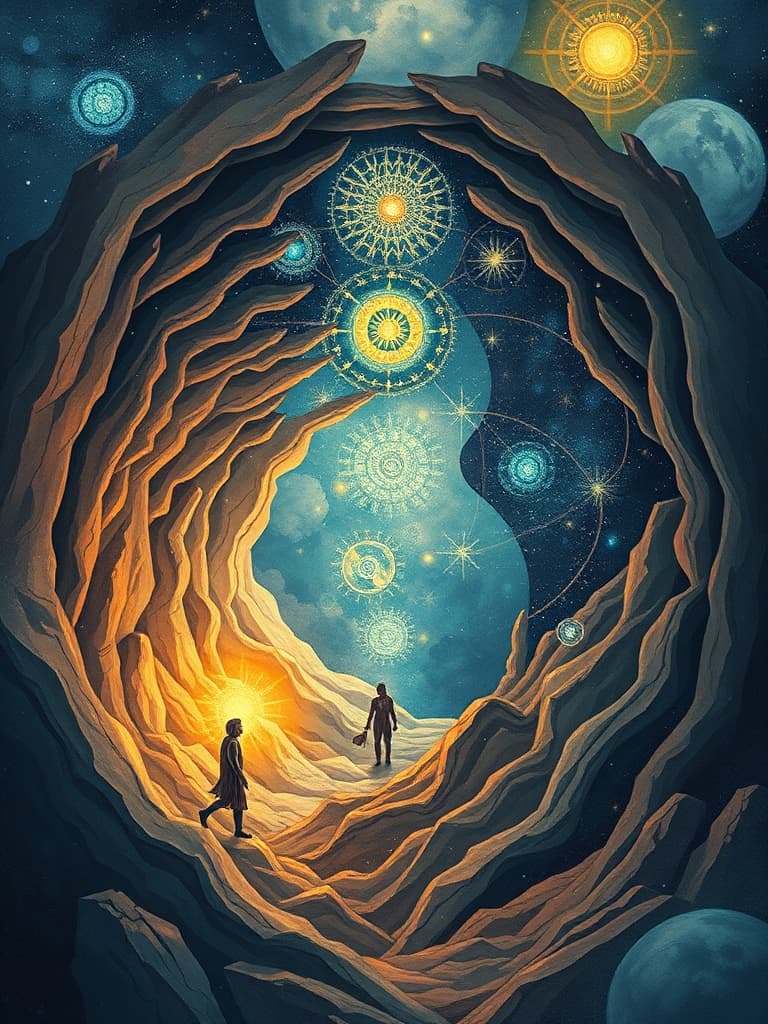
About this book
Unraveling the Inner Universe
52
0
10
0
# Divining Consciousness: The Body as Universal Map of Spiritual Experience ## Central Thesis The cross-cultural convergence of anatomical symbolism, mystical phenomenology, and spiritual practice across civilizations with no historical contact constitutes evidence that ancient mythological and religious systems were, at their core, attempts to encode and transmit knowledge of a shared physiological substrate for consciousness — one that modern neuroscience is only beginning to formally describe. This is not a claim about theology or metaphysics. It is a claim about pattern recognition and its implications: when isolated cultures independently produce the same symbols, locate them in the same places in the human body, describe the same interior experiences, and recommend the same practices for accessing them, coincidence becomes an insufficient explanation. ----- ## Part One: The Anatomical Argument ### Three Structures, One Configuration At the center of this argument are three neurological structures whose cultural significance, across unconnected traditions, maps with unusual precision onto their physiological function. The pineal gland — small, pine-cone-shaped, deep in the brain — is directly sensitive to light cycles and governs the body’s relationship to day and night rhythms via melatonin production. Ancient traditions associated it with fire, the sun, the masculine principle, and the “third eye.” Descartes called it the seat of the soul. Its association with light is not purely metaphorical: it is one of the few brain structures that literally responds to light. The pituitary gland — the master regulator of the endocrine system — governs hormones governing stress, reproduction, bonding, and the subjective experience of love. Ancient traditions associated it with fluid, the moon, the feminine principle, and milk. Its name derives from the Latin for phlegm; its secretions are milky in character. The correspondence between symbolic and physiological is direct. Between them sits the thalamus — the central relay station through which nearly all sensory information passes before reaching conscious awareness. It regulates sleep, wakefulness, alertness, and the integration of experience. Ancient traditions described it as the marriage chamber, the inner room, the holy of holies, the ark. Its Greek etymology means literally “inner chamber” or “bridal bed.” Three structures. One central, two flanking. One associated with fire, one with water, one with their union. This configuration appears — with the same spatial logic and the same symbolic vocabulary — in the caduceus of Hermes (two serpents winding around a central staff), the Ida and Pingala channels of Indian yoga winding around the Sushumna, the double-crowned headdresses of Egyptian deities, and arguably in the sign of the cross itself, tracing forehead, solar plexus, and the horizontal axis between them. The question worth pressing is this: what is the probability that this specific configuration — three structures in this spatial relationship, with these symbolic assignments — emerged independently across Egypt, Greece, India, and the ancient Near East by coincidence? And if not coincidence, what is the more parsimonious explanation? ### The Caduceus as Anatomical Diagram The caduceus, still used as a medical symbol, depicts two serpents winding in opposite directions around a central staff, meeting at a central point, surmounted by wings. If one is looking for a symbolic representation of the pineal and pituitary channels flanking the central spinal axis and converging at the thalamus, the caduceus is an exact match — not approximately, but structurally precise. The same image in India: Ida (lunar, feminine) and Pingala (solar, masculine) winding around Sushumna (the central channel), the practice of Hatha yoga being literally the balancing of Ha (sun) and Tha (moon) through the central axis. The word “Hatha” encodes the thesis of the practice. This is not cultural diffusion — India and Greece were not sharing medical diagrams. It is either remarkable coincidence, or both traditions were mapping the same interior territory and arriving at the same image because the territory itself has that structure. ----- ## Part Two: The Phenomenological Argument ### The Consistency of Reported Experience Setting aside mythology, the experiential testimony across cultures presents a second, independent line of evidence. People reporting spiritual experiences — across Christian mystical literature, yogic accounts of kundalini awakening, Sufi poetry, Buddhist jhana accounts, Indigenous ceremonial traditions, and modern near-death experiences — describe a remarkably consistent phenomenology: A pressure or warmth at the center of the forehead. Heat rising through the body from the base of the spine upward. A sensation of electricity or fire moving from the crown downward through the neck and shoulders. An overwhelming feeling of unconditional love with no apparent external cause. An experience of light described as more vivid or real than ordinary visual experience. A deep, persistent peace qualitatively unlike ordinary calm. An internal sound, often described as a hum or tone. These descriptions appear in people who had no framework for what was happening to them, in traditions that had no contact with each other, across thousands of years. The phenomenology is not merely similar — it is, in its key features, identical. This consistency demands explanation. The most parsimonious one is that these experiences reflect genuine physiological events — states produced by the human nervous system under specific conditions — and that the ancient traditions were attempting, each in their own symbolic language, to describe, transmit, and teach access to those states. ### The Neuroscience of Mystical Experience Modern neuroscience has not yet produced a complete account of mystical experience, but the relevant structures are identifiable. The vagus nerve, the pineal gland, the hypothalamus, the limbic system, and the thalamus are all implicated in the phenomenology described above. The vagus nerve — the longest cranial nerve, connecting the brainstem to nearly every major organ — is the primary channel of the parasympathetic nervous system. Vagal stimulation is associated with calm, love, connectedness, and in intense cases, transcendence. High vagal tone correlates with emotional resilience and physical health. Low vagal tone correlates with anxiety, inflammation, and depression. The default mode network — the self-referential processing system most active during ordinary unfocused waking consciousness — quiets during meditation, prayer, and mystical states. The states associated with reduced default mode activity include feelings of connection, reduced rumination, increased creativity, and what researchers cautiously call self-transcendence. The ancient practices recommended across traditions — fasting, breathwork, celibacy, silence, service — are, when examined through a neurological lens, precisely the practices most likely to reduce sympathetic arousal, increase vagal tone, and quiet default mode activity. The ancients did not have this language. But the functional recommendations are consistent with what the neuroscience predicts would produce the described effects. ----- ## Part Three: The Mythological Argument ### The Spine as Universal Axis Every major mythological tradition contains a vertical axis connecting the lower and upper realms — a route along which something travels, or is meant to travel, upward. Jacob’s ladder. The djed pillar of Osiris. Yggdrasil, the world tree. The Sushumna of yoga. The staff of Moses. The spine of the crucified Christ. The caduceus. In each case, the axis is the route of transformation. Something ascends. The cerebrospinal fluid — which flows through the spinal column, bathes the brain, circulates through the ventricles, and is reabsorbed — is the physiological candidate the ancient traditions called “living water,” “wonder water,” “the waters above.” Recent research suggests cerebrospinal fluid plays a role in clearing metabolic waste from the brain during sleep, a function the ancients may have intuited when they described it as purifying. The solar plexus — a dense network of neurons sometimes called the abdominal brain, operating semi-independently from the central nervous system — appears in Egyptian cosmology as the horizon, the point where above meets below. It appears in the Osiris myth as the missing fourteenth piece (the piece Isis cannot recover), which is also, in the body mapping, the point of conception — the place where Horus is generated. The same structural logic appears in the twelve knights of Arthur’s Round Table, the twelve signs of the zodiac, and the twelve apostles: twelve principles surrounding and guarding a thirteenth, the point of integration and transformation. ### The Founding Error of Reductive Reading The dominant modern approach to ancient mythology has been either literal (these are historical accounts) or purely metaphorical (these are poetic elaborations on natural phenomena). Both readings miss a third possibility: that these traditions were encoding empirical observations about the interior life of the human body, expressed in symbolic language because symbolic language survives when technical description does not. The kingdom of heaven is within you. The body is the temple. These are not metaphors for external events. Read as instructions — as maps — they become precise: the experience being described is interior, physiological, and accessible. ----- ## Part Four: The Practical Argument ### Convergent Technology If the framework above is even partially correct, several practical implications follow with logical force. First, the spiritual practices common to nearly every tradition are more functionally grounded than their symbolic packaging suggests. Fasting reduces sympathetic arousal and increases vagal tone. Silence and meditation quiet the default mode network. Celibacy, in the context of these traditions, represents the conservation and redirection of energy otherwise dissipated outward — a hypothesis that modern neuroscience has not refuted and has begun to investigate through the lens of dopamine regulation and attentional resource allocation. Second, the symbolic language of religion becomes readable in a new register. The ark of the covenant, housed in the holy of holies where only the high priest could enter once a year, is a description of the thalamus — the innermost chamber, the seat of integration, the place where inner light is said to radiate. This is not a reduction of religious meaning. It is an expansion of it: the claim is not that the ark is “merely” the thalamus, but that the thalamus is the site of a genuinely transcendent experience that the tradition was encoding in architectural terms. Third, and most consequentially: these experiences are more common, more accessible, and more teachable than the traditions have typically suggested. The phenomenology described above — the pressure at the forehead, the heat at the crown, the overwhelming love — is reported by people across cultures who had no preparation for it. It is not the exclusive property of mystics or monastics. It appears to be a capacity of the human nervous system that specific conditions reliably activate. ### Humility as Neurological Technology The consistent cross-cultural recommendation of humility — understood not as self-deprecation but as the quieting of the insistent, opinion-generating, justification-building intellectual function — maps directly onto the neuroscience of the default mode network. The default mode network is most active during self-referential processing: rumination, justification, identity maintenance, desire. Its quieting — through meditation, prayer, fasting, service, or spontaneous circumstance — is consistently associated with the states described across traditions as spiritual experience. The ancient instruction to “become like a child,” to “empty oneself,” to “surrender” is, in neurological terms, an instruction to reduce default mode activity and allow access to states that ordinary effortful cognition suppresses. This is the practical heart of the argument: humility is not a moral virtue in the conventional sense. It is a functional state — a technology for clearing the interior space through which these experiences become available. ----- ## Conclusion: The Puzzle and Its Implications The central puzzle is this: across cultures separated by thousands of miles and thousands of years, with no plausible mechanism of cultural transmission, we find the same anatomical focal points, the same symbolic configurations, the same phenomenological descriptions, and the same practical recommendations. Coincidence is not an adequate explanation at this scale. Cultural diffusion does not account for the specificity and independence of the correspondences. The most parsimonious remaining explanation is that these traditions were mapping something real — something arising from within the shared architecture of the human body itself. The implications are significant. If ancient mythological and religious systems encode empirical observations about consciousness and its physiological substrate, then the dismissal of this symbolic vocabulary as primitive metaphor is not scholarly rigor — it is the loss of a map. A map of territory that the map’s dismissers have not explored. The neuroscience of mystical experience is in its infancy. The consistent phenomenology across cultures and centuries represents a data set of extraordinary richness that has been systematically undervalued. The ancient traditions represent a body of practical knowledge about how to access these states that has been obscured by its own symbolic packaging. The hypothesis this essay advances is not theological. It does not require a position on the existence of God, the nature of the soul, or the metaphysical status of spiritual experience. It requires only this: that the consistency of the evidence — anatomical, phenomenological, mythological, and practical — be taken seriously as evidence, and that the question it raises be pursued with the same rigor applied to any other domain of human inquiry. The kingdom of heaven is within you. Not as a theological claim. As a hypothesis worth investigating — with the full resources of modern neuroscience, comparative mythology, and phenomenological research — before the map is lost entirely. ----- *This document is intended as thesis-generation input for essay development. Core claims are intentionally stated with argumentative confidence rather than the hedged inquiry style of the source document, to provide the essay writer with defensible positions to develop and qualify.*
Chapters
- 1The Triad of the Inner SanctumChapter 1 introduces the core anatomical argument: the pineal gland (fire, sun, third eye), pituitary gland (water, moon, milk), and thalamus (union, inner chamber) form a symbolic and spatial triad in disparate ancient cultures. The Unseen Cartographer, driven by an insatiable pattern recognition, presents this configuration as more than coincidence. The Skeptical Scholar will immediately question the validity of such cross-cultural comparisons, demanding concrete evidence beyond symbolic resonance. The protagonist must establish the precise anatomical correspondence and the cultural isolation to build a foundation for the thesis, hinting at a physiological map of consciousness yet to be fully understood.
- 2Serpents on the AxisChapter 2 delves into the visual language of this anatomical triad, focusing on the caduceus and the yogic Ida-Pingala-Sushumna. The Unseen Cartographer uses these as precise structural diagrams, illustrating how two flanking energetic channels converge around a central axis. The Modern Neurologist might offer tentative correlations with neural pathways, while the Skeptical Scholar dismisses them as universal archetypes or pareidolia. The protagonist must demonstrate the specific, functional accuracy of these symbols, arguing they are not mere art but ancient maps of internal physiological processes, a 'technology' for accessing deeper states.
- 3Whispers from the CoreChapter 3 shifts to the phenomenological evidence: the remarkable consistency of reported spiritual experiences across isolated traditions. The Unseen Cartographer details shared accounts – pressure at the forehead, rising heat, overwhelming love, vivid light – from Christian mystics to yogis. This chapter introduces the Echo of Antiquity, whose timeless descriptions resonate with modern testimony. The Skeptical Scholar will challenge the subjectivity of these accounts, while the Modern Neurologist might point to neurotransmitter surges. The protagonist must argue that this shared phenomenology is compelling evidence of a common physiological substrate, a 'language' of inner experience.
- 4The Vagal Current and the Quiet MindChapter 4 bridges ancient experience with modern neuroscience. The Unseen Cartographer connects the described phenomena to the vagus nerve, the default mode network, and the thalamus. The Modern Neurologist provides scientific context, explaining how vagal stimulation induces calm and how quieting the DMN correlates with self-transcendence. The Skeptical Scholar remains wary, cautioning against reductionism. The protagonist’s challenge is to show how these scientific findings don't invalidate, but rather corroborate, the ancient observations, positioning the ancients as empirical observers of neurophysiology, albeit without scientific terminology.
- 5The Spine of the World TreeChapter 5 explores the universal mythological motif of the vertical axis – Jacob’s ladder, Yggdrasil, the djed pillar – as a symbolic representation of the spinal column and cerebrospinal fluid. The Unseen Cartographer argues these are not mere metaphors but encoded instructions for navigating the internal landscape. The Echo of Antiquity's symbolic narratives gain new weight, while the Skeptical Scholar might reinterpret them as reflections of natural phenomena. The protagonist must present this axis as a vital component of the physiological map, essential for the upward flow of 'living water' or transformative energy.
- 6The Body, A Sacred BlueprintChapter 6 directly confronts the 'reductive reading' of ancient texts. The Unseen Cartographer argues that phrases like 'the kingdom of heaven is within you' are not purely metaphorical but functional instructions pointing to interior, physiological states. The Skeptical Scholar will likely defend the metaphorical interpretation as the only intellectually honest approach. The protagonist must advocate for a third reading – one that sees symbolic language as a durable form of empirical reporting, a sophisticated 'technical manual' for the inner human. The body is framed as the temple, not just in a spiritual sense, but as a literal, observable locus of profound experience.
- 7Practices as Neurological KeysChapter 7 reveals the practical implications: ancient spiritual disciplines like fasting, silence, and celibacy are re-framed as functional neurological technologies. The Unseen Cartographer explains how these practices, through the lens of modern neuroscience, effectively reduce sympathetic arousal and cultivate vagal tone. The Modern Neurologist might offer data on the physiological effects of these disciplines. The Skeptical Scholar will question the intentionality of the ancients. The protagonist must demonstrate that these practices are 'technologies' for accessing the Inner Universe, not arbitrary rituals, thereby grounding spiritual discipline in tangible physiological outcomes.
- 8Humility: The DMN's Off SwitchChapter 8 presents humility as a 'neurological technology.' The Unseen Cartographer posits that the ancient emphasis on humility, emptiness, and surrender is, in neuroscientific terms, the suppression of the default mode network. The Skeptical Scholar will dismiss this as psychobabble, while the Modern Neurologist might cautiously agree with the correlation. The protagonist’s crucial argument is that humility is a functional state allowing access to deeper consciousness, a deliberate practice for clearing the internal space. This reframes a moral virtue as a practical tool for accessing the 'map' of the Inner Universe.
- 9The Cartographer's ConvergenceChapter 9 synthesizes the anatomical, phenomenological, and practical arguments. The Unseen Cartographer highlights the overwhelming convergence of evidence across isolated cultures – the same anatomical sites, symbolic configurations, experiential reports, and functional practices. The Echo of Antiquity's persistent message of a unified inner map is made clear. The Skeptical Scholar’s objections are addressed by the sheer scale and specificity of the pattern. The protagonist asserts that coincidence is insufficient, and cultural diffusion cannot explain the independent emergence of such detailed correspondences, pointing to a shared physiological substrate.
- 10Rediscovering the Lost MapChapter 10 concludes by emphasizing the profound implications of this rediscovered 'map.' The Unseen Cartographer argues that dismissing ancient symbolic vocabulary as primitive metaphor is a profound loss of knowledge. The Modern Neurologist acknowledges the vast unexplored territory of consciousness. The Skeptical Scholar may begin to see the weight of the evidence. The protagonist issues a call for interdisciplinary research, urging the integration of neuroscience, comparative mythology, and phenomenology to explore this 'Inner Universe.' The essay ends not with a faith claim, but with a hypothesis: the ancient traditions offer a practical, empirically grounded map to human potential, a map urgently needed in the modern age.
More Non-fiction stories
Browse all Non-fiction →- More Than Sister: A Chronicle of Courage
A younger brother looking Back on how it sister Patrice, has always saved even when I fought the United States of America. I can remember when gang task force had me under arrest I had ran 4,000 miles and I was exhausted when they caught me. I passed out to hear her tell gang task force. That when she comes to get I better look just like I did on the back of the police car. And she did come to bond me out. I stayed in custody for exactly one weekend. No matter what happened to me she's always came to my rescue. When I was 7 Santa Clause didn't have us on his list, he forgot us completely. So we were walking home And I was heart broken along with my sister Tina and Tricee was crying because, she was crying because we were heart broken. She got a job after that day too take care of me her little brother. She was my sister and mother the same time. I can remember when I was ten I would go shovel snow, and then go home and get a grocery list and go shopping for us. Everybody was gone and we were always the only ones that were there no matter how bad it had gotten. We never knew where everyone was at. Next she got a job at Jack-In-Box and I would go too her job every day at 12:00 on the dot and she would serve her little brother lunch everyday. I can remember I got stuck on the roof and she climbed up there too get me and I fell and she caught me and we both hit the ground and she broke her collarbone I felt so bad and couldn't help her, trying too save me.
- Beyond the Surface: A Journey of Discovery
A journey through puberty and all the body changes.
- Wealth Building & AI Side Hustles or Practical Personal Finance
The AI Wealth Code: Build Micro-Empires, Automate Income, and Escape the 9-to-5 Stop trading your life for an hourly wage. The rules of wealth have fundamentally shifted—and the people winning aren't working harder; they are leveraging artificial intelligence. If you have ever felt trapped by rising living costs, stagnant salaries, or the endless grind of traditional side hustles, The AI Wealth Code is your blueprint for breaking free. You don't need a computer science degree, a massive starting budget, or years of technical experience. You just need a system. Written for today’s digital economy, this step-by-step masterclass strips away the hype and reveals how everyday people are building automated, high-margin digital assets and micro-businesses using accessible AI tools. Inside, you will discover: The AI Leverage Formula: How to collapse months of traditional business planning and content creation into hours. High-Income Micro-Services: Exact frameworks for packaging AI writing, automated marketing systems, and digital product creation into recurring revenue streams. The Zero-Inventory Asset Model: How to build, launch, and scale digital products that sell 24/7 while you sleep. The Modern Psychology of Money: Why traditional budgeting fails in a fast-paced economy, and how to transition from active worker to digital business owner. Whether you want to generate an extra thousand dollars a month or build a scalable asset portfolio designed for long-term financial independence, The AI Wealth Code gives you the practical tools, prompt frameworks, and execution mindset to turn technology into real wealth. The tools are ready. The market is waiting. It’s time to rewrite your financial future.
- The Porcelain Throne's Portal
Some forty years ago, I had the opportunity to have as many friends over as I'd like while my parents were at work. I was told that the house was now mine. My siblings, nine years older than me, were all gone. A 3-1/2-bedroom home with two bathrooms and a decked-out basement with a barn that I called Pete's Pub. Pete's Pub also had a large freezer that I easily put quarter barrels in if needed, depending upon the amount of people that came over. It was like running a speakeasy, except there was no famous knock and there was no one not accepted. Everybody could come in as long as you were either a jock, a freak, or just a walking nomad. As long as you had a buck to suck, you were in this party, but this party wasn't for pussies either. It had shots. We were going to do whisky. We were going to do tequila. We even did a day of vodka. It's morning, for God's sake! Make mamasas. Though my friends and I were not into pussy drinks, we went for the gusto, probably whisky and water for the most. Back then, wines were still big: country quencher, Boon's Farm, strawberry hill, things like that. It was amazing at 14% alcohol, and drinking like it's a beer, you get very trashed. You start talking about shit that isn't there. You start to do shit that's not there. You march up big hills by yourself and sit down and what the hell is going on? It's a good time. Have the normies check on you once in a while, just in case you forgot to put your cataract on or you're laying in frozen or whatever your issue may be. Take care. God bless! One of my neighbors is out for me, saying I wasn't home to fight with her. I guess the word that came down is these are the same people, mind you, that flooded our apartment there in 303 or in 203. Our apartment happens to be on the first floor. You go in the basement for 101 and 102. That's either here or there at the moment, because here we are. This is where I got to. I'm pretty much a washed-up wrestler. I got my ass kicked by the guy who ran the meeting prior to this, Mike Canodo. I'm sure he's going to teach another rough crowd to do more of that, because that's what he's about, and that's what I respect about him. He keeps doing the next right thing, allowing himself to make mistakes. You
- I am Jesus
Successful mind set, business owner,a strong sense of self worth yet humbled by time even so we all have our ups and downs key is compassion. .
- Gravity's Green Embrace: The Future of Eco-Hydro
An eco friendly waterfall power station.
Want to write a story like this?
Learn the craft in our free AI story generator, then draft your first chapter with an AI co-writer.
What stayed with you?
Read a chapter and leave the author a comment.
Reader notes
Loading reader notes…