About this book
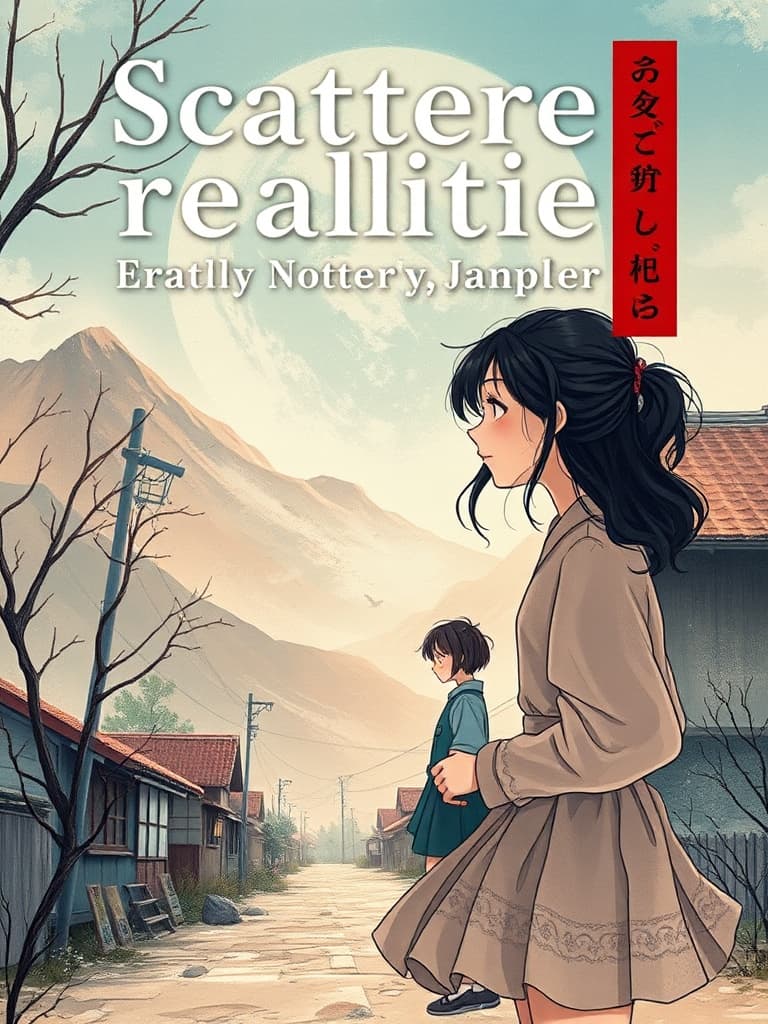
Scattered realities
31
0
20
0
Little village in the mountains of Japan English and Japanese languages Love and folly and across the distance of demintions
Chapters
- 1Whispers from the Mist: A Veil of DoubtChapter 1 opens in the serene, yet isolated, mountain village of Aokigahara, nestled deep within the Japanese Alps. The air is perpetually cool, often shrouded in a soft, ethereal mist that lends an otherworldly quality to the landscape. Our protagonist, Hana, a young woman in her early twenties, lives a quiet life, working in the village's small textile shop and tending to her family's ancestral shrine. Her days are marked by the predictable rhythm of village life – the morning bell from the temple, the chatter of vendors at the small market, the distant calls of mountain birds. However, recently, this tranquility has been subtly disturbed. Hana begins experiencing fleeting, disorienting visions. These aren't dreams; they manifest as brief, vivid flashes during her waking hours – a glimpse of a man's face, unfamiliar yet compelling, his eyes filled with an urgent plea; a stark, alien landscape bathed in an unsettling light; fragments of conversations in a language she doesn't understand, yet feels a strange resonance with. Initially, she dismisses them as fatigue or stress, perhaps a consequence of her solitary nature and the village's isolation. She confides in no one, fearing ridicule or, worse, being seen as unwell. The visions are sporadic, like static on a clear channel, leaving her with a lingering sense of unease and a gnawing curiosity. The man in her visions, whom she instinctively begins to call Kenji, appears increasingly distressed each time. His image is often blurred, as if seen through water or thick fog, reinforcing the ephemeral nature of these occurrences. Hana's internal conflict intensifies. She grapples with the rational explanation versus the undeniable vividness of these experiences. She starts to feel a growing disconnect from her immediate reality, her attention drifting during mundane tasks, her thoughts consumed by these phantom images. The mist outside her window seems to thicken, mirroring the confusion clouding her mind. The chapter explores Hana's internal world, her quiet life in Aokigahara, and the insidious beginnings of her fractured perception. We establish the atmosphere of the village – its beauty, its isolation, and the undercurrent of something ancient and perhaps forgotten. Hana's character is introduced as introspective and slightly melancholic, prone to introspection. Her fear of acknowledging the visions stems from a deep-seated desire for normalcy and a fear of disrupting the delicate balance of her life. The chapter emphasizes the subtle, almost imperceptible nature of the initial intrusions, making Hana question her own sanity. The ending hook focuses on a particularly vivid vision, one where Kenji's lips move, forming words that Hana *almost* understands, leaving her with a desperate urge to decipher his message and a profound sense of foreboding that this is only the beginning. The mist outside her window seems to pulse with an unseen energy, hinting at the unseen forces at play. The continuity note is to ensure the descriptions of the visions are consistent in their vagueness initially, gradually becoming clearer as the story progresses. The emotional arc for Hana is one of growing confusion, self-doubt, and a nascent, unacknowledged fear. The setting details will focus on the natural beauty of Aokigahara, juxtaposed with Hana's internal turmoil, using sensory details – the scent of pine, the damp chill of the mist, the muted sounds of village life – to ground the reader while hinting at the otherworldly intrusions. The character intent for Hana is to maintain her normalcy and suppress these strange occurrences, but she is subtly being drawn into something far larger than herself. Kenji's intent, as perceived by Hana, is to communicate a warning or a plea, but the exact nature remains elusive. Elder Sato, though not yet appearing, is foreshadowed as a potential source of wisdom, given the village's deep roots in tradition and folklore, some of which might relate to such phenomena. The malevolent entity is completely unseen at this stage, its influence only suggested by the unsettling nature of the visions and Hana's growing unease. The chapter's length will be achieved by delving deeply into Hana's sensory experiences, her internal monologue, her daily routines, and the specific details of her surroundings, contrasting the mundane with the extraordinary intrusions.
- 2Echoes of Absence: The Vanishing TrailChapter 2 plunges Aokigahara into a state of quiet panic. The unsettling visions that plagued Hana begin to manifest as a tangible reality within the village. One by one, villagers start disappearing. Not dramatically, but insidiously. Old Man Ito, who always sat by the shrine, is gone one morning. Then, young Akiko, the baker's daughter, fails to return from gathering herbs in the woods. The disappearances are initially attributed to accidents, the treacherous mountain terrain, or perhaps people simply leaving for the city. But the pattern is too unsettling, the silence too profound. The village, once close-knit and communal, begins to fracture under the weight of unspoken fear. Doors are locked earlier, children are kept indoors, and suspicious glances are exchanged. Hana's visions intensify dramatically, mirroring the growing dread. The flashes are no longer fleeting; they are longer, more coherent. She sees Kenji more clearly now, his face etched with desperation. He is in a place that looks uncannily like Aokigahara, yet subtly wrong – the colors are muted, the air heavy, and shadows seem to cling unnaturally to the familiar structures. He appears to be searching for something, or someone, his movements frantic. In one vision, he mouths her name, 'Hana,' the sound a desperate whisper that echoes in her mind even after the vision fades. The connection between her visions and the village's plight becomes undeniable, a terrifying realization that shakes Hana to her core. She starts to suspect Kenji is not merely a figment of her imagination, but a real person, perhaps even connected to these disappearances. Her initial fear of being perceived as mad begins to wane, replaced by a desperate need to understand what is happening. She observes the villagers, their hushed conversations, their averted gazes, and feels an overwhelming sense of isolation, even amidst the community. The chapter delves into the escalating fear and paranoia within Aokigahara. The serene landscape now appears menacing, the mist a shroud for unseen threats. Hana’s internal struggle shifts from self-doubt to a desperate search for answers. She begins to actively observe her surroundings, looking for any sign, any anomaly that might connect to her visions or the disappearances. Her empathy for the missing villagers grows, fueling her determination. Kenji’s presence in her visions becomes a focal point; she starts to analyze his actions, his environment, searching for clues. The continuity note is crucial here: the disappearances must remain unexplained by conventional means, reinforcing the supernatural element. The emotional arc for Hana is a progression from anxiety and self-doubt to a dawning horror and a reluctant sense of responsibility. The setting details will emphasize the contrast between the village's natural beauty and the encroaching psychological darkness, using specific locations like the forest edge, the deserted market stalls, and the silent shrine to highlight the growing absence. The character intent for Hana is to find a logical explanation, but she is increasingly forced to confront the illogical. Kenji’s intent is clearly to communicate a warning, but the method is still unclear. Elder Sato is still an unseen presence, but the villagers’ growing fear and reliance on tradition might lead Hana to seek him out. The malevolent entity’s presence is felt more strongly now, its influence subtly amplified by the fear and chaos it sows. The chapter’s length will be achieved by detailing the individual disappearances and the community’s reaction, exploring Hana's growing obsession with Kenji’s visions, describing the subtle shifts in the village atmosphere, and illustrating Hana’s attempts to reconcile the two realities using vivid sensory descriptions and internal monologue.
- 3The Elder's Tale: Legends of the Sundered VeilChapter 3 sees Hana, driven by a desperate need for answers and a growing conviction that her visions are linked to the village's plight, seeking out the reclusive Elder Sato. He is the oldest resident of Aokigahara, a man steeped in the village’s history and folklore, living in a secluded cabin on the outskirts, surrounded by ancient trees. Initially, Sato is reticent, his eyes holding a depth of knowledge that both comforts and unnerves Hana. He listens patiently to her fragmented account of visions and disappearances, his expression unreadable. Hana recounts the recurring image of Kenji and the unsettling glimpses of another place. She nervously describes her growing terror and the villagers' mounting fear. Elder Sato, after a long silence, begins to speak, not of superstition, but of ancient legends, of a time when the veil between worlds was thinner, more permeable. He speaks of spirits, of other realms, and of the delicate balance that maintains their separation. He explains that Aokigahara, due to its remote location and deep connection to the earth's energies, has always been a place where these boundaries could weaken. He hints that the disappearances are not random acts but symptoms of a larger phenomenon – the 'bleeding' of one reality into another. He uses metaphors of mist and mirrors, of echoes and reflections, to describe the instability. Sato reveals that such occurrences have happened before, though rarely, and were always met with ritual and caution. He speaks of the 'Unseen Weaver,' an ancient entity that thrives in the chaos between dimensions, feeding on the essence of those lost between worlds. He doesn't explicitly confirm Kenji's existence but acknowledges the possibility of beings from beyond the veil reaching out. Hana feels a mixture of validation and dread. Her experiences are not a sign of madness, but of a truth far more terrifying. Sato emphasizes the importance of understanding the old ways, the rituals meant to maintain the balance. He reveals that the village elders have long been custodians of this knowledge, though much has been forgotten or dismissed over generations. He sees in Hana a spark of awareness, a sensitivity that might be crucial. The continuity note is critical: Sato's explanation must be steeped in allegory and metaphor, hinting at the true nature of the threat without fully revealing it. His knowledge should be presented as ancient wisdom, not scientific fact. The emotional arc for Hana is one of initial fear and doubt, followed by a profound sense of validation mixed with an escalated sense of danger. She moves from seeking personal understanding to accepting a larger, communal threat. The setting details will focus on Sato’s cabin – its rustic simplicity, the scent of dried herbs, the ancient scrolls and artifacts that hint at his deep knowledge, and the way the surrounding forest seems to hold its breath. The character intent for Hana is to find answers and guidance, and she now sees Sato as her only hope. Kenji's intent remains to communicate, but his struggle is now contextualized within this larger cosmic conflict. Elder Sato's intent is to guide Hana, to pass on the crucial knowledge without overwhelming her, and to prepare her for what is to come, while also protecting the village's secrets. The malevolent entity, the 'Unseen Weaver,' is now given a name, its nature as a parasitic force between dimensions becoming clearer. The chapter's length will be achieved by elaborating on the legends Sato shares, detailing the atmosphere and symbolism within his cabin, exploring Hana's internal processing of this new, overwhelming information, and describing the subtle shifts in her perception of the village and its history. The dialogue between Hana and Sato will be a key element, focusing on the layers of meaning within his pronouncements.
- 4The Whispering Stone: A Conduit of RealityChapter 4 focuses on Hana's deepening connection to the otherworldly occurrences, directly facilitated by the discovery of a peculiar artifact. Following Elder Sato's cryptic hints about the veil and the interconnectedness of things, Hana finds herself drawn to an ancient, overgrown shrine hidden deeper in the woods than she usually ventures. It's a place whispered about in hushed tones by villagers, considered taboo. Amidst the moss-covered stones and gnarled roots, her hand brushes against something smooth and cool – a stone, unlike any she's ever seen. It's palm-sized, perfectly ovate, with an almost unnatural smoothness, and veined with faint, iridescent lines that seem to shift and shimmer in the dappled sunlight. It feels strangely warm to the touch, humming with a low, almost inaudible vibration. Compelled by an irresistible urge, Hana pockets the stone. As soon as her fingers close around it, her visions surge with unprecedented intensity. The images of Kenji and his world are no longer fragmented; they are a continuous, almost overwhelming stream. She sees him in sharp detail, his environment vivid and palpable – a world that mirrors her own in architecture and nature, but tinged with a pervasive sense of decay and unease. The sky is a perpetual twilight, and the air crackles with unseen energy. Kenji is desperately trying to send a message, his actions more frantic, his eyes pleading directly with her. The stone in her hand pulses in sync with her racing heart, acting as a powerful amplifier. Touching it makes the other dimension feel terrifyingly real, blurring the lines between her reality and his. She feels a phantom chill, hears a distant, distorted cry, and smells an unfamiliar, acrid scent. The stone seems to thrum with the very energy of the rift, acting as a conduit. Hana realizes with dawning certainty that the stone is not just a relic; it is a key, a focus, a tangible link to the world Kenji inhabits. Her initial fear of the visions is now overshadowed by a profound sense of awe and terror at their tangible reality. She clutches the stone, its warmth a strange comfort against the cold dread washing over her. The continuity note is to ensure the stone’s properties are consistent and its discovery feels fated rather than accidental. Its iridescence and subtle hum are key sensory details. The emotional arc for Hana is one of escalating wonder, fear, and a sense of profound, almost overwhelming, connection. She moves from seeking external validation to finding a tangible, internal anchor for her experiences. The setting details will focus on the ancient, forgotten shrine – its atmosphere of neglect and sacredness, the specific textures of moss, stone, and decaying wood, and the quality of light filtering through the dense canopy, all contributing to the sense of discovery and mystery. The character intent for Hana is to understand the stone's power and its connection to Kenji and the disappearances. Kenji's intent is to break through, his desperation amplified by the proximity facilitated by the stone. Elder Sato's intent is to guide Hana towards this realization, knowing the stone's significance. The malevolent entity's influence is subtly growing, its awareness of the stone and Hana likely increasing. The chapter's length will be achieved by detailing the exploration of the shrine, the sensory experience of finding and holding the stone, the vivid and prolonged nature of the visions it triggers, Hana's internal monologue grappling with the implications of this discovery, and the symbolic weight of the stone as a bridge between worlds.
- 5A Plea Across the Veil: Kenji's Desperate WhisperChapter 5 marks a critical turning point as communication, however fractured, is finally established across the dimensional divide. Empowered and terrified by the whispering stone, Hana sits in her room, the artifact clutched tightly in her hand. The stone pulses with a steady rhythm, its faint luminescence casting an eerie glow on her face. Her visions are more intense than ever, the barrier between worlds feeling impossibly thin. Suddenly, amidst the swirling imagery of Kenji's world, a new element emerges: sound. It’s faint at first, like static crackling through an old radio, then coalesces into a distorted, broken voice. It’s Kenji. His voice, strained and filled with palpable dread, struggles to break through the dimensional interference. The message is garbled, punctuated by static bursts and echoing whispers that seem to emanate from the very fabric of reality. Hana strains to understand, her heart pounding against her ribs. "Hana… can you hear me?" the voice rasps, followed by a surge of static. "It’s… it’s not just me… they’re taking… people… both sides…" He mentions a "shadow," an "entity" that feeds on "fear" and "life essence." He speaks of being trapped, of trying to close a "breach" he inadvertently caused, but failing. His voice cracks with desperation as he warns that the entity is growing stronger, consuming memories, identities, and eventually, entire realities. The message is fragmented, incomplete, but the core of his plea is clear: he is in danger, and so is Hana’s world. The malevolent entity he speaks of is directly responsible for the disappearances and poses a threat to both dimensions. The stone in Hana’s hand grows warmer, almost hot, as Kenji’s message intensifies, acting as a temporary, unstable bridge. Hana feels a profound sense of connection to Kenji, his desperation resonating deeply within her. She understands now that he is not a hallucination, but a person fighting for survival, caught in a terrifying cosmic struggle. The chapter concludes with Kenji’s voice fading into a final, chilling whisper, "Don't let it…" before the connection snaps, leaving Hana in the sudden silence, the stone cooling in her hand, her mind reeling with the horrifying implications of his words. The continuity note is essential: the message must be fragmented and difficult to decipher, preserving the mystery while conveying crucial information about the entity and Kenji's predicament. The emotional arc for Hana is one of shock, terror, and a surge of protective instinct towards Kenji. Her self-doubt is replaced by a grim determination. The setting details will focus on the oppressive atmosphere within Hana's room as the connection is made – the interplay of light and shadow cast by the stone, the heightened sensory awareness of the sounds outside, and the oppressive silence after the message cuts off. The character intent for Hana is to fully grasp the gravity of the situation and find a way to help Kenji. Kenji's intent is to warn Hana and seek her help, revealing the nature of the threat. Elder Sato's role is to provide context for this message, potentially recognizing the description of the entity. The malevolent entity is now identified as a significant threat, actively working to sever connections and consume. The chapter’s length will be achieved by detailing the sensory experience of the connection forming, the fragmented nature of Kenji's message with its pauses and static, Hana's intense emotional reaction to his words, her internal processing of the information about the entity and the breach, and the lingering fear and determination after the connection is broken.
- 6The Unseen Weaver: Threads of CorruptionChapter 6 delves into the insidious influence of the malevolent entity, now identified as the 'Unseen Weaver,' on both worlds. Its presence is not marked by overt displays of power but by a creeping, subtle corruption that erodes the fabric of reality and sows discord. In Aokigahara, the disappearances continue, but now, a pervasive sense of paranoia grips the remaining villagers. Trust erodes; neighbors eye each other with suspicion, and hushed rumors spread like wildfire. The natural world itself seems subtly altered – familiar paths become disorienting, shadows lengthen unnaturally, and an unsettling stillness pervades the air, broken only by phantom whispers or distant, unidentifiable sounds. Objects seem to shift when unobserved, and memories of the missing become hazy, as if the Weaver is actively trying to erase them from existence. Hana feels this corruption most acutely. Her visions, though still connected to Kenji, are now also tinged with the Weaver's presence – fleeting glimpses of shadowy tendrils, a pervasive sense of being watched, and chilling whispers that seem to echo her deepest fears. The stone feels colder sometimes, as if tainted by the entity's influence. In Kenji's world, the corruption is more advanced. Hana sees glimpses of cities shrouded in perpetual twilight, populated by listless figures who seem to move without purpose. Buildings decay at an accelerated rate, and the very air feels heavy, suffocating. Kenji is seen fighting against these subtle manifestations – trying to guide lost souls, attempting to mend minor tears in reality, his efforts a constant, draining battle against an enemy that operates on the fringes of perception. The Weaver’s strategy is not brute force, but manipulation; it feeds on fear, doubt, and despair, amplifying negative emotions to weaken the veil and consume energy. It unravels the familiar, making people question their sanity, their memories, and their reality. Hana realizes that the entity isn't just causing the disappearances; it's actively working to destabilize both worlds, preparing them for a complete merging or consumption. This chapter emphasizes the psychological horror and the slow, creeping dread associated with the Weaver's influence. Its power lies in its subtlety, its ability to turn reality itself into a weapon. The continuity note is to ensure the 'corruption' is depicted through subtle environmental shifts and psychological manipulation rather than overt monster attacks. The emotional arc for Hana is one of growing dread and a dawning understanding of the enemy's insidious nature. She feels the weight of the entity's pervasive influence, making her own grip on reality feel tenuous. The setting details will focus on the subtle changes in Aokigahara – the unnerving stillness, the distorted shadows, the growing unease in the villagers' faces – and contrast it with the more advanced decay evident in Kenji's world, painting a picture of a pervasive, reality-warping threat. The character intent for Hana is to understand the Weaver's methods and find a way to resist its insidious influence. Kenji's intent is to contain the Weaver's spread and protect those still somewhat anchored to their reality. Elder Sato's role is to provide context for the Weaver's nature and tactics, drawing from ancient lore. The malevolent entity's goal is to weaken the barriers and feed, its methods becoming clearer. The chapter’s length will be achieved by detailing the subtle manifestations of the Weaver's influence in Aokigahara, exploring Hana’s heightened sensitivity to these changes, depicting Kenji's struggles in his own world against the same entity, and illustrating the psychological impact on both protagonists and the villagers, using atmospheric descriptions and internal monologues.
- 7The Conduit's Secret: Hana's Unseen AnchorChapter 7 reveals Hana's crucial, yet previously unknown, role in the unfolding crisis. As she grapples with the growing influence of the Unseen Weaver and Kenji's desperate pleas, she begins to experience phenomena that suggest a deeper connection than she initially understood. Her visions aren't just random occurrences; they are a symptom of her unique resonance with the dimensional rift. The whispering stone acts as a focal point, but Hana herself is the true conduit, the anchor stabilizing the fragile bridge between worlds. This connection isn't a choice; it's an innate quality, a sensitivity that allows the rift to manifest and, paradoxically, prevents its complete collapse. Without her, the bridge might have already torn reality asunder or snapped shut entirely, trapping Kenji and severing any hope of communication. Elder Sato, observing Hana and sensing the burgeoning power around her, begins to subtly guide her towards this understanding. He doesn't explicitly state her role but assigns her tasks that require focus and a connection to the artifact, watching her reactions closely. He might ask her to 'listen' to the stone, or to 'feel' the energy around it. Hana, initially focused on Kenji and the external threat, starts to notice subtle changes within herself. When she holds the stone and concentrates, she feels a strange sense of grounding, a pull that anchors her even as the visions swirl. She notices that the chaotic energy of the rift seems to coalesce around her, becoming more manageable when she is present. She realizes that her own emotional state directly impacts the stability of the connection; panic causes more intense distortions, while moments of calm allow for clearer, albeit still dangerous, passage. Kenji, through his fragmented messages, might also inadvertently hint at this, speaking of a 'center' or a 'point of stability' he senses when the connection is strongest. This chapter explores the gradual dawning of Hana's true significance. She is not merely an observer or a recipient of visions; she is an active participant, a linchpin in the dimensional instability. Her fear begins to transform into a sense of profound responsibility, a daunting realization of her intrinsic role. The continuity note is to ensure Hana's role as a conduit is shown through her interactions with the stone and the rift's energy, rather than being explicitly told. Her internal feelings of grounding and anchoring are key indicators. The emotional arc for Hana is one of confusion evolving into dawning self-awareness and a heavy sense of responsibility. She moves from seeing herself as a victim of circumstance to recognizing her unique, vital role. The setting details will focus on Hana's internal sensations – the feeling of grounding, the thrumming energy, the way the chaotic visions seem to momentarily clarify around her – and her interactions with the stone as a tangible representation of her connection. The character intent for Hana is to understand these internal shifts and her own burgeoning power. Kenji's intent is to survive and perhaps sense her stabilizing influence. Elder Sato's intent is to nurture Hana's understanding of her role without overwhelming her. The malevolent entity is likely unaware of Hana's full significance, viewing her merely as a point of access. The chapter’s length will be achieved by detailing Hana's internal experiences, her growing self-awareness, her interactions with the stone as a focus for her power, subtle hints from Kenji's messages, and Elder Sato's guiding presence, all contributing to the revelation of her pivotal role.
- 8Kenji's Burden: The Echo of a MistakeChapter 8 shifts focus to Kenji, delving into his past and the origin of the dimensional breach. Through a series of more coherent visions, or perhaps through fragmented memories revealed by the whispering stone, Kenji's story unfolds. He is not native to the world Hana perceives, but hails from a reality eerily similar, yet technologically advanced, or perhaps simply more attuned to interdimensional energies. He was a researcher, an astrophysicist, or perhaps a practitioner of forgotten sciences, driven by curiosity and a desire to understand the universe's hidden layers. In his pursuit of knowledge, he experimented with manipulating dimensional frequencies, attempting to create a stable bridge, a gateway for exploration or communication. However, his calculations were flawed, or perhaps an unforeseen external factor interfered. The experiment went catastrophically wrong, tearing a hole in the fabric of reality – the very breach that the Unseen Weaver exploited. Kenji realizes with horror that his ambition inadvertently unleashed the entity, dooming his world and threatening Hana's. He is plagued by guilt and regret, the weight of his mistake crushing him. He recounts the initial chaos: the first disappearances in his world, the growing fear, the Weaver’s insidious spread, mirroring what is happening to Hana. He tried desperately to contain the breach, to seal the rift, but the Weaver, now aware and empowered, actively resisted his efforts, feeding on the energy generated by the tear. His attempts to reach Hana are not just born of love or destiny, but of a desperate need for atonement and a belief that her unique resonance, perhaps amplified by the stone, might hold the key to undoing his mistake. He reveals that he is trapped in a liminal space, or perhaps in a decaying version of his own world, constantly battling the Weaver's influence. His knowledge of the entity is intimate; he understands its hunger, its methods, and its weaknesses, but he lacks the power or the specific connection needed to defeat it alone. This chapter humanizes Kenji, transforming him from a mysterious figure into a complex character burdened by his past actions. It provides crucial backstory, explaining the genesis of the conflict and raising the stakes considerably. The continuity note is to ensure Kenji’s backstory logically explains the breach and the entity’s emergence, linking his actions directly to the current crisis. The emotional arc for Kenji is one of deep regret, guilt, and a desperate resolve to fix his mistake. He is a man haunted by his past, fighting for a future he may have already destroyed. The setting details will focus on flashbacks or visions of Kenji's world – perhaps a sterile laboratory, a city under siege by unnatural phenomena, or the chaotic energy of the initial breach – contrasting sharply with the natural beauty of Aokigahara. The character intent for Kenji is to confess his role, seek Hana’s help, and find redemption. Hana’s intent is to understand Kenji’s past and solidify her resolve to help him. Elder Sato’s role is to provide historical context or perhaps recognize patterns in Kenji's description that align with ancient warnings. The malevolent entity is now directly linked to Kenji's actions, its power growing due to his mistake. The chapter’s length will be achieved by detailing Kenji's experiments, the catastrophic failure of his attempt, the initial spread of the Weaver's influence in his world, his subsequent struggles and isolation, and his motivations for reaching out to Hana, all conveyed through vivid narrative and internal reflection.
- 9Tanaka's Deeper Knowing: Whispers of the PastChapter 9 sees Elder Sato's stoicism begin to crack as he reveals a more personal and profound connection to the dimensional instability. Witnessing Hana's growing understanding and the escalating threat of the Unseen Weaver, Sato realizes that the time for partial truths is over. He confesses to Hana that his knowledge extends beyond mere legends; he has encountered the instability of the veil himself. Perhaps in his youth, or through a lineage of elders before him, there have been other 'breaches' or 'thinning' periods. He might reveal a personal tragedy linked to such an event – a lost loved one, a strange disappearance within his own family generations ago, or a time when he himself felt the Weaver's pull. This revelation adds a layer of urgency and deepens his commitment to guiding Hana. He explains that the ancient rituals and knowledge he possesses are not just theoretical; they are practical tools honed over centuries to manage and, if necessary, mend the tears between worlds. He might show Hana specific artifacts or texts that detail these practices, emphasizing the importance of balance, respect, and understanding the 'flow' of dimensional energy. Sato stresses the immense danger involved, not just from the Weaver, but from the very act of manipulating the veil. He warns Hana against recklessness, urging caution and patience, reminding her that the veil is a natural boundary, not a door to be forced open carelessly. He might reveal that past attempts to forcefully close rifts have had unforeseen consequences, sometimes strengthening the entity or causing greater instability elsewhere. His own fear, carefully concealed until now, surfaces as he speaks of the Weaver's cunning and its ability to exploit even the smallest weakness. He recognizes the unique resonance Hana possesses, but also the danger it places her in. He might share a specific anecdote about a previous elder who failed, emphasizing the personal cost of failure. This chapter solidifies Sato's role as a mentor and guardian, revealing the depth of his burden and the personal stakes involved. It adds a layer of historical weight to the current crisis, showing it as part of a larger, ongoing struggle. The continuity note is to ensure Sato's personal history aligns with the established lore and adds emotional depth to his character and the overarching narrative. The emotional arc for Sato is one of reluctant revelation, a shedding of his stoic facade to reveal deep-seated fear and a profound sense of duty. The emotional arc for Hana is one of increased trust and a deeper understanding of the gravity of her situation, realizing that even the wise elders carry scars. The setting details will focus on Sato sharing these personal revelations, perhaps in a more intimate setting within his cabin, surrounded by artifacts that now seem imbued with past struggles and forgotten warnings. The character intent for Sato is to impart crucial, hard-won wisdom and prepare Hana for the difficult path ahead. Hana's intent is to absorb his knowledge and strengthen her resolve. Kenji's intent is to learn from Sato's experience, perhaps sensing the elder's wisdom through the connection. The malevolent entity is a constant threat, its presence felt in Sato's cautionary tales. The chapter’s length will be achieved by detailing Sato's personal story, the specific dangers he warns of, the ancient knowledge and rituals he shares, the emotional weight of his confession, and the strengthening bond between him and Hana as they face the shared threat.
- 10The Boy Who Waited: Innocence Amidst ChaosChapter 10 introduces a new perspective, focusing on young Sun Jin, Hana's son, who is around seven or eight years old. His father is absent, a fact that weighs on him, though the true circumstances are unknown to him. Amidst the growing fear and disappearances in Aokigahara, Sun Jin remains largely unaware of the true supernatural nature of the events. To him, people are simply 'gone.' His innocent perception of the unfolding chaos provides a stark, poignant contrast to the adult anxieties surrounding him. He misses his father terribly and often asks Hana when he will return, his innocent questions a painful reminder of the fractured reality they inhabit. Hana, consumed by her visions and the fight against the Unseen Weaver, struggles to balance her duties as a mother with her role as a potential savior. She tries to shield Sun Jin from the worst of the fear, but the pervasive atmosphere of unease is palpable even to a child. Sun Jin, however, possesses a resilience and curiosity that mirrors Hana's own burgeoning strength. He wanders the village, perhaps drawn to the same places Hana feels compelled to visit, his innocent actions inadvertently bringing him close to areas affected by the rift's energy. He might find small, seemingly insignificant objects that have been displaced by the dimensional bleed, or witness fleeting, inexplicable phenomena that he interprets through a child's imaginative lens. He could be drawn to the ancient shrine where Hana found the stone, or feel a strange pull towards the woods where villagers have vanished. His innocence makes him less susceptible to the Weaver's direct manipulation through fear, but his presence serves as a constant, grounding reminder of what Hana is fighting for – the future, the safety of her child, and the preservation of a normal life. His simple desire for his father's return highlights the profound personal cost of the dimensional crisis. This chapter serves to humanize the stakes, grounding the cosmic conflict in a deeply personal loss and the vulnerability of childhood innocence. It also subtly foreshadows Sun Jin's potential connection to the events, perhaps hinting at a latent sensitivity he possesses, inherited from his mother. The continuity note is to ensure Sun Jin's narrative thread remains innocent and observant, not directly involved in the supernatural conflict yet, but serving as an emotional anchor and a symbol of what is at risk. The emotional arc for Sun Jin is one of confusion, longing, and resilient curiosity. The emotional arc for Hana is one of heightened maternal protectiveness, guilt over her divided focus, and renewed determination fueled by her love for her son. The setting details will focus on Sun Jin's perspective of Aokigahara – the familiar village seen through a child's eyes, now tinged with the mystery of absence and the unsettling quiet. The character intent for Sun Jin is to seek answers about his father and navigate his world amidst strangeness. Hana's intent is to protect her son while fulfilling her larger responsibilities. Kenji's intent might be to learn about Sun Jin, perhaps feeling a pang of guilt or responsibility if he is indeed Kenji's son (or if Hana believes him to be). Elder Sato's role is to observe Sun Jin, perhaps recognizing a familiar pattern or potential. The malevolent entity is a looming threat, its actions indirectly impacting Sun Jin's life and innocence. The chapter’s length will be achieved by detailing Sun Jin's daily life, his interactions with Hana and other villagers, his innocent observations of the strange occurrences, his longing for his father, and the juxtaposition of his childlike world with the encroaching darkness, using sensory details from his perspective.
- 11Bridging the Divide: Hana's Focused WillChapter 11 marks a pivotal moment as Hana, guided by Elder Sato and empowered by the whispering stone, makes a conscious effort to bridge the dimensional divide. The fragmented messages from Kenji and the growing understanding of her role as a conduit have spurred her into action. She seeks out Sato, the stone warm in her palm, asking how she can actively help Kenji, how she can widen the rift, even temporarily, to facilitate communication or perhaps even rescue. Sato, having revealed more of his knowledge in the previous chapter, now guides her with specific instructions. He explains that her innate resonance, amplified by the stone, allows her to focus the chaotic energy of the rift. It’s not about forcing the veil, but about harmonizing with it, about projecting her will and intention through the conduit. He teaches her meditative techniques, focusing on breath, visualization, and emotional clarity. The goal is to create a stable, albeit temporary, pathway. Hana retreats to a place of significance – perhaps the ancient shrine where she found the stone, or a secluded spot overlooking the valley known for its potent natural energy. She begins her attempt. Clutching the stone, she visualizes Kenji, pouring her empathy and determination into the connection. She focuses on the energy flowing through her, picturing it expanding, creating a more defined passage. The whispers from the other side become clearer, the images sharper. She feels the strain, the immense effort required to hold the rift open against the Weaver's subtle resistance. The stone pulses intensely, mirroring her exertion. Elder Sato observes from a distance, ready to intervene or offer guidance if needed, his own connection to the village's spiritual energy providing a subtle safeguard. The chapter details Hana's struggle – the mental and emotional exertion, the moments of doubt when the rift flickers or threatens to collapse, and the surge of power when she manages to hold it steady. She might feel Kenji's presence more strongly than ever, sensing his hope and his own efforts to meet her halfway. The success is not a gaping, permanent portal, but a momentary widening, a brief window of opportunity created by her focused will. The continuity note is to ensure Hana’s attempt is portrayed as a significant effort requiring immense concentration and emotional strength, not an easy feat. The outcome should be a temporary, partial success, setting the stage for further interaction. The emotional arc for Hana is one of determination, focused effort, and a growing sense of agency. She actively engages in the fight, moving beyond reactive fear. The setting details will focus on the location chosen for Hana’s ritual, emphasizing its natural energy and atmosphere, and the sensory experience of the rift widening – the shimmering air, the intensified whispers, the palpable energy. The character intent for Hana is to establish a stable connection with Kenji. Kenji's intent is to use this opening to communicate or potentially escape. Elder Sato's intent is to guide and protect Hana during this dangerous process. The malevolent entity is actively resisting this attempt to stabilize the connection, sensing a threat to its influence. The chapter’s length will be achieved by detailing the meditative process, the visualization techniques, the sensory experiences of the rift’s energy fluctuating, Hana’s internal monologue of determination and struggle, the subtle guidance from Sato, and the palpable sense of connection with Kenji during the brief, stabilized passage.
- 12A Glimpse of the Other Side: Mirror of DecayChapter 12 sees Hana, through the momentarily stabilized rift created in the previous chapter, gain a more direct, albeit brief, perception of Kenji's world. This is not a full crossing, but an intense, immersive vision, a window opened just wide enough for her to witness the reality that Kenji inhabits and fights within. The whispering stone acts as her anchor, allowing her to perceive this other dimension without being fully pulled in. She sees Kenji's world in stark detail: the architecture is familiar, echoing Aokigahara’s style, but overlaid with a pervasive sense of decay and neglect. Buildings crumble, streets are deserted, and the sky hangs heavy and grey, devoid of natural light. The air seems thick, difficult to breathe, and a constant, low hum of disquiet permeates the atmosphere. She observes figures moving listlessly through the desolate streets – people who seem drained of life, their eyes vacant, their movements slow and aimless. This is the Weaver's influence made manifest: a reality slowly being consumed, its inhabitants becoming hollow shells. Hana sees Kenji moving through this landscape, a solitary figure of defiance. He is trying to help those he can, urging them towards pockets of relative safety, attempting to mend minor tears in the environment, but his efforts seem like a losing battle against the overwhelming tide of decay. He might be seen warding off shadowy tendrils of the Weaver’s energy or trying to protect a small group of survivors. Hana feels an overwhelming sense of despair wash over her as she witnesses the extent of the corruption. It’s a chilling reflection of what could befall her own world if the Weaver is not stopped. She might also see subtle clues about the Weaver’s nature – perhaps fleeting glimpses of its form in the deepest shadows, or evidence of its parasitic feeding. The vision is intense, emotionally draining, and lasts only a short while before the rift begins to destabilize again, snapping shut and leaving Hana breathless and shaken. The experience solidifies her understanding of the stakes; this is not just about disappearances, but about the potential annihilation of entire realities. The continuity note is to ensure the 'other side' is depicted as a corrupted mirror of Hana's world, emphasizing the decay and loss of vitality caused by the Weaver. The emotional arc for Hana is one of profound shock, sorrow, and a hardened resolve. Seeing the reality of Kenji's struggle fuels her determination to act. The setting details will focus on the visual and atmospheric elements of Kenji's world – the oppressive grey skies, the crumbling architecture, the vacant-eyed populace, and the tangible sense of decay. The character intent for Hana is to fully comprehend the threat and Kenji's plight. Kenji's intent is to show Hana the reality of his world, hoping it will spur her to action. Elder Sato's role is to help Hana process the overwhelming experience and reaffirm the need for caution. The malevolent entity is perceived more directly, its corrupting influence made tangible. The chapter’s length will be achieved by detailing the sensory experience of the 'gaze' into the other world, the specific descriptions of the decaying environment and its inhabitants, Kenji's actions within this world, Hana's intense emotional and psychological reaction to what she witnesses, and the jarring return to her own reality as the rift closes.
- 13The Entity's Hunger: A Growing MawChapter 13 escalates the conflict as the Unseen Weaver, sensing the brief connection and Hana's growing awareness, actively intensifies its efforts to break through. Its hunger for energy and its desire to consume both realities become more pronounced. The subtle manipulations of the previous chapters give way to more direct, albeit still often veiled, assaults on the fabric of existence. In Aokigahara, the atmosphere becomes palpably more oppressive. The mist seems to churn with unseen malevolence, shadows deepen and writhe, and the whispers become more frequent and insidious, preying on the villagers' deepest fears and insecurities. The disappearances might even accelerate, or perhaps those who vanished leave behind unsettling traces – objects out of place, chilling echoes of their final moments, or faint psychic residue that torments those who knew them. Hana feels the Weaver's increased focus on her. The visions of Kenji become more chaotic, frequently interrupted by terrifying glimpses of the Weaver itself – not necessarily a physical form, but a manifestation of pure entropy, a vortex of darkness and consuming energy. The whispering stone feels constantly cold, almost vibrating with a malevolent energy, and Hana experiences moments of intense psychic assault, feeling her own essence being drained. Kenji, sensing the Weaver’s heightened activity and its focus on Hana, becomes more desperate. His messages might speak of the entity actively trying to 'pull' Hana into its grasp, or trying to sever her connection to the stone. He might be seen fighting off direct manifestations of the Weaver in his own world, his struggle becoming more overt and dangerous. The Weaver's power grows not just from the fear it instills, but from the fading essence of the missing villagers, their life force being siphoned off to fuel its expansion. This chapter emphasizes the encroaching danger and the direct threat posed by the Weaver. Its hunger is insatiable, and its focus on Hana and the connection she represents makes her a prime target. The overall tone shifts towards a more immediate sense of peril. The continuity note is to ensure the Weaver's actions become more aggressive, but still retain an element of insidious manipulation rather than straightforward physical confrontation, emphasizing its nature as an entropic force. The emotional arc for Hana is one of increased fear, but also a steely determination to resist the entity's growing power. She feels the direct threat to herself and her world. The emotional arc for Kenji is one of heightened urgency and a desperate race against time to protect Hana and find a way to fight back. The setting details will focus on the increasingly hostile atmosphere in Aokigahara – the distorted natural elements, the palpable sense of dread, and the psychological impact on the villagers. The character intent for Hana is to withstand the Weaver's assault and protect the conduit. Kenji's intent is to warn Hana and find a way to counter the Weaver's direct attacks. Elder Sato's role is to offer spiritual protection and guidance against the Weaver's psychic assaults. The malevolent entity's goal is to consume Hana and collapse the bridge, its hunger driving its actions. The chapter’s length will be achieved by detailing the intensified atmospheric disturbances, the disturbing nature of the Weaver's psychic attacks on Hana, the increasingly chaotic visions of Kenji's struggle, the palpable sense of dread permeating the village, and the rising stakes as the entity's hunger grows more apparent.
- 14A Desperate Gambit: Kenji's SacrificeChapter 14 details Kenji's realization that a direct confrontation is necessary, leading him to devise a high-risk plan. Sensing the Unseen Weaver's increasing power and its focus on Hana, Kenji understands that simply containing the breach is no longer enough. He must draw the entity out, lure it into a position where its power can be focused and potentially countered, even if only temporarily. His plan involves using himself as bait. He knows the Weaver is drawn to strong emotional resonance and points of dimensional instability – like the connection he shares with Hana. He decides to deliberately amplify this connection, making himself a beacon. This might involve using remnants of his failed experiment technology, or leveraging the raw energy of the rift itself, pushing his own essence to the brink. He communicates this desperate gambit to Hana through a brief, intense vision, his voice strained but resolute. He explains that he will create a focal point, an irresistible lure for the Weaver, hoping to draw its attention away from Hana and the village, and perhaps create an opening for Hana and the whispering stone's power to act. He warns her that this will be incredibly dangerous, potentially severing their connection or even consuming him. He asks her to be ready, to use the stone and her focus the moment she senses the Weaver converging on him. This chapter is filled with tension and a sense of impending doom. Kenji’s actions are portrayed as a noble, self-sacrificial act born of guilt and a desire for redemption. Hana watches, helpless but determined, as he puts his plan into motion. She feels the surge of energy as Kenji initiates his gambit, a terrifying beacon drawing the Weaver's attention. The rift becomes violently unstable, a chaotic vortex of conflicting energies. The continuity note is to ensure Kenji's plan is clearly explained and its inherent danger is emphasized. His success should be partial – drawing the Weaver, but not necessarily defeating it, setting up the confrontation. The emotional arc for Kenji is one of grim determination and acceptance of potential sacrifice. The emotional arc for Hana is one of agonizing helplessness, fear for Kenji, and unwavering resolve to seize the opportunity he creates. The setting details will focus on the chaotic energy of the rift as Kenji initiates his gambit, the visual representation of him acting as a beacon, and Hana's perspective from her side of the veil, feeling the tempestuous shift. The character intent for Kenji is to lure the Weaver and create an opening. Hana's intent is to be ready to act when the opportunity arises. Elder Sato's role is to provide spiritual support to Hana and possibly prepare protective measures. The malevolent entity is drawn in by Kenji's lure, its focus shifting. The chapter’s length will be achieved by detailing Kenji's plan, his communication of it to Hana, the visceral description of him acting as bait, the violent destabilization of the rift, Hana's internal struggle watching this unfold, and the palpable sense of impending confrontation.
- 15The Convergence: Worlds CollideChapter 15 depicts the chaotic climax of Kenji's gambit – the moment when the dimensional barrier, stretched to its limit, momentarily breaks, allowing the two worlds and their inhabitants to collide. Following Kenji's desperate act, the rift becomes a maelstrom of raw energy. The whispering stone in Hana's hand pulses erratically, struggling to maintain coherence amidst the chaos. Hana feels an overwhelming pull, a terrifying instability as the boundaries between her reality and Kenji's world blur and fracture. She sees Kenji, battered and weakened, but still defiant, at the epicenter of this dimensional storm. The Unseen Weaver, drawn by Kenji's lure, manifests more powerfully than ever before, a swirling vortex of shadow and destructive energy attempting to consume both Kenji and the fractured rift. This is the nexus point, where the two realities violently intersect. Hana, guided by instinct and Sato's prior teachings, uses the whispering stone not to widen the rift, but to anchor herself and attempt to stabilize the chaotic energy, creating a pocket of relative calm amidst the storm. In a breathtaking, terrifying instant, the veil tears open wide enough for a fleeting, direct encounter. Hana and Kenji are momentarily face-to-face, not through a vision, but through the raw, unstable tear in reality. The air crackles with energy, spectral whispers fill the void, and the very fabric of existence seems to warp around them. They might exchange a single, desperate look, a shared understanding passing between them amidst the pandemonium. This convergence is fleeting, a violent, unstable intersection fueled by the Weaver's aggression and Kenji's sacrifice. The continuity note is to ensure the 'convergence' is depicted as a chaotic, dangerous, and visually spectacular event, highlighting the violent intersection of worlds rather than a smooth transition. The emotional arc for Hana is one of terror mixed with a surge of adrenaline and a desperate focus on reaching Kenji. The emotional arc for Kenji is one of pain, exhaustion, and a flicker of hope as he sees Hana, followed by renewed determination to fight. The setting details will focus on the visual representation of the colliding realities – swirling energies, fractured landscapes, spectral phenomena, and the raw, untamed power of the rift. The character intent for Hana is to reach Kenji and utilize the stone’s power in this critical moment. Kenji's intent is to hold the Weaver’s attention and survive long enough for Hana to act. Elder Sato’s role is to provide remote spiritual support and perhaps enact protective rituals. The malevolent entity is fully engaged, its power unleashed in the nexus. The chapter’s length will be achieved by detailing the violent destabilization of the rift, the sensory overload of the colliding energies, the brief, intense face-to-face encounter between Hana and Kenji, the visual manifestation of the Weaver at its most powerful, and Hana’s struggle to maintain control amidst the chaos.
- 16Confrontation in the Nexus: The Battle of WillsChapter 16 brings Hana and Kenji, alongside the guiding wisdom of Elder Sato, face-to-face with the Unseen Weaver at the heart of the chaotic nexus. Having survived the initial convergence, Hana, still anchored by the whispering stone, and Kenji, battered but resolute, find themselves in the volatile space where the dimensions violently intersect. The Weaver pulses with raw power, its form a terrifying vortex of shadow and consuming energy, feeding on the instability. Elder Sato, though physically distant, projects his spiritual energy and ancient knowledge, acting as a psychic anchor and guide for Hana. He communicates instructions, perhaps through brief, intense mental flashes, urging Hana to focus the stone's power, not as a weapon, but as a harmonizing force, a way to impose order on the chaos. Kenji, using his intimate knowledge of the Weaver and the rift's energies, works in tandem with Hana. He identifies weak points in the Weaver's manifestation, directing Hana's efforts, while simultaneously fighting to disrupt its energy flow, preventing it from fully consuming the nexus or overpowering Hana. The battle is not one of physical blows, but of wills, of focused intent against entropic chaos. Hana must channel her empathy, her resilience, and her connection to Kenji through the stone, projecting a force of stability and order that the Weaver cannot abide. Kenji fights to keep the Weaver occupied, to create openings, and to shield Hana from the direct brunt of its power. Sato’s guidance is crucial, providing ancient chants or mental visualizations that help Hana focus her power and resist the Weaver’s corrupting influence. The climax of the battle involves Hana, with Kenji’s support and Sato’s wisdom, channeling a concentrated surge of harmonizing energy through the whispering stone, directly challenging the Weaver’s chaotic nature. This doesn't destroy the entity, but forces it back, disrupting its hold on the nexus and pushing it away from the fragile bridge between worlds. The continuity note is to ensure the battle is depicted as a clash of energies and wills, emphasizing the roles of Hana, Kenji, and Sato, and that the Weaver is repelled, not destroyed. The emotional arc for Hana is one of intense focus, courage born of necessity, and the strength found in unity. The emotional arc for Kenji is one of renewed purpose, fighting alongside Hana, and the hope of redemption. The setting details will focus on the chaotic, energy-filled environment of the nexus, the visual manifestation of the Weaver's power, and the light and energy generated by Hana's use of the stone. The character intent for Hana is to repel the Weaver using the stone’s harmonizing power. Kenji's intent is to support Hana and disrupt the Weaver. Elder Sato's intent is to guide Hana and provide spiritual defense. The malevolent entity’s intent is to consume and dominate, but it is actively pushed back. The chapter’s length will be achieved by detailing the dynamic of the battle, the interplay between Hana, Kenji, and Sato, the specific visualizations and energies involved, the Weaver’s terrifying manifestations, and the ultimate, costly success in pushing the entity back.
- 17The Price of Passage: Scars of the RiftChapter 17 explores the immediate aftermath of the confrontation, focusing on the cost of repelling the Unseen Weaver. While the entity has been pushed back from the nexus, it is not destroyed, and the violent clash has left indelible marks on both worlds and the individuals involved. Hana and Kenji, exhausted and drained, find themselves separated once more as the nexus begins to destabilize, the brief window of connection closing. Hana feels the lingering tendrils of the Weaver's energy, a psychic residue that leaves her feeling vulnerable and weakened. Her connection to the stone is altered, no longer just a conduit but a repository of the intense energy exchange, leaving her with a constant, low-level hum of residual power and a heightened sensitivity to dimensional fluctuations. Kenji, having borne the brunt of the Weaver's direct attention and the strain of maintaining the rift's instability, is severely depleted. He may appear physically weakened, or suffer from memory gaps or emotional fragmentation as a result of the Weaver’s psychic assault. His attempt at redemption has come at a significant personal cost. In Aokigahara, the lingering effects of the nexus are felt. The oppressive atmosphere may lessen, but the veil between worlds remains thinner than before. Strange phenomena might continue, albeit less intensely – whispers in the wind, fleeting shadows, a general sense of unease that reminds the villagers of the averted disaster. The missing villagers are still gone, their absence a painful reminder of the Weaver's hunger. The land itself might bear subtle scars – areas where the energy discharge was most potent could show signs of unnatural decay or vibrant, unsettling growth. Elder Sato recognizes that while immediate danger has passed, the balance has been irrevocably shifted. The confrontation has demonstrated the Weaver's power and the fragility of their reality. This chapter emphasizes the consequences of wielding immense power and the lingering threats that remain. It’s a moment of somber reflection on the sacrifices made and the enduring impact of the struggle. The continuity note is to ensure the 'price' is tangible, affecting both the characters and their environment, highlighting that victory came at a cost. The emotional arc for Hana is one of exhaustion, lingering fear, and a dawning understanding of the long-term consequences. The emotional arc for Kenji is one of pain, relief at surviving, and the quiet burden of his sacrifice. The setting details will focus on the residual energy in the nexus and its impact on Hana and Kenji, as well as the subtle, lingering disturbances in Aokigahara. The character intent for Hana is to recover and understand the lasting effects. Kenji's intent is to survive and perhaps find a way to heal. Elder Sato's intent is to assess the damage and begin the process of restoring balance. The malevolent entity remains a threat, its power diminished but its hunger undiminished. The chapter’s length will be achieved by detailing the physical and psychic toll on Hana and Kenji, the lingering environmental effects in Aokigahara, Sato’s assessment of the situation, and the overall somber mood reflecting the cost of their victory.
- 18Sealing the Breach: A Fragile TruceChapter 18 focuses on the immediate actions taken to mend the damaged dimensional fabric and create a temporary barrier, preventing further incursions by the Unseen Weaver. With the nexus stabilized but the rift still dangerously thin, Hana, Kenji (despite his weakened state), and Elder Sato work together to enact a ritual of closure. Sato provides the ancient knowledge and focal points for the ritual, drawing upon generations of lore concerning the management of dimensional boundaries. Kenji, using his understanding of the rift's mechanics and the residual energy within the whispering stone, assists in channeling and directing the energies required for sealing. Hana, as the primary conduit and the one most attuned to the veil's fluctuations, is central to the process. Empowered by the stone, which now resonates with the harmonizing energy from their confrontation, she must channel her will and the collective intent of the group to force the rift closed. The process is arduous and requires immense concentration. They might use a combination of ancient incantations, focused meditation, and the physical placement of sacred objects or symbols around key points of instability. The whispering stone acts as the linchpin, its energy amplified and directed to weave the fabric of reality back together. As they channel their combined will, the chaotic energies of the rift begin to recede. The spectral whispers fade, the oppressive atmosphere lifts, and the tangible sense of two worlds pressing against each other diminishes. The sealing is not a violent slam, but a gradual, deliberate mending, like stitching a tear in a delicate tapestry. It requires immense effort and leaves all participants utterly depleted. The goal is not to permanently destroy the Weaver’s connection, but to create a strong, temporary barrier, severing the direct, volatile pathway that was opened. The chapter concludes with the rift finally sealed, leaving a palpable sense of quiet and exhaustion. The immediate danger is averted, but the effort has taken its toll. The continuity note is to ensure the 'sealing' process is depicted as a collaborative effort requiring significant energy and leading to exhaustion, emphasizing the temporary nature of the solution. The emotional arc for Hana is one of focused determination, relief, and profound exhaustion. The emotional arc for Kenji is one of fulfilling his role in the atonement, relief at securing Hana’s safety, and deep fatigue. The emotional arc for Sato is one of quiet satisfaction and solemn acknowledgment of the ongoing vigilance required. The setting details will focus on the ritual site, the energetic interplay as the rift is sealed, and the palpable shift in atmosphere as the barrier solidifies. The character intent for Hana is to complete the sealing process. Kenji's intent is to contribute his knowledge to the sealing. Elder Sato's intent is to oversee and guide the ritual. The malevolent entity is actively resisted by the sealing, its access temporarily denied. The chapter’s length will be achieved by detailing the steps of the sealing ritual, the combined efforts of Hana, Kenji, and Sato, the sensory experience of the rift closing, the visual representation of the barrier forming, and the profound sense of exhaustion and relief that follows.
- 19Lingering Connections: Echoes in the SilenceChapter 19 deals with the immediate aftermath of sealing the rift. The village of Aokigahara slowly begins to return to a semblance of normalcy, but the experience has left an indelible mark. The oppressive fear recedes, replaced by a quiet grief for the missing and a shared sense of having survived something profound and terrifying. Doors are unlocked again, but a newfound wariness lingers in the villagers' eyes. The mist still rolls in from the mountains, but it no longer feels quite as menacing, perhaps simply natural once more. Hana and Kenji, however, are irrevocably changed. Though physically separated by the sealed rift, their connection remains – a silent echo, a psychic tether forged in the crucible of their shared ordeal. Hana continues to feel Kenji's presence, not as vivid visions, but as a subtle awareness, a warmth in her heart, a sense of knowing he is still out there, still fighting. The whispering stone, now quiescent but still holding a residual energy, serves as a tangible reminder of their bond and the reality of the other dimension. Kenji, on his side, carries the memory of Hana and their shared fight, his guilt lessened but replaced by the profound understanding of their intertwined fate. He is no longer just a researcher who made a mistake; he is someone who fought alongside Hana and understands the delicate balance between worlds. Elder Sato observes the changes, recognizing that while the immediate crisis is over, the veil has been fundamentally weakened. He knows that the Weaver is still out there, and the possibility of future breaches remains. He begins the quiet work of reinforcing the village's spiritual defenses, ensuring the ancient knowledge is preserved and passed on. This chapter focuses on the emotional and psychological aftermath, the quiet recovery, and the enduring, though now less volatile, connection between Hana and Kenji. It’s a period of reflection and adjustment, acknowledging that while the door has been closed, the memory of what lies beyond, and the connection forged across it, will remain. The continuity note is to ensure the 'lingering connection' is subtle and emotional rather than overtly supernatural, and that the village's recovery is realistic, acknowledging the lingering trauma. The emotional arc for Hana is one of quiet resilience, acceptance of her altered reality, and a bittersweet longing. The emotional arc for Kenji is one of peace, acceptance of his role, and a quiet hope. The emotional arc for Sato is one of vigilance and preservation. The setting details will focus on the subtle atmospheric shifts in Aokigahara as normalcy returns, but also on the internal emotional landscape of Hana and Kenji, emphasizing their changed perspectives. The character intent for Hana is to adapt to her new reality and cherish her connection. Kenji's intent is to continue his watch and honor their bond. Elder Sato's intent is to prepare for the future. The malevolent entity is a receding threat, but its existence and potential return loom in the background. The chapter’s length will be achieved by detailing the village’s slow recovery, Hana’s internal reflections on her connection to Kenji, Kenji’s perspective on his side of the veil, Sato’s ongoing efforts to maintain balance, and the overall mood of quiet resolution tinged with the awareness of lingering possibilities.
- 20The Horizon's Promise: Worlds Apart, Hearts EntwinedChapter 20 concludes the narrative, not with a definitive end, but with a sense of enduring possibility and a redefined understanding of reality. The rift between worlds is sealed, the immediate threat of the Unseen Weaver contained, but the knowledge of other dimensions, of Kenji's existence, and of the fragile balance that separates realities, remains with Hana and, presumably, Kenji. Hana continues her life in Aokigahara, forever changed by her experiences. She no longer fears the mist or the quiet solitude; instead, she finds a deeper appreciation for the tangible world around her, knowing the immense effort it took to preserve it. Her connection to Kenji persists, a silent, comforting presence, a shared secret that binds them across the unbridgeable distance. The whispering stone, now dormant, rests with her, a symbol of their extraordinary bond and the reality of worlds beyond their own. Kenji, wherever he is, likely continues his watch, his understanding of the universe irrevocably altered. He may dedicate himself to studying the veil, seeking safer ways to explore or simply ensuring the Weaver remains contained. The possibility of future breaches, though lessened, is always present, a reminder of the ongoing vigilance required. Elder Sato continues his role as guardian of ancient knowledge, his wisdom now encompassing a recent, potent validation of the old ways. He may begin training a successor, ensuring the knowledge is passed down. The chapter emphasizes that while the conflict has subsided, the awareness of the interconnectedness of realities has permanently altered the protagonists' perspectives. They live with the knowledge of the fragile balance, the potential for both wonder and danger that lies just beyond the veil. The ending is not one of complete resolution, but of acceptance and a quiet hope. Hana looks towards the horizon, not with fear, but with a sense of expanded possibility, knowing that while worlds may be apart, connections can transcend even the greatest distances. The continuity note is to ensure the ending provides a sense of closure for the immediate conflict while leaving the door open for future possibilities, reinforcing the theme of enduring connection. The emotional arc for Hana is one of peace, acceptance, and a quiet strength, embracing her altered reality. The emotional arc for Kenji is one of continued purpose and enduring connection. The emotional arc for Sato is one of ongoing guardianship. The setting details will focus on the serene beauty of Aokigahara, now viewed through Hana’s matured perspective, and the symbolic imagery of the horizon, representing the unknown and the enduring connection. The character intent for Hana is to live her life with newfound wisdom and cherish her bond. Kenji's intent is to remain vigilant and honor their connection. Elder Sato's intent is to safeguard the balance. The malevolent entity is a known threat, its containment a testament to their efforts, but its potential return is an unspoken possibility. The chapter’s length will be achieved by detailing Hana’s adjusted life in Aokigahara, the subtle nature of her enduring connection to Kenji, the symbolic significance of the whispering stone, Sato’s continued role, and the overarching theme of acceptance and the awareness of a larger, interconnected reality, concluding with a reflective and hopeful outlook.
More Mystery stories
Browse all Mystery →- Where Shadows Bleed
Some secrets don't stay buried. When strange things begin happening in a quiet town surrounded by woods, seventeen-year-old , Skylia, knows something is wrong. People whisper about disappearances that were never solved, strange shadows moving where no one should be, and a place in the forest locals refuse to talk, Then someone close to her disappears. Determined to find the truth, she follows a trail of clues that leads deeper into the town's darkest history—and closer to something that was never meant to be found. But the deeper she goes, the more she realizes the shadows aren't simply hiding something. They're watching her. And whatever is waiting in the darkness knows her name. Some mysteries are meant to be solved. Others are meant to stay buried. Because when the shadows bleed, something always comes looking.
- The Unexpected
Terra is a girl who got a job.she made a friend who seemed nice.but the next was a mystery so she and her best friend Liam went to get food.there was her friend from work Kayleigh
- A silent plead
Elise a weapon created for destruction by verdigard the don of the hurros mafia group is taking hostage by her"mother" as a expected verdigsrd saves her but now it's her turn to decide whose side she's on how is she supposed to decide when she doesn't even remember
- Parallel Sleep
A boy takes pills to fall asleep better, when it takes a turn when falling asleep puts him in a trance of a parallel world where a clown tests him.... And eventually kill.
- Enchanted forest
### The Secret of the Enchanted Forest An adventurous story about two best friends ### Chapter 1: The Mysterious Map Once upon a time, in a small village surrounded by tall mountains, lived two adventurous best friends named Mia and Lily. Mia was brave and curious, while Lily was clever and loved solving mysteries. They spent their days exploring hidden caves, climbing trees, and discovering unusual things. One sunny afternoon, while searching through Mia's grandmother's dusty attic, they discovered an old wooden box hidden beneath a pile of blankets. Inside the box was a mysterious map with golden edges. At the top, written in strange letters, were the words: The Enchanted Forest — Where Magic Never Sleeps. "This must be a treasure map!" Mia exclaimed excitedly. Lily studied the map carefully. "Maybe, but why would someone hide it in your grandmother's attic?" Before they could investigate further, the map began to glow. A tiny golden arrow appeared, pointing towards the dark forest beyond their village. Without wasting another minute, the two friends packed some sandwiches, a bottle of water, a flashlight, and a notebook. They promised to return before sunset and set off on their adventure. Neither of them knew that this journey would change their lives forever. ### Chapter 2: The Forest That Whispered As Mia and Lily entered the forest, they noticed something strange. The trees shimmered with silver leaves, flowers glowed in the shadows, and tiny blue butterflies floated through the air like sparkling stars. "This place is beautiful," Lily whispered. Suddenly, they heard someone calling their names. "Mia... Lily..." The girls froze. "Did you hear that?" Mia asked. "Yes," Lily replied nervously. "But how does this forest know our names?" They followed the mysterious voice until they reached a sparkling river. On the other side stood an enormous tree with a doorway carved into its trunk. Beside the doorway sat a small fox with bright purple eyes. "At last!" the fox said. "The two chosen explorers have arrived." Mia stared at it in amazement. "You can talk?" "Of course," the fox replied. "But talking isn't the strangest thing about this forest." The fox introduced himself as Ember and explained that the forest was protected by an ancient magical crystal. The crystal kept the forest alive, allowing animals to speak, flowers to sing, and trees to move. But the crystal had disappeared three days earlier. Without it, the forest's magic was slowly fading. ### Chapter 3: The Hidden Secret Ember led the girls through a narrow passage behind the enormous tree. Inside was a secret library filled with floating books, glowing candles, and shelves that stretched towards the ceiling. At the centre of the room stood a stone table. Carved into it was a message: Only those who trust each other can find what darkness has hidden. Lily examined the map and noticed three symbols: a moon, a key, and a heart. "The map isn't showing us where the crystal is," she said. "It's showing us what we need to find first!" Their first challenge was to locate a silver key hidden beneath the Whispering Waterfall. After searching between the slippery rocks, Mia spotted something shining underwater. Working together, the girls retrieved the key. Their second challenge led them to a hill where the moonflowers bloomed. They had to solve a riddle before the flowers would reveal the next clue. "What has no voice but can tell a thousand stories?" Ember asked. Lily thought carefully. "A book!" she answered. The moonflowers opened, revealing a small golden heart-shaped pendant. When Mia held the pendant beside the map, a hidden message appeared. The crystal lies beneath the roots of the oldest tree, guarded by the one who fears the light. Suddenly, the forest grew silent. A shadow moved between the trees. Someone—or something—was following them. ### Chapter 4: The Guardian of Shadows Following the map, the girls arrived at the oldest tree in the forest. Its enormous roots twisted around a stone staircase leading underground. At the bottom, they discovered a hidden chamber. In the middle stood a beautiful crystal, glowing faintly inside a glass cage. But guarding it was a giant creature covered in dark leaves and twisted branches. "Leave this place!" it growled. Mia stepped forward, but Lily gently pulled her back. "Wait," Lily whispered. "What if it's not trying to hurt us? What if it's protecting something?" Lily noticed tears shining in the creature's eyes. "Why did you take the crystal?" she asked softly. The creature lowered its head. "My name is Thorn," it replied. "Long ago, I protected this forest. But when the crystal's light began to fade, everyone feared me because my appearance changed. I hid the crystal, hoping its magic would make me beautiful again." Mia and Lily exchanged a sad glance. "You don't have to look a certain way to be important," Mia told him. "The forest needs you because you're its guardian, not because of how you look." For the first time in many years, Thorn smiled. He unlocked the glass cage and carefully handed them the crystal. But just as they reached for it, the entire chamber began to shake. A crack appeared in the ceiling. They had to hurry. ### Chapter 5: The Magic Returns The girls raced up the stone staircase with Thorn and Ember close behind. They reached the oldest tree just as the last rays of sunlight disappeared. At the centre of the forest stood a magnificent stone pedestal. "Place the crystal there!" Ember shouted. Mia and Lily carefully set it in place. For a moment, nothing happened. Then a brilliant golden light burst from the crystal, spreading through the forest like a wave of sunshine. The trees shimmered, the flowers opened, and the river sparkled with thousands of tiny lights. Birds sang from the branches, and magical creatures emerged from their hiding places. Thorn's dark branches transformed into beautiful green leaves, but his most important change was the smile on his face. "You saved our home," he said gratefully. The forest animals gathered around Mia and Lily, celebrating their bravery and friendship. Before the girls left, Ember gave them a small silver bell. "Whenever you need help," he explained, "ring this bell, and the forest will hear you." The girls thanked their new friends and followed the map back to their village. When they arrived home, they discovered something astonishing: although they had spent what felt like hours exploring, only a few minutes had passed in the ordinary world. They hid the map safely in the wooden box, promising to keep the forest's secret. From that day forward, Mia and Lily continued their adventures, knowing that somewhere beyond the mountains, an enchanted forest was waiting for them. And whenever the wind whispered through the trees, they could hear a familiar voice calling: "Until our next adventure, brave explorers..." The End. ✨
- The Whispering Gallery Echoes
A young archivist stumbles upon a coded message hidden within a forgotten manuscript, igniting a desperate race to uncover a conspiracy before history itself is rewritten. He must decipher the truth, or become another silenced voice.
Want to write a story like this?
Learn the craft in our free AI story generator, then draft your first chapter with an AI co-writer.
What stayed with you?
Read a chapter and leave the author a comment.
Reader notes
Loading reader notes…