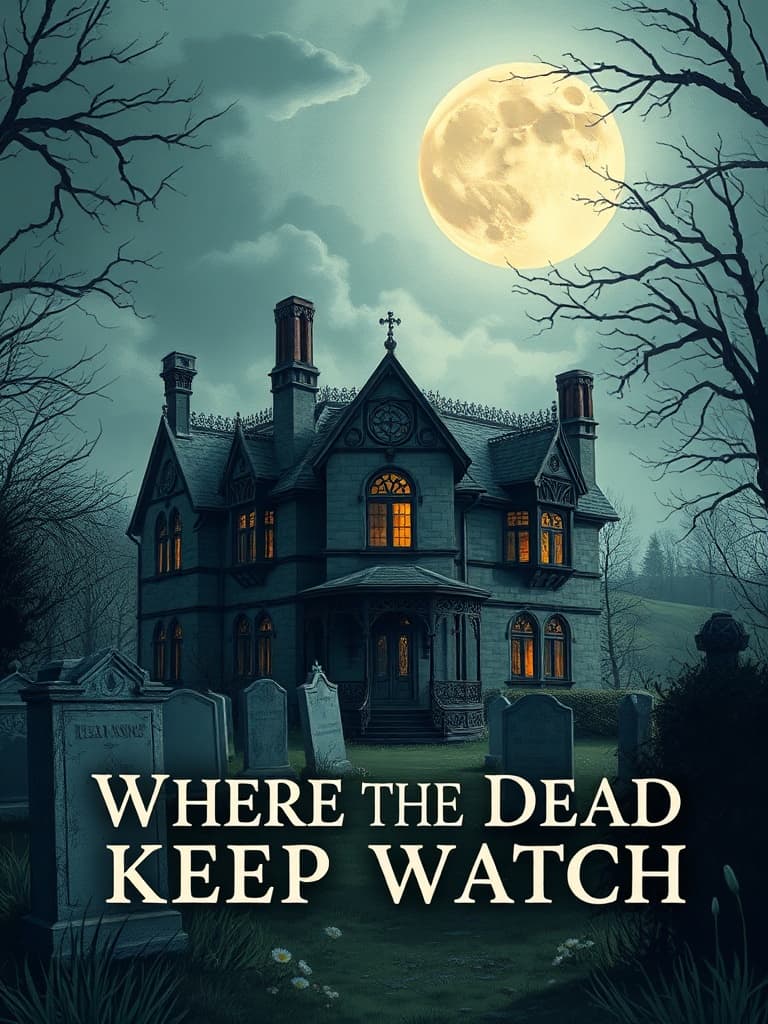
About this book
Where the Dead Keep Watch
22
0
43
0
This is the story of an old Gothic house in the middle of an old cemetery from the 1600s where the dead keep watch.This old mansion has a chilling and terrifying history and the cemetery comes alive during the different phases of the moon..do You dare...
Chapters
- 1An Inheritance of ShadowsThe Vance family—Arthur, Clara, Eleanor, and Thomas—arrive at Blackwood Manor, a sprawling, dilapidated Gothic estate bequeathed to them by a distant, unknown relative. The house itself is a character: weathered stone, ivy-choked walls, towering turrets that pierce the perpetually overcast sky, and windows like vacant eyes. It’s set on a vast, overgrown tract of land, eerily adjacent to a sprawling, ancient cemetery dating back to the 1600s, its tombstones weathered and tilted like forgotten teeth. The air is heavy, thick with the scent of damp earth, decaying leaves, and something else… something indefinable and unsettling. Arthur, ever the pragmatist, sees it as a fixer-upper, a chance for a fresh start and a potential financial windfall. Clara, however, feels an immediate, palpable unease, a prickling sensation on her skin that whispers of unwelcome presences. Eleanor, the elder child at sixteen, is intrigued by the house's gothic grandeur and the mystery of its history, her innate curiosity piqued. Ten-year-old Thomas, sensitive and imaginative, is immediately drawn to the cemetery, his small hand instinctively reaching out towards the wrought-iron gates, a faint smile on his face as if greeting old friends. The initial scene focuses on their arrival, the sheer scale and oppressive atmosphere of the manor and its surroundings. Arthur tries to maintain a cheerful facade, pointing out potential renovations and the 'character' of the place, but his efforts fall flat against Clara’s growing apprehension and Eleanor’s quiet, observant unease. Thomas’s fascination with the cemetery is an odd counterpoint to his parents’ anxieties, marking him as different from the outset. The description of the house should be detailed and evocative, emphasizing its age, decay, and isolation. The cemetery should be portrayed as ancient and foreboding, yet also possessing a strange, almost magnetic pull. The chapter’s emotional arc moves from tentative hope and pragmatism (Arthur) to growing dread (Clara) and morbid fascination (Eleanor, Thomas). The scene culminates with the family entering the house for the first time, the heavy oak door groaning open to reveal an interior cloaked in shadow and dust, a silent testament to decades, perhaps centuries, of neglect and untold stories. The final beat involves a subtle, unexplainable event – perhaps a cold draft that extinguishes a newly lit lantern, or a faint, almost imperceptible whisper that seems to emanate from the very walls, leaving the family unsettled and the reader with a sense of foreboding. Eleanor’s secret connection begins here, a subtle feeling of déjà vu or an inexplicable familiarity with certain architectural details or even the scent of the old wood, hinting at a deeper, perhaps ancestral, link to the property. Arthur’s pragmatism is established as his primary defense mechanism, his insistence on rational explanations a shield against the encroaching dread. Clara’s intuition is presented as a heightened sensitivity to the house’s atmosphere, a primal warning system. Thomas’s innocence and openness are key to his perception of the unseen, setting him apart from the rest of the family. The cemetery's presence should be a constant, looming element, its ancient stones a silent audience to the family's arrival. The chapter ends with the family standing in the grand, dusty foyer, the weight of the house pressing down on them, the first shadow of the manor's true nature falling upon them. The description of the house should include details like peeling wallpaper that reveals older, darker patterns beneath, heavy velvet curtains that block out most of the natural light, and furniture draped in white sheets like shrouded figures. The cemetery's description should include specific details like crumbling angel statues, illegible inscriptions on tombstones, and the way the moonlight (or lack thereof) casts long, distorted shadows. The family's initial interactions should highlight their distinct personalities and how they approach this new, daunting inheritance. Arthur’s attempts to be reassuring should contrast sharply with Clara’s palpable anxiety. Eleanor’s quiet observation and Thomas’s wide-eyed wonder should further emphasize their individual responses to the environment. The atmosphere should be built through sensory details: the creak of floorboards, the smell of dust and decay, the chilling silence broken only by the wind whistling through cracks. The foreshadowing of the pact and the spectral duty will be conveyed through the overwhelming sense of age and history, the feeling that the house and cemetery are more than just inanimate objects, but entities with a long, complex past. Eleanor's secret feeling of familiarity is a crucial early hint of her deeper connection, suggesting a destiny intertwined with Blackwood Manor. The chapter's ending hook should be a subtle but undeniable supernatural event, something that cannot be easily explained away, setting the stage for the escalating paranormal activity to come. The overall impression should be one of grand decay and an unnerving stillness, as if the house and cemetery have been holding their breath, waiting for the Vances to arrive. The family's initial reactions will set the tone for their individual journeys and struggles throughout the story. Arthur's need for control and rationalization, Clara's reliance on intuition and emotion, Eleanor's intellectual curiosity, and Thomas's innocent openness will all be tested by the supernatural forces at play. The history of the pact, though not yet revealed, should be subtly hinted at through the oppressive atmosphere of duty and age that permeates the estate. The description must establish Blackwood Manor not just as a house, but as a place deeply imbued with history, secrets, and a latent power. The cemetery should be presented as an integral part of this power, an extension of the manor's reach. The chapter should feel like the opening act of a gothic horror story, establishing the setting, the characters, and the initial sense of unease that will drive the narrative forward. The author's note will be Amy Kathryn Allen, and the tone will be mysterious, setting the stage for a story that unfolds gradually, revealing its secrets layer by layer. The overall goal is to immerse the reader in the unsettling atmosphere of Blackwood Manor and its surrounding cemetery, making them question what is real and what is supernatural from the very beginning. The description must detail the family's arrival, their initial impressions of the house and cemetery, and the subtle supernatural occurrences that mark their first moments on the estate. It should also introduce the core personalities of each family member and hint at their future roles in unraveling the mystery. The narrative should build suspense through atmosphere and subtle, unexplainable events, rather than overt jump scares, setting a tone of creeping dread and mystery that will define the series. The description of the manor should be rich in gothic detail, emphasizing its age, isolation, and imposing presence. The cemetery should be depicted as ancient, forgotten, and imbued with a silent, watchful energy. The family’s interactions should reveal their dynamics and their initial, differing responses to the unsettling environment. Eleanor’s burgeoning sense of connection and Arthur’s insistence on logic will be key character points introduced here. The chapter should end with a moment of quiet, unnerving supernatural activity that leaves the reader questioning what they just experienced, thus setting the stage for the unfolding mystery. The Vance family's arrival should be a carefully orchestrated descent into an atmosphere of decay and spectral presence. The house, Blackwood Manor, must be described with a palpable sense of age and neglect – crumbling facade, overgrown gardens, stained glass windows depicting unsettling scenes, and an interior that feels frozen in time, filled with dust motes dancing in weak shafts of light. The accompanying cemetery, a relic of the 1600s, should be portrayed as a silent, watchful entity in itself, with gravestones bearing archaic inscriptions, tilted and worn by centuries of weather and neglect, perhaps with a few statues of weeping angels or stern, hooded figures. The emotional journey of the Vance family should be charted: Arthur’s determined pragmatism, his desire to see the property as an asset and a new beginning, clashing with Clara’s heightened intuition and growing sense of dread, her maternal instincts screaming danger. Eleanor, the curious and intelligent teenager, will be drawn to the house’s history and mysteries, her initial skepticism slowly eroding. Young Thomas, innocent and sensitive, will feel an immediate, unexplainable connection, perhaps sensing the presence of the spirits more readily than the others, his fascination with the cemetery a source of parental concern. The chapter should detail their initial exploration of the house, the eerie silence, the cold spots, the strange drafts, and the feeling of being constantly observed. Key sensory details should be emphasized: the scent of dust and mildew, the creak of ancient floorboards, the whisper of wind through broken panes, the oppressive weight of silence. The chapter should culminate in a subtle, yet undeniable supernatural event, something that cannot be easily dismissed as imagination or coincidence – perhaps a door that slams shut on its own in a windless room, a disembodied whisper heard by more than one family member, or a shadow that moves independently of any light source. Eleanor’s secret hint of familiarity with the house, a vague sense of recognition that she can’t explain, should be introduced here, foreshadowing her deeper connection to the manor and its spectral inhabitants. Arthur’s denial and Clara’s intuition will be established as their primary coping mechanisms, setting up their future conflicts and roles in the unfolding mystery. The cemetery should be described as not just a place of death, but as a repository of history and unspoken stories, its ancient stones holding secrets that are beginning to stir. The chapter aims to create a strong sense of gothic atmosphere, establishing the tone of mystery and impending dread that will characterize the entire story. The author’s name, Amy Kathryn Allen, will be associated with this mysterious and atmospheric opening. The chapter’s objective is to draw the reader into the unsettling world of Blackwood Manor, making them as curious and apprehensive as the Vance family themselves. The narrative style will be third-person, maintaining a focus on the family’s collective and individual experiences as they step onto the grounds of their inherited doom. The pacing will be deliberate, allowing the atmosphere to build gradually, mirroring the Vances’ slow realization that their inheritance is far more than just a house and land.
- 2Whispers in the WallsThe Vances begin to settle into Blackwood Manor, though 'settling' feels like an inadequate word for their experiences. The unsettling occurrences that began subtly on their arrival escalate. Doors creak open and shut seemingly on their own, even when there's no discernible draft; cold spots manifest in specific areas of the house, chilling them to the bone; faint, almost inaudible whispers seem to emanate from the very fabric of the manor, particularly when one is alone. Arthur, committed to his rational worldview, attributes these phenomena to the house's age and structural quirks – settling foundations, old plumbing, wind whistling through unseen gaps. He busies himself with repair lists, trying to impose order on the chaos, but even he can’t entirely ignore the persistent unease. Clara grows increasingly anxious, her intuition screaming that these are not mere structural issues but the signs of something more sinister and aware. She starts barricading doors at night and sleeping with a dim light on, her fear a palpable presence in the house. Eleanor, however, finds herself increasingly drawn to these strange happenings. Her curiosity, initially academic, morphs into a fascination bordering on obsession. She spends hours exploring the manor, tracing the sources of the cold spots, trying to decipher the faint whispers. She feels an inexplicable pull towards certain rooms, certain corridors, as if they hold echoes of past events that beckon her. She begins to document the occurrences in a small notebook, her initial skepticism giving way to a growing belief that something is genuinely wrong. Thomas, meanwhile, continues to be drawn to the cemetery, but now he also talks about the house itself having 'voices.' He describes hearing faint music, children’s laughter, and sometimes, what sounds like weeping, all when no one else can. He mentions seeing fleeting shadows in the periphery of his vision, figures that dart away when he tries to look directly at them. His innocence makes his observations both poignant and alarming to his parents. The chapter should delve deeper into the unsettling atmosphere of the house. Descriptions should focus on the sensory details of these phenomena: the specific sound of a door hinge groaning, the localized nature of the cold, the indistinct quality of the whispers that can never be clearly understood. Arthur’s denial should be portrayed as increasingly strained, his explanations becoming more elaborate and less convincing, even to himself. Clara’s fear should be shown to be affecting her health, making her withdrawn and jumpy. Eleanor’s exploration should be a key focus, showing her bravery and her growing fascination, perhaps even a moment where she feels a distinct, non-threatening presence that seems to acknowledge her. Thomas’s interactions should highlight his sensitivity, perhaps him talking to himself, responding to unseen stimuli, making his parents worry about his mental state. The chapter should build suspense by showing how these minor disturbances are chipping away at the family’s sense of security and normalcy. Eleanor’s secret connection might manifest as a moment of uncanny familiarity with a particular creaking sound or a cold spot, as if her subconscious recognizes it. The chapter should also introduce the idea that the spirits are not necessarily hostile, but perhaps trying to communicate or simply making their presence known in their own way. The ending hook should be a more significant event than before, something that directly impacts one of the family members or creates a clear division between Arthur’s denial and the reality of the situation. For example, Eleanor might be alone in a room and hear a clear, distinct whisper directly in her ear, or Thomas might describe a specific figure he saw in the cemetery with an detail that is unnervingly accurate to a historical figure. The focus remains on the building psychological tension and the dawning realization that the Vance family is not alone in their new home. The chapter’s objective is to move beyond the initial shock of inheritance and into the tangible, albeit subtle, manifestations of the supernatural within the house. Arthur's pragmatism is tested, Clara's anxiety intensifies, Eleanor's curiosity deepens, and Thomas's sensitivity becomes more pronounced. The descriptions should be rich in gothic detail, focusing on the oppressive atmosphere of the manor and the subtle, yet persistent, disturbances. The whispers should be described as fleeting, almost subliminal, yet undeniably present, creating a sense of paranoia. The cold spots should be localized and intense, offering a stark contrast to the ambient temperature. Eleanor’s exploration should be a key element, showcasing her growing determination to understand the phenomena, possibly leading her to discover a hidden detail or a peculiar architectural feature that seems to be a focal point for the disturbances. Thomas’s ‘imaginary friends’ or conversations with unseen entities should be portrayed with a childlike sincerity that makes them more disturbing than if they were presented as overtly supernatural. Arthur’s attempts to rationalize these events should become increasingly desperate, highlighting the cracks in his denial. Clara’s fear should manifest in her behavior, perhaps in her sleep patterns or her increasing isolation within the house. The chapter’s ending should feature a more pronounced supernatural event, one that cannot be easily dismissed, perhaps a shared experience that forces Arthur to question his disbelief, or a direct, albeit cryptic, message conveyed through the phenomena. Eleanor’s secret might be subtly hinted at when she feels a strange sense of comfort or familiarity in a particularly unsettling part of the house, as if she’s meant to be there. The chapter aims to solidify the feeling that the house is alive with spectral activity, setting the stage for a deeper investigation into its history and the nature of its ghostly inhabitants. The author, Amy Kathryn Allen, will maintain the mysterious and atmospheric tone, drawing the reader further into the Vances’ predicament. The narrative point of view remains third-person, allowing for exploration of each family member’s internal experience. The pacing is deliberate, focusing on the slow build of unease and the psychological toll of living in a haunted environment. The chapter’s objective is to establish a pattern of supernatural disturbances and to show how each Vance family member reacts to them, setting up their individual journeys of discovery and confrontation. The manor's interior should be described with an emphasis on its decaying grandeur – dust-laden furniture, cobweb-draped chandeliers, faded portraits whose eyes seem to follow the living, and long, echoing corridors where shadows play tricks on the mind. The whispers should be described as almost musical in their indistinctness, sometimes sounding like distant conversations or mournful sighs, always just at the edge of audibility. The cold spots should be intensely localized, creating pockets of unnatural chill that can induce goosebumps and a sense of dread. Eleanor's exploration should be presented as a deliberate investigation, where she meticulously records her observations, her notebook becoming a repository of the house's secrets. Thomas's interactions with the unseen should be innocent and direct, his pronouncements about his 'friends' and the house's 'voices' delivered with the unvarnished truth of a child. Arthur's rationalizations should become increasingly elaborate, bordering on denial, as he tries to maintain control over his family and his perception of reality. Clara's anxiety should be a constant undercurrent, manifesting in her physical appearance and her interactions with her family, her intuition a constant source of worry. The chapter's climax should be a more significant supernatural event, one that directly challenges Arthur's disbelief, perhaps a shared hallucination or a tangible manifestation that affects multiple family members. Eleanor's secret intuition might manifest as an uncanny ability to predict when a phenomenon will occur or a feeling of guidance towards a specific part of the house. The chapter's ultimate goal is to deepen the mystery surrounding Blackwood Manor and its spectral inhabitants, making the reader eager to uncover the truth behind the hauntings.
- 3Moonlit StirringsAs the lunar cycle progresses towards its waxing crescent, the cemetery adjacent to Blackwood Manor begins to exhibit a palpable increase in activity. This is not yet the full moon's chaotic revelry, but a subtle, pervasive shift in atmosphere. Thomas, with his heightened sensitivity, is the first to notice and articulate it. He spends more time gazing out of windows towards the cemetery, his pronouncements growing more frequent and detailed. He claims to see figures among the weathered tombstones – faint, luminous apparitions that drift between the graves, their forms indistinct, like smoke given shape. He describes them as 'sad,' and sometimes, 'lonely.' He even begins to refer to specific 'people' he sees, giving them names like 'Old Man Hemlock' or 'the Lady in Grey,' based on fanciful interpretations of the headstones or the shadows cast by the ancient trees. Arthur, still clinging to his pragmatism, dismisses these sightings as the product of Thomas's overactive imagination, perhaps fueled by the unsettling environment and the old stories of the house he’s undoubtedly overheard. He attributes the perceived ‘activity’ to the changing light, the wind rustling through the overgrown graveyard, or even nocturnal animals. He tries to steer Thomas towards more conventional activities, suggesting games or reading, but the boy remains captivated by the cemetery's spectral inhabitants. Eleanor, however, notices a correlation between Thomas’s sightings and subtle changes within the house itself. She observes that during the evenings when Thomas claims to see the most figures, the whispers in the walls seem more insistent, the cold spots more pronounced, and the feeling of being watched intensifies. She begins to suspect that Thomas’s ‘imaginary friends’ are indeed spirits, and that their activity in the cemetery is somehow linked to the disturbances within Blackwood Manor. She starts spending more time observing the cemetery herself, particularly at dusk and dawn, trying to reconcile Thomas’s descriptions with what she can perceive. Clara, already on edge, finds the cemetery’s increased spectral presence deeply disturbing. She tries to keep Thomas away from the windows facing the graveyard, her maternal anxiety escalating. She experiences increasingly vivid nightmares, glimpses of a dark past tied to the estate, though she struggles to recall the specifics upon waking. Her intuition screams danger, a primal fear that Arthur’s rational explanations are not only insufficient but actively dangerous because they dismiss the threat. The chapter should meticulously detail the transition of the cemetery’s atmosphere. The description should evoke the eerie beauty of the graveyard under the waxing moon: moonlight casting long, distorted shadows, mist weaving through the tombstones, the silence punctuated by the hoot of an owl or the rustle of unseen things. Thomas’s perceptions should be described with a childlike wonder that makes them both innocent and profoundly unsettling. His descriptions of the spirits should be specific enough to be intriguing but vague enough to maintain mystery. Arthur’s dismissiveness should be portrayed as a coping mechanism, his arguments becoming more forceful as his underlying unease grows. Eleanor’s observational skills should be highlighted as she connects the cemetery’s activity to the house’s phenomena, bridging the gap between Thomas’s perceptions and the tangible disturbances. Clara’s nightmares should be presented as fragmented visions, hinting at the historical context of the pact and the sacrifices made. The chapter should build tension by showing how the supernatural is becoming more overt, yet still operating just outside the realm of easy comprehension or definitive proof, particularly for Arthur. Eleanor’s secret connection might manifest as a fleeting feeling of recognition towards one of the spectral figures Thomas describes, a sense that she knows them. The ending hook should be a moment where Arthur’s dismissal is directly challenged by a shared, undeniable experience, or where Thomas’s descriptions become too specific and accurate to be mere fantasy, perhaps identifying a detail about a grave that Eleanor later confirms through research. The focus is on the growing evidence of the supernatural, the increasing activity tied to the lunar cycle, and the family’s divergent responses to it. The chapter's objective is to establish the link between the cemetery and the house, and to demonstrate how the approaching full moon amplifies the spectral presence. The manor's interior should reflect this heightened activity, perhaps with more frequent whispers or a more pervasive chill. The cemetery should be described as a place awakening from slumber, the ancient dead stirring with a subtle, mournful energy. Thomas's pronouncements should be presented with a matter-of-fact sincerity that makes them unnerving. Eleanor's methodical documentation of events should be contrasted with Arthur's increasingly strained attempts at rationalization. Clara's fear should be palpable, driving her to seek comfort and security, perhaps by trying to leave the house temporarily, only to be thwarted by circumstances or an unseen force. The chapter's climax should involve a shared observation or experience that shakes Arthur's disbelief, or a moment where Thomas reveals knowledge he couldn't possibly possess, prompting Eleanor to investigate further. Eleanor’s secret intuition might guide her to a specific grave or a particular section of the cemetery that Thomas mentioned, reinforcing her belief in his claims. The chapter aims to move the narrative from subtle hauntings to more apparent manifestations, directly influenced by the lunar cycle, and to underscore the growing divide within the Vance family regarding the reality of the supernatural. The author, Amy Kathryn Allen, continues to weave a tale of gothic mystery, where the boundaries between the living and the dead blur with the phases of the moon. The third-person perspective allows for an exploration of the internal struggles and growing anxieties of each family member. The pacing remains deliberate, focusing on the atmospheric build-up and the psychological impact of the increasing spectral activity. The chapter’s objective is to solidify the connection between the cemetery’s spectral inhabitants and the disturbances within Blackwood Manor, and to highlight the influence of the moon on these events, setting the stage for further escalation.
- 4Echoes of the PastClara's anxiety begins to manifest not just as fear, but as increasingly vivid and disturbing nightmares. These are not mere bad dreams; they are potent, fragmented glimpses into a dark and tumultuous past inextricably linked to Blackwood Manor and its surrounding cemetery. Upon waking, she struggles to recall the precise details, but the emotional resonance lingers—a profound sense of dread, a feeling of desperation, and a chilling awareness of sacrifice. These fragmented visions often involve figures in archaic clothing, scenes of hushed, urgent conversations, and an overwhelming sense of sorrow and obligation. Her intuition, already heightened, screams that these nightmares are more than just stress-induced hallucinations; they are premonitions, echoes of the events that shaped the estate's spectral nature. She tries to articulate these feelings to Arthur, describing the pervasive sense of danger that clings to the house, but he remains steadfast in his pragmatic explanations, attributing her distress to the unsettling environment and her own overwrought nerves. His dismissiveness, intended to reassure, only serves to isolate Clara further and amplify her fear. She begins to feel trapped, not just by the house, but by her husband's refusal to acknowledge the undeniable wrongness of their situation. Eleanor, witnessing her mother's growing distress and the increasingly disconnected nature of her accounts, becomes more determined to uncover the truth. She sees Clara’s nightmares not as mere delusions, but as potential clues, pieces of a puzzle that her mother is too frightened or too fractured to assemble. Eleanor begins to spend more time observing her mother, trying to glean any coherent details from her waking moments of confusion and fear. She starts cross-referencing the fragmented imagery Clara describes with the historical context she’s beginning to piece together about the estate from local archives and the manor’s own neglected library. Her secret connection to the house might lead her to find a particular artifact or a specific room that resonates with Clara’s descriptions, acting as a focal point for the spectral echoes. Thomas, meanwhile, continues his interactions with the spectral world, his innocent observations sometimes inadvertently mirroring elements of Clara’s nightmares, further unsettling her and reinforcing Eleanor’s suspicions. He might mention a 'sad lady' he sees near a specific part of the cemetery, or humming a tune that Clara dimly recognizes from her dreams. The chapter should focus on Clara's internal struggle and the growing disconnect between her lived experience and Arthur’s perception. Her nightmares should be described with evocative imagery, focusing on the emotional impact rather than explicit detail, creating a sense of mystery and dread. The contrast between Clara’s intuitive understanding and Arthur’s rational dismissal should be a central theme, highlighting the growing rift between them. Eleanor’s role as the investigator and observer should be emphasized, showing her piecing together clues from her mother’s fragmented visions and her own research. The library of the manor should be described as a place of forgotten knowledge, filled with dusty tomes that might hold the key to the estate’s history. Thomas’s innocent remarks should serve as unintentional corroboration of Clara’s experiences, adding another layer of unease. The chapter should build a sense of historical weight, suggesting that the present disturbances are deeply rooted in the past. Eleanor’s secret intuition might guide her to a specific book or document that seems to address the very themes Clara is experiencing in her nightmares, hinting at the nature of the pact. The ending hook should be a moment where one of Clara’s dream fragments is corroborated by an external event or discovery, forcing Arthur to acknowledge that there might be more to her distress than he initially believed, or where Eleanor finds a direct link between a nightmare and a historical record, validating Clara's experiences and intensifying the mystery. The chapter's objective is to introduce the historical dimension of the haunting through Clara's experiences, establishing that the current events are a continuation of a long-standing legacy of sorrow and obligation tied to the estate. The manor's atmosphere should feel heavier, burdened by the weight of past tragedies. The descriptions should emphasize the psychological toll on Clara, her increasing isolation, and her desperate attempts to communicate her fears. Eleanor's role as the detective, piecing together the fragmented clues, should be central. Arthur's denial should be portrayed as a form of self-preservation, his inability to confront the supernatural rooted in his own past traumas. Thomas's innocent comments serve as unintentional guides, pointing towards significant elements of the past. The chapter's climax should be a moment of revelation or undeniable connection between Clara's nightmares and the tangible history of the estate, prompting a shift in Arthur's perspective or deepening Eleanor's resolve. Eleanor's secret might manifest as a sudden, intuitive understanding of a particular historical event Clara dreams about, or a feeling of empathy towards a figure from the past. The chapter aims to deepen the mystery by introducing the historical context of the hauntings, making the spectral presence more than just random apparitions but echoes of a significant, tragic past. The author, Amy Kathryn Allen, continues to build a complex narrative, where the past intrudes upon the present, and the characters must confront not only the supernatural but also their own buried fears and traumas. The third-person perspective allows for an exploration of Clara's inner turmoil and Eleanor's investigative process. The pacing remains focused on the psychological and historical elements, drawing the reader into the Vances' deepening predicament. The chapter's objective is to establish the historical significance of the hauntings and to foreshadow the nature of the spectral duty that binds the estate, making it clear that the Vances are now entangled in a generations-old mystery.
- 5The DiscoveryDriven by the escalating strangeness and her mother Clara’s increasingly disturbing nightmares, Eleanor intensifies her exploration of Blackwood Manor. She feels an almost magnetic pull towards the less-traveled parts of the house, spending hours in dusty libraries, forgotten attics, and disused servant quarters. While Arthur remains preoccupied with structural repairs and Clara retreats further into her anxious shell, Eleanor’s curiosity becomes a relentless force. Her secret intuition, that feeling of familiarity with the house, guides her subtly, nudging her towards specific areas. One rainy afternoon, while investigating a section of the attic that seems unusually sealed off, Eleanor notices a faint seam in the wallpaper, almost perfectly disguised by the intricate, faded floral pattern. Driven by an instinct she can’t explain, she carefully peels back a corner. Beneath it, she discovers not just plaster, but the outline of a hidden door, cleverly integrated into the wall. With considerable effort, she manages to pry it open, revealing a small, compact room, untouched by time and thick with the scent of aged paper and leather. This hidden chamber is clearly a repository of secrets. Dust motes dance in the single beam of light that penetrates the gloom. The room contains a sturdy wooden desk, a single, high-backed chair, and shelves lined with brittle, leather-bound books and scattered parchments. Most prominently, lying open on the desk, is an ancient, imposing journal. Its cover is deep, worn leather, embossed with an indecipherable symbol. The pages are yellowed and brittle, filled with elegant, spidery script in a language that appears to be archaic English, interspersed with strange diagrams and unsettling illustrations. Eleanor’s heart pounds with a mixture of trepidation and exhilaration. This journal feels like the key, the missing piece that might explain everything – the whispers, the cold spots, Thomas’s ‘friends,’ Clara’s nightmares, and the pervasive sense of watching. As she carefully turns the pages, she begins to decipher fragments of text, hinting at a generations-old pact, a spectral duty, and a binding that connects the house, the cemetery, and the spirits within. The chapter should meticulously describe the discovery of the hidden room and the journal. The atmosphere of the room should be one of preserved time, a sanctuary of secrets. Eleanor’s actions should be detailed: her careful peeling of the wallpaper, the effort to open the door, her awe and trepidation upon entering. The journal itself should be described as an object of immense historical and spectral significance – its texture, its smell, the nature of the script and illustrations. Eleanor’s initial attempts at deciphering the text should be shown, hinting at the profound revelations to come. Arthur’s continued focus on practical matters should serve as a stark contrast to Eleanor’s discovery, highlighting his blindness to the true nature of their inheritance. Clara’s state of mind should be depicted as fragile, making Eleanor’s discovery potentially a source of hope or further terror for her. Thomas’s role might be minimal in this chapter, perhaps he is drawn to the attic for a moment, sensing the significance of the hidden room, but is quickly called away. Eleanor’s secret connection might be amplified here; perhaps she recognizes the symbol on the journal’s cover, or a particular phrase within the text resonates with a deep, inexplicable familiarity. The chapter’s ending hook should be Eleanor deciphering a key phrase or sentence that explicitly mentions the ‘pact’ or the ‘duty’ of the dead, confirming her suspicion that this journal holds the answers she seeks and setting the stage for the next chapter’s revelations. The chapter’s objective is to provide the inciting incident for understanding the supernatural phenomena, through Eleanor’s discovery of the ancient journal, which promises to reveal the house's dark history and the nature of its spectral inhabitants. The manor's hidden spaces should be explored, emphasizing the secrets they hold. The journal should be presented as a tangible link to the past, its contents hinting at a profound mystery. Eleanor’s character should be further developed as the determined investigator, driven by a need for truth and a growing sense of responsibility. Arthur’s denial and Clara’s anxiety should continue to frame the family’s dynamic, making Eleanor’s discovery even more significant. Thomas’s sensitivity might lead him to the vicinity of the hidden room, sensing its importance without fully understanding it. The chapter should culminate in Eleanor’s realization that she has found something of immense importance, a document that will change everything, leaving the reader eager to know what secrets it contains. Eleanor’s secret intuition might be evident in her persistence in searching that particular part of the attic, an area others might have overlooked. The chapter aims to move the narrative from unexplained phenomena to the beginning of concrete investigation and revelation. The author, Amy Kathryn Allen, is building a story where knowledge is power, and the Vances’ survival depends on uncovering the truth. The third-person perspective allows access to Eleanor’s thoughts and discoveries, as well as the contrasting attitudes of her family members. The pacing accelerates slightly as Eleanor uncovers the hidden room, creating a sense of discovery and anticipation. The chapter’s objective is to provide the crucial plot device – the journal – that will drive the subsequent unfolding of the story’s central mystery.
- 6A Pact UnveiledWith the ancient journal clutched in her hands, Eleanor dedicates herself to deciphering its cryptic contents. The script is challenging, filled with archaic terminology and allegorical language, but her intelligence and growing desperation fuel her efforts. She spends hours in the hidden room, the air thick with the scent of age and forgotten secrets, poring over the brittle pages. The journal details a profound, generations-old pact, an agreement forged in a time of great desperation, that binds the spirits of the cemetery to the estate of Blackwood Manor. It speaks of a ‘spectral duty’ – the obligation for the dead to ‘watch’ over something, or perhaps, to be watched over. The exact nature of this duty is initially unclear, but the implications are chilling: the spirits are not merely lingering; they are bound, imprisoned by an ancient covenant. The journal reveals that this pact was not a voluntary act for all involved; it was a binding, a curse of sorts, designed to maintain a balance or to contain a threat. The house and the cemetery are, in essence, a prison, and the spirits are its eternal inmates, compelled by the pact to maintain a constant vigil. Eleanor realizes with dawning horror that the strange occurrences, the whispers, the cold spots, are not random hauntings but manifestations of these bound spirits, their attempts to communicate their plight or perhaps their resentment. She begins to understand that the cemetery isn't just a graveyard; it's a ward, and the manor is its keeper. The journal hints at the original purpose of the pact – a desperate measure taken by ancestors to protect something, or perhaps to contain something malevolent that was unleashed or threatened to be unleashed. The exact details are shrouded in metaphor and historical ambiguity, but the core concept of an eternal, imposed duty becomes clear. Eleanor’s secret intuition might allow her to grasp the more nuanced, emotional underpinnings of the pact, sensing the sorrow and resignation of the bound spirits. Arthur remains largely oblivious, dismissing Eleanor’s focused study as a teenage fixation on the house’s history, though he notices her increasing pallor and preoccupation. Clara, sensing Eleanor’s deep dive into the manor’s secrets, grows more fearful, her nightmares perhaps offering fragmented visual confirmations of the pact’s dark origins. Thomas might express a vague understanding, perhaps mentioning that the ghosts he sees seem ‘tired’ or ‘waiting,’ echoing the concept of duty. The chapter should focus on Eleanor’s intellectual and emotional journey as she unravels the journal’s secrets. The descriptions should emphasize the archaic nature of the text and the profound implications of the pact. The concept of ‘spectral duty’ and the house/cemetery as a prison should be central. Eleanor’s growing understanding should be depicted as a burden, a heavy realization of the supernatural forces at play and her family’s unwitting entanglement. The contrast between Eleanor’s profound discovery and Arthur’s continued ignorance should be stark. Clara’s fear should be amplified by the implications of a binding pact, suggesting a more profound and inescapable supernatural presence. Eleanor’s secret connection might allow her to feel the ‘weight’ of the pact, an almost physical sensation of the spirits’ burden. The ending hook should be Eleanor deciphering a specific passage that names the origins of the pact, or reveals a crucial detail about the entity or threat that necessitated it, leaving her with a clearer, and perhaps more terrifying, understanding of her family’s predicament and the true nature of Blackwood Manor. The chapter’s objective is to reveal the existence and nature of the spectral pact, explaining the underlying reason for the hauntings and establishing the house and cemetery as a place of supernatural obligation. The journal’s contents should be central, detailing the spectral duty and the binding of spirits. Eleanor’s role as the primary investigator and interpreter of the past should be solidified. Arthur’s denial should be presented as a growing obstacle, while Clara’s intuition and Thomas’s sensitivity provide indirect support. The chapter should emphasize the historical weight of the pact, suggesting a long-standing legacy of supernatural involvement. Eleanor’s secret intuition might manifest as an uncanny ability to interpret the journal’s most obscure passages, or a deep empathy for the plight of the bound spirits. The chapter aims to provide the foundational mythology of the story, explaining *why* the house and cemetery are haunted and the nature of the supernatural forces at play. The author, Amy Kathryn Allen, is building a narrative where historical secrets have tangible, terrifying consequences in the present. The third-person perspective allows for deep dives into Eleanor’s thought process as she deciphers the journal, as well as showing the contrasting perspectives of her family members. The pacing is driven by the intellectual discovery of the pact, creating a sense of revelation and escalating stakes. The chapter’s objective is to reveal the core supernatural mechanism of the story: the pact that binds the spirits and dictates their eternal duty.
- 7The Watcher's GazeFollowing Eleanor’s discovery of the journal and her realization of the spectral pact, the supernatural activity within and around Blackwood Manor escalates dramatically. The vague whispers and cold spots coalesce into more defined manifestations, suggesting a deliberate, directed presence. A formidable entity, one that Eleanor begins to think of as the ‘Watcher,’ starts to make its presence known. This is not a fleeting apparition or a disembodied sound; it is a palpable force, imbued with an ancient sorrow and an immense, melancholic power. Its gaze, though unseen, feels like a physical weight upon the Vance family, particularly upon Eleanor, who is now the unintentional keeper of the pact’s secrets. The Watcher’s manifestations are initially subtle but potent: doors that slam shut with impossible force, objects that move inexplicably when no one is looking, and an overwhelming sense of being observed by something ancient and deeply unhappy. The temperature in certain rooms plummets to an unnatural degree, and the air becomes heavy, charged with an almost suffocating despair. Eleanor senses that the Watcher is not inherently malevolent in the way a traditional ghost might be, but rather a guardian, or perhaps a prisoner, bound by the same pact she has uncovered. Its sorrowful gaze seems to be fixed upon the family, testing their resolve, perhaps seeking something from them, or warning them away. Arthur, witnessing these more overt phenomena, finds his carefully constructed wall of denial beginning to crack. The sheer intensity and undeniable nature of these events make his rationalizations increasingly difficult to maintain. He becomes more protective, his pragmatic approach shifting towards a desperate need to shield his family from this unseen threat. Clara’s intuition amplifies, her nightmares perhaps becoming more focused on this specific entity, the Watcher, sensing its immense burden and sorrow. Thomas, surprisingly, seems less frightened by the Watcher than the others. He might even describe seeing a ‘big, sad shadow’ that doesn’t scare him, suggesting his innocent perception registers the Watcher’s sorrow rather than its power. Eleanor, now carrying the burden of knowledge, feels a direct connection to the Watcher. She senses its ancientness, its loneliness, and the immense weight of its duty – the eternal vigil it’s forced to maintain. She believes the Watcher is a key figure in the pact, perhaps its enforcer or its primary victim. The chapter should detail the intensification of the supernatural activity, focusing on the presence of the Watcher. Descriptions should evoke its immense power and sorrow, making it a figure of both dread and pity. Eleanor’s growing understanding of the Watcher’s role and her sense of connection should be central. Arthur’s cracking denial and shift towards protection should be a significant character development. Clara’s intuition should provide insight into the Watcher’s emotional state. Thomas’s innocent perception of the Watcher should offer a unique perspective. Eleanor’s secret intuition might allow her to sense the Watcher’s emotional state or intentions, almost as if they are communicating telepathically. The chapter’s ending hook should be a direct, albeit non-violent, confrontation or interaction between Eleanor and the Watcher, where the entity makes a clear gesture or communicates a feeling that confirms Eleanor's understanding of its burden and its role in the pact, leaving her with a profound sense of responsibility and perhaps a hint of its true purpose. The chapter’s objective is to introduce the primary spectral antagonist/guardian, the Watcher, and to demonstrate the escalating supernatural activity, directly linked to the revelation of the pact. The Watcher should be portrayed as a powerful, sorrowful entity bound by duty, its presence a significant challenge for the Vance family. Eleanor's growing understanding and connection to this entity should be a central focus. Arthur's denial should be shown to be failing, while Clara's intuition and Thomas's sensitivity offer different perspectives on the unfolding events. The chapter should emphasize the emotional weight of the Watcher’s presence, making it more than just a terrifying apparition but a figure of tragic significance. Eleanor’s secret intuition might allow her to feel the Watcher’s ancient pain or sense its unspoken directives. The chapter aims to raise the stakes by introducing a powerful, central supernatural force that directly interacts with the family, particularly Eleanor, as the story moves towards understanding how to break the cycle. The author, Amy Kathryn Allen, is weaving a narrative where the supernatural is not just about fear, but also about ancient sorrow and imposed duty. The third-person perspective allows for a deep exploration of Eleanor’s evolving relationship with the Watcher. The pacing picks up as the spectral activity becomes more pronounced, creating a sense of urgency and increased danger. The chapter’s objective is to establish the Watcher as a pivotal character in the supernatural drama and to show the direct impact of the pact’s revelation on the intensity of the hauntings.
- 8Thomas's FriendThomas's conversations about his 'imaginary friend' in the cemetery, initially dismissed by Arthur as childish fantasy and by Clara as a symptom of her anxiety, become a focal point for Eleanor. She recalls the journal's mention of the spectral duty and the bound spirits, and begins to suspect that Thomas's 'friend' is not imaginary at all, but a genuine spectral entity attempting to communicate. Eleanor starts to pay closer attention to Thomas's interactions, subtly observing his conversations with this unseen companion. He describes his friend as 'quiet' and 'sad,' and often speaks of his friend's 'job' or 'waiting.' He mentions that his friend sometimes tells him things, 'like secrets,' that he doesn't fully understand but finds interesting. These 'secrets' often relate to the cemetery—a particular tombstone that is about to fall, a patch of ground that needs tending, or stories about people buried there, which Thomas relays with a child's innocence. Eleanor begins to wonder if this spirit is trying to use Thomas as a conduit, a way to convey messages to the living, perhaps warnings or pleas related to the pact. She observes that Thomas seems to have a unique connection to this entity, one that doesn't involve the fear or dread that the other family members experience. His innocent interaction suggests a level of familiarity, perhaps even trust, between the boy and the spirit. Eleanor tries to gently probe Thomas for more details, asking about his friend's appearance, his name (which Thomas might not know, or perhaps the spirit doesn't have one in the human sense), and what his friend says. Thomas's answers are often vague but contain kernels of information that resonate with Eleanor's understanding of the journal. For instance, he might mention that his friend 'watches the moon' or 'waits for the sun to go down,' directly correlating with the cemetery's activity during specific times. Eleanor starts to believe that this spirit might be one of the bound entities, perhaps one that is less burdened or more willing to engage, and is using Thomas to try and bridge the gap between the spectral and living worlds. Arthur, however, remains deeply concerned about Thomas's 'delusions,' seeing them as a sign of his son’s distress and instability, especially given the unsettling nature of their new home. He might consider seeking professional help, further isolating Thomas and potentially hindering his ability to communicate with the spirit. Clara, while still anxious, is more open to the possibility that Thomas is interacting with something real, given her own experiences with the supernatural. She sees the innocence in Thomas's interactions and trusts his perceptions more than Arthur does. Eleanor’s secret intuition might allow her to sense the presence of Thomas’s spirit friend when she is near him, a faint echo or a sense of another presence. The chapter should focus on Eleanor's investigation into Thomas's 'friend,' her growing conviction that it's a spirit, and her attempts to understand its purpose. The descriptions should highlight Thomas's innocent interactions and the unsettling nature of his 'imaginary' companion. Eleanor's role as the investigator should be emphasized, as she tries to decipher the meaning behind Thomas's words. Arthur's concern for Thomas should be portrayed as a genuine, albeit misguided, attempt to protect his son. Clara's growing acceptance of the supernatural should be evident. The chapter's ending hook should be a moment where Thomas's spirit friend conveys a specific, verifiable piece of information—perhaps describing a detail about a particular grave, a historical event, or even a warning about an impending phenomenon—that Eleanor can later confirm, solidifying her belief that Thomas is acting as a conduit and that this spirit holds a crucial key to understanding the pact. The chapter’s objective is to explore the potential of Thomas as a bridge between the living and the spectral, highlighting his unique connection to a specific spirit entity. The 'imaginary friend' should be revealed as a genuine spectral presence, potentially trying to communicate vital information about the pact or the spirits' plight. Eleanor's investigation into Thomas's interactions should be central, as she seeks to understand the spirit's purpose and motivations. Arthur's denial should create conflict, while Clara's growing acceptance offers a counterpoint. The chapter should emphasize the theme of innocent perception versus adult skepticism. Eleanor’s secret intuition might allow her to feel the presence of Thomas’s spirit friend, or even to pick up on faint fragments of its communication. The chapter aims to deepen the mystery by introducing a specific spectral character through Thomas, suggesting that not all spirits are as formidable or sorrowful as the Watcher, and that communication is possible. The author, Amy Kathryn Allen, is developing a narrative where different characters have different levels of connection to the supernatural, and Thomas's innocence provides a unique pathway to understanding. The third-person perspective allows insights into Eleanor's deductions and Thomas's unfiltered pronouncements. The pacing focuses on the investigative aspect of Eleanor's efforts and the subtle unfolding of Thomas's interactions. The chapter’s objective is to establish Thomas’s spirit friend as a significant character and potential ally, and to explore the idea of spirits communicating through the living.
- 9Arthur's DenialArthur Vance’s carefully constructed world of logic and reason is irrevocably shattered by a terrifying event that directly threatens his family. For weeks, he has dismissed the escalating phenomena—the whispers, the cold spots, the apparitions Thomas claims to see, the palpable sorrow of the Watcher, and Eleanor’s increasingly alarming research—as products of an old house’s quirks and his family’s collective stress. He has clung to his pragmatism like a life raft, his dismissiveness a shield against the encroaching supernatural dread. However, a specific, undeniable incident occurs that can no longer be explained away by drafts, settling foundations, or overactive imaginations. This event is deeply personal and directly targets Arthur’s core protective instincts, forcing him to confront the terrifying reality of their situation. Perhaps it involves one of his children being directly imperiled by a spectral force—Thomas being physically moved or trapped by an unseen hand, or Eleanor being cornered and menaced by a manifestation that Arthur himself witnesses. The sheer terror and helplessness he experiences in that moment override his ingrained skepticism. His protective instincts, always strong but previously channeled into practical solutions, now clash violently with his disbelief. He is forced to acknowledge the supernatural threat not as a possibility, but as a terrifying, immediate reality. This event triggers his buried trauma, the deep-seated fear of losing his family that he rarely speaks of, amplifying his desperation to protect them. His denial, once a source of stubbornness, transforms into a frantic, almost primal need to fight against the unseen. He becomes hyper-vigilant, his focus shifting from fixing the house to defending his family against the spectral inhabitants. Clara, witnessing Arthur’s breakdown of denial and his subsequent terror, finds her own fears validated but also amplified by his raw panic. She tries to be the steady presence, but his uncharacteristic fear is unsettling. Eleanor, while relieved that her father is finally acknowledging the truth, is also concerned by the intensity of his reaction, recognizing that his fear might cloud his judgment. Thomas, sensing the shift in his father’s demeanor and the palpable increase in fear, might become withdrawn or unusually quiet. The chapter should focus on the pivotal event that breaks Arthur's denial and its immediate aftermath. The description of the event should be visceral and terrifying, emphasizing its direct impact on Arthur and his family. Arthur’s internal struggle, the crumbling of his worldview, and the surge of protective primal fear should be central. Clara’s reaction should reflect her own anxieties but also her attempt to anchor the family. Eleanor’s role should be to observe and perhaps try to guide her father’s new-found belief towards understanding rather than pure fear. Thomas’s reaction should highlight the emotional atmosphere of the family. Eleanor’s secret intuition might manifest as a sense of Arthur’s deep-seated trauma being stirred, or a feeling of empathy from the spirits towards his fear. The ending hook should be Arthur, no longer denying the supernatural, making a firm declaration of intent to fight back or protect his family at all costs, perhaps even directly confronting a manifestation, or making a desperate plea to Eleanor for answers, acknowledging her role in uncovering the truth. The chapter’s objective is to shatter Arthur’s denial, forcing him to confront the supernatural reality of Blackwood Manor and to propel him into a more active role in protecting his family. The pivotal event should be terrifying and undeniable, directly impacting Arthur and his core fears. Clara’s validation and increased anxiety, Eleanor’s relief and concern, and Thomas’s sensitivity to the shift in atmosphere should be explored. The chapter should emphasize the emotional turmoil within the Vance family as they grapple with this new reality. Arthur’s secret trauma should be hinted at, explaining the depth of his fear and his newfound desperation. Eleanor’s secret intuition might allow her to sense the connection between Arthur's trauma and the spirits’ actions. The chapter aims to escalate the conflict by transforming Arthur from a skeptic into a protector, albeit one driven by fear, setting him on a collision course with the supernatural forces and potentially with Eleanor’s more measured approach. The author, Amy Kathryn Allen, is driving the plot forward by forcing a key character to confront the truth, thereby changing the family’s dynamic and increasing the stakes. The third-person perspective allows for exploration of Arthur’s internal breakdown and the subsequent shift in his behavior. The pacing accelerates significantly during the pivotal event, creating a sense of immediate danger and urgency, before settling into the aftermath of his shattered denial. The chapter’s objective is to mark a turning point for Arthur and the family, moving them from uncertainty and denial to a shared, albeit fearful, understanding of the supernatural threat.
- 10Clara's VisionsClara's recurring nightmares, which previously offered only fragmented glimpses and emotional echoes of the past, begin to sharpen and coalesce into clearer, more coherent visions. These visions are no longer mere anxieties but detailed narratives, revealing the origins of the pact that binds the spirits to Blackwood Manor and the cemetery. She sees the desperation of her ancestors, the dire circumstances that led them to forge such a pact – perhaps a dire threat, a dangerous entity, or an unbearable curse that they sought to contain or appease through this eternal spectral duty. The visions depict specific events: the ritualistic agreement, the sacrifices made, the solemn pronouncements that bound the spirits to their vigil. She sees the faces of those who made the pact, their expressions a mixture of grim determination and profound sorrow. Clara begins to understand that the spirits are not acting out of malice, but are trapped by an ancient obligation, their unrest a testament to their unwilling servitude. Her visions provide crucial context for the spectral activity, revealing that the spirits are not simply haunting the house but fulfilling, or perhaps rebelling against, their imposed duty. Her intuition, now amplified by these clear visions, becomes a guiding force, not just for herself, but for Eleanor as well. Clara starts to articulate the details of her visions to Eleanor, her voice trembling but her conviction unshakeable. She describes specific historical figures, locations within the manor that are significant to the pact’s making, and the emotional weight of the sacrifices. Eleanor, already deep in her research of the journal, finds that Clara’s visions offer a vital, human element that the text, with its archaic language, often obscures. The visions provide visual and emotional corroboration for the journal’s accounts, helping Eleanor to interpret its more ambiguous passages and understand the true plight of the spirits. Arthur, now accepting of the supernatural, listens intently to Clara’s visions, his protective instincts and newfound fear driving him to seek any possible solution. He sees Clara’s visions not as madness but as vital intelligence, a roadmap to understanding and potentially appeasing the spectral forces. Thomas, sensitive to the emotional atmosphere, may react to certain elements of Clara’s visions, perhaps recognizing a face or a place, further reinforcing their significance. The chapter should focus on the clarity and detail of Clara’s visions, emphasizing their role in revealing the historical context and emotional weight of the pact. The visions should be described with evocative imagery, focusing on the key moments of the pact’s creation and the sacrifices involved. Clara’s role as the seer, guided by her intuition, should be central. Eleanor’s use of Clara’s visions to further her understanding of the journal should be highlighted. Arthur’s shift from denial to seeking understanding through Clara’s visions should be a key character development. The chapter should emphasize the concept of the spirits being bound by duty rather than malice, shifting the narrative from pure horror to a more nuanced exploration of their plight. Eleanor’s secret intuition might allow her to connect specific details from Clara’s visions to passages in the journal that she previously struggled to understand, unlocking deeper meanings. The ending hook should be Clara experiencing a vision that reveals a specific, actionable detail about the pact – perhaps a forgotten ritual, a hidden artifact crucial to its binding, or a specific condition that needs to be met to release the spirits – providing Eleanor and the family with a concrete path forward, or a terrifying new understanding of the stakes involved. The chapter’s objective is to provide crucial historical context for the pact through Clara’s increasingly clear visions, revealing the origins and sacrifices involved, and framing the spirits as bound entities rather than malevolent forces. Clara’s role as the intuitive seer should be central, with her visions offering vital clues that complement Eleanor’s textual research. Arthur’s acceptance of the supernatural and his focus on protection, and Thomas’s sensitivity should also be explored. The chapter should emphasize the emotional depth of the spirits’ situation, highlighting their plight rather than just their spectral nature. Eleanor’s secret intuition might allow her to bridge the gap between Clara’s visions and the journal’s text, revealing hidden layers of meaning. The chapter aims to provide the 'why' behind the hauntings, giving the Vance family a clearer, though perhaps more daunting, understanding of their situation and the potential for resolution. The author, Amy Kathryn Allen, is deepening the narrative by revealing the historical tragedy at the heart of the story. The third-person perspective allows for exploration of Clara’s visionary experiences and Eleanor’s interpretation of them. The pacing is driven by the unfolding of the historical narrative through Clara’s visions, creating a sense of revelation and urgency. The chapter’s objective is to reveal the foundational tragedy of the pact, humanizing the spirits and setting the stage for the Vances to potentially alter the course of this ancient legacy.
- 11The Cemetery's SecretsArmed with the knowledge gleaned from the journal and Clara’s increasingly lucid visions, Eleanor feels compelled to venture into the cemetery at night. The moon, now nearing its full phase, casts an ethereal, spectral light upon the ancient tombstones, amplifying the graveyard’s already potent atmosphere. Guided by specific details from the journal—marked gravestones, unusual formations of trees, or peculiar landmarks—Eleanor navigates the uneven terrain, the silence broken only by the rustling of leaves and the distant hoot of an owl. Her initial apprehension gives way to a profound sense of empathy as she walks among the resting places of the bound spirits. She begins to understand that these spirits are not inherently malevolent entities seeking to harm the living, but rather souls burdened by an ancient, sorrowful duty. The journal’s cryptic passages, combined with the silent testament of the weathered stones and the palpable aura of resignation emanating from the graveyard, paint a picture of entrapment. She senses the weight of their eternal vigil, the weariness of their imposed watch. Eleanor might discover that certain graves hold particular significance, perhaps belonging to those who were directly involved in the creation of the pact, or those who bore the brunt of its consequences. She might find inscriptions that, when viewed in the moonlight, reveal hidden meanings or connect to symbols mentioned in the journal. Her secret intuition might guide her to a specific spot that feels particularly charged with spectral energy, a place where the veil between worlds feels thin. She realizes that the cemetery is not merely a place of burial, but a prison yard, and the spirits are its inmates, forever bound to their task. The journal hinted at this, but experiencing it firsthand, feeling the collective sorrow and resignation of the spirits, solidifies her understanding. She contemplates the nature of their duty: what are they watching? Or is it that they are being watched? The journal suggests a dual purpose, a complex binding. As she walks, she might have fleeting, non-threatening encounters with spectral presences – a momentary chill, a sigh on the wind, a shadow that seems to linger too long. These are not aggressive manifestations but subtle confirmations of the spirits’ presence and their bound state. Arthur, though accepting of the supernatural, remains wary of Eleanor venturing into the cemetery alone at night, his protective instincts overriding his desire for knowledge. He might insist on accompanying her, or at least waiting anxiously by the house. Clara, understanding Eleanor’s need for direct experience, offers her support, perhaps providing her with a protective charm or a calming word. Thomas might express a vague awareness of Eleanor’s presence in the cemetery, perhaps mentioning that his 'friend' is 'with the girl.' The chapter should focus on Eleanor’s immersive experience in the cemetery, emphasizing the atmosphere and her growing empathy for the spirits. Descriptions should highlight the cemetery’s ancient, melancholic beauty under the lunar glow. Eleanor’s internal monologue should reveal her evolving understanding of the spirits’ plight – their duty, their entrapment, their sorrow. The journal’s secrets should be brought to life through Eleanor’s sensory experience. Arthur’s concern and Clara’s support should frame Eleanor’s solitary exploration. Eleanor’s secret intuition might guide her to a specific, forgotten grave that holds a key to the pact’s origin or purpose. The ending hook should be Eleanor discovering a specific artifact, inscription, or a unique spectral phenomenon within the cemetery that provides a critical piece of information about the nature of the spirits’ duty or the exact terms of the pact, perhaps revealing that their duty is not just to watch, but to guard against something, or that a specific condition of the pact is nearing fulfillment, increasing the urgency for the Vance family. The chapter’s objective is to immerse Eleanor, and by extension the reader, in the spectral reality of the cemetery, revealing the spirits’ plight as one of sorrowful duty and entrapment, rather than malice, and providing critical context for their bound state. Eleanor’s empathy and growing understanding should be central, supported by her research and Clara’s visions. The cemetery should be depicted as a place imbued with ancient sorrow and a palpable sense of eternal obligation. Arthur’s protective concerns and Thomas’s subtle awareness should frame Eleanor’s exploration. The chapter should emphasize the thematic shift towards understanding the spirits’ predicament, paving the way for appeasement rather than confrontation. Eleanor’s secret intuition might manifest as an uncanny ability to sense the emotional resonance of specific graves or areas within the cemetery. The chapter aims to deepen the reader’s connection to the spirits by revealing their tragic circumstances and setting the stage for Eleanor to seek a way to release them from their eternal vigil. The author, Amy Kathryn Allen, is building a nuanced supernatural narrative where understanding and empathy are key to resolution. The third-person perspective allows for a deep dive into Eleanor’s sensory and emotional experiences within the cemetery. The pacing is deliberate, allowing the atmosphere and Eleanor’s realization to unfold gradually. The chapter’s objective is to reveal the true nature of the spirits' predicament as one of tragic, imposed duty, thereby shifting the narrative’s focus towards resolution and release.
- 12A Plea for PeaceThe knowledge gleaned from the journal and Clara’s visions, coupled with Eleanor’s direct experience in the cemetery, leads her to a profound conclusion: the spirits are not seeking revenge or torment, but release from their eternal, sorrowful duty. The incessant whispers, the cold spots, the apparitions—these are not acts of aggression but desperate cries for attention, for acknowledgment of their plight, and perhaps, for an end to their imposed vigil. Eleanor believes the pact, forged out of desperation in a bygone era, has become a cage for the spirits, and their spectral existence is one of weary servitude. She theorizes that the approaching full moon, a time of heightened spectral energy, may be amplifying their unrest and their silent plea for peace. The journal, while detailing the pact’s creation and binding, offers oblique hints about its potential dissolution or appeasement. These hints are not explicit instructions but rather philosophical musings on balance, understanding, and the breaking of ancient chains. Eleanor interprets these passages as suggesting that the spirits’ duty can be fulfilled in a different way, or that a new understanding between the living and the dead can absolve them from their servitude. She begins to formulate a strategy, not of confrontation or banishment, but of appeasement and release. This requires more than just understanding; it requires empathy and a demonstration that the living family acknowledges the spirits’ burden and desires to end their suffering. Eleanor believes that the key lies in addressing the original purpose of the pact and fulfilling its underlying need in a way that liberates the spirits. This might involve a symbolic act, a ritual, or a sincere offering of peace and understanding to the spectral entities, particularly the formidable Watcher. She discusses her burgeoning theory with the rest of the family. Arthur, his denial shattered and his protective instincts now focused on finding a solution, listens intently. He is willing to try anything to ensure his family’s safety and to break the curse that has befallen them. Clara, her intuition resonating with Eleanor’s conclusions, offers her full support, believing that compassion is the path forward. Thomas, perhaps sensing the spirits’ weariness, nods in agreement, adding simple but profound observations like, ‘They just want to rest.’ Eleanor’s secret intuition might allow her to feel the spirits’ yearning for peace, a palpable sense of relief or hope emanating from the cemetery when she speaks of release. The chapter should focus on Eleanor’s evolving understanding of the spirits’ true desires and her development of a plan for appeasement. The journal’s cryptic hints about breaking the pact should be explored, serving as the basis for Eleanor’s strategy. The thematic shift from fear and confrontation to empathy and resolution should be central. Arthur’s willingness to embrace unconventional solutions, Clara’s supportive role, and Thomas’s innocent affirmation should all be highlighted. Eleanor’s secret intuition might allow her to sense the spirits’ receptiveness to the idea of peace. The ending hook should be Eleanor articulating a specific plan or ritual for appeasing the spirits, perhaps involving a symbolic act or a plea directed towards the Watcher, based on her interpretation of the journal and her experiences, setting the stage for the family to enact this plan during the approaching full moon. The chapter’s objective is to establish Eleanor’s hypothesis that the spirits desire release, not revenge, and to formulate a plan for appeasement based on empathy and understanding, shifting the narrative’s focus towards resolution. The journal’s cryptic hints about dissolving the pact should be explored as the foundation for this plan. Arthur’s acceptance of the supernatural and desire for a solution, Clara’s intuitive support, and Thomas’s innocent agreement should frame Eleanor’s strategy. The chapter should emphasize the compassionate approach needed to address the spirits’ plight. Eleanor’s secret intuition might allow her to feel the spirits’ collective yearning for peace, guiding her plan. The chapter aims to pivot the story towards a hopeful, albeit challenging, resolution, where understanding and compassion are the weapons against the supernatural burden. The author, Amy Kathryn Allen, is building a narrative where empathy is the key to breaking ancient curses. The third-person perspective allows for exploration of Eleanor’s thought process as she devises her plan and the family’s collective agreement to pursue it. The pacing is driven by the intellectual and emotional discovery of the spirits’ true desires, creating a sense of purpose and anticipation for the next phase. The chapter’s objective is to shift the narrative’s primary conflict from survival to resolution, by proposing a path towards peace for the bound spirits.
- 13The Watcher's BurdenEleanor’s direct encounters and growing understanding of the spectral entities lead her to focus on the most powerful of them: the Watcher. This formidable presence, initially perceived as a source of dread, is now seen by Eleanor as the linchpin of the pact, bearing the heaviest burden of the spectral duty. She senses its immense sorrow, its loneliness, and the crushing weight of centuries of enforced vigilance. The Watcher is not a tormentor by nature, but a guardian bound by an ancient, desperate covenant, perhaps tasked with preventing something terrible from escaping or entering. Its sorrowful gaze, which once felt menacing, now appears to Eleanor as a silent testament to its unending and thankless task. Eleanor feels an overwhelming urge to confront the Watcher directly, not with fear or aggression, but with empathy and understanding. She believes that any hope of appeasing the spirits and breaking the pact lies in acknowledging and addressing the Watcher’s burden. She ventures towards the center of the cemetery, or perhaps towards a specific, significant location within the manor that the journal or Clara’s visions have indicated as the Watcher’s domain. As she approaches, the atmosphere thickens, the spectral energy intensifies, and the Watcher’s presence becomes overwhelmingly palpable. Eleanor speaks to it, not with demands, but with heartfelt recognition of its plight. She acknowledges the pact, the duty, and the suffering it has endured. She expresses her family’s desire not to fight or banish it, but to understand and, if possible, to help it find release from its eternal watch. Her secret intuition allows her to perceive the Watcher’s reactions not just through visual cues (if any are present) but through a direct, emotional resonance—a wave of ancient grief, a flicker of surprise, a deep, unspoken weariness. She senses that the Watcher is a victim of circumstance, a powerful entity ensnared by the pact made by humans long ago. The journal might hint that the Watcher was once something else, perhaps a protector or an innocent, now transformed by its duty. Arthur, though not present, is aware of Eleanor’s intentions and is filled with dread and hope, his protective instincts now focused on his daughter’s dangerous undertaking. Clara offers silent prayers, her intuition sensing the profound significance of Eleanor’s confrontation. Thomas might mention that his 'friend' is 'watching the big watcher,' indicating a subtle awareness of the hierarchy and importance of the Watcher. The chapter should culminate in Eleanor’s direct, empathetic confrontation with the Watcher. Descriptions should focus on the immense power and sorrow of the entity, and Eleanor’s courageous, compassionate approach. The concept of the Watcher’s burden and its role as a guardian or enforcer of the pact should be central. Eleanor’s secret intuition should allow for a deeper, more profound connection and understanding between her and the Watcher. The ending hook should be the Watcher’s subtle, yet undeniable, response to Eleanor’s plea—perhaps a flicker of acknowledgment, a softening of its oppressive aura, or a non-verbal communication that conveys a sense of weary acceptance or a hint of hope, suggesting that Eleanor’s empathetic approach has made an impact and opened a new possibility for breaking the pact. The chapter’s objective is to establish a direct, empathetic connection between Eleanor and the Watcher, revealing its role as a burdened guardian and suggesting that appeasement, rather than conflict, is the path to resolution. Eleanor’s courageous confrontation, driven by her understanding of the pact and her secret intuition, should be central. The Watcher’s immense sorrow and its victimhood within the pact should be emphasized. Arthur’s anxious support, Clara’s prayers, and Thomas’s subtle awareness should frame Eleanor’s undertaking. The chapter should highlight the theme of compassion as a powerful force against ancient curses. Eleanor’s secret intuition should allow her to perceive the Watcher’s emotional state and intentions, facilitating the connection. The chapter aims to shift the dynamic with the primary supernatural entity from one of fear to one of potential alliance or understanding, setting the stage for the Vances to actively work towards breaking the pact. The author, Amy Kathryn Allen, is building a narrative where true understanding transcends fear, even when confronting immense supernatural power. The third-person perspective allows for deep exploration of Eleanor’s internal state during her confrontation. The pacing is deliberate, building tension towards the encounter and then focusing on the subtle nuances of the Watcher’s response. The chapter’s objective is to humanize the primary spectral antagonist, revealing its tragic role and opening a dialogue for resolution.
- 14The Price of the PactThe journal, once deciphered, reveals the dark and desperate circumstances that led to the creation of the spectral pact. It was not an act of malice or ambition, but a measure born of dire necessity, a last resort to protect the Vance lineage and perhaps the wider community from a threat that loomed in the 1600s. The exact nature of this threat is shrouded in the journal's allegorical language, but it implies something ancient, powerful, and malevolent—perhaps a destructive force, a malevolent entity, or an uncontrolled magical anomaly. The pact was designed to contain this threat, to bind certain spirits to the estate as eternal guardians or wardens, ensuring it remained dormant or imprisoned. The price of this protection, however, was steep: the perpetual servitude of these spirits, their unending vigil, and the resulting sorrow and unrest that now permeates Blackwood Manor and its cemetery. The journal details the sacrifices made by the original pact-makers—perhaps their own souls, their descendants' future peace, or the imposition of a curse that would pass down through generations. It highlights that the pact was not a choice made lightly, but a terrible bargain struck out of fear and a desperate desire to preserve life or prevent a greater catastrophe. Eleanor learns that the pact wasn't just about binding spirits; it was about creating a perpetual ward, a living prison powered by spectral energy. The Watcher, she understands more deeply now, is likely the primary enforcer of this ward, its existence intrinsically tied to the containment of the ancient threat. The journal might also reveal that the pact has a temporal element, perhaps a cycle or a specific condition that, if met or if broken, could lead to its dissolution or, conversely, its catastrophic failure. Clara’s visions might offer complementary details, showing the specific rituals or the emotional anguish of those who forged the pact. Arthur, now fully invested in understanding and resolving the situation, seeks to grasp the historical context to find a way to break the cycle. He realizes that their family is not merely haunted but is intrinsically linked to this ancient bargain, potentially inheriting the responsibility or the consequences. Thomas’s innocence might unknowingly reflect the ancient threat, perhaps describing shadows that seem ‘hungry’ or ‘cold in a bad way.’ Eleanor’s secret intuition might allow her to feel the lingering echoes of the original fear that drove the pact-makers, or to sense the residual energy of the contained threat. The chapter should delve into the historical context and the desperate motivations behind the pact. The journal entries should be presented as revealing the ‘why’ behind the hauntings, emphasizing the noble but tragic intentions of the original pact-makers and the immense 'price' paid. The nature of the ancient threat, though perhaps not fully revealed, should be hinted at to underscore the pact’s necessity. Arthur’s desire to understand the history to find a solution should be prominent. Clara’s visions should provide emotional depth to the historical account. The chapter should emphasize the idea that the spirits are victims of circumstance, bound by a pact made for a perceived greater good. Eleanor’s secret intuition might allow her to sense the lingering malevolence of the ancient threat, or the profound sorrow of the pact’s original makers. The ending hook should be the discovery of a critical detail within the journal about the pact’s conditions or its potential to fail, perhaps revealing that the full moon is not just a time of increased activity but a point where the ward is tested, or that a specific action taken by the Vance family could either break the pact or unleash the ancient threat, creating immense stakes for their next move. The chapter’s objective is to reveal the desperate origins and tragic cost of the spectral pact, emphasizing that it was created out of necessity to contain an ancient threat, thus framing the spirits as victims and the Vance family as inheritors of a profound responsibility. The journal’s contents detailing the sacrifices and the nature of the threat should be central. Arthur’s focus on historical understanding to find a solution, Clara’s intuitive reinforcement of the pact’s tragedy, and Thomas’s subtle reflections of the ancient threat should be explored. The chapter should emphasize the moral ambiguity of the pact—a necessary evil that has resulted in perpetual suffering. Eleanor’s secret intuition might allow her to sense the residual fear associated with the ancient threat, or the profound sadness of the pact’s original creators. The chapter aims to provide the full context for the Vances’ predicament, revealing the historical tragedy that underpins the hauntings and setting up the ultimate confrontation with the consequences of the pact. The author, Amy Kathryn Allen, is building a narrative where the past directly influences the present, and the Vances must grapple with the legacy of their ancestors’ choices. The third-person perspective allows for exploration of the historical revelations and the family’s reactions to them. The pacing is driven by the unfolding of historical information, creating a sense of escalating stakes and a deeper understanding of the supernatural forces at play. The chapter’s objective is to provide the foundational mythology of the pact, explaining its purpose, its cost, and the lingering threat it was meant to contain.
- 15A Lingering FearThe oppressive atmosphere of Blackwood Manor, amplified by the escalating supernatural phenomena and the revelations about the pact, begins to stir deep-seated anxieties within Arthur Vance. His pragmatism has crumbled, replaced by a fierce protectiveness, but beneath this lies a profound, lingering fear rooted in a past trauma he has long suppressed. This trauma, likely stemming from a past incident where he felt powerless to protect someone he loved—perhaps a previous family member or a close friend—is now being reawakened and amplified by the house’s oppressive aura and the perceived threat to his current family. He finds himself haunted by memories he’d tried to bury, visions of helplessness and loss resurfacing with unnerving clarity. This fear manifests not only in his heightened vigilance over Clara, Eleanor, and Thomas but also in his own increasingly erratic behavior. He might become overly cautious, excessively worried about small details, or prone to sudden outbursts of anger or despair. The specters of the house seem to sense this vulnerability, this deep-seated fear, and perhaps even feed upon it, subtly exacerbating his anxieties through whispers or fleeting apparitions that play on his past regrets. Arthur’s struggle is not just against the supernatural entities but against his own internal demons. He fears losing his family again, a fear that makes him desperate to find a solution, yet also makes him prone to rash decisions or overwhelming panic. Clara, attuned to Arthur’s emotional state, recognizes the resurfacing of his past pain. Her nurturing instincts kick in, and she tries to offer him comfort and reassurance, even as she shares his fear of the house. Her intuition might tell her that Arthur’s past trauma is somehow connected to the manor’s history or the nature of the pact, perhaps that his fear is a resonance with the original sacrifices made. Eleanor, observing her father’s distress, feels a mix of sympathy and concern. While she understands his fear, she also recognizes that unchecked panic could hinder their efforts to appease the spirits. She tries to communicate with him, to ground him in the present and focus their efforts on the task at hand, but his fear is a powerful, almost tangible force. Thomas, sensitive to the emotional currents within the family, might become withdrawn or unusually quiet, sensing the amplified fear and anxiety. He might even draw pictures of his father looking scared, or speak of ‘shadows that make daddy sad.’ The chapter should focus on Arthur’s internal struggle with his past trauma and how it impacts his present actions and fears. Descriptions should emphasize the oppressive atmosphere of the house and how it amplifies his anxieties. The resurfacing of his buried memories and the manifestation of his fear should be central. Clara’s attempts to comfort and her intuitive understanding of his pain should be highlighted. Eleanor’s efforts to ground him and focus their efforts should be portrayed. Thomas’s sensitivity to the family’s emotional state should be evident. Eleanor’s secret intuition might allow her to sense the nature of Arthur’s past trauma, or to perceive how the spirits are subtly exploiting it. The ending hook should be a moment where Arthur, in a state of heightened fear, makes a rash decision or expresses a desperate, perhaps misguided, plan to protect his family, directly influenced by his past trauma and amplified by the house’s atmosphere, which could either endanger them further or inadvertently lead to a crucial discovery about the pact or the spirits’ intentions. The chapter’s objective is to explore Arthur’s internal struggle with past trauma and how the oppressive atmosphere of Blackwood Manor exacerbates his fears, making him more vulnerable to the supernatural but also more desperate for a solution. His fear of losing his family again should be central, and how it connects to his actions and reactions. Clara’s intuitive support and Eleanor’s efforts to ground him should be highlighted. The chapter should emphasize the psychological toll of the haunting, showing how it affects each family member differently. Eleanor’s secret intuition might allow her to sense the resonance between Arthur’s past trauma and the spirits’ own suffering, creating a potential bridge for understanding. The chapter aims to deepen the characterization of Arthur, showing his vulnerabilities and the complex roots of his fear, and to demonstrate how personal history can intersect with the supernatural, adding another layer of complexity to the Vances’ struggle. The author, Amy Kathryn Allen, is exploring the intersection of psychological trauma and supernatural horror. The third-person perspective allows for exploration of Arthur’s inner turmoil and the family’s dynamic. The pacing is deliberate, focusing on the psychological build-up of Arthur’s fear and its impact on the family. The chapter’s objective is to reveal a significant character vulnerability that influences the family’s approach to the supernatural threat.
- 16The Unseen BridgeThomas Vance’s unique sensitivity to the spectral world, initially perceived as childish fantasy, begins to manifest as a crucial element in the family’s quest to understand and appease the spirits. His connection to his 'friend' in the cemetery, and his openness to the unseen presences within Blackwood Manor, have established him as an unwitting bridge between the living and the spectral realms. As the family grapples with the complex history of the pact and the overwhelming presence of the Watcher, Thomas’s ability to perceive and, to some extent, communicate with spirits becomes indispensable. He acts as a conduit, relaying fragmented messages, emotional impressions, and sometimes even direct observations from the spectral inhabitants. These insights, often delivered with a child’s artless sincerity, prove invaluable in piecing together the spirits’ plight and the true nature of their duty. For instance, he might convey a feeling of intense longing from a particular spirit, or describe a visual impression of the ancient threat that the pact was meant to contain, offering details that neither Eleanor’s research nor Clara’s visions have fully illuminated. Eleanor actively relies on Thomas’s perceptions, treating his ‘imaginary friend’ as a genuine spectral guide. She encourages him to share what he sees and feels, carefully interpreting his words for clues, comparing his insights to the information from the journal and Clara’s visions. This collaboration between Eleanor’s intellect and Thomas’s intuition becomes a powerful tool for uncovering the truth about the pact and the spirits’ suffering. Arthur, now committed to finding a resolution, recognizes the importance of Thomas’s unique role. While still protective, he allows Thomas to communicate with his spectral contacts, understanding that hindering this connection could jeopardize their chances of appeasing the spirits. He watches his son with a mixture of awe and apprehension, recognizing the burden that this sensitivity places upon him. Clara, too, embraces Thomas’s gift, seeing it as a sign that their family is meant to intervene and bring peace to the restless spirits. She offers Thomas comfort and reassurance, ensuring he feels safe and supported in his role. Thomas’s secret might be that he doesn't just relay messages but actively feels the emotions of the spirits he connects with, experiencing their sorrow and longing as if it were his own. The chapter should focus on Thomas’s role as a bridge between worlds, highlighting how his sensitivity becomes crucial for understanding the spirits’ plight and the nature of the pact. Descriptions should emphasize the innocent nature of his perceptions and the profound implications of his communications. Eleanor’s reliance on Thomas’s insights and her careful interpretation of his words should be central. Arthur’s acceptance of Thomas’s role and Clara’s supportive approach should be depicted. The chapter should explore the theme of innocence as a conduit for truth and the idea that communication can bridge the divide between the living and the dead. Thomas’s secret might be that he feels a growing empathy for the spirits, experiencing their pain as his own. The ending hook should be Thomas relaying a particularly significant message or vision directly from a spirit—perhaps the Watcher, or a spirit directly involved in the pact’s creation—that provides a critical piece of information about how to break the pact or appease the spirits, something that cannot be obtained through any other means, thus solidifying his importance and pointing towards a specific course of action for the family. The chapter’s objective is to establish Thomas as a vital spiritual conduit, whose unique sensitivity provides crucial insights into the nature of the pact and the spirits’ desires, bridging the gap between the living and the spectral realms. Eleanor’s collaborative approach with Thomas, Arthur’s acceptance of his role, and Clara’s supportive stance should be central. The chapter should emphasize the theme of innocence as a powerful tool for understanding the supernatural. Thomas’s secret might be his deep emotional connection to the spirits he communicates with. The chapter aims to solidify the Vances’ understanding of the spirits’ plight and to provide them with direct, albeit fragmented, guidance towards resolution, reinforcing the idea that empathy and communication are key. The author, Amy Kathryn Allen, is developing a narrative where different forms of perception and connection are essential to unraveling the mystery. The third-person perspective allows for exploration of Eleanor’s interpretation of Thomas’s communications and the family’s collective reliance on his gift. The pacing is driven by the unfolding of information through Thomas’s perceptions, creating a sense of discovery and building anticipation for the next steps. The chapter’s objective is to highlight Thomas’s crucial role as a bridge between worlds and to provide direct, vital information from the spectral realm that guides the family’s actions.
- 17The Approaching Full MoonThe lunar cycle is nearing its zenith. The full moon, a celestial event steeped in folklore and spectral lore, looms large, its imminent arrival casting a palpable sense of urgency and inevitability over Blackwood Manor and its surrounding cemetery. The journal, Clara’s visions, Eleanor’s research, and Thomas’s channeled messages have all pointed towards this moment as a critical juncture—a time when the spectral energy of the estate will be at its absolute peak, when the pact’s influence will be most potent, and when a confrontation or resolution is unavoidable. The atmosphere within the house has become almost unbearable. The whispers are more insistent, the cold spots more pervasive, and the presence of the Watcher, though not always visible, is a constant, heavy pressure. The cemetery, under the waxing moonlight, seems to hum with latent power, the ancient stones radiating a silent, expectant energy. The Vance family is acutely aware that the time for passive observation and piecemeal investigation is over. They know a definitive confrontation is imminent, a moment when the cycle of unrest and spectral duty must be addressed, broken, or succumbed to. Eleanor, armed with her understanding of the pact’s origins, the spirits’ desire for peace, and the Watcher’s burdened existence, feels the weight of responsibility pressing down on her. She has formulated a plan, a desperate attempt to appease the spirits and offer them release, but its success hinges on the precise timing and the family’s collective will. Arthur, his fear now tempered by resolve, is ready to stand by his family and face whatever spectral forces they must confront. His past trauma has been acknowledged, and his protective instincts are now focused on actively safeguarding his loved ones and breaking the curse. Clara, her intuition guiding her, prepares herself spiritually and emotionally for whatever is to come, her faith in compassion and understanding unwavering. Thomas, sensing the heightened spectral energy and the family’s collective focus, becomes unusually quiet but also resolute, aware that his role as a bridge might be more critical than ever. The chapter should build a powerful sense of anticipation and dread, emphasizing the approaching full moon as a catalyst for the climax. Descriptions should focus on the intensified spectral activity, the palpable tension within the family, and the charged atmosphere of the house and cemetery. The journal’s hints about the full moon’s significance should be reiterated. The family’s collective awareness of the impending confrontation and their differing preparations should be highlighted. Eleanor’s plan, though not fully revealed, should be presented as their only hope. Arthur’s resolved protectiveness, Clara’s spiritual readiness, and Thomas’s quiet focus should be emphasized. Eleanor’s secret intuition might allow her to feel the impending surge of spectral power, a physical sensation that heightens her readiness. The ending hook should be the first rays of the full moon beginning to touch the horizon or the full moon itself rising, marking the official commencement of the climactic phase, and the Vance family bracing themselves for the inevitable confrontation, perhaps with a final, unifying statement of intent or a shared look of determination. The chapter’s objective is to build suspense and anticipation for the story’s climax, emphasizing the approaching full moon as the catalyst for the final confrontation and resolution of the spectral pact. The heightened spectral activity, the family’s readiness, and the sense of inevitability should be central. Eleanor’s plan, though not yet enacted, should be presented as their last hope. Arthur’s resolve, Clara’s spiritual preparedness, and Thomas’s quiet focus should be highlighted. The chapter should emphasize the concept of destiny and choice as the full moon arrives. Eleanor’s secret intuition might allow her to feel the spectral energies coalescing, preparing for the main event. The chapter aims to create a powerful sense of foreboding and determination, leading directly into the story’s resolution. The author, Amy Kathryn Allen, is bringing the narrative to its critical turning point, where the Vances must face the consequences of the pact and their own choices. The third-person perspective allows for exploration of each family member’s internal state as they prepare for the confrontation. The pacing accelerates significantly, creating a sense of urgency and impending doom. The chapter’s objective is to set the stage for the climactic confrontation, highlighting the significance of the full moon and the family’s collective resolve.
- 18A Desperate BargainWith the full moon at its zenith, bathing Blackwood Manor and the cemetery in an eerie, silver light, Eleanor knows this is the moment to enact her plan. The spectral energy is at its peak, the spirits are at their most restless, and the Watcher’s presence is suffocatingly powerful. Eleanor, emboldened by her understanding of the pact and her empathetic connection to the spirits, approaches the heart of the cemetery, or the most significant locus of spectral power, to confront the Watcher directly. Her intention is not to banish or destroy, but to propose a new bargain, one born of understanding and compassion, aiming for release rather than continued servitude. She addresses the Watcher, acknowledging its immense burden, its centuries of lonely duty, and the sorrow it carries. She speaks of the original pact, its desperate origins, and the unintended consequences that have trapped both the spirits and potentially the Vance lineage. Eleanor proposes a different path: not one of eternal vigilance, but of peace. She offers their family’s sincere desire for the spirits’ liberation, their acknowledgment of the sacrifices made, and their willingness to undertake a symbolic act or ritual that might satisfy the pact’s underlying purpose in a way that grants freedom. This bargain requires immense empathy and a profound understanding of the spirits’ plight. Eleanor’s secret intuition is crucial here; it allows her to sense the Watcher’s receptiveness, its weariness, and perhaps a flicker of hope that this new approach might offer an escape from its endless duty. She might offer a symbolic exchange, a promise of remembrance, or a shared act of acknowledgment that honors the original intent of the pact but releases its captives. Arthur stands ready, not to fight, but to support Eleanor, his protective instincts now channeled into ensuring her safety and the success of her proposal. He is prepared to make a commitment, a promise from the Vance family that might form the basis of this new bargain. Clara offers her spiritual support, perhaps reciting words of peace or offering a symbolic gesture of goodwill towards the spirits. Thomas, sensing the shift in energy, might be the one to convey a direct message from a spirit that supports Eleanor’s plea, or perhaps he offers a simple gift, like a flower from the garden, as a symbol of peace. The chapter should focus on Eleanor’s courageous attempt to negotiate a new pact with the Watcher, one based on empathy and release. Descriptions should emphasize the intense spectral atmosphere and the significant presence of the Watcher. Eleanor’s eloquent plea, her understanding of the spirits’ suffering, and her proposed act of appeasement should be central. Arthur’s supportive role and Clara’s spiritual presence should frame Eleanor’s undertaking. The chapter should highlight the theme of compassion as a powerful force for breaking ancient curses. Eleanor’s secret intuition should allow her to gauge the Watcher’s reaction and guide her negotiation. The ending hook should be the Watcher’s response to Eleanor’s proposed bargain—not necessarily an immediate acceptance, but a clear indication of consideration, perhaps a subtle shift in its aura, a gesture that signifies it has heard and is contemplating the offer, leaving the family in a state of tense anticipation for the final outcome, or a challenge that Eleanor must meet to secure their peace. The chapter’s objective is to present Eleanor’s attempt to forge a new bargain with the Watcher, one based on empathy and release, as the pivotal moment in breaking the spectral pact. The full moon’s peak energy should be central to this confrontation. Eleanor’s courageous negotiation, Arthur’s supportive presence, Clara’s spiritual reinforcement, and Thomas’s potential role as a messenger should be highlighted. The chapter should emphasize the theme of compassion and understanding as the key to resolving the supernatural conflict. Eleanor’s secret intuition should allow her to perceive the Watcher’s subtle reactions and guide her proposal. The chapter aims to build towards the final resolution, showcasing the Vances’ active effort to bring peace to the spirits and break the ancient curse. The author, Amy Kathryn Allen, is driving towards the story’s climax, where the Vances’ choices will determine their fate and the fate of the spectral inhabitants. The third-person perspective allows for deep exploration of Eleanor’s internal state and her courageous actions. The pacing accelerates as the confrontation unfolds, creating a sense of high stakes and intense anticipation. The chapter’s objective is to present the critical moment of negotiation and the potential for a breakthrough in the supernatural conflict.
- 19The ReckoningUnder the full moon’s intense, spectral glow, the Vance family stands at the precipice of their destiny. The cemetery and Blackwood Manor are alive with an almost unbearable energy, the culmination of centuries of bound duty and spectral unrest. Eleanor, having made her plea and proposed her bargain to the Watcher, now faces the ultimate test: proving that her family understands the spectral duty and can offer genuine peace, thereby breaking the ancient pact. This is the reckoning, the moment of truth where the living must demonstrate their capacity for empathy, respect, and perhaps even shared responsibility, to appease the restless spirits and the formidable Watcher. The scene is set for a profound confrontation, not necessarily of violence, but of emotional and spiritual consequence. The family must collectively embody the principles of their proposed bargain—understanding, compassion, and a desire for release. This might involve a specific ritual, a symbolic act of acknowledgment, or a shared moment of profound empathy directed towards the spirits, particularly the Watcher. Eleanor leads the way, her connection to the spectral world now stronger than ever, guided by her intuition and the knowledge she has painstakingly acquired. Arthur stands as a bulwark of protective resolve, his acceptance of the supernatural now a source of strength rather than fear, ready to defend his family and uphold any commitment made in the bargain. Clara offers her spiritual fortitude, her intuitive understanding of the spirits’ suffering channeling through her presence, perhaps leading a prayer or a symbolic gesture of peace. Thomas, as the unseen bridge, might be crucial in conveying the spirits’ final acceptance or rejection of the proposed peace, or perhaps he offers a simple, innocent act that resonates deeply with the spirits’ desire for rest. The spectral manifestations reach their peak—apparitions may become clearer, the whispers might coalesce into understandable words, and the Watcher’s presence will be overwhelming, its ancient sorrow palpable. The family must face these manifestations not with fear, but with understanding and respect, demonstrating that they have indeed learned from the past and are committed to ending the cycle of suffering. The journal’s secrets, Clara’s visions, and Eleanor’s research all converge here, providing the framework for this final act of appeasement. Eleanor’s secret intuition allows her to sense the collective emotional state of the spirits and the Watcher, guiding the family’s actions in real-time, ensuring they respond with the appropriate empathy and intention. The chapter should be the climax of the story, a dramatic and emotionally charged confrontation where the Vance family actively works to break the spectral pact. Descriptions should emphasize the heightened spectral energy, the family’s collective resolve, and the spiritual nature of their actions. The journal’s contents and Clara’s visions should inform their actions. The theme of understanding and empathy as the key to resolution should be paramount. Arthur’s protective role, Clara’s spiritual guidance, and Thomas’s unique connection should be integral to the family’s success. Eleanor’s secret intuition should play a critical role in navigating the complex spectral landscape and ensuring the correct emotional responses. The ending hook should be the direct outcome of the family’s actions: either a clear sign of appeasement and release—spirits fading into peace, the Watcher’s burden lifting, the oppressive atmosphere dissipating—or a moment of uncertainty where the pact’s fate hangs in the balance, leaving the reader to wonder if they have succeeded, or if the cycle will continue, setting up the final resolution. The chapter’s objective is to serve as the story’s climax, where the Vance family actively confronts the spectral forces, employing their newfound understanding and empathy to break the pact and appease the spirits. The full moon’s peak energy should be the backdrop for this ultimate test. The family’s collective actions, guided by Eleanor’s plan and informed by their experiences, should be central. The theme of understanding and compassion as the means to resolution should be paramount. Arthur’s protective role, Clara’s spiritual grounding, and Thomas’s unique connection should all contribute to the outcome. Eleanor’s secret intuition should be critical in navigating the spectral energies and ensuring the correct emotional responses. The chapter aims to provide a powerful, emotionally resonant climax that directly leads to the story’s resolution. The author, Amy Kathryn Allen, is bringing the narrative to its ultimate confrontation, where the characters’ choices and inner strength will determine the outcome. The third-person perspective allows for exploration of the intense emotional and spiritual experiences of each family member during this critical juncture. The pacing is at its peak, creating a sense of urgency and high stakes as the family faces the spectral reckoning. The chapter’s objective is to fulfill the promise of the story's premise, bringing the conflict to a head and setting the stage for the final resolution.
- 20Where the Dead Find RestThe culmination of the Vance family's ordeal unfolds in the aftermath of their confrontation during the full moon. The final breaths of the spectral energy, the lingering echoes of the pact, and the ultimate fate of Blackwood Manor and its cemetery are determined by the actions taken during the reckoning. The chapter will explore the immediate consequences of the family’s attempt to appease the spirits and break the pact. If successful, the oppressive atmosphere of the house will begin to lift, the whispers will cease, and the cemetery will regain its stillness, albeit a stillness imbued with a sense of peace rather than foreboding. The spirits, having found release from their eternal duty, will fade into a state of true rest, their sorrow finally assuaged. The Watcher, its burden lifted, might transform or dissipate, its ancient duty fulfilled. Eleanor, having played the pivotal role in understanding and negotiating, will feel a profound sense of accomplishment and peace, though perhaps tinged with the melancholy of having connected so deeply with the spectral world. Arthur will experience the relief of his family’s safety and the resolution of the curse, his past trauma finally finding peace in the present. Clara will feel a deep sense of solace, her intuition validated and her compassionate approach rewarded. Thomas, no longer burdened by the spectral communications, will return to a more innocent childhood, the 'friends' he once spoke of now truly at rest. The journal and the hidden room might remain as silent testaments to the history, but the active supernatural threat will be gone. However, if the family’s actions were insufficient, or if the bargain was not fully met, the chapter will explore the dire consequences. The spectral energy might not dissipate but become more chaotic, the Watcher’s sorrow transforming into a more potent, perhaps vengeful, force. The Vances could find themselves permanently bound to the estate, their own fates intertwined with the eternal vigil, becoming the new keepers of the spectral duty, or worse, succumbing to the unrest. The story will resolve the central conflict, definitively answering whether the Vance family managed to appease the Watcher and break the cycle, or if they became permanent residents of the house and cemetery, lost to the eternal vigil. The narrative will provide a sense of closure, addressing the fates of each family member and the ultimate destiny of Blackwood Manor and its spectral inhabitants. Eleanor’s secret intuition might linger, a subtle awareness of the spiritual realm, or it might fade completely as the spectral connection is severed. The chapter should provide a clear resolution to the story’s central conflict, detailing the fate of the Vance family and the spectral entities. Descriptions should reflect the change in atmosphere—either one of peace and release or one of continued unrest and entrapment. The theme of breaking cycles and finding rest should be paramount. The chapter aims to provide a satisfying conclusion, leaving the reader with a sense of closure and reflection on the themes explored throughout the story. The author, Amy Kathryn Allen, is bringing the narrative to its conclusion, offering a final glimpse into the transformed lives of the Vance family and the resolved fate of Blackwood Manor. The third-person perspective allows for exploration of the family’s individual experiences of peace or continued struggle. The pacing is deliberate, allowing the resolution to unfold and providing a sense of emotional closure. The chapter’s objective is to provide a definitive resolution to the story, showing the ultimate outcome of the Vance family’s struggle with the spectral pact and determining whether the dead have found rest or continue their eternal watch.
- 21The Beginning...How it all began..Let's start from the beginning...
- 22blackwood Manor...
- 23The First Inhabitants...
- 24The building of Blackwood Manor and it's first tragedy
- 25The old Cemetery received its first resident...and the ground around the grave became disturbed...
- 26The Cemetery beckons for more....
- 27The Secret Rituals of Thorne...
- 28Blood for Blood...
- 29Thorne and His Hunger...
- 30Thornes First Victim...
- 31The Obsession
- 32Episode 32Thornes madness...
- 33The Poisoned Water
- 34The land is cursed
- 35More Townsfolk arrive to settle...
- 36Thorne finds a hidden book..but of what...
- 37Episode 37The pages of the book were ancient and made of flesh..
- 38The local Tribes fear the town...
- 39They Who cursed the land...
- 40The down fall of Thorne
- 41What was the illness that killed the earliest Inhabitants
- 42How first case of Plague and it's source
- 43Breaking of the curse
More Fantasy stories
Browse all Fantasy →- University of Elements
International University of Elements was attended mostly by Koreans, Full of prestige. Every student controlled one of four main elements: fire, water, air, earth. Then one day a Polish foreigner passed a entry exam, a water user. She caught attention of second year fire user, seniority and honorofics were really important at this school but she didn't know about it. They saying that a darkness user who is prince of fallen empire would show himself. Royals exist, same as nobility
- Blood & Fur: An Ancient Reckoning
Ancient battles between vampires and werewolves only gets deeper now in a new age the call of the old ancestors is needed Magic transformation, bloodshed will it ever be over
- The unrivalled flame
A Duke's son who everyone believes is a nobody but actually he is the chosen one. And it happens after he gets reincarnated and awakens a system which teaches him fire magic and overtime he grows to become the strongest fire mage in existence
- My thinking
Two kids which helps others and learn
- The tree of hope
Princess Lokie violet and 8 year old who can communicate with animals her and Draco a shape shifting dragon from before the stars were born shone a dark purple with his scales like amythst set out on an adventure in the whispering woods to restore hope through kindness team work and compassion
- The Whispering Twins of Eldoria
Twin foals were born into Eldoria, a beautiful land full of horses unicorns, Pegasus and Alicorns all with powers the twins were born with the 2 strongest powers the colt with spirit energy and the filly with Galaxion the strongest the filly is named Soul and the colt Spring
Want to write a story like this?
Learn the craft in our free AI story generator, then draft your first chapter with an AI co-writer.
What stayed with you?
Read a chapter and leave the author a comment.
Reader notes
Loading reader notes…