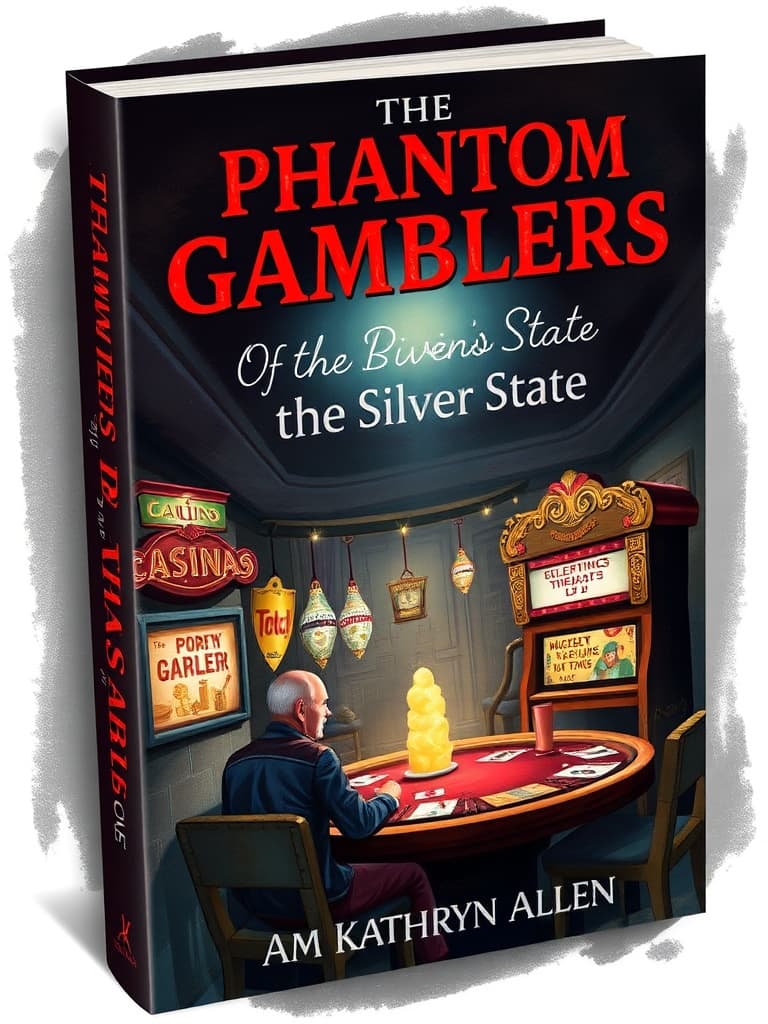
About this book
The Phantom Gamblers of the Silver State
32
0
98
0
I am delving into the reported Hauntings of the Casinos of Nevada. Some of which I have witnessed and experienced Myself
Chapters
- 1Whispers from the Desert FloorElias Thorne, a paranormal investigator whose reputation precedes him in hushed circles of cryptozoologists and spectral sleuths, arrives in the sprawling, sun-baked expanse of Nevada. The dry desert air, thick with the scent of sagebrush and distant exhaust fumes, carries with it the legends of the Silver State's most glittering and historically rich casinos. These aren't just places of chance and fleeting fortunes; they are rumored to be imbued with something far more enduring – the restless echoes of patrons who never truly cashed out. Elias, a man whose life has been a tapestry woven with the threads of the unexplained, feels the familiar thrum of anticipation. His worn leather satchel, a veteran of countless investigations, rests by his side, containing an arsenal of EMF meters, audio recorders, thermal cameras, and meticulously organized journals filled with cryptic notes from past encounters. His motivation is not merely professional curiosity, though that is a significant driver; it is also a deeply ingrained empathy for the unresolved, a desire to offer solace to those trapped between worlds. He carries the weight of past cases, some resolved with a quiet sense of closure, others lingering like phantom limbs in his memory. One particular unresolved case from his early career, a domestic haunting that ended in tragedy and unanswered questions, fuels his methodical approach and his unwavering belief that every spirit has a story, a reason for its continued presence. He has chosen Nevada specifically because of the sheer density of reported phenomena in its casinos, a concentration that suggests more than just isolated incidents. He's heard the whispers, the anecdotal evidence, the hushed confessions of dealers and cleaners who have seen and heard things they can't explain. He's drawn to the Golden Nugget first, a landmark that has witnessed decades of high-stakes drama and whispered secrets. His initial preparations involve meticulous research into the Golden Nugget's history, poring over old newspaper clippings, archival photographs, and even digitizing oral histories from local historical societies. He’s particularly interested in any significant events that may have occurred within its walls – tragedies, sudden deaths, or even unusually dramatic wins and losses that might have imprinted themselves onto the very fabric of the building. He knows that the most potent hauntings often stem from intense emotional experiences, moments of extreme joy, despair, greed, or fear. Elias checks into a modest, nondescript motel on the outskirts of downtown Las Vegas, a deliberate choice to maintain a neutral base of operations, away from the overwhelming sensory input of the casinos themselves. He spends the evening meticulously calibrating his equipment, ensuring every device is functioning optimally. He reviews his notes, sketching out a preliminary plan of action for the Golden Nugget, identifying key areas of reported activity: the main gaming floor, specific high-limit rooms, and perhaps even older, disused sections of the building. He reflects on the nature of hauntings, the theories he holds dear – residual energy, intelligent hauntings, or something entirely unique to these temples of chance. He believes these casinos, with their constant flow of human emotion, their high stakes and dramatic narratives, are fertile ground for lingering presences. The desert night is vast and silent, a stark contrast to the cacophony of the Strip, and Elias feels a profound sense of isolation, yet also a deep connection to the unseen forces he seeks. He understands that his journey into the heart of Nevada's haunted casinos will require not just scientific rigor but also intuition, patience, and an open mind. He closes his eyes, picturing the glittering facade of the Golden Nugget, and prepares himself for the first whispers from the desert floor, the first subtle invitations from the spectral denizens of the Silver State. The chapter ends with Elias standing at the threshold of the Golden Nugget, the pulsating energy of the casino a palpable force even before he steps inside, his equipment humming softly, ready to begin his investigation. He takes a deep breath, the scent of stale smoke and hopeful anticipation filling his lungs, and steps into the vibrant, yet potentially spectral, heart of Las Vegas. His goal here is to establish a baseline of activity, to observe and document any anomalies before they escalate, setting the stage for the deeper dives to come. He is a detective of the ethereal, tasked with solving mysteries that transcend the earthly realm. His secret, the unresolved case from his past, serves as a constant reminder of the stakes involved, not just for the living, but for the lingering souls he hopes to understand and, perhaps, to help. The sheer volume of human experience concentrated in these casinos, he muses, must leave an indelible mark. He is ready to read those imprints. The weight of expectation, both his own and that of the unseen entities, settles upon him as he prepares to cross the threshold into a world where the games never truly end. His past personal experience with an unresolved paranormal event makes him particularly attuned to the nuances of distress and lingering emotion, a trait that will prove invaluable as he navigates the complex spectral landscape of Nevada's casinos. He is not just an investigator; he is a reluctant empath, drawn to the sorrow and the unfinished business of the departed. The desert night outside is an indifferent observer to the human drama unfolding within the casino walls, a drama that Elias is about to join from a unique, spectral perspective. He is a solitary figure entering a world teeming with both the living and the potentially the dead, armed with technology and a profound sense of purpose.
- 2The Golden Nugget's Ghostly GlareElias Thorne steps into the dazzling, clamorous arena of the Golden Nugget, a venerable institution in the heart of downtown Las Vegas. The air is thick with the scent of expensive cologne, stale cigarette smoke, and the metallic tang of countless coins exchanged. Slot machines chime an incessant, hypnotic melody, their lights a dazzling, perpetual twilight. Elias, a figure of quiet intensity amidst the revelry, begins his methodical sweep. He moves with a practiced grace, his eyes scanning the opulent decor, his ears attuned to the symphony of the casino floor. His primary objective is to establish a baseline of perceived 'normal' activity before attempting to discern the anomalous. He begins in the less crowded areas, the hallways and periphery, allowing him to observe without immediately drawing undue attention. His EMF meter, a sleek, handheld device, hums softly as he moves, its needle fluctuating subtly with the electromagnetic fields generated by the vast array of electronic equipment. He notes the ambient temperature, periodically checking his thermal camera for any inexplicable cold spots that might indicate a presence. His audio recorder, discreetly placed in his pocket, captures the ambient soundscape, a sonic diary of his investigation. He starts with the historical sections of the casino, areas that have likely witnessed the most significant shifts in fortune and emotion over the decades. He finds himself drawn to a particular corner near a row of older, less frequented slot machines, where the air feels perceptibly cooler, a chill that seems independent of the building's climate control. He pauses, his breath misting slightly in the frigid pocket of air. His EMF meter spikes dramatically, the needle jumping erratically. He takes a series of readings, noting the precise location and intensity of the fluctuations. He then turns his thermal camera on the spot, revealing a patch of significantly lower temperature, a distinct, localized anomaly. As he stands there, meticulously documenting the readings, he hears it – a faint, almost imperceptible scent, like lavender and rosewater, a perfume that speaks of a bygone era. It’s delicate, ethereal, and utterly out of place in the modern casino environment. He scans the area, his gaze sweeping over the faces of passing gamblers and staff, but sees nothing that could explain the olfactory phenomenon. He moves towards the main gaming floor, the heart of the casino's energy. He observes the dealers, the pit bosses, the players hunched over tables, their faces etched with hope, despair, and intense concentration. He notes the subtle shifts in the casino’s atmosphere – the ebb and flow of energy, the palpable tension during high-stakes hands. He spends hours simply observing, his senses on high alert. He records instances of what could be considered minor poltergeist activity: a deck of cards shuffling itself slightly when no one is near, a dropped chip rolling inexplicably across the floor, a fleeting shadow darting at the periphery of his vision. He records these events with a detached, scientific precision, but an undercurrent of excitement begins to build. These aren't just random occurrences; they are deliberate, or at least, responsive. He feels a distinct sense of being watched, a prickling sensation on the back of his neck that intensifies when he’s in certain areas, particularly near the high-limit blackjack tables. He suspects a presence, an entity that is aware of his investigation. He tries to engage with the environment, speaking aloud in a calm, neutral tone, asking simple questions into the air. “Is anyone here?” he might ask, his voice barely audible above the din. “Can you give me a sign?” The response is subtle: a slight flicker in the overhead lights, a momentary gust of cool air, a barely perceptible sigh that seems to emanate from the empty space beside him. He meticulously documents each occurrence in his journal, cross-referencing it with his equipment readings. He recognizes the need to be patient, to allow the phenomena to unfold naturally, rather than forcing an interaction. He understands that some spirits are shy, others perhaps wary. He recalls the details of his personal unresolved case, the initial subtle signs that were easily dismissed, and he is determined not to make the same mistake. His goal in this chapter is not to have a full-blown encounter, but to gather irrefutable evidence of subtle, yet persistent, paranormal activity. He wants to build a case, one anomaly at a time, to demonstrate that the Golden Nugget is indeed a place where the veil between worlds is thin. He notes the distinct personality of the haunting he’s encountering – it feels feminine, elegant, perhaps a bit melancholic, hinted at by the perfume and the gentle nature of the anomalies. He wonders if this presence is tied to a specific game, a lost love, or a tragic moment within the casino's storied past. The chapter concludes with Elias sitting in a quiet corner booth, reviewing his notes and recordings. The EMF meter still shows elevated readings in the area of the cold spot, and the audio recorder has captured the faint sigh. He feels a sense of quiet satisfaction, knowing he has gathered concrete evidence, but also a growing intrigue about the nature of the entity he's sensed. He knows this is just the beginning, and the Golden Nugget holds more secrets than he’s yet uncovered. The lingering scent of old perfume seems to follow him, a spectral signature of the presence he's encountered. He makes a note in his journal: 'Presence detected. Appears to be feminine, subtle, possibly residual or a low-level intelligent entity. Associated with cold spots, EMF spikes, and faint olfactory phenomena. Further investigation required, particularly into historical female patrons or employees.'
- 3Shadows on the Roulette WheelElias Thorne, having gathered initial evidence from the Golden Nugget, now turns his attention to another downtown Las Vegas landmark, a classic casino whose red-carpeted halls have witnessed countless fortunes won and lost. This establishment, steeped in the golden age of Vegas, is known for its more traditional, perhaps more poignant, paranormal reports. Elias arrives during the late afternoon, a time when the casino's energy begins to shift from a steady hum to the more frantic pulse of the evening. He chooses to focus his investigation on the roulette tables, areas that have historically been focal points of intense emotion, from the elation of a big win to the crushing despair of a streak of bad luck. He positions himself near a perpetually silent roulette table, one that, according to his research, has been out of commission for several months due to renovations or perhaps a more spectral reason. The felt is a deep crimson, worn smooth by the phantom touch of countless hands. The wheel itself, a polished mahogany marvel, stands still and expectant. Elias sets up his equipment discreetly: a high-definition camera positioned to capture the table and wheel, a sensitive audio recorder, and a portable EMF meter. He begins by observing the general atmosphere, noting the subtle shifts in temperature and the ambient electromagnetic fields. He notices a recurring pattern of cold spots that seem to congregate around this specific table, even when the main casino floor is comfortably warm. His EMF meter registers intermittent but distinct spikes in these areas, suggesting a localized energy source that defies conventional explanation. He spends hours in silent observation, his patience a virtue honed by years of chasing the intangible. He records the usual casino sounds – the clatter of chips, the murmur of voices, the distant ding of slot machines – but he is listening for something more, something that doesn't belong. Around dusk, as the casino's evening crowd begins to swell, Elias notices a subtle change. The air around the silent roulette table seems to thicken, becoming heavy and still. The faint scent of cigar smoke, another aroma from a bygone era, drifts into his awareness, not strong, but distinct. He checks his equipment. The EMF readings are climbing steadily, and the thermal camera reveals a significant temperature drop directly in front of the empty dealer's position. Then, he sees it. A fleeting, translucent figure begins to coalesce at the roulette table. It's a man, dressed in a sharp, vintage suit, his form shimmering and indistinct, like heat haze rising from asphalt. He appears to be reaching for the roulette wheel, his spectral hand passing through the polished wood. Elias holds his breath, his heart pounding, but his movements are precise. He adjusts the focus on his camera, ensuring the shot is clear. He activates his audio recorder, straining to catch any sound. The apparition moves with a strange, jerky fluidity, as if caught in an endless loop. He seems to be placing a bet, his phantom fingers hovering over the betting layout. Elias can discern the outline of a particular number – a deep red, perhaps 32, a number that Elias recalls from his research as being significant in a past gambling scandal. The apparition seems to be placing an imaginary chip, his spectral gaze fixed on the wheel. There’s an intense aura of frustration and desperation emanating from the figure, a palpable sense of unfinished business. Suddenly, the figure seems to notice Elias. Its translucent head turns, and for a brief, terrifying moment, Elias feels a piercing, spectral gaze lock onto him. The apparition’s features remain indistinct, but the intensity of its focus is undeniable. Then, as quickly as it appeared, the figure dissolves, fading back into the ambient energy of the casino. The cold spot dissipates, the EMF readings return to normal, and the scent of cigar smoke vanishes. Elias is left breathless, his hand trembling slightly as he checks his camera and audio recorder. He replays the footage, confirming the visual manifestation. The audio recorder has captured a faint, almost inaudible whisper, a frustrated sigh, and perhaps the ghost of a chip clicking against felt. He meticulously logs the event in his journal, noting the specific details: the appearance of the apparition, its actions, the apparent focus on the roulette wheel and a specific number, and the brief, unnerving moment of eye contact. He recognizes the distinct characteristics of this haunting – more direct, more interactive than what he experienced at the Golden Nugget. This wasn't just residual energy; it felt like an intelligent entity, trapped in a recurring moment of intense emotional significance. He wonders if this apparition is one of the legendary 'Phantom Gamblers' he's begun to hear about in hushed tones from casino staff. The intensity of the apparition's focus on the roulette wheel suggests a deep connection to the act of gambling itself, perhaps a final, fateful bet that was never resolved. The visual evidence is compelling, far more concrete than the subtle anomalies of his previous investigation. He feels a surge of adrenaline, mixed with a deep sense of empathy for the spectral gambler trapped in his eternal game. He understands that these manifestations are not mere spectacles; they are echoes of profound human experiences, frozen in time. The chapter ends with Elias poring over his recordings, the image of the spectral gambler burned into his mind. He meticulously analyzes the audio, trying to decipher the whispered words. He zooms in on the video footage, scrutinizing the spectral figure, its vintage attire, the phantom bet it seemed to place. He acknowledges that this encounter has significantly deepened his understanding of the hauntings and has solidified his belief that a collective tragedy or unresolved issue connects these spectral patrons. The roulette wheel, once a symbol of chance, now represents a prison for this lost soul. Elias is more determined than ever to uncover the story behind these 'Phantom Gamblers', to understand the game they are still playing, and to find a way for them to finally leave the table. The ghostly gaze of the apparition lingers in his thoughts, a silent plea from the other side of the veil.
- 4The Bellagio's Weeping LadyThe Bellagio, a modern monument to opulence and illusion, stands as a stark contrast to the vintage establishments Elias Thorne has previously investigated. Yet, beneath its glittering facade and the mesmerizing dance of its iconic fountains, whispers of a sorrowful spirit persist. Elias is drawn by reports of a weeping lady, an entity associated with profound sadness and an inexplicable connection to the water features. His investigation begins not within the casino floor's cacophony, but in the serene, albeit artificial, landscape surrounding the Bellagio's famous fountains. He arrives during the day, observing the synchronized ballet of water, light, and music, noting the ambient energy and the subtle emotional responses of the crowds gathered to watch. He senses a pervasive undercurrent of melancholy, a quiet sorrow that seems to permeate the very air, distinct from the transient frustrations of gamblers. Elias positions himself in a less crowded area, near the edge of the water, allowing him to observe the fountains discreetly while remaining sensitive to any energetic shifts. His equipment is set to capture audio and environmental data, focusing on subtle atmospheric changes. He notices that during certain musical sequences of the fountain show, a localized drop in temperature occurs near a specific jet of water, accompanied by faint electromagnetic fluctuations. His audio recorder picks up faint, almost subliminal sounds – soft sighs, the occasional choked sob – that are not part of the fountain's programmed soundtrack. These sounds are intermittent and difficult to isolate, suggesting a subtle, perhaps fading, presence. Elias decides to focus his efforts during the evening performances, when the fountains are at their most spectacular and the emotional resonance of the crowd is heightened. He returns after sunset, the air cooler and the crowds denser. As the fountains erupt in their dazzling display, Elias concentrates his attention on the area where he previously detected anomalies. During a particularly poignant musical crescendo, he clearly perceives a sorrowful feminine presence. It’s not a visual apparition, but an overwhelming emotional resonance, a wave of sadness that washes over him, almost incapacitating. He feels an echo of profound loss, of unfulfilled longing, and a deep, inconsolable grief. It’s as if the spirit is tethered to the very essence of the water, its tears mingling with the spray. He attempts to communicate, speaking softly into the night, asking about the source of her sorrow. “What troubles you?” he whispers, his voice barely audible above the music. “What loss do you mourn?” The response is not verbal, but an intensification of the emotional wave, a palpable sense of despair that seems to emanate from the heart of the fountain. He notices that the water jets in a particular section seem to flicker or falter slightly when the emotional intensity peaks, as if the spirit’s distress is momentarily disrupting the physical manifestation. Elias records the ambient audio, capturing what he believes to be the faint, spectral weeping. He also uses his thermal camera, noting a persistent cold spot localized around the base of the main fountain structure, a frigid pocket of energy within the warm Nevada night. He spends hours observing, feeling the ebb and flow of the spirit's sorrow. He senses that this is not a haunting born of greed or unfinished business in the gambling sense, but something far more personal and tragic – perhaps a lost love, a miscarriage, or a life cut short before its time, a narrative of profound personal grief. He recalls the 'weeping lady' reports and realizes they are not just folklore; they are an accurate reflection of the intense emotional residue left behind. He hypothesizes that the water, with its constant flow and reflective surface, acts as a conduit or a focal point for this lingering sorrow. He considers the possibility that this spirit is not directly connected to the casino's gambling history but is rather a victim of circumstance or tragedy that occurred in the vicinity before or during the Bellagio's construction. His investigation here is less about 'solving a crime' and more about acknowledging and perhaps validating the profound emotional pain that has been imprinted onto this location. He tries to offer comfort, projecting feelings of peace and understanding towards the source of the sorrow. He wonders if her tears are forever bound to the water, a perpetual lament. Elias takes a moment to sit on a nearby bench, observing the fountain show with a new perspective. He sees the beauty, but he also feels the profound sadness interwoven within it. He makes notes in his journal, detailing the emotional resonance, the specific anomalies, and his hypothesis about the nature of the haunting. He realizes that not all hauntings are dramatic or overtly interactive; some are subtle, deeply personal expressions of enduring pain. The Bellagio’s weeping lady represents a different facet of the paranormal landscape he is exploring – one of pure, unadulterated grief. The chapter ends with Elias watching the fountains, the spectral sorrow still a palpable presence around him. He feels a deep sense of empathy for the weeping lady, recognizing that her pain is as real as any tangible loss. He has documented her presence, but the question remains: can this profound sorrow ever find peace, or is she condemned to weep eternally with the waters of the Bellagio? He feels a responsibility to acknowledge her pain, even if he cannot fully resolve it. His secret, the unresolved haunting from his past, makes him particularly sensitive to the lingering pain of others, urging him to seek understanding and offer solace where possible. The constant movement and reflection of the water seem to mirror the unending cycle of the spirit’s grief. He wonders if there’s a way to offer her a moment of respite, a break in the eternal downpour of her sorrow. He feels a profound sadness for her, a shared understanding of lingering emotional pain.
- 5Echoes in the Flamingo's HallsThe Flamingo, a legendary establishment steeped in the glitz, glamour, and perhaps the ghosts of old Hollywood, beckons Elias Thorne with tales of spectral laughter and phantom music. This casino, once the playground of mobsters and movie stars, is rumored to hold the echoes of its flamboyant past. Elias begins his investigation by immersing himself in the Flamingo's rich history. He pores over biographies of its notorious founder, Bugsy Siegel, and the many entertainers who graced its stages. He delves into the stories of lavish parties, whispered deals, and the larger-than-life personalities that defined its golden era. His initial sweep of the casino floor reveals a vibrant, energetic atmosphere, but he is searching for the subtle dissonances, the spectral undertones. He focuses his attention on areas historically associated with entertainment and high-stakes gambling, particularly the older sections of the hotel and the former locations of its legendary showrooms. He notes the ambient temperature and EMF readings, looking for any deviations from the norm, but initially, the activity is subdued, almost teasing. He spends time in the hotel corridors, where many guest rooms have reported unexplained phenomena. He finds himself drawn to a particular suite, one that was once occupied by a famous singer during the Flamingo's heyday. As he stands outside the door, his EMF meter registers a moderate, sustained spike. He waits patiently, listening intently. He begins to hear it – faint, disembodied laughter, seemingly coming from within the room, yet the door is closed and no one is visible. The laughter is light, effervescent, and tinged with a playful mischievousness. It fades in and out, as if carried on a spectral breeze. Elias decides to attempt communication, speaking calmly into the empty corridor. “Hello?” he calls out. “Is someone there? I’m here to listen.” The laughter subsides, replaced by the faint, unmistakable strains of distant music – a jaunty jazz tune, reminiscent of the 1950s. It seems to emanate from the walls themselves, a phantom orchestra playing an eternal serenade. He checks his audio recorder, capturing the faint music and the residual echoes of laughter. He moves deeper into the casino, exploring the perimeter of where the main showroom once stood. Here, the energy feels different – more theatrical, more performative. He experiences brief moments of intense heat, followed by sudden, inexplicable cold drafts. He catches glimpses of movement at the edge of his vision – fleeting shadows that seem to mimic the gestures of dancers or performers. He finds himself in an old, less-trafficked bar area, a relic of the casino's earlier days. The bartender, a man who has worked at the Flamingo for decades, notices Elias’s focused intensity. Intrigued, he strikes up a conversation. Elias gently probes about any unusual occurrences. The bartender, initially hesitant, eventually shares a story about a particular slot machine in a secluded corner that often pays out inexplicably, almost as if someone is guiding the players. He also mentions hearing faint music late at night when the casino is nearly empty, and sometimes, the distinct sound of someone clearing their throat, as if about to speak. Elias follows up on the bartender’s tip about the slot machine. He observes it for a while, noting that it does seem to attract a disproportionate number of winners. He doesn't witness any direct paranormal activity at the machine itself, but he does feel a subtle, playful energy emanating from the area. He hypothesizes that the spirit associated with this machine might be a benevolent gambler, perhaps trying to help others win, or simply enjoying the game vicariously. Elias dedicates his time to capturing the spectral music and laughter. He records hours of ambient sound, meticulously analyzing it later for any distinct patterns or phrases. He believes these auditory phenomena are residual imprints, echoes of a vibrant past that have become embedded in the casino's fabric. He acknowledges that while the 'weeping lady' at the Bellagio represented profound sorrow, the Flamingo’s spectral presence seems to embody the joy and exuberance of its heyday. It’s a haunting of celebration, not despair. He speculates that the collective energy of so many performers, gamblers, and revelers has left a lasting imprint, a spectral symphony that continues to play long after the show has ended. He finds the playful nature of the haunting intriguing, a stark contrast to the desperation he sensed at the roulette wheel. He wonders if these spirits are aware of his presence, or if they are simply replaying their most potent memories. Elias begins to feel a deeper connection to the history of these places, seeing them not just as casinos, but as living repositories of human experience. The Flamingo, in particular, feels alive with the ghosts of its glamorous past. The chapter concludes with Elias sitting in a quiet corner, listening to his recordings. The faint strains of jazz music and the echoes of laughter fill his headphones. He feels a sense of wonder at the enduring power of memory and emotion. He has captured the spectral symphony of the Flamingo, a testament to a bygone era. He realizes that the 'Phantom Gamblers' might not be a single entity, but a collection of diverse spirits, each with their own story and reason for lingering. The Flamingo's echoes are a sweet melody, but they hint at a larger, more complex narrative woven through the Silver State. He makes a note in his journal: 'Flamingo haunting characterized by auditory phenomena – laughter, music. Appears to be residual energy tied to its history of entertainment and revelry. Less overtly interactive than previous encounters, but pervasive and atmospheric. Potential benevolent spirit associated with a specific slot machine. Suggests a diversity of spectral presences across casinos.' His personal unresolved case, with its lingering questions, makes him particularly attuned to the power of memory and the desire for experiences to be remembered, even beyond death. He feels a sense of respect for these spectral echoes, recognizing them as fragments of lives lived fully, now playing out in perpetuity.
- 6The Sands' Silent ShowmanElias Thorne stands on the hallowed ground where the iconic Sands Hotel once roared with life, a legendary venue synonymous with Frank Sinatra, the Rat Pack, and the golden age of Las Vegas entertainment. Though the building itself is gone, replaced by a more modern structure, the energy of its storied past is said to linger, a spectral echo of its most famous performers. Elias's investigation here is more challenging, requiring him to tune into a location that exists primarily in memory and historical record. He begins by visiting the current site, a place now bustling with contemporary activity, yet he seeks the subtle vibrations of what once was. He spent considerable time researching the Sands' history, focusing on the personalities and events that left the most indelible marks. He is particularly interested in any reports of hauntings associated with specific performers, especially those whose lives ended tragically or were marked by intense passion. He walks the perimeter of the current building, his EMF meter held steady, his senses attuned to any anomalies that might indicate a lingering energetic imprint. He finds the modern environment somewhat disorienting, the new construction potentially disrupting or overlaying the older energies. However, he believes that intense emotional imprints can transcend physical structures. He focuses his attention on areas that were historically significant to the Sands – the approximate locations of its main showroom, its casino floor, and perhaps the presidential suite. He notes that while the physical building is gone, the land itself may still hold residual energy. He experiences brief, localized cold spots and faint EMF fluctuations, particularly in the early morning hours when the area is less crowded. These anomalies are subtle, fleeting, almost like phantom touches from the past. Elias decides to recreate a scene from the Sands' heyday, hoping to evoke a response. He finds a quiet spot, perhaps a nearby public area with a view of the former hotel's footprint, and begins to hum a tune famously associated with Frank Sinatra. He speaks aloud, invoking the spirit of the place and its legendary performers. “This is where the magic happened,” he says, his voice resonating with respect. “Where legends were made. Is anyone here to remember?” For a moment, nothing happens. The modern city hums around him, oblivious. Then, Elias feels a subtle shift in the atmosphere. The air grows heavy, and he experiences a fleeting, almost theatrical manifestation. It’s not a full apparition, but a distinct impression – the feeling of being observed by a charismatic presence, a sense of suave confidence and showmanship. He catches a whiff of a distinctive cologne, perhaps a scent associated with one of the Rat Pack members. He also experiences a brief, phantom sensation, as if a hand has lightly tapped him on the shoulder, a gesture of acknowledgment or perhaps a playful interruption. His EMF meter registers a sharp, but brief, spike in the vicinity of the phantom touch. He records the subtle sensory data: the cologne, the feeling of presence, the tap on the shoulder. He interprets this as a brief, almost dismissive acknowledgment from a spirit deeply embedded in the persona of a performer. It’s as if the 'showman' is making a grand exit, a final bow before the curtain falls. Elias hypothesizes that the energy of performers like Sinatra and the Rat Pack, accustomed to commanding attention and embodying larger-than-life personas, might have left a uniquely potent imprint. This energy may not manifest as a trapped soul seeking resolution, but as a lingering performance, a spectral encore. He considers the possibility that some spirits are simply so defined by their public personas that they continue to 'perform' even after death. His own personal unresolved case, which involved a lingering sense of unfinished business, makes him sensitive to the idea of spirits being trapped in their defining moments. However, with the Sands, it feels less like being trapped and more like an eternal, unscripted show. He makes a note in his journal: 'Sands site: Residual energy imprint from legendary performers. Manifestations subtle – cold spots, EMF spikes, phantom cologne scent, brief tactile sensation (shoulder tap). Suggests a lingering performance or persona, less a 'haunting' and more an energetic echo of showmanship. No clear indication of distress or a need for resolution, but a powerful reminder of the past.' Elias feels a sense of profound respect for the enduring legacy of the Sands and its stars. While he hasn’t encountered a distressed spirit seeking peace, he has experienced a powerful connection to the vibrant energy that once defined this place. The 'Silent Showman' represents a different facet of the paranormal – the enduring power of charismatic personalities and their impact on the places they inhabited. The chapter concludes with Elias standing on the site, the modern city lights reflecting in his eyes. He feels a sense of satisfaction, having connected with the spectral echoes of the Sands. He recognizes that not all hauntings are about unresolved issues or tragic deaths; some are simply the lingering resonance of extraordinary lives lived. The memory of the phantom tap on his shoulder lingers, a subtle reminder of the showmen who once ruled this desert stage. He understands that the 'Phantom Gamblers' might encompass not just those who gambled with money, but those who gambled with their lives and legacies on the grand stage of Las Vegas. He feels a quiet awe at the sheer force of personality that could leave such an enduring mark on the world, even after the physical presence has vanished. He considers the possibility that some spirits are simply too vibrant, too larger-than-life, to ever truly fade away. They become part of the landscape, a spectral encore for those who know how to listen.
- 7A Common Thread UnravelsElias Thorne, having experienced a diverse range of paranormal phenomena across several iconic Las Vegas casinos, begins to notice a recurring pattern that transcends the individual hauntings. The fleeting apparitions, the unexplained sounds, the cold spots, and the emotional resonances – they all seem to orbit around a shared historical undercurrent. His meticulous notes, filled with observations from the Golden Nugget, the Bellagio, the Flamingo, and the site of the Sands, reveal subtle but persistent connections. He starts by cross-referencing the timelines of reported hauntings with significant historical events in Las Vegas. He notices that many of the reported spectral activities cluster around specific decades, primarily the mid-20th century, the era of the Rat Pack, the rise of organized crime's influence in the casinos, and the subsequent shifts in power and fortune. He revisits his interviews with casino staff and locals, digging deeper into the anecdotal evidence. He recalls Agnes 'Aggie' O'Malley, the veteran pit boss he plans to interview soon, and her cryptic references to 'the regulars who never left.' He also remembers the bartender’s mention of a specific older section of town that Elias intends to explore. Elias begins to suspect that these individual hauntings are not isolated incidents but rather fragments of a larger, collective story. He hypothesizes that a significant event, a shared tragedy or a pivotal moment in Las Vegas history, might have imprinted itself deeply onto the fabric of multiple establishments. He starts mapping out the reported hauntings geographically, noting how they seem to spread across different casinos, often those with historical ties to each other or to common figures. He pores over old city records, newspaper archives, and historical accounts of Las Vegas, searching for a common denominator. He looks for instances of mass misfortune, financial collapses, unsolved crimes, or widespread betrayals that might have affected a significant number of people and left a collective energetic residue. He considers the possibility of a shared curse or a mass unresolved trauma. His own secret, the unresolved haunting from his past, makes him particularly sensitive to the idea of lingering emotional imprints and the potential for them to connect across different individuals and locations. He realizes that the 'Phantom Gamblers' might not just be individual spirits, but a collective entity or a group bound by a shared fate. He begins to focus on the era when Las Vegas was rapidly expanding, a time of immense wealth creation but also of significant risk and volatility, a period when fortunes could be made and lost overnight. He looks for stories of high-stakes gamblers, influential casino figures, or even ordinary patrons who experienced devastating losses or met untimely ends. He starts to see connections between the types of hauntings: the desperation at the roulette wheel, the sorrow of the weeping lady, the flamboyant echoes of performers, and the subtle energies of the Golden Nugget. They all seem to point towards a period of intense emotional volatility and perhaps a shared destiny. He dedicates hours to archival research, sifting through microfiche and digital databases, looking for any historical event that could explain the widespread and interconnected nature of the hauntings. He finds mentions of significant financial downturns that affected multiple casinos, rumors of corrupt dealings that led to ruin, and accounts of individuals who seemed to vanish or meet unfortunate ends under mysterious circumstances. He starts to compile a timeline of these potential events, looking for a nexus point, a single incident or period that could have triggered such widespread spectral activity. The idea of a 'Phantom Gambler' collective begins to solidify in his mind. He hypothesizes that these spirits are not just tied to individual casinos but to the very spirit of old Las Vegas itself, a spirit forged in high stakes, risk, and the potential for both spectacular triumph and devastating loss. He realizes that understanding this common thread is crucial to unraveling the full story and potentially bringing peace to these restless souls. The chapter ends with Elias surrounded by stacks of historical documents, a complex web of timelines and interconnected events spread out before him. He has identified a potential historical period and a recurring theme of widespread misfortune. The individual hauntings are no longer isolated incidents but pieces of a grand, tragic narrative. The unraveling thread has become a tapestry, and Elias is determined to trace its pattern to its source, believing that the key to understanding the 'Phantom Gamblers' lies in uncovering the collective tragedy that binds them. He feels the weight of history pressing down on him, the silent stories of countless lives intertwined with the rise and fall of the Silver State's most iconic establishments. He is closer than ever to understanding the deeper mystery, but the full picture remains elusive, shrouded in the mists of time and spectral whispers.
- 8The Pit Boss's TaleArmed with the nascent understanding that the hauntings across Las Vegas casinos might be interconnected, Elias Thorne seeks out those who have witnessed the spectral tapestry firsthand from within the heart of the action. His next crucial step is to interview Agnes 'Aggie' O'Malley, a seasoned pit boss whose tenure at various casinos spans decades, making her a living repository of the Silver State's most enduring, and uncanny, experiences. Elias finds Aggie in a quiet, out-of-the-way diner on the outskirts of the Strip, a place where the relentless neon glow softens into a more subdued ambiance. Aggie, a woman whose sharp eyes have seen it all – the desperate hopes, the crushing defeats, and the spectral whispers – is initially reserved, her skepticism a well-worn shield. Elias approaches her with respect and genuine curiosity, sharing a brief, anonymized overview of his investigation, emphasizing his desire to understand the phenomena rather than sensationalize them. He mentions the recurring themes he's discovered – the persistent presences, the feeling of being watched, the subtle anomalies. Aggie listens intently, her gaze steady. She eventually concedes that she’s ‘seen more than her fair share of strange things.’ She speaks of 'the regulars,' a term she uses with a knowing, almost affectionate, tone, referring to spirits who seem to inhabit specific tables or machines, patrons who never truly left their favorite spots. She describes instances of chips moving on their own, the faint scent of perfume or cigar smoke appearing and disappearing without explanation, and the unnerving sensation of a spectral presence standing behind a dealer during a busy shift. She recounts a specific story about a high-stakes poker game at a now-defunct casino where a particular player, known for his audacious bets and his volatile temper, died suddenly at the table. According to Aggie, players at that table, even after it was cleared and cleaned, often reported feeling an intense pressure, as if someone was watching their every move, and sometimes, the distinct sound of a spectral deck of cards being shuffled. She emphasizes that these aren't fleeting occurrences; they are persistent, almost routine, for those who work the floors long enough. Aggie also shares whispers she’s overheard from older dealers and employees about a 'group,' a specific set of high rollers from a particular era, whose fortunes were inextricably linked to the casinos. She refers to them as 'the ones who played too hard,' their spirits seemingly bound to their lost fortunes and the tables where they staked everything. Elias carefully documents Aggie’s accounts, noting the recurring themes of specific players, high-stakes games, and the idea of spirits being tied to their favorite spots. Aggie’s insights provide a human element to the historical data Elias has been collecting. She confirms his suspicion that many of these entities are intelligent, aware presences, not just residual energy. Her description of 'the regulars' and 'the ones who played too hard' directly correlates with his developing theory of the 'Phantom Gamblers.' She speaks with a pragmatic weariness, as if recounting a familiar, albeit unsettling, aspect of her long career. Elias probes further, asking about any specific events or periods that seemed to coincide with an increase in paranormal activity. Aggie recalls a period in the late 1970s and early 1980s, a time of significant expansion and a shift in casino ownership, when the reports of strange occurrences seemed to multiply. She mentions rumors of financial improprieties and sudden disappearances during that era, further solidifying Elias’s suspicion of a collective tragedy. She doesn't offer concrete proof of a single devastating event, but her experiences paint a vivid picture of a casino environment where the veil between worlds is thin and the echoes of past lives are a constant presence. Aggie’s testimony is invaluable, adding a layer of credibility and lived experience to Elias’s research. She doesn't believe in ghosts in a sensationalized way, but she acknowledges the undeniable presence of 'something more.' She expresses a quiet hope that Elias can bring some understanding, if not peace, to these lingering souls. The chapter ends with Elias thanking Aggie for her candor. As he leaves the diner, the desert night air feels charged with the weight of her stories. Aggie’s words have transformed Elias’s research from a collection of historical data and anecdotal reports into a vivid tapestry of personal experiences, confirming that 'the regulars' are indeed the 'Phantom Gamblers' he seeks, bound by a shared history and an unresolved presence within the casinos of the Silver State. He feels a renewed sense of purpose, understanding that the human element provided by Aggie is crucial to piecing together the full story. Her pragmatic acceptance of the paranormal provides a grounded perspective that complements his own investigative methods. Elias now has a clearer picture of who these spirits might be and the era they likely belong to, paving the way for deeper historical investigation into the specific events that might have bound them to the casinos.
- 9The Bartender's BurdenFollowing the insightful revelations from Aggie O'Malley, Elias Thorne understands the need to delve deeper into the historical context and perhaps uncover the specific events that might have bound the 'Phantom Gamblers' to their spectral existence. His next lead points him towards one of the oldest establishments in downtown Las Vegas, a place that has witnessed the city's evolution from its nascent days to its current glittering status. Here, he seeks out a seasoned bartender, a figure often privy to the hushed conversations and intimate confessions of patrons and staff alike. Elias finds his target, a man named Sal, working at a classic, dimly lit bar that feels like a portal to a bygone era. The air is thick with the comforting aroma of aged spirits and the low murmur of conversation. Sal, with his weathered hands and observant eyes, has a quiet demeanor that suggests he's heard more than he's ever spoken. Elias approaches Sal with the same respectful, investigative approach he used with Aggie, explaining his interest in the historical hauntings and the potential connection to a specific group of gamblers from the past. He mentions Aggie's insights and the phrase 'the ones who played too hard.' Sal listens, nodding slowly, a faint smile playing on his lips. He confirms that the 'old guard' – the dealers, the bartenders, the regulars – all have their stories about the spirits that linger. He speaks of a particular era, the late 1960s and early 1970s, a time when Vegas was perhaps more raw, more dangerous, and when high-stakes gambling was intertwined with powerful, sometimes shadowy, figures. Sal recounts instances of drinks being moved inexplicably on the bar, spectral conversations overheard when no one else was present, and the unsettling feeling of being watched by unseen patrons. He describes seeing faint figures sitting at the bar late at night, their forms indistinct, their presence marked only by a chill in the air or a sudden drop in temperature around them. Elias carefully documents these occurrences, noting the parallels with his previous findings. Sal then directs Elias's attention towards a specific, older section of the city, a part of downtown that predates the megaresorts and retains a more authentic, historical character. He explains that many of the 'old timers' who experienced the height of the 'Phantom Gamblers' era frequented establishments in this area. He mentions a particular notorious gambling den, now long gone, that was a hub for high-stakes games and drew a clientele whose fortunes, and perhaps lives, were deeply intertwined with the city's burgeoning casino industry. Sal’s narrative paints a picture of a community where fortunes were made and lost with dizzying speed, and where the lines between legitimate business and illicit dealings were often blurred. He hints at stories of players who vanished, debts that were never settled, and rivalries that may have led to tragic ends. Elias feels a growing sense of urgency, realizing that the key to understanding the 'Phantom Gamblers' lies in uncovering the specific events that transpired in these older, less-documented corners of Las Vegas. Sal’s burden, it seems, is the weight of all the unspoken stories and lingering presences he has witnessed over his long career. He shares a poignant anecdote about a particular gambler, a man known for his charm and his reckless bets, who seemed to possess an uncanny intuition at the card tables. Sal recalls this gambler disappearing without a trace one night, only for rumors to surface later of a massive debt and a deal gone wrong. The bartender's conscience seems heavy with the memories of these lost souls, their stories forever etched in the fabric of the establishments he’s served. Elias is struck by the bartender's description of spectral conversations – it suggests a level of interaction far beyond mere residual energy. He wonders if these spirits are trying to communicate, to share their stories, or perhaps to warn others. The chapter ends with Elias thanking Sal for his invaluable insights and his willingness to share his burden. As Elias leaves the bar, the dimly lit streets of old downtown Las Vegas seem to hold a new significance. Sal's words have provided a direct link to the era and the characters that likely form the core of the 'Phantom Gamblers' legend. The mention of a specific, notorious gambling den and the hints of unresolved conflicts and disappearances give Elias concrete leads for his next phase of investigation. He feels a growing conviction that the answers he seeks are buried in the history of these older establishments, waiting to be unearthed. The weight of Sal's stories, like the spirits themselves, lingers, propelling Elias forward on his quest to understand the spectral gamblers of the Silver State.
- 10The Gamblers' GambitFollowing the breadcrumbs left by Aggie O'Malley and Sal, Elias Thorne now focuses his investigation on a specific group of individuals whose spectral presence seems to permeate the casinos of the Silver State: the legendary 'Phantom Gamblers.' His research takes him deep into the archives of Las Vegas's most tumultuous periods, particularly the mid-20th century, a time when fortunes were made and lost with breathtaking speed, and the lines between legitimate business and shadowy dealings were often blurred. Elias is particularly interested in a notorious group of high-stakes gamblers whose reputations preceded them, men and women whose lives were as dramatic and unpredictable as the games they played. He discovers that this group, often referred to in hushed tones as 'the Syndicate' or 'the High Rollers,' operated primarily during the 1960s and 1970s, a period Sal had alluded to. They were known for their audacious bets, their immense wealth, and their seemingly unshakeable confidence at the tables. Elias meticulously pieces together their stories, using old newspaper clippings, court records, and even interviews with descendants or associates who are willing to speak. He learns that these gamblers were not just players; they were integral to the very foundation of some of the casinos, their fortunes deeply intertwined with the establishments' success and failures. He uncovers tales of legendary games played for astronomical sums, where entire casinos could be won or lost in a single night. He finds records of individuals who seemed to vanish without a trace, their fortunes inexplicably gone, their whereabouts unknown. These disappearances, often occurring during periods of significant financial flux in the casino industry, raise red flags for Elias. He hypothesizes that the 'Phantom Gamblers' are not just specters of misfortune, but perhaps individuals who met tragic ends due to their gambling activities, whether through betrayal, debt, or violence. He focuses on a few key figures within this group: a charismatic card shark named 'Silas the Slick' Sterling, known for his uncanny ability to read opponents and his legendary winning streaks; a flamboyant socialite, Isabella 'Izzy' Dubois, whose losses were as spectacular as her wins; and a stoic, enigmatic businessman, Arthur Pendelton, who seemed to possess an almost supernatural intuition for the market and the tables. Elias meticulously researches their financial dealings, their known associates, and any documented instances of extreme luck or devastating ruin. He finds that their fortunes often mirrored the volatile economic landscape of Las Vegas during that era, with periods of unprecedented prosperity followed by sudden, catastrophic downturns. He uncovers rumors of insider trading, rigged games, and backroom deals that were integral to their success—and potentially, their downfall. His personal unresolved case, which involved a lingering sense of injustice and unanswered questions, makes him particularly attuned to the potential for betrayal and hidden truths in the stories of these gamblers. The more he learns, the more he suspects that their spectral presence is not just about the thrill of the game, but about unresolved debts, betrayals, and perhaps even murder. He starts to connect the dots between these individuals and the specific casinos he visited. For instance, a particular casino known for its high-stakes poker might be linked to Silas Sterling, while a more opulent establishment might be associated with Isabella Dubois. Arthur Pendelton's influence might be felt across multiple casinos, given his broader financial dealings. Elias realizes that the 'Gamblers' Gambit' refers not only to their audacious play at the tables but also to the high-stakes gamble of their lives, a gamble that may have ultimately cost them everything, leaving their spirits tethered to the places where their fortunes were made and lost. The chapter ends with Elias poring over a complex web of financial records, correspondence, and newspaper clippings, piecing together the intricate lives and potential downfalls of the key members of the 'Phantom Gamblers.' He has identified the central figures and the era of their influence, and he is beginning to see the outlines of a shared tragedy, a grand, ill-fated gambit that may have led to their eternal presence in the casinos of the Silver State. The question now is: what was the ultimate price of their gamble, and how did it lead to their spectral existence?
- 11Tragedy at the TablesHaving identified the key players of the 'Phantom Gamblers,' Elias Thorne now seeks to uncover the specific tragic event or series of events that may have bound their spirits to the casinos of Nevada. His research intensifies, focusing on the period when these gamblers were most active and influential, a time rife with both unprecedented prosperity and hidden dangers. Elias delves into financial records, legal documents, and even the gossip columns of the era, searching for evidence of a calamitous downfall. He discovers that the 'Phantom Gamblers,' particularly the inner circle including Silas Sterling, Isabella Dubois, and Arthur Pendelton, were not immune to the inherent risks of their high-stakes lifestyle. While they enjoyed periods of immense success, their fortunes were often built on precarious foundations, susceptible to market fluctuations, rivalries, and illicit dealings. Elias uncovers accounts of a significant financial downturn that swept through Las Vegas in the late 1970s, a period that saw several casinos struggle and some even face bankruptcy. He believes this economic upheaval may have been the catalyst for the tragedy that befell the 'Phantom Gamblers.' He finds evidence suggesting that many of them were heavily invested, both financially and emotionally, in specific casinos or ventures. When these ventures faltered, their losses were catastrophic. Elias focuses on a particular incident: a meticulously planned, high-stakes play orchestrated by Arthur Pendelton, designed to consolidate power and wealth among the core group of 'Phantom Gamblers.' This gambit, however, may have backfired spectacularly, leading to a cascade of financial ruin. He finds veiled references in old correspondence to betrayal within the group, suggesting that one or more of the gamblers may have double-crossed the others to secure their own survival or to eliminate rivals. Silas Sterling, known for his cunning, and Isabella Dubois, whose flamboyant lifestyle often masked financial struggles, are prime candidates for involvement in such betrayals. Elias also uncovers reports of sudden, unexplained deaths and disappearances among associates and creditors of the 'Phantom Gamblers' during this period, hinting at a darker, more violent resolution to their financial woes. He finds a particular newspaper article detailing the mysterious suicide of a prominent casino owner who was heavily indebted to Arthur Pendelton, just weeks before the supposed financial collapse. This suggests that the 'tragedy' might not have been solely financial, but also involved coercion, threats, or even murder. Elias's personal unresolved case, which involved a sense of profound injustice and a feeling of being wronged, makes him particularly sensitive to the implications of betrayal and coercion. He begins to construct a narrative: the 'Phantom Gamblers,' at the height of their power, attempted a massive, risky gambit to secure their dominance, but internal betrayals and external pressures led to their collective downfall. The financial collapse was merely the manifestation of deeper treachery and perhaps even violence. The tragedy wasn't just losing money; it was the loss of trust, the shattering of their ambition, and for some, perhaps, the loss of their lives under sinister circumstances. He hypothesizes that the lingering spectral energy is a manifestation of this collective trauma – the shock of sudden ruin, the agony of betrayal, and the unfulfilled desire for retribution or resolution. The specific manifestations he's encountered – desperation at the roulette wheel, sorrow, echoes of past performances – could all be tied to different facets of this overarching tragedy. The chapter ends with Elias piecing together a compelling, albeit still incomplete, picture of the 'Phantom Gamblers'' downfall. He has identified a period of intense financial upheaval, internal betrayals, and suspicious deaths that likely culminated in their ruin. The tragedy at the tables was not just about losing money; it was about the destruction of their ambitions, their relationships, and potentially their lives. He has found the core of their unresolved energy, a collective wound that continues to echo through the casinos. The question now is how to address this profound tragedy and offer these spirits a path towards peace. He feels the weight of their lost fortunes and broken trust, a palpable energy that continues to resonate in the Silver State.
- 12The Phantom's PactWith a clearer understanding of the tragic events that befell the 'Phantom Gamblers,' Elias Thorne now seeks to understand the specific circumstances that might have bound their spirits so persistently to the casinos. He theorizes that beyond the financial ruin and betrayals, there might have been a deeper, more intentional mechanism at play – a pact, a curse, or a shared existential bargain that ensures their eternal presence. Elias revisits the historical records, now with a focus on the psychological and perhaps even esoteric aspects of the 'Phantom Gamblers'' lives. He looks for any mention of rituals, superstitions, or beliefs that might suggest an attempt to bargain with fate or the supernatural. He finds intriguing, albeit fragmented, accounts of the group's intense belief in luck, destiny, and the idea of 'playing until the end.' Some of the more sensationalist newspaper articles from the era hint at clandestine meetings and unusual practices among the core members of the group, particularly Silas Sterling and Arthur Pendelton. Elias finds correspondence that speaks of a desperate desire to maintain their status and wealth, even in the face of overwhelming odds. There are mentions of a 'final agreement' or a 'binding promise' made amongst the core members, particularly as their financial situation grew dire. While concrete evidence of a formal pact is elusive, the recurring language of commitment, shared destiny, and an unwillingness to let go of their fortunes suggests a powerful collective intention. Elias considers the possibility that in their desperation, facing ruin and betrayal, they may have inadvertently or intentionally invoked something beyond mortal understanding. He looks for any connections to occult practices or fringe beliefs that may have been prevalent among the elite circles of the time, though such information is scarce and often couched in rumor. His personal unresolved case, which involved a sense of being trapped in a cycle and a feeling of spiritual obligation, makes him particularly sensitive to the idea of a binding agreement. He hypothesizes that the 'Phantom Gamblers,' in their collective desperation to defy fate and cling to their wealth, may have made a subconscious or conscious pact to remain bound to their games, their fortunes, and the casinos that represented their ultimate ambition. This pact, born out of extreme emotion – greed, fear, defiance – might have created a powerful energetic tether, anchoring their spirits to the physical locations where these emotions were most intensely felt. Elias also considers the possibility that the 'betrayals' he uncovered might have inadvertently strengthened this pact. If one member broke faith, the remaining members might have reinforced their commitment to each other and their shared fate, thus solidifying the spectral bond. He revisits the locations he investigated, looking for any subtle signs that might indicate the presence of such a pact. He senses a lingering intensity, a heavy atmosphere in certain areas that goes beyond residual energy. He considers that perhaps the 'Phantom Gamblers' are not merely trapped, but actively engaged in a perpetual game, a pact to continue playing, to continue seeking the fortune that eluded them in life. This could explain the recurring manifestations at tables and machines, the sense of ongoing activity. He hypothesizes that the 'pact' might involve a shared unfinished game, a collective debt that can only be settled through continued play. The 'Gamblers' Gambit' takes on a new meaning – not just a risky play, but an eternal game, a spectral covenant. The chapter ends with Elias contemplating the nature of this 'Phantom's Pact.' While concrete proof remains elusive, the consistent themes of shared destiny, desperate ambition, and an unwillingness to let go suggest a powerful energetic agreement that binds these spirits. He believes this pact, born out of extreme circumstances and intense emotion, is the key to understanding why they remain tethered to the casinos, forever playing out their eternal game. The search for definitive proof of a pact may be an investigation into the intangible, but the evidence of its effects is undeniable. Elias feels a growing conviction that he is on the verge of understanding the true nature of their spectral existence, a pact that transcends life and death, binding them to the very heart of the Silver State's legendary casinos.
- 13A Séance in the Silver StateWith the theory of a 'Phantom's Pact' solidifying in his mind, Elias Thorne decides it's time for a more direct approach. He believes that to truly understand the spirits' unrest and potentially facilitate their peace, he must attempt to communicate with them directly. He chooses a location historically significant to the 'Phantom Gamblers,' a casino that was central to their rise and fall, and where the spectral energy feels most potent. This might be a casino that was particularly prominent during the era of Silas Sterling and Arthur Pendelton, or perhaps one that has a high concentration of reported hauntings. Elias meticulously prepares for a controlled séance, understanding the risks involved but believing it's a necessary step. He selects a private room within the chosen casino, ensuring it is free from public disturbance and has a palpable sense of history. He brings his essential equipment: sensitive audio recorders, EMF meters, and perhaps a spirit box, a device that rapidly scans through radio frequencies, theoretically allowing spirits to form words. He also brings items that might serve as anchors or focal points – historical photographs of the 'Phantom Gamblers,' or even artifacts associated with their era, if he can procure them. Elias ensures that the participants, if any, are aware of the potential risks and are mentally prepared. For this endeavor, he might enlist the help of a trusted colleague, or perhaps even a sympathetic casino employee who has had personal experiences. The séance begins with Elias setting a calm, respectful atmosphere. He explains the purpose: to understand their plight, to hear their stories, and to offer assistance if possible. He begins by calling out to the 'Phantom Gamblers,' specifically mentioning Silas Sterling, Arthur Pendelton, and Isabella Dubois, and invoking the concept of their pact. He asks them to make their presence known, to communicate their needs. Initially, the room remains silent and still, the only sounds being the ambient hum of the casino filtering in from outside. Elias patiently waits, his senses heightened, his equipment monitoring for any changes. He might start by playing some music from their era, hoping to evoke a response. After a period of quiet anticipation, subtle phenomena begin to occur. The EMF meter might register a slight increase, or a faint cold spot might develop in the center of the room. Elias might hear faint whispers on his audio recorder that weren't audible live. If using a spirit box, words might begin to form – fragmented, often cryptic, but potentially significant. Elias guides the process, asking clarifying questions based on the responses. He might ask about their pact, about the betrayals, about their unfinished games. The spirits, if present and communicative, might respond with single words, emotions, or even brief phrases. The communication is likely to be disjointed and challenging, requiring Elias to interpret the fragmented messages. He might sense strong emotions emanating from the spirits – frustration, anger, sorrow, or a desperate longing for something lost. The séance could take an intense turn if the spirits are particularly agitated or if their unresolved issues are deeply painful. Elias must remain calm and methodical, ensuring the safety and well-being of himself and any other participants. He needs to avoid provoking or antagonizing the spirits, focusing instead on understanding and offering a path to resolution. He might experience personal sensations – a touch, a feeling of pressure, or a sudden emotional surge – as the spirits attempt to communicate their experiences. His own secret, the unresolved haunting from his past, might make him particularly susceptible to these sensations, but also more adept at discerning their meaning. The séance is not about banishing spirits, but about facilitating communication and potentially offering them a chance to resolve their lingering issues. Elias might ask directly about their unfinished business, about what they need to find peace. The responses, if any, could be cryptic, pointing towards specific locations, unfinished games, or unresolved betrayals. The chapter ends with Elias concluding the séance, the room now quiet once more, the equipment having captured significant data. He feels a profound sense of awe and perhaps a touch of exhaustion. The communication, however fragmented, has provided invaluable insights into the 'Phantom Gamblers'' state of being and their unresolved desires. He has glimpsed the depth of their pact and the pain it has caused. The question now is what to do with this knowledge. The séance has opened a door, but the path to resolution remains unclear. He has heard their spectral voices, however faint, and knows that their stories must be brought to light. The information gathered is crucial, but the real work of bringing them peace has just begun. He feels the weight of their spectral burdens and the potential responsibility he now carries.
- 14The Unfinished HandThe séance has yielded fragmented, yet crucial, insights into the 'Phantom Gamblers'' state of being. Elias Thorne now understands that their spectral presence is driven by an 'unfinished hand' – a collective desire to complete a final game, settle a debt, or deliver a message that was left unresolved in life. His task is to decipher these spectral clues and discover what this 'unfinished business' truly entails. Elias meticulously analyzes the recordings and his own impressions from the séance. He focuses on recurring words, emotions, and symbolic imagery that emerged. Perhaps the spirits repeatedly mentioned a specific number, a particular card game, or a location within a casino. He might have sensed a strong feeling of injustice related to a specific betrayal or a desperate need for a debt to be acknowledged. He revisits his historical research, cross-referencing the spectral clues with the known lives and downfall of Silas Sterling, Isabella Dubois, Arthur Pendelton, and their associates. He looks for any events that align with the fragmented messages. For example, if the spirits repeatedly mentioned 'the Ace of Spades,' Elias might investigate any significant games or events involving that card, or perhaps a symbolic meaning associated with it in their lives. If a sense of betrayal was dominant, he might focus on the potential betrayers and the nature of their treachery. He might also re-examine the historical accounts of suspicious deaths or disappearances, looking for any connections to the 'unfinished hand' that the spirits are trying to communicate. Elias hypothesizes that the 'unfinished hand' could represent several possibilities: a specific game that was never completed, a debt owed to one of the gamblers that was never paid, a hidden truth about their downfall that needs to be revealed, or even a message of warning or reconciliation to their living descendants or associates. He might also consider that the 'pact' they made involved a perpetual game, and their 'unfinished hand' is simply the current state of that eternal play. The challenge lies in interpreting the often-cryptic communication from the spirits. Elias must use his intuition, his understanding of their history, and his analytical skills to piece together the puzzle. He might also seek further input from individuals who have had lingering experiences with the 'Phantom Gamblers,' perhaps revisiting Aggie or Sal, or seeking out descendants or former associates. He could also use his equipment in different locations that were significant to the 'Phantom Gamblers,' hoping for more direct manifestations or clearer communication. The chapter builds suspense as Elias gets closer to understanding the 'unfinished hand.' He might experience more direct paranormal phenomena as he gets nearer to the truth, as if the spirits are guiding him or becoming more agitated by his progress. He might have vivid dreams or visions that offer further clues. He needs to determine if the 'unfinished hand' is a singular event or a complex web of unresolved issues that need to be addressed collectively. The chapter ends with Elias having a strong sense of what the 'unfinished hand' entails. He may not have all the answers, but he has identified the core desire or unresolved issue that is keeping the 'Phantom Gamblers' tethered to the Silver State. This could be a specific game that needs to be symbolically completed, a hidden truth that needs to be revealed, or a debt that needs to be acknowledged. He now has a clear objective, a task to fulfill that could potentially bring peace to these restless spirits. The question remains: how will he go about fulfilling this 'unfinished hand,' and what will be the consequences of his intervention?
- 15Righting Old WrongsArmed with the knowledge of the 'Phantom Gamblers'' unfinished business, Elias Thorne embarks on the crucial phase of his investigation: righting old wrongs and fulfilling the spirits' requests. This is where his methodical approach meets the practical, and sometimes challenging, realities of addressing spectral desires. The specific task will depend on what Elias has deciphered as the 'unfinished hand.' If the spirits are tied to a specific unfinished game, Elias might need to orchestrate a symbolic completion. This could involve arranging for a particular card game to be played at a historically significant location, perhaps with players who are aware of the spectral context. He might need to ensure a specific bet is placed, or a particular outcome is reached, not to manipulate fate, but to symbolically close that chapter for the spirits. If the 'unfinished hand' involves a debt that was never settled, Elias might need to locate descendants or associates of the 'Phantom Gamblers' and facilitate a symbolic repayment, perhaps through a charitable donation in their name or by revealing the truth about the debt. This could involve extensive genealogical research and careful communication with living relatives, many of whom may be unaware of their ancestors' spectral plight. If the spirits are seeking to expose a hidden truth about their downfall or betrayals, Elias might need to uncover definitive proof – a lost document, a witness statement, or corroborating evidence from historical archives. He may then need to find a way to bring this truth to light, perhaps through a formal report, an article, or by discreetly informing relevant parties. His personal unresolved case, which involved a deep sense of injustice, makes him particularly driven to ensure that existing wrongs are addressed, even if symbolically. Elias recognizes that 'righting old wrongs' is not about altering history, but about acknowledging it and providing closure for those who are trapped by its unresolved aspects. He must tread carefully, respecting the boundaries between the living and the spectral realms, and ensuring his actions do not cause further disruption or distress. He might need to revisit the casinos where the hauntings are most prevalent, seeking to perform these acts of closure in the very places where the spirits' pain is most acutely felt. This could involve discreetly arranging for a specific ritual, leaving an offering, or simply acknowledging the spirits' presence and their desire for resolution in a meaningful way. The process might be fraught with challenges. Some spirits might be resistant to closure, their pact or their anger too deeply ingrained. Others might require multiple attempts at resolution, their messages or needs being complex and multifaceted. Elias may encounter skepticism from casino management or staff, requiring him to navigate these interactions with diplomacy and a clear explanation of his intentions. The chapter builds towards the execution of Elias's plan to address the 'unfinished hand.' He might face unexpected obstacles or revelations as he attempts to fulfill the spirits' requests. The outcome of these actions will directly influence whether the spectral activity begins to subside. The chapter ends with Elias having taken concrete steps to right the old wrongs. Whether it's orchestrating a symbolic game, facilitating a symbolic repayment, or uncovering a hidden truth, he has actively intervened to address the 'Phantom Gamblers'' unfinished business. The immediate aftermath of his actions might be subtle, but the stage is set for observing whether these interventions have had the desired effect, leaving the reader to wonder if peace is finally within reach for the spectral gamblers of the Silver State.
- 16The House Always Wins... or Does It?As Elias Thorne observes the aftermath of his attempts to 'right old wrongs,' he begins to notice a subtle but tangible shift in the paranormal activity within the casinos he has investigated. The intense phenomena, the palpable unease, and the persistent spectral manifestations that once defined these locations appear to be diminishing. This chapter focuses on Elias's observation and documentation of this gradual subsiding of paranormal energy, a testament to the potential success of his interventions. He revisits the key locations – the Golden Nugget, the Bellagio, the Flamingo, and the site of the Sands – paying close attention to the subtle changes in atmosphere. He notes a decrease in EMF spikes and cold spots, his equipment registering more normal environmental readings. The unsettling feeling of being watched, once a constant companion, begins to fade, replaced by a more neutral, albeit still historically resonant, ambiance. He speaks with casino staff, including Aggie O'Malley and perhaps even Sal, gauging their perceptions. Aggie might comment on a newfound quietness on the gaming floor, a sense of lightness that wasn't there before. Dealers might report fewer inexplicable occurrences at the tables, fewer phantom sounds or movements. Even the subtle, often dismissed anomalies – the fleeting shadows, the faint scents – seem to have lessened in frequency and intensity. Elias meticulously documents these observations, comparing his current readings and subjective experiences with his initial findings. He recognizes that paranormal phenomena, especially those tied to intense emotional events, can linger for a long time, and their dissipation might be gradual rather than instantaneous. He considers the possibility that the 'Phantom Gamblers,' having had their 'unfinished hand' addressed, are now finding a measure of peace, their spectral energy slowly dissipating. He reflects on the nature of the 'Phantom's Pact' and how, by fulfilling its terms or acknowledging its consequences, he may have weakened its hold. His personal unresolved case, which involved a lingering sense of unfinished business, makes him particularly attuned to the subtle signs of resolution and the profound impact of closure. He understands that the 'House' – the casinos, the system, the relentless cycle of gambling – always seems to win in a material sense, but perhaps, in this instance, the spirits have finally achieved a different kind of victory, a release from their eternal game. Elias contemplates the implications of this fading presence. It's not a dramatic vanishing act, but a gentle receding, like a tide going out. The casinos, while still holding their history and folklore, are becoming less actively haunted. The spectral players are finally leaving the table. He also considers that some residual energy might remain, echoes of the past that will always be a part of these locations, but the active, distressed hauntings are diminishing. The chapter ends with Elias feeling a quiet sense of accomplishment, albeit tinged with the bittersweet understanding that the vibrant, albeit spectral, personalities he encountered are moving on. The casinos of the Silver State are becoming quieter, their ghostly gamblers finally finding their rest. He has witnessed the potential for resolution and the subtle power of addressing unresolved issues, even those that transcend the physical realm. The question remains: how complete is this peace, and what will be the lasting legacy of the 'Phantom Gamblers' in the memory of Nevada?
- 17Aggie's BlessingWith the paranormal activity in the casinos noticeably subsiding, Elias Thorne seeks out Agnes 'Aggie' O'Malley, the veteran pit boss whose firsthand accounts were instrumental in shaping his understanding of the 'Phantom Gamblers.' Aggie represents the lived experience of these hauntings, and her perspective on the calming of the spectral energy is crucial. Elias finds Aggie in her usual haunt, a quiet corner of a casino lounge where she often unwinds after her shifts. The atmosphere is relaxed, a stark contrast to the high-stakes tension of her workplace. Elias approaches her with a sense of quiet gratitude, ready to share his observations and receive her seasoned insights. He mentions the general decrease in anomalous occurrences, the feeling of a lighter atmosphere, and asks for her professional opinion. Aggie, her sharp eyes now softened with a hint of weary contentment, readily agrees. She speaks of a 'calm' that has settled over the floors, a distinct absence of the unsettling presences she had grown accustomed to over the decades. She describes how the 'regulars' – the spectral patrons she had come to know – seem to have finally moved on. She recounts a specific instance where a notoriously haunted slot machine, one that often experienced unexplained activity, has remained quiet for weeks. She expresses a sense of relief, not just for herself and her colleagues, but for the spirits themselves, whom she now views with a sense of empathy rather than apprehension. Aggie shares a poignant observation: she believes the spirits were not malevolent, but simply trapped by their own unresolved desires and the circumstances of their lives and deaths. Her own pragmatic experience has led her to a place of understanding and even acceptance of their lingering presence, but she acknowledges that their departure brings a sense of closure. She attributes the change to Elias's intervention, not in a way that attributes supernatural power to him, but by acknowledging that his efforts to understand and address their 'unfinished business' have likely provided them with the peace they sought. She offers a final, reflective thought: that the casinos, while places of chance and fortune, are also repositories of human stories and emotions, and that sometimes, those stories need to be acknowledged to find their end. Elias thanks Aggie for her invaluable perspective and her willingness to share her experiences. Her confirmation of the calming spectral energy provides a significant validation of his work. He feels a profound sense of satisfaction, knowing that his investigation has not only unearthed historical truths but has also potentially brought peace to restless souls. Aggie's blessing, her acknowledgment of the spirits' peace, serves as a powerful confirmation that his mission is nearing its successful conclusion. The chapter ends with Elias and Aggie sharing a quiet moment of understanding. Aggie, with a knowing smile, offers a final piece of advice: that the desert wind carries many stories, and while some find their end, others become part of the enduring folklore. Elias departs, carrying with him Aggie's profound insights and the quiet confirmation that the 'Phantom Gamblers' are finally at rest, their spectral presence replaced by the enduring myths of the Silver State. Her perspective, grounded in decades of observation, provides a crucial human element to the resolution of the spectral narrative. Elias feels a sense of gratitude for her pragmatism and her eventual empathy towards the spirits.
- 18A Final FarewellWith the spectral energy of the 'Phantom Gamblers' having demonstrably subsided, Elias Thorne prepares for his departure from Nevada. Before he leaves, he seeks one last, subtle encounter, a final acknowledgment from the spirits he has helped find peace. This chapter focuses on a gentle, conclusive manifestation, a moment of serene farewell that confirms the spirits' release. Elias revisits one of the casinos where the hauntings were most pronounced, perhaps the Golden Nugget or the casino where the séance took place. He chooses a quiet time, perhaps early morning or late evening, when the crowds are sparse and the atmosphere is more conducive to reflection. He doesn't bring all his equipment, opting for a more personal, less intrusive approach. He simply sits in a place of significance – perhaps near the silent roulette table or in a quiet corner of the gaming floor – and allows himself to be present in the space. He doesn't actively try to provoke a manifestation, but opens himself to the possibility of a final, gentle interaction. He reflects on the journey he has undertaken, the stories he has uncovered, and the spirits he has encountered. He feels a sense of closure, not just for the 'Phantom Gamblers,' but for himself, especially in relation to his own unresolved past haunting. He contemplates the unique blend of history, folklore, and the supernatural that defines the Silver State. As he sits in quiet contemplation, a subtle shift occurs. It's not a dramatic apparition or a surge of paranormal activity, but something far more delicate. He might feel a brief, gentle touch on his arm, like a phantom pat of acknowledgment. Or perhaps he catches a fleeting, almost imperceptible scent – the lavender and rosewater from the Golden Nugget, or the cigar smoke from the roulette table – a spectral signature of farewell. He might experience a moment of profound peace, a sense of gratitude emanating from the unseen. In some instances, he might witness a very brief, faint visual phenomenon – a shimmering in the air, a fleeting shadow that seems to form a fleeting gesture, like a nod or a wave. This manifestation is not one of distress or urgency, but of quiet contentment and gratitude. It’s the spirits’ way of saying thank you, of acknowledging that their games have ended and their pact is fulfilled. Elias experiences this final encounter with a deep sense of reverence and a quiet satisfaction. He understands that this is not a dramatic climax, but a gentle conclusion, a final bow from the spectral performers. He feels a profound connection to these spirits, not as subjects of investigation, but as individuals whose stories he has helped to bring to a peaceful close. He makes a mental note, or perhaps a brief entry in his journal, capturing the essence of this final farewell. The chapter ends with Elias leaving the casino, the desert air feeling lighter and cleaner than when he first arrived. He carries with him the memory of this final, gentle encounter, a confirmation that his mission is complete. The 'Phantom Gamblers' have finally left the table, their spectral presence replaced by the quiet hum of the living world. He feels a sense of profound gratitude for the experience and for the lessons learned, both about the paranormal and about himself. He is ready to move on, forever changed by his time in the Silver State, carrying the echoes of its spectral gamblers with him as a reminder of the enduring power of stories and the possibility of peace, even beyond the veil.
- 19Reflections in the Neon GlowWith his investigation complete and the 'Phantom Gamblers' seemingly at peace, Elias Thorne finds himself in a quiet casino bar, bathed in the mesmerizing, ever-present glow of neon lights. This chapter is dedicated to his reflections on the unique blend of history, folklore, and the supernatural that he has encountered in Nevada's casinos. He sips a drink, the ice clinking softly in the glass, a stark contrast to the spectral sounds he has grown accustomed to. He contemplates the sheer scale of human experience concentrated in these establishments – the hopes, the dreams, the desperate gambles, the triumphs, and the crushing defeats. He sees these casinos not just as places of chance, but as living archives of human emotion, where intense experiences can leave indelible imprints on the very fabric of reality. Elias reflects on the evolution of his understanding of the hauntings. He began with a methodical, evidence-based approach, seeking tangible proof. He encountered subtle anomalies, then more direct manifestations, and eventually, the complex narrative of the 'Phantom Gamblers' – their tragedy, their pact, and their eventual release. He acknowledges that while his equipment provided data, it was his empathy, his willingness to listen, and his understanding of human (and perhaps spectral) psychology that allowed him to connect with the spirits and facilitate their peace. He considers the diversity of the hauntings he experienced: the elegant, subtle presence at the Golden Nugget; the sorrowful weeping lady at the Bellagio; the joyful echoes at the Flamingo; the charismatic performance at the Sands; and the collective tragedy of the 'Phantom Gamblers.' Each represented a different facet of the human condition, amplified by the high-stakes environment of Las Vegas. He muses on the enduring power of stories and folklore, how legends of spectral gamblers and haunted casinos become woven into the identity of a place. He sees the 'Phantom Gamblers' not just as ghosts, but as cautionary tales, reminders of the allure and the potential dangers of chasing fortune. His own personal unresolved haunting, the one that propelled him into this field, also comes to mind. He reflects on how this case has informed his empathy and his drive to bring closure to others, and perhaps, in a way, his work with the 'Phantom Gamblers' has offered him a form of vicarious resolution. He contemplates the nature of the 'House Always Wins' adage. While the casinos always operate to profit, Elias has witnessed a different kind of win – the spirits' ultimate victory over their unresolved past, their release from the eternal game. He sees this not as a subversion of the casino's power, but as a testament to the enduring human spirit, capable of finding peace even in the face of profound loss and despair. The neon lights outside cast long shadows, creating a mesmerizing, almost hypnotic effect. Elias sees them not just as commercial fixtures, but as beacons that have guided countless individuals, both living and spectral, through the labyrinth of chance and destiny. He acknowledges that while the 'Phantom Gamblers' may have found their rest, their stories and the lessons learned from their spectral existence will continue to resonate. The chapter concludes with Elias raising his glass in a silent toast – to the history of Las Vegas, to the enduring power of stories, to the spirits who have found their peace, and to the uncanny blend of reality and legend that makes the Silver State so captivating. He feels a sense of profound gratitude for the experience, ready to carry these reflections with him as he departs, leaving behind the lingering echoes of the 'Phantom Gamblers' but forever marked by their spectral journey.
- 20The Silver State's SecretsElias Thorne stands on the precipice of departure, the vast Nevada landscape stretching out before him, a silent witness to the spectral dramas he has uncovered. This final chapter marks his exit from the Silver State, carrying with him the profound lessons learned and the indelible memories of the 'Phantom Gamblers.' He departs not just as a paranormal investigator, but as a storyteller, forever changed by the unique blend of history, folklore, and the uncanny that he has experienced. Elias takes a final drive through the quiet desert roads, the morning sun casting long shadows, illuminating the stark beauty of the landscape that cradles such vibrant, and often haunted, human endeavors. He reflects on the journey from his initial arrival, filled with anticipation and a touch of trepidation, to this moment of quiet resolution and profound understanding. He acknowledges that the casinos of Nevada are more than just places of chance; they are living testaments to the human spirit, repositories of intense emotions, and, in some cases, the lingering homes of those whose stories have not yet concluded. He carries the weight of the 'Phantom Gamblers'' narrative – their ambition, their downfall, their pact, and their eventual peace. He understands that while their spectral presence may have faded, their stories will continue to resonate, becoming part of the enduring folklore of the Silver State. He recognizes that his work has not been about banishing ghosts, but about understanding their plight, acknowledging their existence, and facilitating their journey towards resolution. The secrets of the Silver State, once veiled in mystery and spectral whispers, have been partially revealed, not through force, but through empathy, patience, and a deep respect for the past. Elias considers the impact of his investigation on himself. His own unresolved haunting, which once seemed like a burden, now feels like a source of strength and understanding, enabling him to connect with and help others who are trapped by their past. He has found a vicarious sense of closure, not by solving his own mystery, but by contributing to the resolution of others. The casinos he visited, once symbols of spectral unrest, now hold a different meaning for him – places where history breathes, where stories endure, and where even in the face of overwhelming odds, peace can eventually be found. The chapter concludes with Elias Thorne driving away from Nevada, the iconic neon signs of Las Vegas fading in his rearview mirror. He leaves behind the physical manifestations of the hauntings but carries with him the intangible echoes of the 'Phantom Gamblers' and their journey towards rest. He departs with a sense of wonder, a deeper appreciation for the complexities of the human (and spectral) experience, and the quiet satisfaction of having played a role in bringing peace to those who were once lost in the shadows of the Silver State. The casinos will continue to hold their secrets, but the 'Phantom Gamblers' have finally found their ultimate jackpot – peace. His departure signifies not an end, but a transition, carrying the lessons learned into future investigations, forever marked by his encounters in the haunted casinos of Nevada.
- 21Episode 21The Haunted Hotels of The Silver State
- 22Episode 22
- 23Episode 23
- 24Episode 24
- 25Episode 25
- 26Episode 26
- 27Episode 27
- 28Episode 28
- 29Episode 29
- 30Episode 30
- 31Episode 31
- 32Episode 32
- 33Episode 33The Ghosts of Wendover
- 34Episode 34
- 35Episode 35
- 36Episode 36
- 37Episode 37
- 38Episode 38
- 39Episode 39
- 40Episode 40Haunted Elko
- 41Episode 41
- 42Episode 42
- 43Episode 43
- 44Episode 44The Spirits of Reno
- 45Episode 45
- 46Episode 46The Special hauntings of Laughlin,Boulder City,Henderson and Las Vegas where No One gas a ghost of a chance
- 47Episode 47
- 48Episode 48
- 49Episode 49
- 50Episode 50
- 51Episode 51
- 52Episode 52
- 53Episode 53
- 54Episode 54Ghostly Gamblers of Virginia and Carson City
- 55Episode 55
- 56Episode 56
- 57Episode 57
- 58Episode 58
- 59Episode 59Fernly,Fallon and Mesquite. Is that a knocking at Your Hotel door?
- 60Episode 60
- 61Episode 61
- 62Episode 62
- 63Episode 63
- 64Episode 64Sightings of Doc Holliday
- 65Episode 65
- 66Episode 66
- 67Episode 67Doc Hollidays favourite Barber Chair Elko Nevada
- 68Episode 68
- 69Episode 69
- 70Episode 70The Poltergeists of Railroad Pass Casino and Hotel
- 71Episode 71
- 72Episode 72
- 73Episode 73
- 74Episode 74
- 75Episode 75Spooktacular Tonepah
- 76Episode 76
- 77Episode 77
- 78Episode 78
- 79Episode 79Gunfights in the Gambling Halls 1880- 1980
- 80Episode 80
- 81Episode 81
- 82Episode 82
- 83Episode 83How Wendover got its start..
- 84Episode 84
- 85Episode 85
- 86Episode 86
- 87Episode 87Where and when did gambling in Nevada get its start?
- 88Episode 88
- 89Episode 89From dance hall girls to whiskey shots Nevada is the place that's hot... From The Chicken Ranch to the roulette wheel. Come on down..there's lots of appeal
- 90Episode 90
- 91Episode 91
- 92Episode 92
- 93Episode 93Dead Wood has nothing on Nevada and that's a fact
- 94Episode 94Just think..if it hadn't been for sheep farmers the Red Garter i and all of the Casinosand Saloons n Wendover would never have been an idea in a sketch book.. Gotta love those wooly.littke fellas..not baaaaaaas huh...
- 95Episode 95Poetry about Nevada written by Amy Kathryn Allen
- 96Episode 96
- 97Episode 97Speaking of Jackpots... I can't forget JackPot Nevada
- 98Episode 98If You ever feel that Someone is watching.over Your shoulder or whispering in Your ear. It just might be a Phantom Gambler of Nevada .
More Adventure stories
Browse all Adventure →- Strands of the Future: A Style Quest
As a child Between 11-12 years old I started braiding cutting hair weaving and crochet hair I learned from older cousin.
- Flaw$ N $in
Music ability demon angels
- The Scary Cave Of Pizza Cookies.
A Woman Named Sarah Going To A Scary Cave Called The Scary Pizza Cookie Cave, This Cave Filled With Faces Of Evil, Scary Jumpscares Of The Pizza Cookie Demons And Witches.
- The legend of The Lost Tree and Three
A group of neighbors who grew up hearing about a old indian legand of the magical tree and the three wishes. They decide to pursue this adventure not knowing all the fairy tale creatures they would encounter along the way. The closer they get the further it seems to take them, until finally by accident and luck a magical kiss, they stumble across it. Only to find that they have to use 2 wishes just too survive and make it back alive. What will they use the last wish for?
- The long way around
Jack Kristen Dean A lover of truth and and hater of lies He searches for someone who loves him no matter his flaws and seeks redemption Coming from a world of fame and knowing that type of life since long he can remember Didn't expect to find love And truth In the woman God brought his way A long way around God came searching for him
- The fight of jk
A red stick figure known as kj is saving the day kinda😅😅
Want to write a story like this?
Learn the craft in our free AI story generator, then draft your first chapter with an AI co-writer.
What stayed with you?
Read a chapter and leave the author a comment.
Reader notes
Loading reader notes…