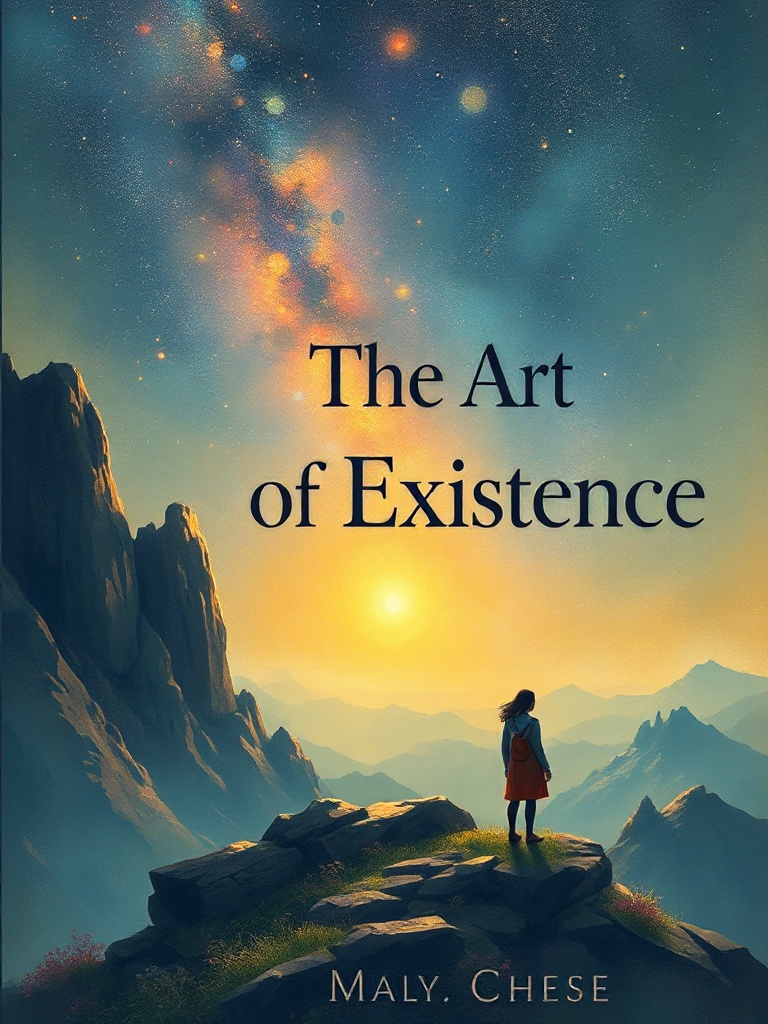
The university’s old observatory rises above the city’s yellow haze, a fortress of weathered stone crowned by the battered, silver dome of its telescope. Within its cool, echoing corridors, every step brings the scent of old paper and the faint buzz of electronics humming like distant insects. It is here, late in the semester, that Elara finds herself alone with Aris after hours, their research stretching into the blue hours of evening. They have agreed to meet one more time before dispersing—he to his lecture circuit, she to the archives and late-night data runs that chase clarity through the labyrinth of consciousness studies.
Outside, dusk gathers and, through the observatory’s massive windows, the city falls away, replaced by the darkening sweep of sky. Across the table, Aris leans back in his chair, arms folded, gaze fixed on the golden flecks swirling in his tea. Elara, notebook open and pen poised, is less interested in the drink than in the way the silence has grown between them, thick with questions neither has yet dared to ask.
She glances out, letting her mind drift to the sweep of constellations above. The Milky Way is faint tonight, barely visible, but it is there—a river of distant suns, each a reminder of the scale of everything she does not know. "Do you ever think," she asks quietly, unable to keep the tremor from her voice, "that we’re chasing shadows? That awareness is just... an accidental byproduct, a trick of the brain?"
Aris studies her, his eyes reflecting a mixture of compassion and curiosity. “Sometimes,” he admits. “But when I stand beneath the stars, it feels impossible that consciousness is simply incidental. The very act of asking is its own kind of evidence.”
She wants to believe him, wants to be swept up in the poetry of it. Yet the ache of uncertainty pulls at her chest. "But that’s just feeling, isn’t it? Not proof."
He nods, accepting her challenge. "Feeling may not be proof, but it is the root of all inquiry. We only ask because we sense something is missing. That hunger—the yearning to know—might itself be the bridge between mind and cosmos."
As she listens, the atmosphere in the little stone room shifts. The boundaries of debate soften, revealing something like kinship in their shared search. Both are caught, for a heartbeat, in the tension between reason and awe.
Suddenly, a low mechanical rumble interrupts the moment. The telescope’s dome, programmed to rotate for nightly stargazing, begins to move. A band of moonlight washes over them, illuminating a folder on the table—a sheaf of ancient, hand-written notes from an astronomer long dead, sent up from the university’s archives. The edges of the pages shimmer where the light finds them, and for an instant, Elara feels a chill, as if the room itself is poised on the threshold of revelation.
Aris’s eyes widen. “Those weren’t here before. Did you bring them?”
She shakes her head, unsure. The silence is sharper now, charged with a sense of anticipation—as if the past is reaching forward, the cosmos itself drawing close. The dome above them creaks open, exposing a sliver of the night sky. And in that moment, a single meteor blazes across the heavens, reflected in the glass of the observatory, burning bright enough to fill the room with its fleeting, silent promise.
For Elara, the boundaries between personal fear, scientific method, and cosmic wonder dissolve. Everything hangs in the balance—the next word, the next action, the next truth that might be found within those glowing, mysterious pages.
She draws a trembling breath as the meteor’s afterglow fades, the future waiting to be chosen.