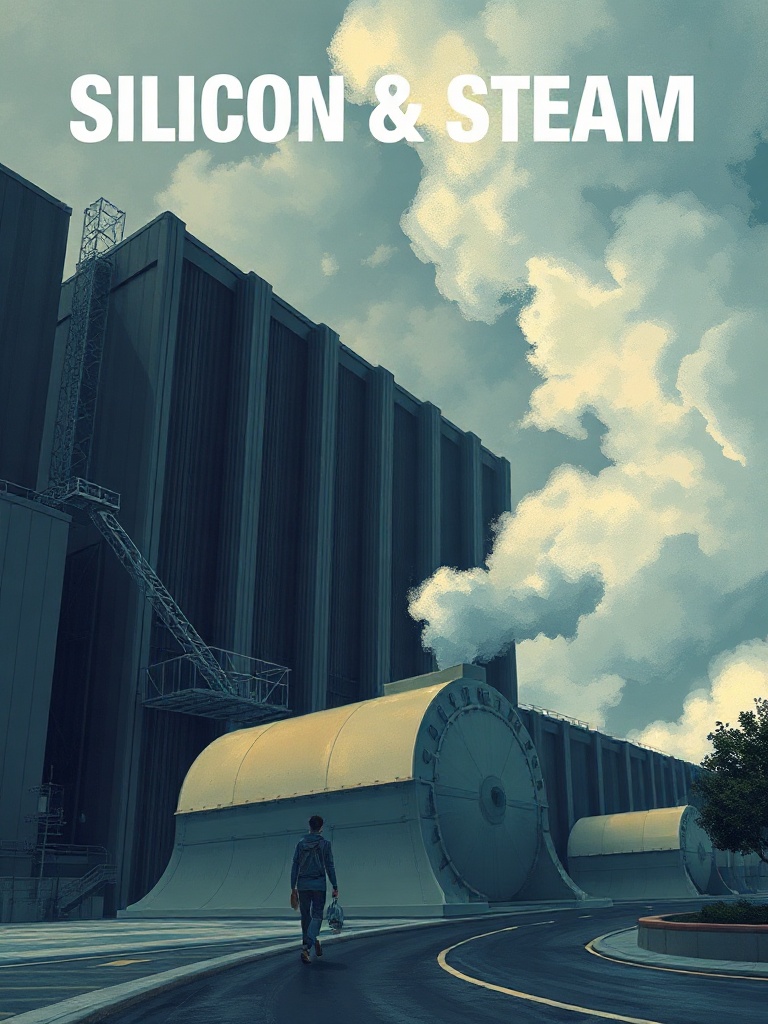
The conference room’s glass walls shimmered with the late afternoon sun, casting golden lines across the polished table where Evelyn sat with her team. The investors had left, their footsteps echoing down the hallway, their voices blending with the hum of distant cooling fans. The data center’s proof-of-concept churned on in the next room, but here, in this brief hush, the adrenaline of the demonstration still coursed through Evelyn’s veins.
Anya slumped into a chair nearby, releasing a long, trembling breath. Her hands, usually so steady, fidgeted with the cap of a stray marker. “We did it. I mean, it wasn’t perfect, but—”
“We did what we promised,” Marcus said, already pulling up the freshly exported data on his laptop. “The numbers don’t lie. Even if the engines sounded like an antique locomotive for a second.”
Evelyn’s mind swam with a thousand calculations, all racing alongside her hope. The system hadn’t failed. The efficiency curve was better than any of their models had predicted. For a moment, she let herself imagine the next phase: a facility ten times this size, Sterling engines lined up in gleaming ranks, each one transforming computational waste into pure, humming power.
The door creaked and Yvette, their business analyst, poked her head in, face flushed from running. “The VC wants a word,” she said softly. “He’s waiting in the corridor.”
Evelyn stood, brushing invisible dust from her blazer. The memory of his skeptical gaze returned, sharper than before. She walked to the door, her heels clicking, and found him leaning against the wall, phone in hand. He looked up, studied her, and pocketed the device.
“I won’t pretend I’m completely convinced,” he said, voice low, “but I’ve never seen a pitch do exactly what it claimed under pressure. That alone is rare.”
She steadied herself, careful not to let too much hope bleed through her words. “This is just the beginning. The data is preliminary, but the model scales—”
He cut her off with a slight raise of his hand. “I want to see your scaling plan—costs, partners, supply chain. Show me how you go from this model to a city-block-sized facility without losing efficiency or hemorrhaging money.”
Her heart pounded. This was the inflection point—the moment Phoenix Energy would either soar or fall back to earth. “Give us forty-eight hours,” she said. “We’ll have a detailed roadmap.”
He nodded. “Forty-eight hours. Get it right, and you’ll have your next round.”
He didn’t offer a handshake, just a tight smile and a nod before walking away, leaving her standing in the sunlit corridor, staring at the place where possibility had suddenly blossomed into responsibility.
Back in the conference room, the team looked up as Evelyn re-entered. Anya’s eyes searched hers. Marcus closed his laptop with a soft click. The air vibrated with expectation, anxiety, and the first flares of genuine, electric momentum.
“He wants the plan,” Evelyn said quietly. “Forty-eight hours. That’s all.”
A tense, silent moment stretched. Then, as if prompted by some invisible conductor, the team snapped into action. Anya began sketching thermal maps on the whiteboard. Marcus called up supply chain projections. Yvette started drafting the capital requirements spreadsheet. The window filled with the dying light, turning the glass golden, the room a crucible of invention and hope.
Minutes passed. Then a warning klaxon blared from the pilot room—loud, insistent, cutting through the fevered excitement.
Evelyn spun around, heart in her throat. The Sterling engine’s telemetry spiked red across the wall screen. Pressure in the secondary piston chamber was climbing—dangerously fast. The system was supposed to auto-regulate, but the failsafe hadn’t engaged. If the pressure breached the next threshold, the demo unit could blow a gasket—or worse, set back everything they’d just achieved.
Evelyn raced from the room, her mind already mapping out possibilities. Down the corridor, she could see orange light flashing through the window of the pilot room. Anya was already halfway there, her lab coat flying. Marcus fumbled for his badge, swearing under his breath.
This was no longer a demonstration. It was a test of everything they’d built—and everything they dreamed of becoming.