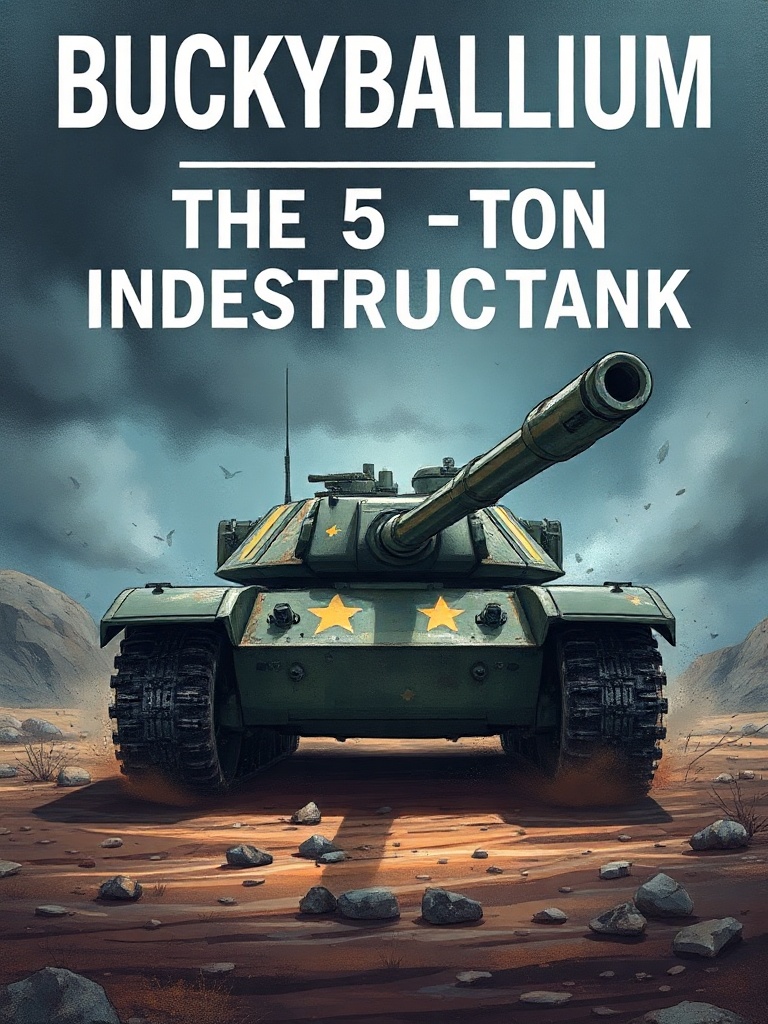
With the last echo of applause drifting away from the proving ground, the Buckyballium tank is guided back to its hangar. The sunlight gleams off its unblemished surface, and the security gate slides shut with a hydraulic sigh. The press will have their day, but for now, only the core team is allowed access.
Inside the hangar, the air is cool and dry, the lights overhead stark and clinical. Thorne is already poring over sensor readouts, his brow furrowed in concentration. Rostova paces the length of the tank, running a hand along the smooth, alien material. A hush lingers, broken only by the subdued whir of ventilation fans and the soft tap of computer keys.
The twin chassis—the heart of Project Chimera—rests on thick rubber pads. Its impossibly low weight is still disorienting; every time it’s touched, there’s a momentary fear it will simply drift away, buoyed by its own disregard for physics. The carbon architecture holds firm, molecular bonds flexing but never yielding. Thorne mutters to himself about running a simulated breach test, but the data speaks for itself. Not a single atom is out of place.
A technician signals. Something is wrong with the emissions capture unit. The generator, still softly ticking as it cools, has produced a new chemical byproduct—not in the original design. Readouts show an unfamiliar compound accumulating in the containment vessel.
Rostova bends closer, squinting at the numbers flickering across the monitor. The composition is nearly pure, heavier than the expected output, and somehow bonded to trace elements from the Buckyballium lattice. The exhaust shouldn’t interact with the chassis—shouldn’t—but here it is, a mystery molecule, engineered by accident.
A sharp metallic scent, sweet and biting, lingers near the vent. Thorne turns, his expression shifting from curiosity to concern. If this compound is unstable, it could jeopardize everything. If it’s stable—but reactive—it might open new frontiers.
The evidence is undeniable. The tank hasn’t just resisted destruction, it’s changed the very chemistry of its exhaust. Unintended, perhaps dangerous, perhaps revolutionary. The team converges, a cluster of strained faces in the LED glare, each of them acutely aware that they stand at the razor’s edge between triumph and disaster.
A pulsing red icon on the environmental monitor signals that the concentration of the new compound is still climbing. The containment protocols are untested for anything beyond standard diesel emissions. Alarms remain silent—for now. Thorne’s hand hovers over the emergency vent release, and Rostova’s heart thuds with a mix of dread and anticipation.
Outside, the world waits for a press release. Inside, the Buckyballium tank pulses with the secret of its own creation, and the team knows this is the threshold that will define them: contain, investigate, or abandon.
Suddenly, the containment vessel emits a high-pitched, resonant hum. The lights flicker. The unfamiliar compound begins to glow faintly blue, throwing spectral shadows across the faces of those assembled. Time stretches thin. The moment is charged, alive with possibility and threat. The next action could mean everything.